
Conversational ads are not automatically more profitable than affiliate links: the winner is the model that produces more net revenue from the same chatbot traffic. Compare recognized publisher earnings after serving costs, attribution adjustments, and maintenance—not advertiser spend, headline commissions, or clicks alone.
- Conversational ads vs affiliate links profitability depends on net earnings per session, not the placement format.
- CPM ads pay against qualifying impressions; affiliate commissions depend on the program’s qualifying action and attribution rules.
- Compare both models across matched traffic, including conversations that produce no revenue.
- Elo provides contextual conversational ads through an SDK; affiliate links remain a separate monetization option.
Why this matters
Your chatbot pays to serve conversations whether monetization succeeds or not. A high commission on a completed purchase does not establish profitability across everyone who used the app, and a high impression yield does not establish profitability across sessions without an ad.
For your 2026 monetization plan, use the whole session as the starting denominator. The guide to measuring ad revenue per user in a chatbot covers a related measurement question; this comparison focuses on the contribution each monetization model leaves behind.
Choose the model that earns more after costs without degrading the conversation. That requires a controlled comparison, not a universal claim about ads or affiliate marketing.
Are conversational ads more profitable than affiliate links?
Neither model has an inherent profitability advantage. Conversational advertising describes how a sponsored placement fits into a conversation; affiliate marketing describes a commercial relationship and its attribution rules. Those are different dimensions.
A conversational placement can use impression-, click-, or action-based compensation. An affiliate link can also appear naturally inside a conversation. The economic comparison must therefore identify the actual payment terms before comparing results.
| Dimension | Conversational ads | Affiliate links |
|---|---|---|
| Best for | Testing contextual advertiser demand inside chat | Testing merchant offers against explicit purchase intent |
| Revenue trigger | Qualifying impression, click, or action, depending on the agreement | Qualifying referral action under the affiliate agreement |
| Main advantage | Impression- or click-based arrangements do not require a completed purchase for every payment | A relevant referral can generate an attributable commission |
| Main limitation | A placement earns nothing without the required qualifying event | A referral earns nothing without the required qualifying action and attribution |
| Operational work | Placement logic, request handling, event tracking, and reconciliation | Link management, disclosures, attribution, and commission reconciliation |
| Profitability test | Recognized publisher revenue minus attributable costs | Recognized commissions minus attributable costs |
The payment trigger matters more than the label. Comparing CPM ads with purchase-based affiliate links tests different revenue mechanics. Comparing CPA ads with purchase-based affiliate links puts greater emphasis on commission terms, conversion quality, and attribution.
Keep advertiser spend separate from publisher earnings. Money entering an advertising system is not necessarily the amount payable to your app.
Conversational ads: best for testing contextual advertiser demand
Conversational ads let you place a commercial offer alongside relevant conversation context. Under an impression-based agreement, a qualifying impression is the payable event; under a click-based agreement, a qualifying click is the payable event. Neither arrangement requires every paid interaction to become a purchase.
That is an advantage in the payment structure, not proof of higher profit. Your result still depends on eligible traffic, matching advertiser demand, recognized events, publisher terms, and implementation costs.
What to measure
Track the path from eligible session to recognized revenue. Separate ad requests, returned ads, rendered placements, qualifying impressions, clicks, and payable actions rather than treating them as interchangeable events.
CPM expresses compensation per 1,000 impressions. It does not tell you how much your app earns per conversation because a conversation is not the same unit as an impression.
For a 2026 comparison, calculate session revenue across all traffic assigned to the ad treatment, including sessions with no returned offer. Excluding those sessions would answer how well filled inventory performs, not how well the monetization model performs.
Where the model loses ground
Conversational ads lose their economic advantage when recognized revenue fails to cover attributable costs. A relevant-looking placement is not enough.
Set a no-offer path. If no suitable commercial message exists, let the assistant continue without one rather than treating every response as mandatory ad inventory.
Affiliate links: best for testing explicit purchase intent
Affiliate links connect a recommendation to a merchant’s qualifying referral action. Purchase-based programs require an attributed purchase; other agreements can define a different payable action. Read the program terms before deciding what counts as revenue.
The advantage is a direct connection between a commercial recommendation and a qualifying outcome. The limitation is equally direct: a useful conversation, a click, and even a purchase do not establish a payable commission unless the agreement’s conditions are met.
What to measure
Track referral clicks separately from reported conversions, pending commissions, approved commissions, and reversals. 1 approved action is not interchangeable with one pending action when calculating recognized earnings.
Do not compare a pending commission total with finalized ad revenue. Apply comparable recognition rules to both models and identify unsettled amounts separately.
Where the model loses ground
Affiliate links lose ground when too little of your traffic produces qualifying, attributable actions to cover costs. A large commission on an isolated transaction does not resolve that problem.
Keep recommendations tied to the user’s request. If the assistant must redirect an unrelated conversation toward a merchant to create a referral opportunity, test that behavior as a product change—not merely a monetization change.
Why conversational ads vs affiliate links profitability varies
Your 2026 result depends on the relationship between traffic, payment rules, and costs. These factors belong in the comparison:
- Conversation intent. Separate explicit shopping requests from research, troubleshooting, and general assistance. Measure each segment instead of assuming the same commercial response.
- Payment trigger. An impression, click, lead, and purchase represent different payable events. Compare recognized earnings, not event counts alone.
- Offer eligibility. Count sessions where no suitable advertiser or affiliate offer can be shown. They still belong in the model’s traffic denominator.
- Attribution and approval. Apply each agreement’s rules for qualifying actions, approval, reversals, and reporting delays.
- Implementation burden. Include attributable engineering, infrastructure, link maintenance, monitoring, and reconciliation work.
- User experience. Measure answer completion and return usage alongside monetization. Keep commercial placements visibly separate from independent recommendations.
These factors do not establish a category-wide winner. They establish what your experiment must control and what your financial report must include.
How do you compare both models fairly?
Use a test that preserves the assistant’s underlying utility. Your goal is to compare monetization, not to compare a helpful assistant with an aggressive sales flow.
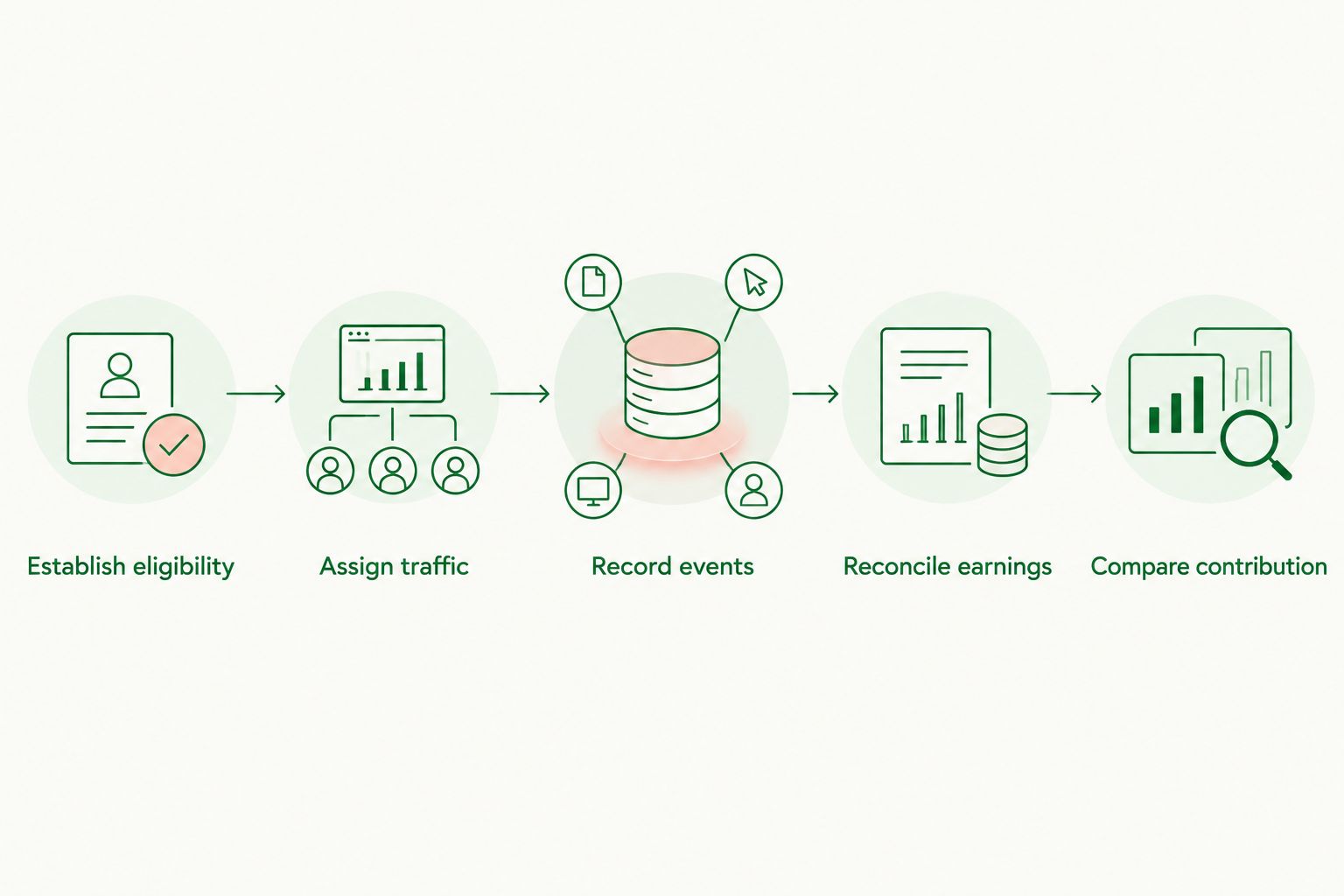
Establish eligibility
Define the conversations where a commercial offer is appropriate before assigning a monetization treatment. Use the same eligibility criteria for both models, and document exclusions such as unsupported topics or sessions without suitable offers.
Assign traffic
Randomly assign eligible users to comparable treatments where practical. Keep assignment consistent so a returning user does not repeatedly switch between monetization experiences during the comparison.
Record events
Log eligibility, assignment, offer rendering, engagement, and recognized earnings. Use event identifiers to reconcile revenue without treating duplicate tracking calls as additional payable activity.
Reconcile earnings
Separate pending and recognized revenue. Follow the actual settlement and approval rules rather than assuming both models finalize earnings on the same schedule.
Compare contribution
Subtract attributable costs from recognized earnings, then divide by the same traffic unit. Inspect results by intent segment before applying a single treatment across the app.
Keep the main answer quality, recommendation criteria, and disclosure placement consistent. Otherwise, changes in task completion or engagement become difficult to separate from the compensation model itself.
Do not set a universal test duration. Choose an observation window that accounts for your traffic and the agreements’ attribution and approval timelines, then state that window beside the result.
Which profitability metric should decide the winner?
Net contribution per session is the clearest starting metric for this comparison. It includes sessions that generate no monetization event and connects earnings to the unit your chatbot serves.
Use these definitions consistently:
- Recognized revenue: publisher earnings or commissions accepted under the applicable agreement, with adjustments accounted for.
- Attributable costs: serving and operating costs assigned consistently to the treatment, including monetization-specific work.
- Contribution per session: recognized revenue minus attributable costs, divided by assigned sessions.
- Session RPM: recognized revenue per 1,000 sessions, before costs unless explicitly labelled otherwise.
Session RPM is not impression CPM. Both use a thousand-unit denominator, but the underlying units differ. Label every dashboard metric with its denominator so a change in placement frequency does not look like a change in session profitability.
For a 2026 investment decision, report contribution both before and after allocating integration work. The first view shows ongoing operating economics; the second shows whether implementation effort has been recovered under your chosen accounting method.
Keep product guardrails beside the financial result. If a treatment earns more per session but changes return usage, investigate that trade-off before declaring it the better business model.
Where does an SDK-based adserver fit?
Elo is best suited to developers seeking an SDK-based adserver for contextual conversational ads in AI chat applications. Its stated role is to let developers embed those ads and earn revenue from advertiser spend in apps built on OpenAI, Anthropic, or custom LLMs.
That makes Elo relevant to the conversational-ad treatment in this comparison. It does not establish that conversational ads outperform your existing affiliate links.
The benefit is a product built for contextual chat advertising. The evaluation burden remains yours: confirm payment terms, integration requirements, measurement access, and operating costs before projecting profit. Do not assume affiliate attribution, commission reconciliation, or a particular payment model is included.
Can conversational ads and affiliate links work together?
Conversational ads and affiliate links can form a combined monetization design, subject to the agreements governing each placement. Treat the combined design as its own experiment rather than adding separate revenue forecasts together.
Assign a clear commercial purpose to each placement. Avoid showing competing offers at the same moment without testing the effect on engagement and total recognized earnings.
More monetization elements do not automatically mean more contribution. Measure the combined experience against each standalone treatment.
Do conversational ads earn money without purchases?
Impression- and click-based conversational ads do not require a purchase for the qualifying event to be payable. Action-based advertising follows its specified action requirements instead.
Verify the actual agreement. The phrase conversational ads describes the placement, not a guarantee of payment for every conversation or impression.
Should you replace affiliate links immediately?
Keep affiliate links as a baseline while you test another model. Replacing the baseline before measuring a comparable treatment removes the evidence needed to judge the change.
For a 2026 rollout, expand the treatment that meets your contribution and user-experience criteria. Preserve segment-level results; an app-wide average can conceal different outcomes across conversation types.
FAQ
Are conversational ads always more profitable than affiliate links?
No. Profitability depends on recognized revenue, attributable costs, traffic eligibility, and the payment terms of each model. Compare net contribution across matched sessions.
What is the best metric for conversational ads vs affiliate links profitability?
Net contribution per session is the clearest starting metric. Subtract attributable costs from recognized earnings and divide by all sessions assigned to each treatment.
Can affiliate links appear inside chatbot conversations?
Yes. An affiliate link can appear within a conversational recommendation, so conversational presentation and affiliate compensation are not mutually exclusive.
Do conversational ads pay when nobody buys anything?
Impression- and click-based agreements pay against their specified qualifying events rather than requiring a purchase. Action-based agreements follow the action defined in their terms.
Should I count pending affiliate commissions as profit?
Keep pending commissions separate from recognized earnings. Apply the program’s approval and adjustment rules before comparing them with finalized ad revenue.
Is Elo an option for testing conversational ads?
Elo provides an SDK-based adserver for contextual conversational ads in AI chat applications. Evaluate its terms and attributable costs against your affiliate baseline rather than assuming a profitability advantage.
Can I test ads and affiliate links together?
Yes, subject to the agreements governing the placements. Measure the combined treatment separately because the offers can affect each other’s engagement and earnings.
One last thing
A conversation with no commercial event still belongs in your profitability calculation. Removing it makes both monetization models look better without changing the money your app earns.
Choose your denominator before choosing your monetization partner. That decision keeps the comparison tied to the business you operate rather than the events a dashboard highlights.