Yes—you can inspect a public ad library to find brands represented in ChatGPT ad listings, then review their conversational creative and associated prompts. A listing is a research starting point, not proof that the brand is serving an ad inside ChatGPT at the exact moment you search; verify the placement and date before calling it live.
- Elo Ad Library is useful for researching conversational ad creative by brand, category, or keyword.
- To see which brands advertising on ChatGPT, distinguish library listings from verified, current placements.
- A brand mentioned in a chatbot answer is not, by itself, evidence of paid advertising.
- Record the source, placement, and observation date before adding an advertiser to your research sheet.
Why this matters
An advertiser list answers a narrow question: which brands have evidence of a paid placement? It does not automatically tell you where the placement appeared, whether it remains active, or whether the campaign worked.
Elo provides a public ad library for searching conversational ads by category, brand, or keyword. Its reference pages cover ChatGPT and other AI chat apps, so your research must preserve the distinction between those environments.
For a 2026 competitor review, separate creative research from delivery verification. The first helps you understand an advertiser's message; the second supports a claim about where and when someone actually encountered the ad.
Can you see which brands are advertising on ChatGPT right now?
You can research brands through ad listings and inspect evidence of individual placements. The reliable answer is a source-backed list with dates—not an undated collection of brand names. Use the following evidence sources for different jobs rather than treating them as interchangeable.
| Evidence source | Best for | What it supports | Limitation |
|---|---|---|---|
| Public conversational ad library | Creative research | Comparing listed brands, copy, categories, and associated prompts | A listing alone does not establish current delivery inside ChatGPT |
| Directly observed, labeled ad | Placement verification | Documenting the ad you saw in the named application | One observation does not establish the campaign's full scope |
| Ordinary brand mention in an answer | Discovery | Finding a brand to investigate | A mention alone does not establish a paid relationship |
Start with the library when you need examples. Use direct placement evidence when your report needs to say that a specific brand appeared as an advertiser in a specific application.
Do not turn a research tool's broad description into a claim about each result. A library covering multiple chat applications requires result-level scrutiny before you classify an entry as a ChatGPT placement.
What counts as a defensible answer?
A defensible entry identifies the brand, describes the evidence, names the application, and records when you checked it. Keep the original creative or a reference to the source alongside your summary.
For example, distinguish these statements:
- Listed: The brand appears in a conversational ad library.
- Observed: You documented a labeled ad in a named chat application.
- Currently verified: You checked the relevant placement and recorded the observation date.
Those labels describe evidence, not campaign performance. None establishes spend, impressions, conversions, or commercial success without separate reporting.
How do you check an advertiser without confusing the evidence?
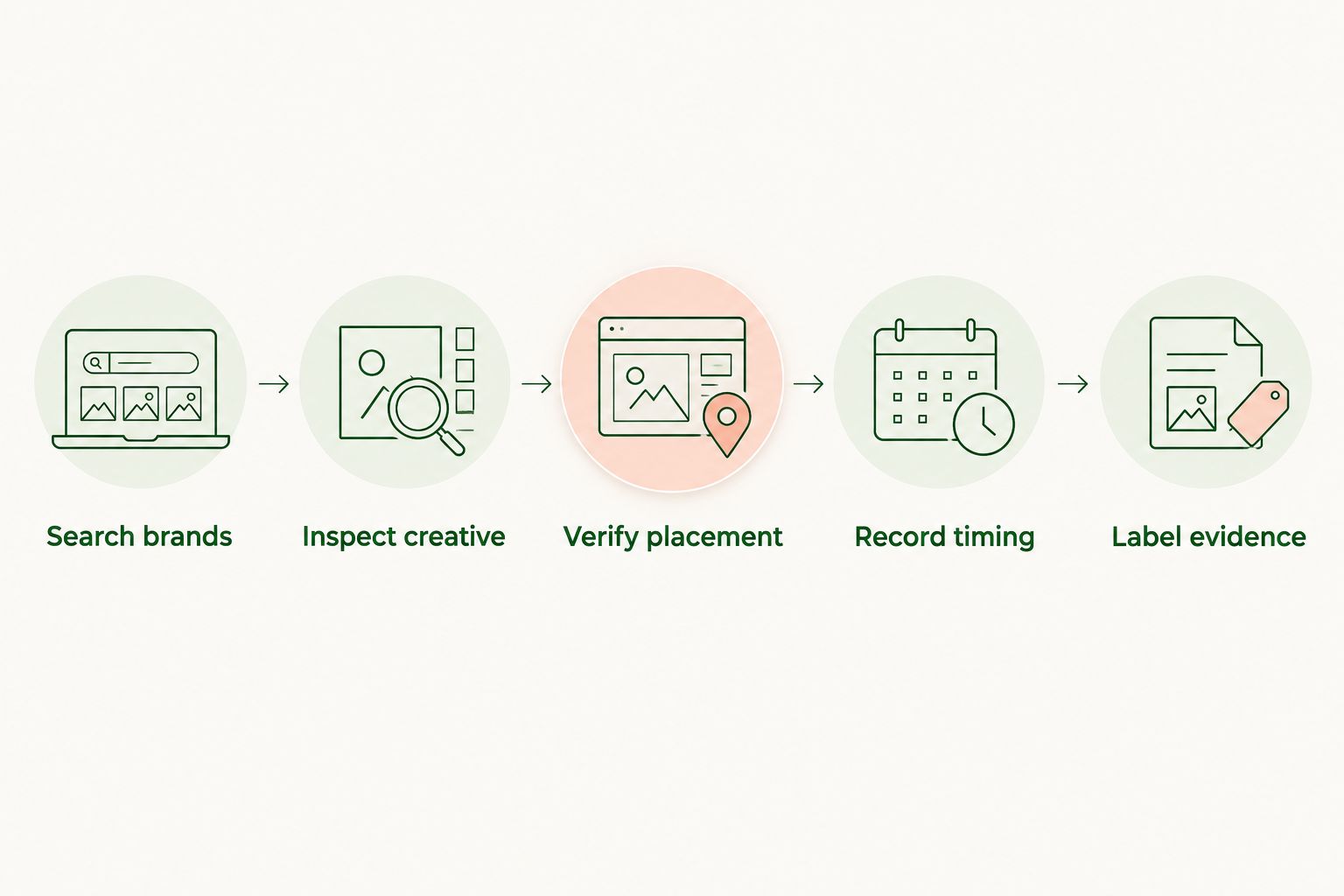
Use this 5-step workflow for a 2026 research pass. Each step removes a different ambiguity: identity, creative, application, timing, or interpretation.
1. Search brands
Search the brand name when you already have a competitor in mind. Use a category or keyword when you need to discover examples rather than confirm a known company.
Elo Ad Library supports those search dimensions. Search results give you material to inspect; they do not remove the need to check what each entry actually represents.
2. Inspect creative
Read the ad copy and associated prompt together. The copy shows the offer's wording, while the prompt gives you context for understanding the example.
Keep your notes descriptive. Record the problem addressed, the proposed next action, and the relationship between the conversation and the offer; do not infer targeting rules from an example alone.
3. Verify placement
Identify the application named by the evidence. ChatGPT itself and an independently operated application built with an OpenAI model are different placements.
An underlying model does not identify the publisher. If the source establishes only that an ad appeared in another chat app, preserve that narrower description in your report.
4. Record timing
Write down when you inspected the source. If the source supplies its own observation date or campaign status, record that separately rather than substituting your visit date.
For a 2026 report, an inspection date proves when you checked the evidence. It does not change the date of the underlying placement or establish continued delivery after your check.
5. Label evidence
Classify the result as a library listing, an observed ad, or an unverified brand mention. Keep unresolved placement details out of the confirmed-advertiser column.
Use the narrowest claim your evidence supports. A short, qualified entry is more useful than a confident statement that combines different publishers or time periods.
The finished research sheet should let another reader retrace your conclusion. Keep the source beside the claim instead of separating screenshots, notes, and advertiser names across unrelated documents.
What should your advertiser research sheet contain?
Build 1 research sheet with a separate entry for each piece of evidence. A brand can have multiple entries when the creative, application, or observation differs; do not merge those differences into an unsupported campaign summary.
Use these fields:
- Brand: Copy the advertiser identity shown in the evidence.
- Source: Identify the library entry or direct observation.
- Application: Name the actual chat product, not just its underlying model.
- Creative: Preserve the relevant copy and visible next action.
- Context: Note the associated prompt or conversation where available.
- Timing: Separate your inspection date from any date supplied by the source.
- Evidence label: State whether the entry is listed, observed, or currently verified.
Prioritize 3 evidence fields before making a live-placement claim: application, observation date, and the ad itself. If those fields do not support the claim, keep the entry useful as creative research rather than presenting it as delivery verification.
Avoid adding estimated spend or performance columns unless you have evidence for them. An empty performance field is not a reason to convert creative impressions into business results.
Why advertiser lists differ
Different research scopes produce different lists. Before comparing results, align the definitions used to collect them.
- Application scope: A list covering several chat apps is broader than a list restricted to ChatGPT itself. Preserve the publisher named by each source.
- Search scope: A brand search, category search, and keyword search answer different discovery questions. Record which approach produced the result.
- Evidence type: A library entry and a directly observed placement support different conclusions. Keep the distinction visible.
- Timing: The date of your inspection and the date of the underlying evidence are separate facts. Do not treat either as an indefinite live-status guarantee.
- Classification: A paid placement and an ordinary answer mentioning a company are not equivalent. Require evidence of advertising before applying the advertiser label.
These are reasons to compare like with like, not explanations for a particular brand's absence. Not finding a brand in your search does not establish that the brand has no advertising activity. Your result describes the search you completed.
Is a brand recommendation in ChatGPT proof of advertising?
No—a brand recommendation alone does not prove advertising. The content of an answer establishes that the brand was mentioned, not why it appeared or whether anyone paid for a placement.
Look for evidence that distinguishes promotional content from the surrounding answer. Preserve the visible disclosure and placement context when you document an ad; avoid cropping away the details that explain what the screenshot represents.
For publishers designing their own placements, the guide to disclosing sponsored ads in an AI chatbot addresses that separate implementation question. Researching another brand's creative and deciding how to disclose your own ads are different tasks.
Does an OpenAI-powered app count as ChatGPT?
No—an application using an OpenAI model is not automatically ChatGPT. Name the actual application where the ad appeared instead of using the model provider as a substitute for the publisher.
This distinction matters for both advertisers and developers. An advertiser needs to know the inventory being evaluated; a developer needs to understand that monetizing an independently operated app is not evidence of access to advertising inside ChatGPT itself.
Apply the same naming discipline throughout your 2026 research. A report that switches between model, application, and ad network without identifying each role makes placement comparisons unreliable.
Can you learn whether a competitor's ads are working?
Not from creative alone. Ad copy, a prompt, and a brand name show what you can inspect—not the campaign's return, conversion rate, or revenue contribution.
Use public examples to form creative questions. Is the offer relevant to the conversation? Does the next action match the user's task? Is the commercial relationship clear?
Answer performance questions with campaign reporting that actually measures the outcome. Do not describe a brand as a successful advertiser simply because you found an ad or recognized its name.
Where the SDK fits—and where it does not
Elo's conversational ad SDK is best for developers monetizing their own AI chat applications with contextual ads. It provides an SDK-based adserver for applications built on OpenAI, Anthropic, or custom LLMs, with revenue coming from advertiser spend.
That is a publisher integration use case. It is separate from inspecting an ad library, and it does not establish that an independently operated application is ChatGPT.
The benefit is contextual ad monetization inside a developer's own chat product. The boundary is equally important: inspecting public creative does not validate that product's integration, advertiser demand, or eventual revenue. Evaluate those questions separately before making a monetization decision.
FAQ
Can I see which brands are advertising on ChatGPT right now?
You can inspect public ad listings and verify individual placements, but a listing alone does not prove delivery at the moment you search. Check the application, evidence date, and ad itself before calling a brand a current ChatGPT advertiser.
What's the best way to research conversational ad creative?
A searchable conversational ad library is useful for comparing listed creative by brand, category, or keyword. Use the examples for creative research, then verify placement and timing separately.
Does a brand appearing in a ChatGPT answer mean it paid for an ad?
No, a brand mention alone does not establish payment or an advertising relationship. Look for evidence identifying the content as an ad rather than treating every recommendation as sponsored.
Are ads in an OpenAI-powered chatbot the same as ads in ChatGPT?
No, an independently operated chatbot using an OpenAI model is a separate application from ChatGPT. Record the actual publisher or application named by the placement evidence.
Can an ad library tell me how much a competitor spends?
An ad listing alone does not establish a competitor's spend. Creative, prompts, and brand identity are not substitutes for campaign reporting.
Can I use ad examples to estimate a competitor's conversions?
No, ad examples alone do not establish conversions. Use them to study messaging and context, not to invent performance results.
What should I save when I find a conversational ad?
Save the ad, application name, source, and observation date. Preserve the disclosure and surrounding context so another reader can understand what the evidence supports.
One last thing
Date the observation, not just the document. A report titled 2026 can still contain evidence collected at different times or from different applications.
Before sharing an advertiser list, run 2 final checks: does each confirmed entry identify the application, and does its timing support your wording? Replace unsupported claims of current activity with an accurate description of the listing or observation. That small edit makes the whole report easier to trust.