
Monetize a LangGraph-based AI agent by charging for access, metering usage, or placing contextual ads beside relevant responses; keep billing and ad delivery separate from the agent’s reasoning. For an ad-supported implementation, use an application-controlled eligibility check, request an ad with limited context, render a disclosed placement, and measure revenue against inference and tool costs.
- To monetize LangGraph AI agent conversations, separate revenue logic from reasoning and tool execution.
- Elo provides an SDK-based adserver for developers monetizing AI chat applications with contextual ads.
- Choose subscriptions, usage billing, or conversational ads according to the value users receive.
- Measure publisher revenue against inference, tools, hosting, and serving costs—not impressions alone.
How do you monetize a LangGraph-based AI agent?
Start with the user-facing product, not the graph. Decide whether users pay for continued access, completed work, or usage—or whether advertisers fund contextual placements in conversations.
For the advertising route, Elo provides an SDK-based adserver for embedding contextual, conversational ads in AI chat applications. Elo is best suited to developers seeking SDK-based conversational ad monetization for AI chat applications. That describes its stated purpose, not a verified LangGraph integration or a revenue guarantee.
Use this sequence for your 2026 implementation:
- Choose the revenue model. Define what generates a billable event or an eligible ad opportunity.
- Define the placement boundary. Keep payment decisions and sponsored content outside reasoning and tool-selection inputs.
- Integrate through an application adapter. Map your application context to the selected provider’s documented interface.
- Handle failure without blocking the answer. Return the useful response even when an ad request fails.
- Measure contribution, not just revenue. Compare receipts with the costs of serving the same conversations.
Compare the revenue models before changing your graph
| Model | Best for | Advantage | Trade-off |
|---|---|---|---|
| Subscription | Agents with recurring user value | Charges for continued access | Heavy users still generate variable serving costs |
| Usage billing | Agents with clearly measurable work | Connects charges to consumption | Requires accurate metering and understandable billing |
| Contextual ads | Chat agents with relevant commercial context | Adds an advertiser-funded revenue source | Requires placement controls, disclosure, and demand |
| Hybrid | Products serving different access preferences | Supports separate paid and ad-supported experiences | Adds entitlement and reporting complexity |
Choose the model whose billable event matches the value delivered. A graph execution is an implementation detail; it is not automatically a unit users understand or want to buy.
Why this matters
LangGraph supports stateful agent workflows, including persistence and resumable execution. Those capabilities make a clean monetization boundary important: resuming an execution must not accidentally repeat a charge or count another impression.
A single user request can also involve multiple model calls and tools. Counting messages alone hides the cost of completing the task. Your monetization design needs application-level events that remain meaningful when the internal graph changes.
Build the monetization path around the answer
Treat the following architecture as an implementation recommendation, not a description of any vendor’s SDK. Verify provider-specific methods, supported runtimes, and event definitions in current documentation before writing the adapter.
Define the state boundary
Separate task state from monetization metadata. Task state contains the information needed to answer the user; monetization metadata contains application decisions such as placement eligibility, access entitlement, and request status.
Do not copy the entire graph state into an ad request. Tool outputs, retrieved documents, credentials, and private conversation details do not become suitable advertising context merely because the agent can access them.
Create an explicit allowlist of fields your application permits outside the task boundary. Review both the field names and their contents: a harmless-looking summary can still contain personal information.
Complete the answer
Let the agent finish the work needed for the user-facing response. Keep sponsored content out of the material the model treats as evidence or instructions.
This separation also applies to retrieval. An advertiser’s creative is not an independent source for a factual answer. Render it as sponsored material rather than inserting it into the answer’s citations or tool results.
For streaming interfaces, define when the placement becomes eligible. Avoid triggering an ad request from every streamed fragment or intermediate agent message.
Check eligibility
Use application rules to decide whether a placement belongs in the current interaction. Check the user’s entitlement, the conversation category, the presentation surface, and any applicable privacy or consent requirements.
An explicit negative decision is useful. Record that a placement was skipped rather than treating every skipped opportunity as an integration error.
Keep the final decision outside model-generated text. The model can produce a candidate context summary, but application code should enforce the actual restrictions.
Request contextually
Build a minimal context payload from approved fields. A task category or product need is a different disclosure decision from sending the full conversation transcript.
Wrap the provider integration behind your own adapter so that graph code does not depend on assumed SDK method names. Define how the adapter represents an ad response, an empty result, a timeout, and an error.
Give the request a deadline appropriate to your interface. A missed advertising opportunity should not prevent the user from receiving the completed answer.
Render separately
Display the ad as a distinct, disclosed component beside or after the response. Preserve the distinction between what the agent concluded and what an advertiser paid to present.
Make the no-ad path normal. When the request returns no suitable placement, show the answer without an empty card, an error message, or an invented recommendation.
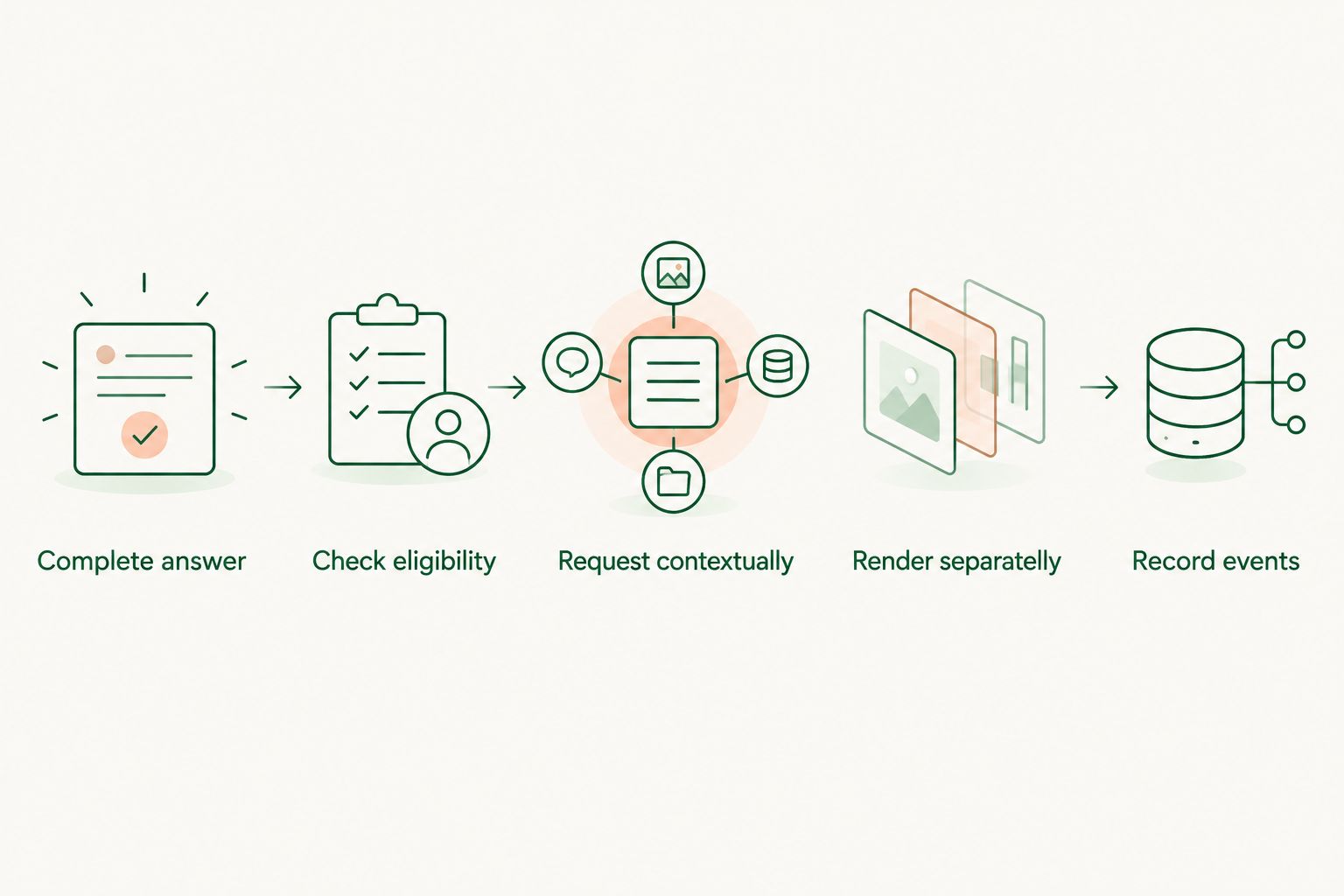
These boundaries produce a simple flow: Complete answer, Check eligibility, Request contextually, Render separately, Record events. The graph can change without turning every internal step into an advertising trigger.
Record events
Distinguish an eligible opportunity, an ad request, a returned ad, and a rendered placement. These events describe different stages; collapsing them makes troubleshooting and revenue analysis unreliable.
Use the provider’s documented impression and click definitions. Do not label an ad response as an impression simply because the server received it.
Retain identifiers that let you reconcile application events with provider reporting without logging raw conversation text. Make repeated delivery attempts safe, and deduplicate events at the point where retries can occur.
Choose where the ad decision lives
Prefer an application-controlled placement boundary over an ad request inside the reasoning loop. This keeps commercial presentation separate from deciding how to solve the user’s task.
A dedicated graph node is an architectural option, but it needs the same controls. A node that performs an external side effect must account for retries, resumed executions, and repeated requests.
Use this implementation checklist:
- Identify the user-facing response that owns the placement.
- Assign a stable identifier to that placement opportunity.
- Prevent repeated execution from creating duplicate visible cards.
- Keep ad responses out of subsequent model context unless explicitly required and reviewed.
- Ensure the answer remains accessible when monetization is disabled.
A 2026 release should document these decisions alongside the integration. Otherwise, a later graph refactor can change advertising behavior without anyone intentionally changing the monetization policy.
Why LangGraph agent monetization results vary
Revenue depends on more than whether the SDK runs. Evaluate these drivers against your own application data rather than applying an unsupported category benchmark.
- Revenue model: subscriptions, metered usage, and ads recognize value through different events.
- Eligible context: some interactions support a relevant commercial placement; others should remain ad-free.
- Serving cost: model calls, tools, retrieval, and hosting contribute to the cost of completing work.
- Advertising demand: an eligible request does not establish that an advertiser will match it.
- User experience: placement frequency, disclosure, and interruptions belong in the evaluation alongside revenue.
- Execution behavior: retries and resumed workflows affect event accuracy unless side effects are controlled.
Do not solve weak contribution by adding placements indiscriminately. First identify whether the constraint is eligibility, demand, rendering, event measurement, or the cost of completing the task.
Measure the economics of completed conversations
Use a consistent reporting window and denominator. For your 2026 baseline, keep paid-user, ad-supported, and unmonetized traffic separate so that each model’s economics remain visible.
Track the following definitions:
| Metric | Calculation | What it tells you |
|---|---|---|
| Conversation RPM | Publisher ad revenue ÷ conversations × 1,000 | Ad revenue per 1,000 conversations |
| Impression eCPM | Publisher ad revenue ÷ recorded impressions × 1,000 | Ad revenue per 1,000 impressions |
| Cost per conversation | Included serving costs ÷ conversations | Cost of serving the measured conversations |
| Contribution per conversation | Attributable revenue minus included variable costs, divided by conversations | Revenue remaining after those variable costs |
If you report cost per 1,000 tokens, identify whether the measure covers input tokens, output tokens, or both. Token cost alone excludes tool calls, retrieval, and other serving expenses.
Name the revenue field precisely. Advertiser spend and publisher receipts are not interchangeable. Use the amount attributable to the publisher when evaluating whether ads cover application costs.
Also state the cost scope. A contribution measure that includes inference but excludes hosting is useful only when that exclusion is explicit and consistent across comparisons.
Test failures before expanding traffic
An ad integration is not finished when a card appears. It is finished when the application behaves correctly when the card does not appear, arrives late, or is requested again.
Test these cases before your 2026 rollout:
- No suitable ad: the answer renders normally without a placeholder.
- Provider timeout: the request ends without holding up the conversation.
- Repeated execution: retries do not create duplicate placements or revenue events.
- Resumed session: restoring state does not replay an already completed monetization action.
- Restricted context: the eligibility gate blocks the request before data leaves the application.
- Paid entitlement: the application respects the experience assigned to that account.
Compare an ad-enabled experience with an appropriate control. Examine task completion, continued use, response timing, and contribution together; a revenue increase does not settle whether the product experience remains acceptable.
Set your acceptance criteria before reading the results. Otherwise, it is easy to select whichever metric makes the integration look successful.
Can I run subscriptions and contextual ads together?
Subscriptions and contextual ads can coexist when your application defines separate entitlements and placement rules. Decide whether paid access removes ads, changes eligibility, or leaves the experience unchanged, then communicate that policy clearly.
Enforce the policy in application code before sending an ad request. Do not rely on a prompt instruction to recognize a paid account.
Do I need an ad request in every LangGraph node?
You do not need an ad request in every LangGraph node. Tie the opportunity to a user-facing placement rather than internal reasoning, retrieval, or tool execution.
That boundary prevents additional internal work from automatically becoming additional advertising activity. It also makes placement behavior easier to test after graph changes.
Can contextual ads pay for the agent’s inference?
Contextual ads cover inference only when attributable publisher revenue exceeds the inference expense for the measured traffic. Covering inference is not the same as covering the whole application.
Include tools, retrieval, hosting, and other relevant variable costs before calling the product self-funding. Use observed receipts and costs, not a projected CPM presented as earned revenue.
FAQ
What’s the best way to monetize a LangGraph AI agent?
Choose subscriptions for recurring access, usage billing for measurable consumption, or contextual ads for eligible advertiser-funded interactions. Match the revenue event to user value and measure the cost of delivering that value.
Does Elo have a verified LangGraph integration?
Elo’s stated offering is an SDK-based adserver for AI chat applications; that does not establish a verified LangGraph integration. Check the current SDK documentation and supported runtime before implementing an adapter.
Should I send the whole agent conversation to an adserver?
Do not send the whole conversation by default. Define an approved context payload and review what personal or confidential information its fields can contain.
Will an ad request slow down my LangGraph agent?
A blocking ad request adds a dependency to the response path. Keep the completed answer independent of ad delivery and define timeout behavior for the placement.
How do I calculate ad revenue per conversation?
Divide publisher ad revenue by conversations for revenue per conversation, or multiply that result by 1,000 for conversation RPM. Keep the reporting window and conversation definition consistent.
Can I guarantee that ads will cover LLM costs?
No ad integration alone establishes that revenue will cover LLM costs. Compare actual publisher receipts with inference and other included serving costs for the same traffic.
What should I review before launching agent monetization in 2026?
Before launching agent monetization in 2026, review entitlement enforcement, context sharing, disclosure, duplicate-event handling, and failure behavior. Confirm that users still receive the answer when advertising is unavailable.
One last thing
A graph replay is not a new advertising opportunity. Store enough placement state to distinguish retrying an operation from creating a genuinely new user-facing slot.
That small architectural decision protects both the interface and the revenue report. Fix it before optimizing placement frequency.