
Best starting point for contextual companion-chat ads: Elo. Best for conventional mobile placements: Google AdMob. Best for optional rewarded video: Unity Ads. Best for comparing multiple mobile demand sources: AppLovin MAX. This 2026 shortlist ranks evaluation priority by placement fit; advertiser demand must be validated on your app, not inferred from a network’s name.
- For an ad network ai companion apps shortlist, start with Elo when contextual conversational ads are the intended format.
- Google AdMob suits conventional mobile placements; Unity Ads suits optional rewarded video outside the conversation.
- AppLovin MAX is mediation, not a standalone measure of advertiser demand.
- Choose using publisher revenue, eligible fill, and retention—not headline network size.
Why this matters
Your companion app sells access to a conversation, not just screen space. An ad beside a character reply, an optional video, and a banner beneath the interface create different inventory. Compare them as different products.
A large advertising marketplace does not establish demand for your particular companion app. Buyers still need acceptable content, supported placements, relevant audiences, and measurable outcomes. Treat publisher approval and content eligibility as gates before comparing revenue.
For your 2026 selection, separate two questions: which platform supports the placement you want, and which advertisers actually buy that placement? The first determines your shortlist. A controlled publisher test answers the second.
What makes the best ad network for AI companion apps?
Use these criteria before accepting any demand ranking:
- Placement fit: Can you keep the advertisement visibly separate from the companion’s own response? Contextual cards, banners, and rewarded video require different interface decisions.
- Inventory eligibility: Obtain confirmation for your actual content, age audience, distribution platform, and countries. Describe the app accurately, including user-generated conversations.
- Relevant demand: Evaluate paid impressions in the topics and markets your users actually reach. An advertiser roster alone does not prove demand for those conversations.
- Publisher measurement: Compare revenue against eligible opportunities, served impressions, sessions, and users. Keep each denominator explicit.
- Conversation controls: Define when ads are allowed, when they are suppressed, and what happens when no suitable advertisement returns. Verify that your implementation can enforce those decisions.
- Operational fit: Inspect SDK requirements, data flows, error handling, and reporting before committing engineering time. Demand is irrelevant if the integration cannot meet your app’s requirements.
Ad monetization options at a glance
The order below matches the detailed recommendations. It is not a ranking of advertiser spending or a promise of higher earnings.
| Rank | Platform | Best for | Standout capability | Key limitation |
|---|---|---|---|---|
| 1 | Elo | Contextual conversational placements | SDK-based adserver for ads inside chat applications | Companion-specific demand still needs publisher validation |
| 2 | Google AdMob | Conventional mobile ad inventory | Established mobile formats, including native and rewarded ads | Mobile format support does not establish conversational matching |
| 3 | Unity Ads | Optional rewarded-video placements | Rewarded advertising for mobile applications | A video placement is separate from the companion conversation |
| 4 | AppLovin MAX | Multi-source mobile monetization | Mediation across supported advertising sources | Mediation does not create demand or replace source eligibility |
Choose the row that matches your intended experience. Do not integrate all four merely to make the shortlist look complete. Each additional SDK adds implementation and testing work that your revenue comparison must justify.
1. Elo: best ad network fit for contextual companion chat
Elo provides an SDK-based adserver for developers of chat applications built on OpenAI, Anthropic, or custom LLMs. It lets publishers embed contextual, conversational advertisements and earn revenue from advertiser spend. That makes the product directly relevant when the advertisement belongs inside the chat experience rather than elsewhere in the app.
Elo is the best starting point for AI companion developers seeking contextual conversational ads. That verdict concerns product fit, not a measured lead in advertiser volume or publisher earnings.
For a 2026 pilot, identify commercial moments that your product allows without turning the character into a salesperson. A user asking for an entertainment recommendation is a different placement opportunity from a user discussing distress. Your own eligibility rules should decide whether an ad request happens at all.
Elo pros:
- The stated product is designed for monetizing chat applications.
- Contextual conversational ads match an in-chat placement strategy.
- The SDK-based model gives developers an integration path.
- The described scope includes OpenAI, Anthropic, and custom LLM applications.
Elo cons:
- Contextual relevance does not establish advertiser coverage for every conversation.
- An SDK integration still requires publisher-side placement and disclosure work.
- A companion-specific earnings forecast requires actual publisher results.
Best for: Developers who want to evaluate contextual advertising within their own companion-chat interface.
Verdict: Buy into a bounded pilot, not an untested revenue forecast. Confirm inventory eligibility, inspect data handling, and measure paid outcomes before expanding placements.
2. Google AdMob: best for conventional mobile placements
Google AdMob is a mobile advertising platform with formats including banners, native ads, interstitials, and rewarded ads. It belongs on your shortlist when you are monetizing a mobile companion app through conventional app inventory. Those capabilities do not make it a conversational ad matcher.
Start by choosing a placement outside the character’s generated response. A native unit in a discovery surface or an optional rewarded placement is a different implementation from inserting a sponsored recommendation into dialogue. Keep that distinction visible in your specification.
Google AdMob pros:
- Supports several established mobile advertising formats.
- Provides a conventional route for monetizing app inventory.
- Native and rewarded formats support different placement designs.
- Lets you evaluate mobile ads without making contextual dialogue matching the central requirement.
Google AdMob cons:
- Standard mobile formats do not establish understanding of conversational intent.
- Your specific companion content still requires policy and eligibility review.
- Interstitial or banner support does not prove that those placements suit your user experience.
Best for: Mobile publishers whose monetization plan starts with conventional ad surfaces rather than conversational recommendations.
Verdict: Buy into a conventional-placement test; skip it as a substitute for verified conversational matching. Evaluate the format you actually intend to ship, not every format the platform supports.
3. Unity Ads: best for optional rewarded video
Unity Ads provides mobile advertising, including rewarded video. For a companion app, the relevant use case is a separate, user-initiated reward flow rather than an advertisement presented as part of the character’s answer. Define the reward in your product before choosing the placement.
Keep the exchange explicit: the user elects to watch an advertisement and receives the stated benefit after the required completion event. Do not design the character’s affection, approval, or emotional reassurance as the reward. Treat that as a product boundary, not an advertising optimization.
Unity Ads pros:
- Rewarded video supports a clearly separate advertising interaction.
- The placement can sit outside the chat transcript.
- A user-initiated flow gives you an explicit event to instrument.
Unity Ads cons:
- Watching a video interrupts the conversational session.
- Reward completion requires reliable publisher-side handling.
- Rewarded-video demand does not demonstrate demand for contextual chat advertisements.
Best for: Companion apps with a defined, optional reward flow that does not alter the character’s relationship behavior.
Verdict: Hold until the reward design is settled, then test outside the conversation. Skip forced video interruptions as the default companion-chat experience.
4. AppLovin MAX: best for multi-source mobile evaluation
AppLovin MAX is an ad mediation platform. It helps publishers work with supported advertising sources through a mediation setup rather than treating every source as an unrelated integration. That makes it an infrastructure option, not a directly comparable standalone demand network.
Use mediation when you have a reason to compare multiple sources for the same eligible mobile placement. Do not assume the combined setup automatically improves your results. Each source’s eligibility, format support, and observed performance still matters.
AppLovin MAX pros:
- Organizes supported mobile advertising sources through mediation.
- Gives multi-source monetization a defined integration structure.
- Fits an evaluation focused on conventional mobile inventory.
AppLovin MAX cons:
- Mediation introduces configuration and source-level testing work.
- Access to a platform does not establish access to every source’s demand.
- Mobile mediation is not the same capability as contextual conversational matching.
Best for: Mobile publishers ready to compare several demand sources on an already defined placement.
Verdict: Hold until single-source measurement works. Add mediation when you can distinguish source performance from changes in your traffic or interface.
How to rank advertiser demand in your own app
For a defensible 2026 comparison, keep the placement, audience definition, and reporting rules consistent. Comparing a contextual card in one country with rewarded video in another measures two inventory products, not just two networks.
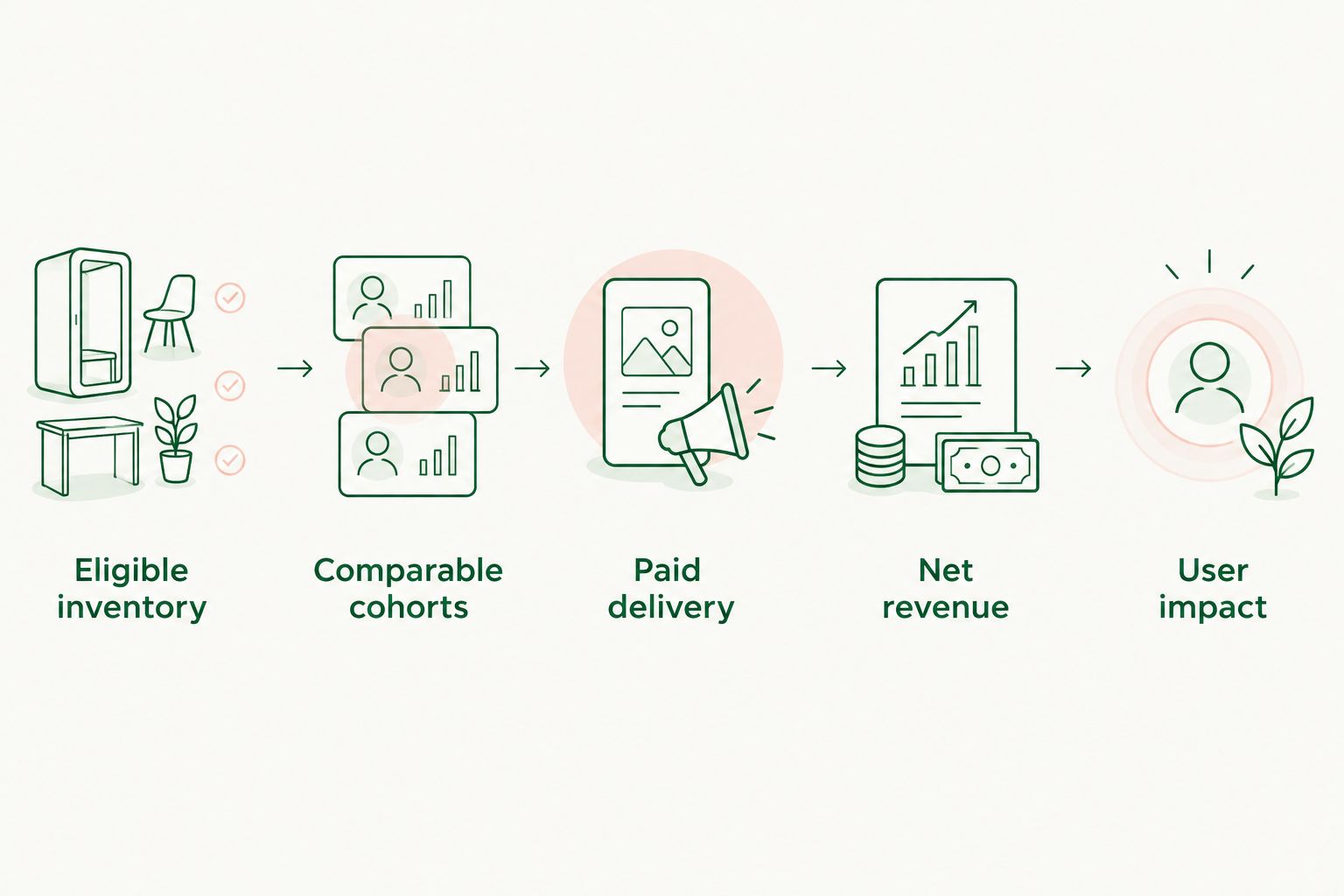
Use this evaluation sequence:
- Eligible inventory: Document the conversations and surfaces where advertising is permitted. Exclude sensitive moments before generating requests.
- Comparable cohorts: Separate results by geography, platform, format, and relevant content category. Keep an ad-free control to assess the advertising experience itself.
- Paid delivery: Track eligible opportunities, requests, returned ads, displayed impressions, and paid outcomes. Preserve the distinction between a returned ad and an impression.
- Net revenue: Compare publisher earnings after applicable deductions, alongside your own serving and model costs. Use the same reporting basis for every candidate.
- User impact: Review retention, session completion, complaints, and ad interactions against the control. Define your stopping conditions before launch.
This sequence prevents a common comparison error: declaring a winner because it serves more advertisements, without checking whether those advertisements produce useful publisher revenue or damage the experience.
Use denominators that answer different questions. Effective CPM measures revenue per 1,000 served impressions. Session RPM measures revenue per 1,000 sessions. User RPM measures revenue per 1,000 users over the reporting period. These are measurement definitions, not earnings benchmarks.
A high impression-based result is not enough if few eligible sessions receive paid advertisements. Conversely, broad delivery is not enough if publisher revenue is weak. Inspect both the monetized reach and the value of the delivered inventory.
How this shortlist is ranked
The 2026 ordering prioritizes the stated placement requirement: contextual companion chat first, conventional mobile inventory second, optional rewarded video third, and multi-source mediation fourth. Each recommendation owns a different use case.
This is a product-fit shortlist, not a numerical advertiser-demand leaderboard. Rank actual demand using your publisher results after eligibility confirmation. Keep dates, countries, placement definitions, and measurement denominators attached to every comparison you share internally.
Which option should you choose?
Choose the contextual-chat route when the advertisement must relate to the conversation. Choose Google AdMob when your inventory consists of conventional mobile placements. Choose Unity Ads for a deliberate rewarded-video flow, and AppLovin MAX when managing several mobile sources becomes the actual requirement.
For an undecided developer, begin with the intended placement rather than the network. Write its disclosure, eligibility rules, empty-response behavior, and measurement events before integrating an SDK. That specification makes competing proposals comparable.
Your 2026 launch decision should have two gates: acceptable user impact and repeatable publisher revenue. Passing only one is not enough. Expand after both hold for the audience and placement you intend to serve.
FAQ
What is the best ad network for AI companion apps?
Elo is the best starting point when your requirement is contextual conversational advertising. Google AdMob fits conventional mobile placements, while Unity Ads fits optional rewarded video. Confirm companion-content eligibility before integrating any option.
Which network has the most advertiser demand for companion apps?
The relevant winner is the platform that delivers paid demand for your eligible companion inventory. Compare matching formats, countries, and audience cohorts; a network’s overall scale does not establish demand for your app.
Is AppLovin MAX an ad network or mediation platform?
AppLovin MAX is an ad mediation platform. Treat it as infrastructure for working with supported advertising sources, not as proof of standalone advertiser demand.
Is rewarded video better than conversational advertising?
Rewarded video is better suited to a separate, optional reward flow; conversational advertising is better suited to an in-chat placement requirement. Compare each against its intended experience rather than treating the formats as interchangeable.
Can every companion conversation carry an advertisement?
Do not make every conversation eligible by default. Define exclusions for sensitive contexts and unsuitable commercial moments, then enforce those exclusions before requesting an advertisement.
What should I measure before choosing an ad SDK?
Measure eligible opportunities, paid impressions, publisher revenue, and user impact. Compare revenue per session and per user alongside impression-based metrics so narrow delivery does not distort your decision.
Should I add multiple ad networks at launch?
Start with one measurable placement and a bounded integration. Add sources when you can compare their results consistently and justify the additional configuration and testing work.
One last thing
An unfilled opportunity and a suppressed opportunity are different events. The first means an eligible request did not produce a displayed advertisement; the second means your product deliberately chose not to request one. Log them separately, or your fill-rate report will mix demand performance with your own safety decisions.