Google AdSense can monetize an eligible content website that also includes an AI chatbot, but that does not make the chatbot conversation an approved ad placement. In 2026, treat website display ads and ads inside chat as separate implementations: Google’s publisher policies, site approval, and placement rules still apply to the specific experience you build.
- Can Google AdSense monetize AI chatbot interfaces? Website approval does not establish that a conversation placement is permitted.
- Google AdSense fits eligible website content; do not assume a chat-only interface qualifies.
- Elo provides SDK-based conversational ads for developers monetizing AI chat applications.
- Keep sponsored content separate from model answers, and measure revenue against inference costs.
Can Google AdSense be used to monetize an AI chatbot?
AdSense on a website containing a chatbot is different from AdSense inside the chatbot. An eligible article page with an embedded assistant and a chat-only application present different content, placement, and policy questions.
Start by identifying the surface you control. Then choose the monetization implementation. The guide to launching an ad-supported AI chatbot covers the application-side planning that comes after this distinction.
| Implementation | Best for | Advantage | Limitation |
|---|---|---|---|
| Google AdSense around eligible website content | Publishers with useful, independently readable pages | Monetizes website content without turning an answer into an advertisement | Site approval and compliant placements remain necessary; chat eligibility is not automatic |
| Conversational ads through Elo | Developers monetizing contextual moments inside AI chat applications | SDK-based adserver built for contextual, conversational ads | Requires application integration and evaluation of privacy, placement, and economics |
| No ads in the conversation | Assistants where commercial interruptions conflict with the task | Keeps the conversation free of sponsored placements | Does not generate advertising revenue from that conversation |
This is an implementation comparison, not a prediction of earnings. A technically compatible ad placement still needs acceptable content, clear disclosure, appropriate data handling, and sufficient advertiser demand.
Why this matters
A chatbot is an interface, not a publisher-policy exemption. Adding an ad script does not establish that the screen is eligible, that its content is suitable, or that its placement follows the provider’s rules.
The distinction also affects your engineering plan. A website ad slot sits in a page layout; a conversational placement needs a decision about when an offer belongs in the interaction. Those are different responsibilities, even when both appear in a browser.
For a 2026 implementation review, consult Google Publisher Policies, AdSense Program policies, and Google’s ad placement policies. Focus on publisher content, low-value content, restricted content, privacy, and accidental-click risks rather than treating successful script execution as approval.
AdSense around website content: evaluate the page first
Evaluate the underlying page independently of the chatbot. A useful tutorial, reference page, or editorial article does not become a chat-only screen merely because you add an assistant to it. Conversely, an empty page with a message box does not become a substantive publishing property because it generates responses.
Google Publisher Policies address ads on screens without publisher content or with low-value content. That makes the surrounding experience central to your assessment. Do not equate a growing transcript with an automatic answer to those requirements.
Before pursuing this route, inspect what a visitor receives before sending a message. Can the visitor understand the page’s purpose? Is useful publisher content present? Are ads clearly separate from the assistant’s controls?
Check the active conversation state too. A layout that looks clear before the chat opens can become confusing when the composer, suggested prompts, or expanded panel moves near an ad. Test the actual interaction, not just a static screenshot.
This route fits publishers whose content pages have a purpose beyond hosting a chatbot. Its limitation is equally clear: approval of website monetization does not give you unrestricted permission to insert the same ads into every conversational state.
Ads inside the conversation: evaluate the application separately
In-chat monetization starts with the application’s interaction model. You decide which conversational moments are suitable for sponsorship, how to label an offer, and what happens when no relevant ad is returned.
That is not the same as placing a display unit next to a transcript. Do not assume that an AdSense placement can read private conversation context, select an offer from it, or behave as a conversational ad SDK.
Elo is best for developers who need SDK-based contextual ads inside AI chat applications. Its stated role is an adserver for applications built on OpenAI, Anthropic, or custom LLMs, with publisher revenue coming from advertiser spend.
The trade-off is integration responsibility. You still need to assess the application’s data flow, define acceptable ad locations, and test how sponsored content affects the task. An SDK does not replace your privacy review or establish that every conversation should carry an ad.
For a 2026 launch, keep the generated answer and the sponsored placement distinguishable. Your interface should make the commercial relationship visible without requiring the user to infer it from the wording.
Why the right monetization route varies
The decision depends on the experience you publish, not simply the model provider you use. Review these factors before choosing an implementation:
- Publishing surface: A content website, native application, and third-party messaging bot offer different integration surfaces. Browser access alone does not establish AdSense eligibility.
- Publisher content: Assess what useful content exists outside the live exchange. Google’s publisher-content requirements remain relevant to website monetization.
- Placement behavior: Inspect scrolling, expanding chat panels, message streaming, and composer movement. Keep ads away from interactions that invite accidental clicks.
- Conversation sensitivity: Decide which topics should exclude advertising and which information must stay out of ad requests. Write those rules before implementing contextual matching.
- Measurement scope: Page impressions, rendered ads, and chat sessions measure different things. Choose a denominator that matches the inventory you actually sell.
- Platform control: Confirm that you control the interface where the ad will appear. Access to a model API does not grant control over a separate company’s chat product.
These factors explain why a single yes-or-no answer is inadequate. The same business can have eligible editorial pages and an in-chat placement that needs an entirely separate assessment.
How should you assess a chatbot ad implementation?
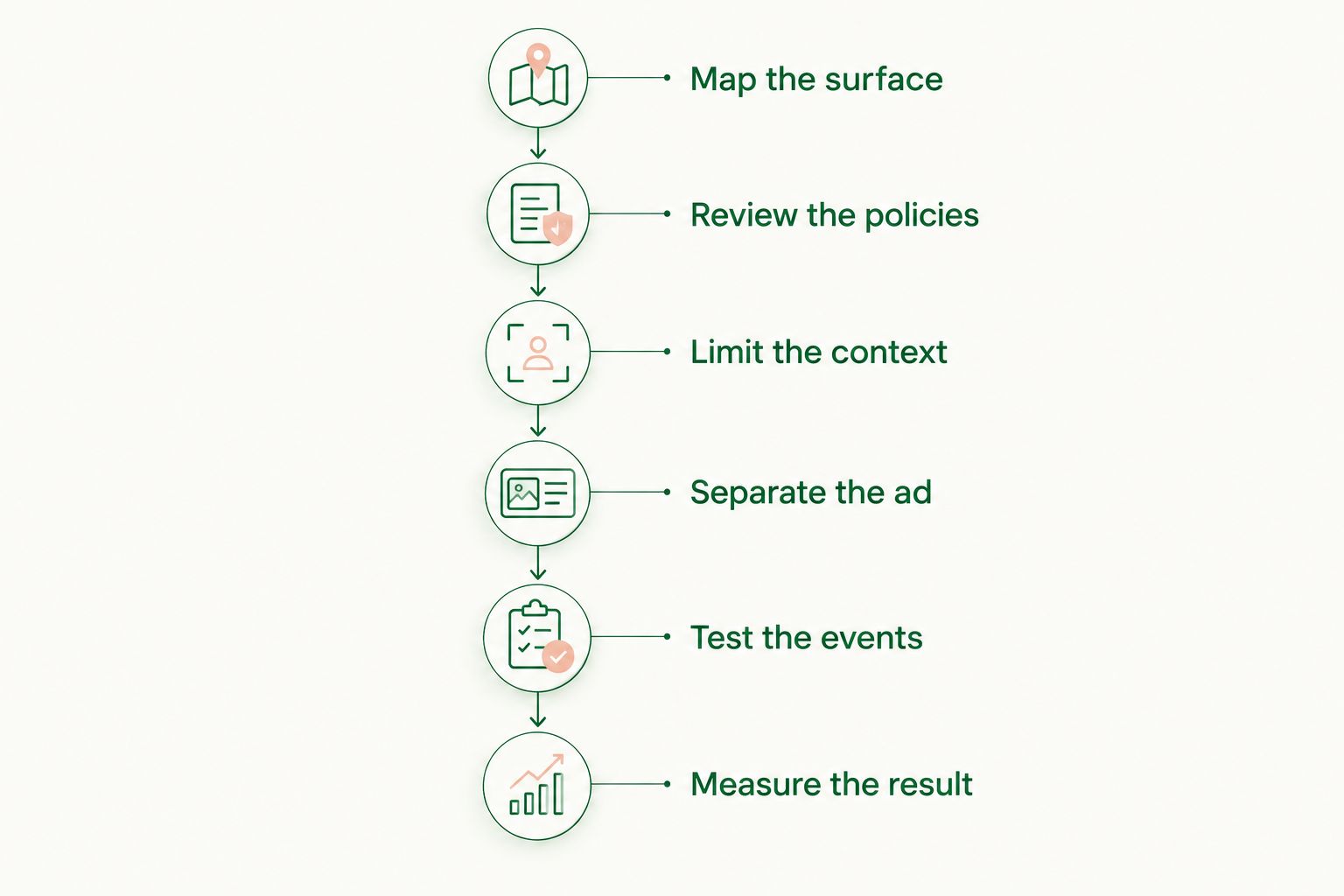
Use the following sequence for your 2026 implementation review. It separates policy suitability from technical delivery and prevents a working integration from being mistaken for a finished monetization system.
- Map the surface. Identify whether the proposed ad belongs on a content page, inside your chat interface, or inside a host platform you do not control. Record which system renders it.
- Review the policies. Read the applicable provider and host-platform rules for that exact surface. Include the content shown during a conversation, not only the landing page.
- Limit the context. Define the minimum information a contextual ad request needs. Keep credentials, private documents, and unnecessary personal information out of the request.
- Separate the ad. Render the sponsored placement as identifiable commercial content. Do not ask the model to disguise advertising as independent advice.
- Test the events. Distinguish ad requests, returned ads, rendered placements, and clicks. Confirm that streaming updates and conversation rerenders do not duplicate recorded events.
- Measure the result. Compare publisher revenue with serving costs and product outcomes. Inspect task completion and repeat use alongside advertising performance.
The sequence matters. Resolve the placement and policy question before committing engineering effort to an ad format, then validate the economics after the integration works.
What should you measure before expanding ads?
Measure revenue against the cost of the same activity. Page-level reporting alone cannot tell you whether monetizing a conversation pays for serving it.
Keep these measurement definitions explicit:
| Metric | Definition | What it tells you |
|---|---|---|
| Impression RPM | Publisher revenue per 1,000 ad impressions | Revenue yield from rendered advertising inventory |
| Session RPM | Publisher revenue per 1,000 chat sessions | Revenue yield across monetized and unmonetized conversations |
| Click-through rate | Clicks per 100 ad impressions, expressed as a percentage | How frequently displayed ads receive clicks |
| Contribution after serving costs | Publisher revenue minus the serving costs included in your calculation | Whether advertising covers the operating costs you chose to measure |
Do not compare impression RPM with session RPM as though they share a denominator. A conversation can contain no ad or multiple placements, and an ad request is not itself a rendered impression.
For your 2026 dashboard, state which costs the contribution calculation includes. Model inference, application hosting, and other serving expenses should not disappear simply because the advertising report measures only revenue.
Also inspect the no-ad path. Users should still receive a complete answer when no suitable placement exists; otherwise, advertising becomes a dependency of the core product rather than a separate monetization layer.
Does an AI chatbot website automatically qualify for AdSense?
No. An AI chatbot website still needs to satisfy applicable AdSense eligibility, publisher-content, and placement requirements. Neither the presence of generated text nor an existing publisher account establishes that every chat screen is acceptable.
Assess the actual experience submitted for review. Do not replace a useful publishing plan with the assumption that conversation volume equals eligible content.
Is a conversational ad SDK the same as AdSense?
No. A conversational ad SDK integrates advertising into an application’s chat experience, while AdSense website monetization operates under Google’s publisher and placement requirements. Choose based on the surface you need to monetize rather than treating the tools as interchangeable.
Elo conversational ads are relevant when your requirement is SDK-based contextual monetization inside an AI chat application. Evaluate the integration against your own placement, privacy, and reporting requirements before adopting it.
Should every chatbot conversation contain an ad?
No. Define eligibility by context rather than forcing an advertisement into every session. A request involving confidential information, a sensitive situation, or no relevant commercial intent deserves an explicit placement decision.
Make suppression a normal application outcome. It should be possible to finish the conversation without showing sponsored content or delaying the answer while waiting for an ad.
FAQ
Can I put AdSense beside an AI chatbot on my website?
An eligible website can contain a chatbot, but the specific ad placement must still comply with Google’s policies. Assess the page’s publisher content and the layout during active chat use; do not treat site approval as permission for every placement.
Can I paste AdSense code directly into a chatbot response?
Do not treat a generated response as an approved AdSense placement. Keep ad rendering under application control and verify that the intended surface and implementation satisfy the provider’s placement rules.
Does Google ban a website just because it uses AI content?
AI use alone does not settle whether a website meets Google’s publisher requirements. Evaluate the usefulness of the publisher content, prohibited or restricted material, and the actual ad implementation rather than assuming either automatic approval or automatic rejection.
Is Elo an alternative for ads inside my chatbot?
Elo provides an SDK-based adserver for contextual, conversational ads inside AI chat applications. It is relevant to developers building on OpenAI, Anthropic, or custom LLMs, but implementation still requires your own privacy, placement, and economic assessment.
Will chatbot ads cover my model inference costs?
Advertising revenue does not establish that inference costs are covered. Compare measured publisher revenue with serving expenses for the same set of sessions, including conversations that produce no ad revenue.
Can I use an ad SDK inside someone else’s hosted chatbot interface?
Only evaluate an integration where the host platform permits it and exposes the necessary implementation surface. Using a model provider’s API in your own application is different from controlling that provider’s consumer chat interface.
What should I verify before adding chatbot ads in 2026?
Verify the publishing surface, applicable policies, data sent with ad requests, sponsored-content disclosure, and event measurement. Test the no-ad path as well as the successful placement so the assistant remains usable without an advertisement.
One last thing
Test an ad request that returns nothing before testing the best-looking sponsored placement. Your chatbot should still answer, preserve the conversation, and leave its controls usable.
The cleanest monetization boundary is an assistant that works without an ad. Keep that boundary intact when you add contextual matching, reporting, and additional placements.