
Yes. A chatbot platform can white-label conversational ads when its integration and contract allow platform-controlled presentation; that does not automatically include custom domains, tenant dashboards, or resale rights. Keep the platform’s identity separate from the advertiser’s identity, and label paid placements clearly rather than disguising them as the assistant’s independent recommendations.
- White label conversational ads chatbot platform requirements extend beyond styling: verify SDK controls, tenant isolation, reporting, and contractual rights.
- Keep sponsored placements identifiable even when the adserver stays behind your platform’s interface.
- Elo provides contextual advertising infrastructure for AI chat developers; confirm white-label permissions separately.
- Approve the integration against written requirements, not a branded demo alone.
Why this matters
White-labeling changes who appears to operate the advertising experience. It does not remove the underlying responsibilities for ad disclosure, data handling, event measurement, or advertiser attribution. Your platform needs a clear boundary between what customers control and what the adserver controls.
For a 2026 implementation, define those boundaries before choosing a rendering approach. Start with how to disclose sponsored ads in an AI chatbot, because matching your interface must not make a paid placement look like an unpaid answer.
White-label the infrastructure, not the fact that an advertisement is an advertisement. That distinction belongs in your product specification, customer agreement, and acceptance tests.
Can conversational ads be white-labeled for a chatbot platform?
Yes, provided the adserver exposes the controls you need and grants the relevant permissions. Treat white-labeling as a set of separately verifiable capabilities, not a single feature checkbox. A customizable card proves presentation control; it does not prove that you can operate a customer-facing advertising business under your own name.
Use this comparison to define the scope. These are implementation choices to evaluate, not claims that every SDK supports them.
| Approach | Best for | Main advantage | Main limitation |
|---|---|---|---|
| Styled ad placement | A publisher branding its own chatbot | Keeps the placement visually consistent with the chat interface | Does not establish domain, dashboard, or resale rights |
| Platform-owned renderer | A development team needing interface control | Lets your application determine presentation within permitted creative rules | Your team owns rendering, accessibility, and event implementation |
| Tenant-facing monetization service | A chatbot platform serving multiple customers | Presents advertising controls within the platform’s customer experience | Requires explicit permissions, tenant boundaries, and reporting rules |
Choose the smallest scope that meets your actual requirement. If you only need a card to match your chat interface, do not make a fully branded advertiser portal a launch dependency. If customers expect their own controls and reports, styling alone is insufficient.
What counts as evidence of white-label support?
Ask for a demonstration of each required capability and written confirmation of its permitted use. Your evidence should cover both the interface and the agreement. A screenshot cannot establish contractual rights, and a contract cannot prove that a renderer handles your application’s layout.
For your 2026 vendor review, turn the phrase white-label support into specific questions: which surfaces can change, which attribution must remain, which domains are supported, and which functions customers can access? Record the answers as acceptance criteria rather than informal sales assurances.
Which white-label scope should you choose?
Separate presentation, operations, and commercial permissions before assigning work. These three control layers give engineering, product, and legal teams distinct questions to resolve. None should be inferred from the others.
Presentation control
Best for: publishers that need ads to fit an existing chatbot interface. Specify the permitted card layout, typography, spacing, disclosure placement, and destination behavior. Ask whether you receive structured creative data or must display a supplied component.
The benefit is a consistent interface. The trade-off is responsibility: if your team builds the renderer, your team must test truncation, keyboard access, mobile layouts, and missing creative fields. Do not rewrite advertiser claims simply to make copy fit a component.
Operational control
Best for: platforms that manage advertising across customer chatbots. Define who enables ads, who selects eligible placements, and who can view performance. Decide whether those actions happen in your application or in a separate provider interface.
The benefit is a platform-owned workflow. The trade-off is a larger permission and support surface: customers need clear limits, platform administrators need oversight, and every customer-facing report needs a defined scope. A branded dashboard without reliable access boundaries is not a finished integration.
Commercial control
Best for: platforms offering monetization as part of their customer service. Confirm whether the agreement permits you to offer the integration to customers under your own name. Establish who contracts with advertisers and publishers, who handles disputes, and how revenue attribution is documented.
The benefit is commercial clarity. The constraint is that software customization cannot grant rights absent from the agreement. Do not promise customers a resold advertising service merely because an SDK can render inside their chatbot.
Why white-label conversational ad requirements vary
The scope depends on the product you intend to operate. An individual publisher needs different controls from a platform hosting customer-owned chatbots. Use these factors to define requirements rather than assuming a provider supports them:
- Application ownership: Establish whether your company operates the chatbot or supplies software to another publisher.
- Rendering responsibility: Determine whether your application draws the placement or displays a provider-controlled component.
- Customer access: Specify whether customers need settings, reports, or administrative functions inside your platform.
- Data boundaries: Define which conversation context leaves the application and which customer is associated with each request.
- Commercial relationship: Identify who receives advertiser spend, attributes publisher earnings, and handles customer questions.
- Brand attribution: List the platform, provider, and advertiser identifiers that must remain visible on each surface.
For a 2026 requirements document, assign an owner to every factor. Product should not approve branding while engineering assumes someone else has resolved tenant isolation. Likewise, a commercial agreement should not describe capabilities that the integration has not demonstrated.
How do you validate a white-label integration?
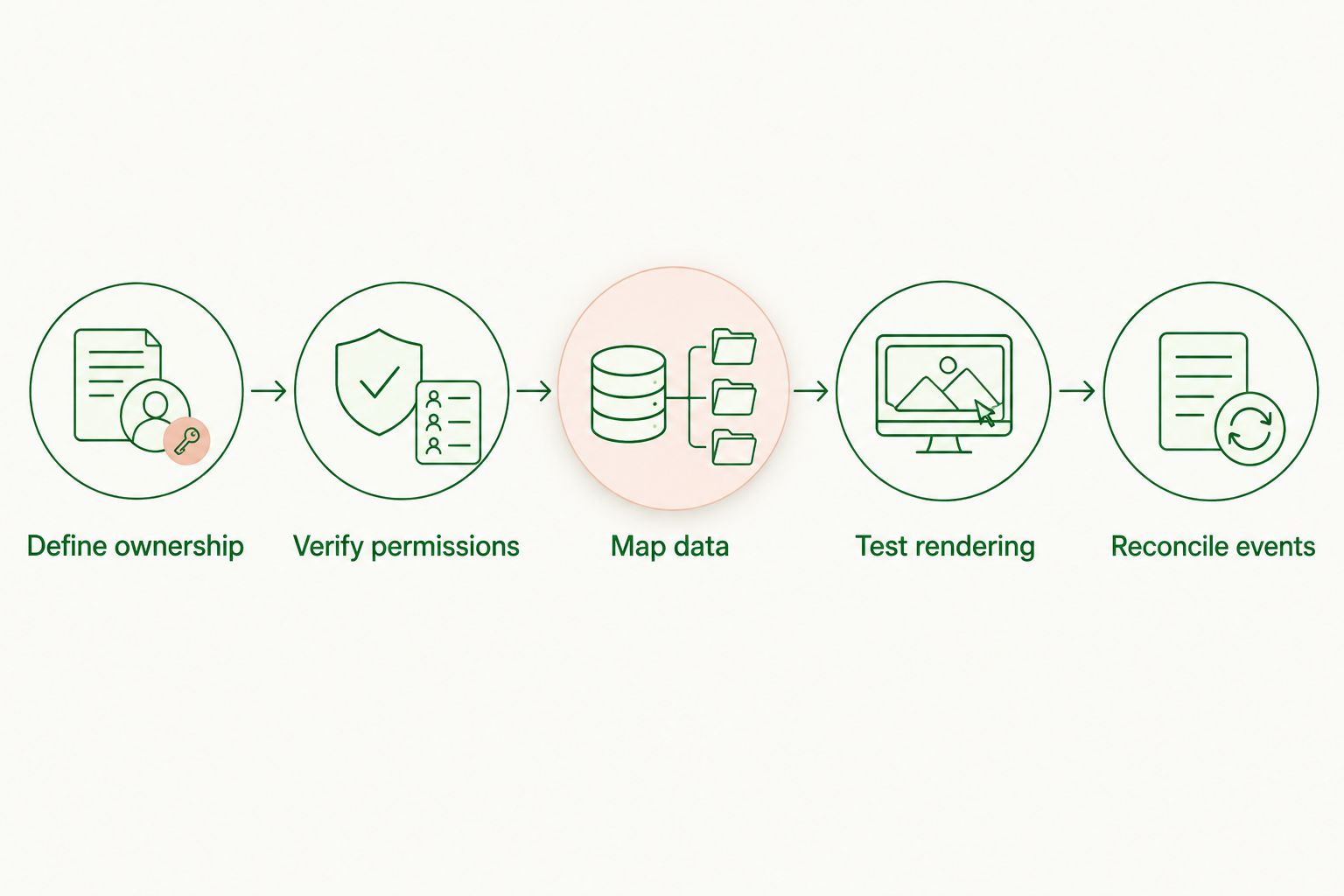
Use a requirements-led review before exposing monetization controls to customers. The sequence below separates permission, implementation, and verification. It is an acceptance process, not a claim about any provider’s existing features.
- Define ownership. List the application surfaces, account relationships, and support responsibilities your platform will own. Include the chat placement and customer settings, not just the public-facing card.
- Verify permissions. Obtain written confirmation covering branding, attribution, customer access, and your intended commercial model. Resolve exceptions before building around them.
- Map data. Document the context sent for matching, the customer identifier used, and the events returned. Keep credentials and customer permissions outside untrusted client input.
- Test rendering. Check approved creative, visible disclosure, destination links, and empty responses. Confirm that an unavailable ad does not prevent the chatbot from answering.
- Reconcile events. Trace a placement through the request, rendered result, recorded interaction, and customer report. Confirm that the same event cannot be credited repeatedly through retries.
A successful demo shows the happy path. Acceptance testing must also show rejection, missing data, and disabled monetization. Test the customer boundary with deliberately mismatched identifiers rather than assuming that separate dashboard views prove isolation.
What should the acceptance record contain?
Keep the approved scope, test evidence, and unresolved restrictions together. Include the integration version, the agreement reviewed, and the owner responsible for each decision. A record dated 2026 is useful only if it identifies the configuration actually tested.
Write pass conditions as observable behavior. For example, require that a disabled customer receives no ad placement, that a sponsored label remains visible in a narrow viewport, and that one customer cannot request another customer’s report. These are test requirements, not performance promises.
Does white-labeling mean you can remove sponsored labels?
No. White-labeling concerns the service provider’s presentation; disclosure concerns the commercial nature of the placement. Treat these as separate decisions, and keep the sponsored identity attached to the ad even when your platform controls the surrounding interface.
In the United States, FTC native advertising guidance addresses whether consumers can recognize advertising as advertising. Use that principle when reviewing the placement, and get legal review for your actual presentation. Do not treat a styling option as a legal determination.
Keep the assistant’s answer distinguishable from paid creative. A sponsored card should not silently become a source citation, an organic recommendation, or part of the model’s reasoning. Your renderer needs an explicit boundary even when both elements appear in the same conversation.
Can each customer use a different chatbot brand?
Yes, as an application design, if the integration supports the required presentation controls and the agreement permits the intended use. Store customer-specific presentation settings separately from platform-wide advertising rules. A customer’s branding preference should not override disclosure or access restrictions.
Do not confuse customer branding with customer isolation. Two differently styled chatbots can still share an incorrectly scoped reporting query. Validate settings, requests, and reports against the authenticated customer context, not a customer identifier supplied without verification.
Can the platform own the customer dashboard?
Yes, if it has authorized access to the necessary data and permission to present it to customers. Define each metric before building the screen: an ad request, a rendered impression, and a click represent different events. Do not label all of them as views.
Specify reporting periods, time zones, and adjustment handling. If a customer sees estimated earnings, distinguish estimates from finalized amounts without promising a settlement process that the agreement does not establish. A clean dashboard is useful only when its numbers have a traceable meaning.
Where does Elo fit?
Elo is built for developers monetizing AI chat applications with contextual ads. Its SDK-based adserver lets developers embed conversational advertising and earn revenue from advertiser spend. The stated application scope includes apps built on OpenAI, Anthropic, or custom LLMs.
Elo provides the contextual advertising infrastructure relevant to this evaluation. That establishes its role in chatbot monetization, not a blanket promise of white-label domains, reselling permissions, tenant dashboards, or custom reporting. Confirm each requirement against the integration and agreement before including it in a customer commitment.
For a 2026 evaluation, assess Elo’s conversational adserver against your required control layers. The fit is SDK-based contextual monetization for chat developers; the decision boundary is your additional white-label specification. Do not substitute a relevant product category for proof of every requested capability.
FAQ
Can I white-label conversational ads in my chatbot platform?
Yes, when the integration provides the controls you need and the agreement permits your intended use. Confirm presentation, customer access, attribution, and commercial permissions separately.
Does a native ad SDK automatically include white-label rights?
No. An SDK establishes an integration method, not permission to remove provider branding or resell the service. Obtain written confirmation of those rights.
Can I make sponsored cards match my chatbot interface?
You can match sponsored cards to your interface when the integration permits styling or platform-owned rendering. Preserve required disclosure and advertiser information while changing presentation.
Do white-label chatbot ads still need a sponsored label?
White-labeling does not remove the need to make advertising recognizable. Keep disclosure clear and review the actual placement against applicable advertising requirements.
Can multiple customers share the same ad integration?
A shared integration requires verified customer boundaries. Test authorization, request attribution, settings, and reporting rather than assuming that different branding creates isolation.
Does Elo provide conversational advertising for custom LLM apps?
Elo provides an SDK-based adserver for contextual conversational advertising in AI chat applications, including custom LLM apps. Confirm any additional white-label requirements separately.
What should I verify before promising white-label ads to customers?
Verify contractual permissions and demonstrated technical controls before making the promise. Include branding, data handling, tenant access, reporting, and support responsibility in the approved scope.
One last thing
Test the empty placement before approving the branded placement. Disable monetization, remove an eligible creative, and simulate an ad request failure. Your chatbot should still deliver its answer without a broken card, unexplained gap, or blocked response.
Then inspect the customer report. A missing placement must not become a rendered impression merely because a request was sent. That boundary connects the user experience to the reporting system—and reveals more than another polished branding demo.