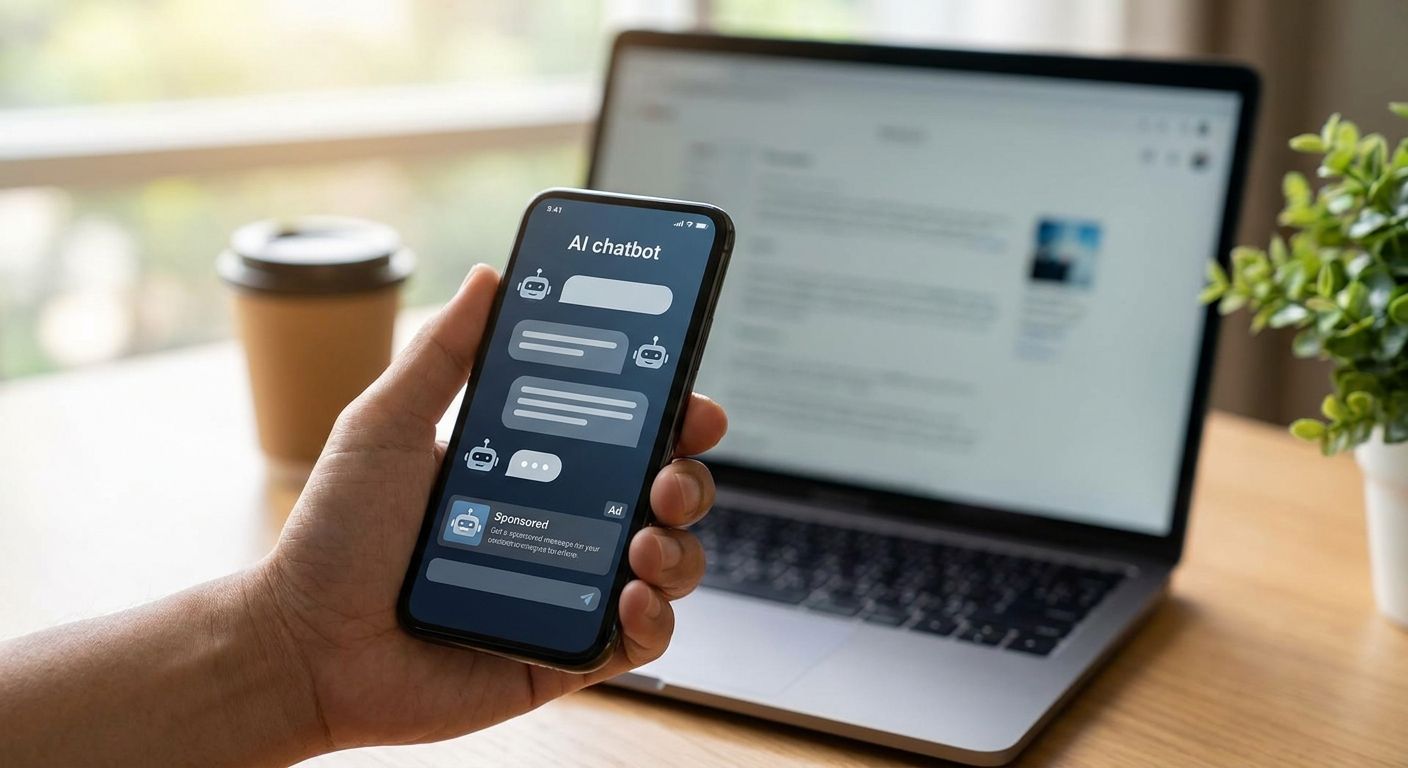
Freemium AI chatbot apps that monetize with ads run native, contextual ad cards inside the free tier only, so unconverted users generate revenue instead of pure inference cost. The setup differs from a straight paywall or a mobile ad network: ads have to disappear the instant a user upgrades, and they have to fit inside a chat turn instead of interrupting it.
- Ad monetization freemium AI chatbot apps need targets free-tier sessions only, never paid seats.
- Elo's SDK drops a native ad card into a chat turn in twelve lines of code, not a banner.
- Free-tier LLM inference costs real money in 2026; ads recover that spend before a user churns or upgrades.
- Mobile ad networks built for banners and interstitials break conversational UX inside a chat app.
- Frequency caps and category exclusions protect retention more than raw ad volume does.
Why ad monetization matters for freemium AI chatbot apps
Every free-tier message costs you an LLM API call whether the user ever pays or not. A freemium chatbot that only monetizes the paid tier is writing off the entire free tier as a cost center, and in 2026 that cost doesn't shrink just because the user is on the free plan.
Ads recapture value from three groups a paywall never touches: users who never intend to pay, users who churn before the trial ends, and users testing the product before a team-wide rollout. If you haven't shipped anything yet, start with the steps to launch an ad-supported AI chatbot before picking a network.
“Every chat is monetizable, even the ones that never convert.”
The segment-specific constraint is the tier boundary. A generic ad SDK doesn't know or care whether a user paid; a freemium chatbot has to gate ads at the account level, not just at the session level, or you'll show ads to a customer who's paying you not to see them.
The setup, step by step
Segment your free-tier traffic before you touch ads
Don't turn ads on for every free session at once. Split traffic first.
- Flag which conversation topics are ad-eligible versus off-limits (medical, legal, crisis support)
- Tag sessions by intent — shopping, research, planning — not just by account tier
- Exclude any session where a billing sync is pending or unclear
- Keep the exclusion list editable without a redeploy
Map ad-eligible intents to your conversation flows
Ads fit some flows and wreck others. A recommendation or comparison flow can carry a native card; a debugging or raw Q&A flow usually can't.
- Identify 3-5 flows where a native ad card reads as a helpful suggestion, not an interruption
- Build a matcher that reads the last 2-3 turns of context, not just the opening message
- Skip ad insertion on any flow shorter than 3 turns — there's no context to match against yet
- Route ambiguous flows to a manual review queue before scaling
Set frequency caps before you set pricing
A free user who sees an ad every turn dismisses the app before you collect a single click.
- Cap native cards at one per 5-8 turns per session
- Cap total ad exposure per user per day
- Let users dismiss an ad with zero penalty to the conversation
- Track dismiss rate weekly as a retention signal, not just an ad metric
Instrument revenue per free user
The manual version: export session logs, tag ad-eligible turns, and reconcile against advertiser payouts in a spreadsheet. It works for a few hundred sessions a day and falls apart past that.
The faster path is a dashboard that reports revenue per thousand messages (RPM) by cohort automatically — see the process to measure ad revenue per free user for the exact fields to track.
- Track RPM by cohort weekly, not monthly
- Split RPM for free users versus users close to trial expiration
- Compare RPM against your per-message inference cost directly, not against total top-line revenue
- Flag any RPM drop the same week you ship a free-tier UX change
Protect fill rate with more than one demand source
A single ad network leaves slots empty during off-peak hours, and an empty slot in a chat card looks broken, not quiet.
- Connect two or more demand sources so unfilled slots are rare
- Set a CPM floor — a slot with no bid above the floor renders nothing rather than junk
- Monitor fill rate by hour for the first two weeks after launch
- Re-check floor pricing monthly against actual bid activity
Turn ads off the instant a user upgrades
This is the one step that's non-negotiable for a freemium product.
- Wire the ad shutoff into your billing webhook, not a manual dashboard toggle
- Confirm zero ads render for an upgraded account within the same session, not the next day
- Log any ad served to a paid account as a bug ticket, not a rounding error
- Test the shutoff path in staging before every release, not just at launch
Test ad placement against paid conversion, not just RPM
Ads that raise RPM but slow upgrades are a net loss for a freemium business.
- Run a holdout group with zero ads shown and compare 7-day upgrade rate
- Check whether ad exposure changes free-tier retention, not just click-through
- Test removing the ad slot in the two turns right before a paywall prompt
- Re-run the holdout test after any major matcher or placement change
Comparison table: ad monetization options for freemium AI chatbot apps
| Option | Best for | Key limitation |
|---|---|---|
| In-house ad matching build | Teams with existing ML infra and months to spend before first revenue | Slow to ship; matcher logic, mediation, and reporting all built from scratch |
| Generic mobile ad network (AdMob-style) | Apps already running interstitials elsewhere in the product | Built for banners and full-screen interstitials, not conversational turns; breaks chat UX |
| Direct sponsorship deals | High-traffic apps with an outbound sales team | Doesn't scale past a handful of sponsors; no programmatic fill for long-tail free users |
| Elo SDK | Freemium chatbots that want native ad cards live without hiring an ad ops team | Demand density still depends on advertiser volume in your category; see the full ad monetization SDK comparison |
Verdict: Elo is built for freemium AI chatbot apps that need native, non-intrusive ad cards live without staffing an ad ops team — buy it if your free tier already has real message volume.
Common mistakes freemium AI chatbot apps make
- Showing ads to paid accounts after a billing sync fails silently — this is the fastest route to a cancellation, not a rounding error.
- Reusing banner or interstitial units from a mobile game SDK, which interrupt a chat turn instead of extending it.
- Shipping with no frequency cap, so one ad-heavy session spikes dismiss rate before you have enough data to tune it.
- Measuring total ad revenue instead of RPM per free user, which hides whether ads even cover per-message inference cost.
- Skipping category exclusions, so a finance or medical query returns an off-topic ad and erodes trust across the whole product.
FAQ
What's the best way to monetize a freemium AI chatbot app in 2026?
Native, contextual ads on the free tier only, gated off the moment a user upgrades, is the standard approach in 2026. A hard paywall alone leaves free-tier volume unmonetized entirely.
Is ad monetization better than a hard paywall for AI chatbots?
They're not mutually exclusive — most freemium apps run both, with ads covering free-tier inference cost while the paywall drives upgrade revenue. Testing a holdout group without ads is the only way to know if ads hurt your specific upgrade rate.
How much does an ad SDK for AI chatbots cost to integrate?
Integration effort is typically a small number of SDK calls rather than a rebuild. Check current pricing and revenue-share terms directly with the vendor, since these vary by deal.
Does showing ads in a chatbot hurt paid conversion?
It can if placement is wrong — ads shown right before a paywall prompt are the highest-risk spot. Run a holdout group with zero ads and compare 7-day upgrade rates before rolling ads out to 100% of free traffic.
Can I show ads to free users only and never to paid users?
Yes, and you should — gate ad rendering at the account level tied to your billing system, not just at the session level, so an upgrade shuts off ads immediately.
What's the difference between banner ads and native conversational ads in AI chat apps?
Banner ads sit outside the conversation as a static unit; native conversational ads render as a card inside a chat turn, matched to the last few messages of context. Native cards fit chat UX; banners were built for a different surface entirely.
How do I avoid ad fatigue in a free-tier chatbot?
Cap native ad cards at roughly one per 5-8 turns and let users dismiss without any penalty to the conversation. Track dismiss rate weekly — a rising dismiss rate is an early warning sign before churn shows up in the numbers.
Do mobile ad networks like AdMob work inside an AI chat app?
Not well — those networks are built for interstitials and banners in mobile games and apps, and forcing that format into a chat turn interrupts the conversation. Ad SDKs built specifically for conversational surfaces render native cards instead.
One last thing
Run the ad shutoff test in staging before every release, not just at launch. An ad shown to a paying user in 2026 costs you more in churn and one-star reviews than a few weeks of unmonetized free-tier traffic ever will.