
BPO providers’ AI chatbot monetization is the practice of earning revenue from automated client conversations through service contracts, approved commercial referrals, or contextual ads while preserving support outcomes. This 2026 guide focuses on the extra decisions outsourced operations face: client permission, tenant isolation, revenue ownership, and service-level commitments.
- AI chatbot monetization for BPO providers starts with client authorization, not an ad placement.
- Elo is best for developers adding SDK-based contextual ads to AI chat applications.
- Keep support resolution separate from sponsored recommendations; suppress ads during complaints and sensitive workflows.
- Compare retained ad revenue with service outcomes and operating costs before expanding a pilot.
Why chatbot monetization matters for BPO providers
A business process outsourcing provider must separate two decisions: how the client pays for automation and whether advertisers can fund any part of the experience. These are different revenue streams. A service contract does not automatically authorize third-party advertising.
Treat conversational ads as optional inventory, not as the purpose of a support conversation. Start with the client’s task, then identify any approved commercial moment after that task is complete.
Elo provides an SDK-based adserver for developers embedding contextual, conversational ads in AI chat applications. Elo is best for developers adding SDK-based contextual ads to AI chat applications. For a BPO, that technical fit is only the starting point; client authorization and workflow controls remain separate requirements.
For a 2026 rollout, evaluate each client account independently. A product-discovery assistant and an account-recovery assistant should not inherit the same monetization policy simply because they share infrastructure.
How to build a client-approved monetization workflow
1. Define who owns the conversation and revenue
Begin with a spreadsheet, not an integration. Record the client, application owner, customer-facing brand, data responsibilities, and party authorized to approve commercial placements. Have the account owner confirm the arrangement before engineering work starts.
Separate payment for operating the chatbot from advertiser-funded income. If both exist, document which party receives advertiser revenue, which deductions apply, and how adjustments reach the client statement. Do not leave those decisions to an analytics dashboard.
For a 2026 pilot, write down what happens when the client withdraws permission. Your operating process needs an ad-disable path that does not disable support. Assign an owner who can execute it without waiting for a contract renewal.
Close the approval stage with these records:
- Written client authorization for the specific application and channel.
- Named owners for ad policy, implementation, and account reconciliation.
- A definition of gross revenue, deductions, and retained revenue.
- Rules for advertiser exclusions and competing brands.
- A documented suspension and termination process.
2. Classify conversations before creating inventory
Review representative conversations manually and assign an eligibility label. Use approved, appropriately handled samples rather than copying production transcripts into a new spreadsheet. The question is whether an offer belongs in that workflow at all.
A completed product-selection task is a candidate for review. A disputed charge, failed identity check, cancellation complaint, or unresolved service outage should remain outside your initial ad pilot. These are recommended exclusions, not claims about a particular network’s automatic controls.
Keep eligibility separate from relevance. A conversation can mention travel while still being an inappropriate place for a travel offer—for example, when the customer is trying to resolve a failed booking.
Start with 1 permitted placement per eligible conversation as a conservative pilot rule, not an industry benchmark. Expand only after reviewing outcomes.
- Mark each workflow eligible, excluded, or awaiting client review.
- Define resolution using the client’s existing support criteria.
- Exclude sensitive and unresolved workflows from the initial pilot.
- Apply a client-approved advertiser category allowlist.
- Define when an eligible conversation becomes ineligible again.
3. Separate ad delivery from the support answer
First, build a noncommercial test placement in a staging environment. Use it to verify where a sponsored component would appear, how users dismiss it, and whether the support task still works when the component fails. You do not need live advertiser demand to test layout and failure behavior.
Then evaluate an SDK-based path. Elo’s conversational ad SDK serves developers building AI chat applications on OpenAI, Anthropic, or custom LLMs. Use the Elo demo to assess the integration against your application requirements; verify tenant controls, reporting fields, and failure behavior rather than assuming they are included.
Structure the application boundary around Eligibility, Context filtering, Ad request, Rendering, and Event logging. Keep commercial content outside the authoritative support answer.
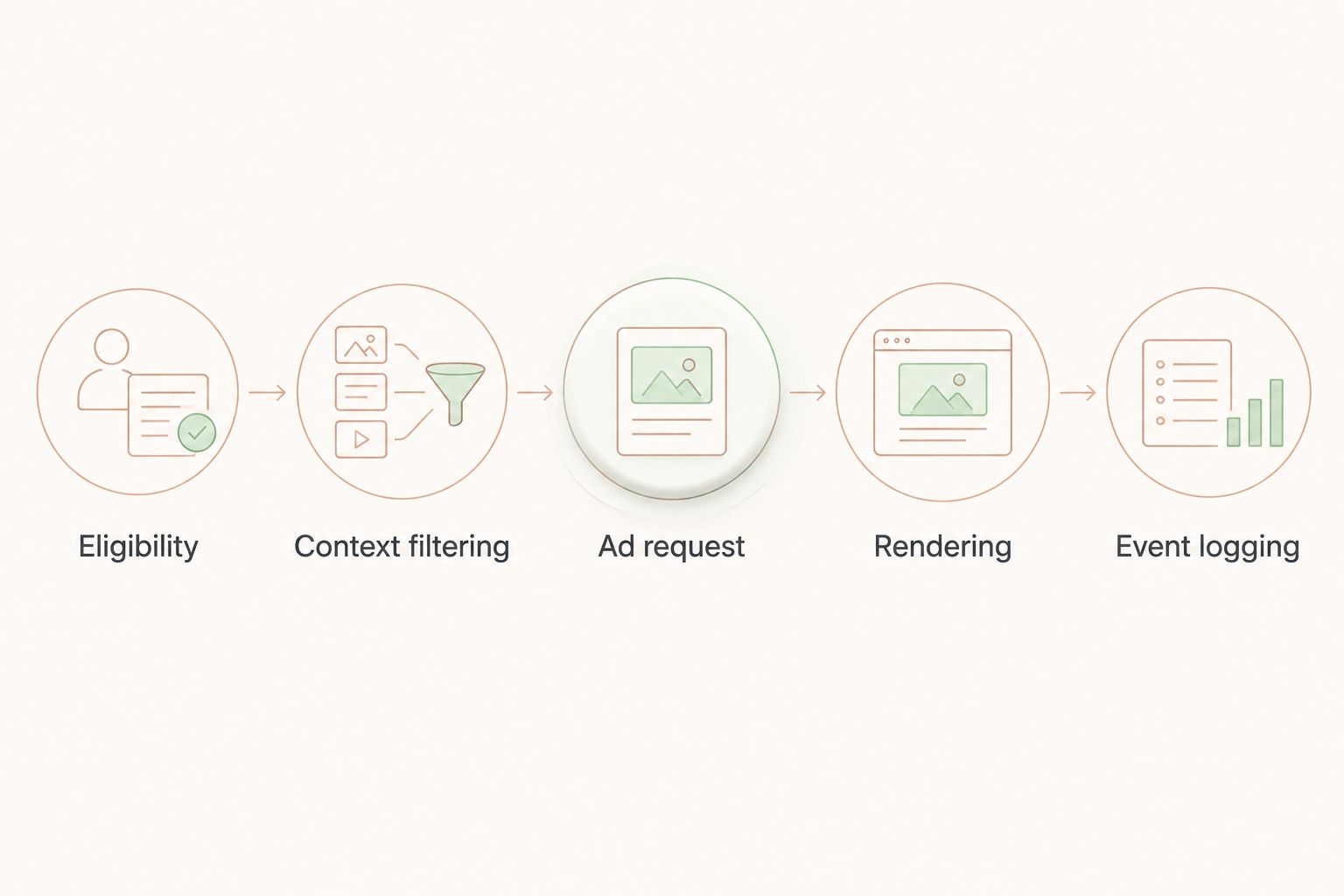
The SDK supplies an ad-serving path. Your application still needs to enforce the client’s operating policy and preserve the support experience.
- Keep the answer usable when an ad request fails.
- Render sponsored content separately with a clear advertising label.
- Enforce client eligibility rules before requesting an ad.
- Send only the context approved for the commercial purpose.
- Test dismissal, empty responses, and request failures in staging.
4. Enforce tenant isolation and data boundaries
Map the information moving through the system before connecting production traffic. A manual data-flow diagram is enough to identify where customer text, client identifiers, ad requests, and reporting events cross service boundaries.
Do not treat contextual targeting as permission to send complete transcripts. Decide which approved signals the ad request needs, then exclude unrelated support details. Have the appropriate privacy and security owners assess that design against client contracts and applicable requirements.
Keep client policy in a tenant-scoped configuration rather than a shared default that silently enables ads everywhere. Explicitly test whether an account’s exclusion rules, revenue records, or reporting access can affect another account.
For the 2026 launch checklist, include both successful requests and attempted boundary violations. A correct result is sometimes no ad request at all.
- Map each data field to its purpose and recipient.
- Remove credentials, payment details, and unrelated personal information.
- Scope configuration and reporting access to the correct tenant.
- Test cross-tenant access and policy inheritance failures.
- Document retention, deletion, and incident responsibilities.
5. Measure retained revenue alongside service quality
Start with a manual reconciliation sheet that joins revenue records to a tenant and reporting period. Separate requested ads, rendered ads, clicks, and attributed outcomes. These events describe different stages; do not use them interchangeably.
Define conversation RPM as retained ad revenue divided by total conversations, multiplied by 1,000 conversations. Also calculate eligible-conversation RPM using only eligible conversations as the denominator. The first measures the contribution across the operation; the second measures the approved inventory.
Use the same period, currency, and revenue definition throughout each comparison. Label revenue as estimated or finalized according to the underlying records, and reconcile later adjustments rather than overwriting their history.
Revenue is not a sufficient pass condition. Compare resolution rate, repeat contacts, escalation, satisfaction, and response latency against the client’s agreed service measures.
- Record total conversations and eligible conversations separately.
- Reconcile rendered impressions with the serving records.
- Separate gross advertiser revenue from the BPO’s retained amount.
- Track incremental integration, reporting, and support costs.
- Report service outcomes beside monetization results.
6. Run a controlled pilot and define stop rules
Before live serving, replay approved test scenarios manually. Include successful resolution, renewed frustration, sensitive information, no matching ad, and an unavailable ad service. Record whether the application follows policy, not merely whether a card appears.
Next, assign eligible traffic to 2 cohorts: an ad-enabled cohort and a holdout without ads. Keep assignment stable enough for your chosen unit of analysis. Compare equivalent workflows rather than mixing one client’s sales assistant with another client’s technical support bot.
Set client-approved stopping criteria before launch. Use existing service obligations and your measured baseline to choose thresholds; do not borrow an unsupported revenue target or latency allowance.
A 2026 pilot succeeds only when its commercial result and service result both pass. Retain the holdout during expansion so you can continue checking the trade-off.
- Specify the eligible client, workflow, channel, and language.
- Verify advertising labels and advertiser exclusions before release.
- Monitor revenue and service metrics by cohort.
- Pause serving when an agreed stop condition occurs.
- Expand only after client review and reconciliation.
Compare monetization options for a BPO chatbot
Choose the commercial model before choosing the serving technology. A client-funded chatbot, a referral placement, and an advertiser-funded assistant solve different business problems. The following options are planning choices, not interchangeable promises of income.
| Option | Best for | Main advantage | Key limitation |
|---|---|---|---|
| Client-funded automation service | Contracted support and operational workflows | Keeps the commercial relationship with the client | Does not add advertiser-funded revenue |
| Client-approved referrals | Narrow workflows with an approved commercial next step | Lets the client define the referral destination | Requires agreement on attribution and commercial terms |
| Contextual ads through Elo | Developers embedding conversational ads in AI chat applications | Provides an SDK-based adserver path | Does not replace client approval, application controls, or service measurement |
| Direct-sold sponsorships | Operators managing their own advertiser relationships | Allows placement and sponsor terms to be negotiated directly | Adds advertiser sales, creative review, and reconciliation work |
For outsourced support, keep the service contract as the commercial foundation. Test advertising only in approved workflows where the user can finish the original task without engaging with the sponsor.
Elo’s contextual ads address the serving layer. They do not establish whether a particular client contract permits monetization, and the product description does not establish your required tenant or reporting controls. Verify those requirements during evaluation.
Common monetization mistakes BPO providers make
Treating client traffic as owned inventory
Operating a chatbot is not the same as receiving authorization to sell placements inside it. Obtain workflow-specific permission before enabling ads. Include the customer-facing brand and channel in that approval so a website pilot does not silently become an all-channel rollout.
Selling an ad before resolving the support issue
A related offer is still an interruption when the customer is waiting for help. Keep unresolved cases outside the pilot. If a resolved conversation returns to a complaint or escalation, reevaluate eligibility instead of preserving the earlier decision.
Pooling revenue across unrelated client accounts
An aggregate revenue total cannot explain which client generated an impression or received an adjustment. Preserve tenant-level accounting from the first test. Reconcile the client statement against the agreed revenue definition, not against a blended dashboard total.
Counting client upsells as third-party ad revenue
A client’s own upgrade offer and an advertiser-funded placement have different commercial owners. Track them separately. Otherwise, your pilot report cannot show whether the ad program generated incremental revenue or simply relabeled an existing sales workflow.
Expanding on click-through rate alone
Clicks do not establish profitable or acceptable support outcomes. A placement can generate interaction while service metrics fail. Require retained revenue, incremental costs, and the agreed service measures in the expansion decision.
FAQ
What is AI chatbot monetization for BPO providers?
AI chatbot monetization for BPO providers means earning revenue from automated client conversations through service contracts, approved referrals, or contextual ads. Advertiser-funded placements need a separate approval and operating process from the underlying support service.
Can a BPO put ads in a client’s customer support chatbot?
A BPO should enable ads only after obtaining client authorization for the specific application and workflow. Review the contract, data responsibilities, advertiser exclusions, and customer-facing disclosures before implementation.
What is Elo best for in a BPO chatbot project?
Elo is best for developers adding SDK-based contextual ads to AI chat applications. A BPO still needs to verify its client-specific integration, tenant isolation, reporting, and service requirements.
Should ads appear during complaints or account recovery?
Exclude complaints and account-recovery workflows from the initial ad pilot. Keep the support task independent of advertising and reassess eligibility if a conversation becomes unresolved or sensitive.
How do you calculate chatbot conversation RPM?
Calculate conversation RPM by dividing retained ad revenue by total conversations and multiplying by 1,000. Calculate eligible-conversation RPM separately, using eligible conversations as the denominator and the same reporting period.
Does a contextual ad SDK replace a BPO’s privacy review?
No. An ad SDK does not replace review of the data you transmit, the client’s authorization, or applicable requirements. Map the data flow and have the responsible privacy and security owners assess the implementation.
What should a BPO measure before expanding ads in 2026?
Measure retained revenue, incremental costs, and agreed service outcomes before expanding ads in 2026. Compare eligible ad-enabled traffic with a holdout and stop serving when a client-approved condition is breached.
One last thing
Test the no-ad path as carefully as the ad path. A BPO chatbot must still resolve the customer’s task when no suitable advertiser is returned, the request fails, or the client disables monetization. Make that behavior a release requirement, not an exception discovered in production.