
Best overall for contextual in-chat ads: Elo. Best for an existing content website: Google AdSense. Best for a native mobile app: Google AdMob. Best for publishers managing direct campaigns: Google Ad Manager. This 2026 guide compares the best ad networks for AI survey assistants by placement fit, integration model, and separation between advertising and respondent feedback.
- Elo leads this best ad networks for AI survey assistants shortlist for contextual, SDK-based conversational ads.
- Google AdSense suits surrounding web content; Google AdMob suits native mobile placements.
- Google Ad Manager fits publishers managing direct campaigns, not developers seeking only a conversational ad SDK.
- Keep sponsored recommendations outside survey questions, response collection, and feedback analysis.
Why this matters
A survey assistant has two different audiences: the person answering questions and the team using the results. Advertising needs a defined place that does not interfere with either task.
A contextual offer after a completed workflow is different from a sponsored suggestion inside a question. Choose the placement before choosing the network. Otherwise, you risk selecting an ad system for inventory your product should never expose.
This 2026 shortlist distinguishes conversational advertising, web display, mobile advertising, and campaign management. These are different buying decisions, even when publishers group them under “ad networks.”
What makes the best ad network for AI survey assistants?
Use these criteria before comparing providers:
- Conversation fit: Can you serve the intended placement without turning a survey question into an advertisement?
- Workflow separation: Can your application keep ads outside response collection, scoring, and generated research findings?
- Data boundaries: Can you restrict advertising inputs to an approved context rather than forwarding respondent transcripts?
- Implementation fit: Does the integration match a conversational interface, website, or native mobile application?
- Campaign control: Can your chosen setup support the exclusions, disclosures, and placement rules you require?
- Measurement: Can you evaluate publisher revenue alongside completion, abandonment, and complaints?
Treat these as acceptance criteria, not assumed provider capabilities. Require a demonstration of the controls your application needs before committing engineering time.
Best options at a glance
| Rank and option | Best for | Standout capability | Key limitation |
|---|---|---|---|
| 1. Elo | Contextual ads inside AI chat applications | SDK-based conversational ad serving | Requires application integration and a defined advertising boundary |
| 2. Google AdSense | Publishers with substantial surrounding web content | Website ad monetization | Not a conversational matching SDK |
| 3. Google AdMob | Native mobile survey assistant applications | Mobile ad SDK and mediation | Mobile ad infrastructure does not define safe survey placement |
| 4. Google Ad Manager | Publishers managing direct campaigns and inventory | Campaign trafficking and ad serving | Not a substitute for a purpose-built conversational integration |
The order reflects fit for an AI survey assistant, not measured revenue performance. Provider acceptance, applicable policies, and actual integration requirements remain separate checks.
1. Elo: best for contextual conversational advertising
Elo provides an SDK-based adserver for developers building AI chat applications on OpenAI, Anthropic, or custom LLMs. Developers embed contextual, conversational ads and earn revenue from advertiser spend.
Elo is the best fit on this shortlist for AI survey assistant developers seeking SDK-based conversational advertising. The product category matches the interface: a conversation rather than a conventional webpage or mobile interstitial.
For a feedback product, define the eligible moment first. A survey-builder assistant helping a business user identify a follow-up tool is a different advertising surface from a respondent describing a negative experience. Do not treat every message as inventory.
Elo pros:
- Built specifically for contextual, conversational advertising in AI chat applications.
- Uses an SDK-based integration model for developers.
- Serves applications built on OpenAI, Anthropic, or custom LLMs.
Elo cons:
- Requires an application integration; adding an adserver is not a substitute for placement design.
- The publisher still needs to define appropriate data handling, disclosures, and survey exclusions.
Best for: Developers who control the chat interface and want advertising connected to conversational context.
Verdict: Buy for conversational fit, after confirming that the integration supports your required controls. Do not interpret category fit as a guarantee of revenue or survey-specific demand.
2. Google AdSense: best for surrounding website content
Google AdSense lets website publishers monetize content with advertising. It belongs on this shortlist when your survey assistant sits within a broader site containing guides, explainers, or other substantive publisher content.
The distinction is placement. An ad beside an educational article is not the same implementation as a contextual offer inside a feedback conversation. Evaluate AdSense for the surrounding website rather than assuming it supplies a conversational ad layer.
Google AdSense pros:
- Designed for website publisher monetization.
- Supports established web advertising placements.
- Offers a separate monetization path for content outside the assistant.
Google AdSense cons:
- Does not replace a conversational matching SDK.
- Site eligibility and placement policies still govern implementation.
Best for: Publishers whose survey assistant is part of a content-rich website, rather than the entire product.
Keep the question flow visually separate from advertising. In your 2026 implementation review, assess the actual page layout and applicable policies; a website integration does not automatically establish that an in-chat placement is acceptable.
Verdict: Hold for a chat-only product; buy for eligible surrounding web content. Choose it for the website surface, not because the assistant happens to run in a browser.
3. Google AdMob: best for native mobile applications
Google AdMob provides mobile advertising tools, including an SDK and mediation. It fits developers evaluating monetization for a native mobile application that includes a survey or feedback assistant.
AdMob addresses mobile ad delivery. Your application still decides whether a placement belongs after task completion, on a separate screen, or nowhere in the respondent journey.
Google AdMob pros:
- Designed for mobile application advertising.
- Provides mobile SDK integration.
- Includes mediation for working with multiple advertising sources.
Google AdMob cons:
- Mobile placement support does not establish conversational relevance.
- Requires mobile integration work and compliance with applicable advertising policies.
Best for: Native mobile publishers who need mobile advertising infrastructure beyond the chat interface.
Do not reward respondents for selecting a particular answer or make an ad interaction look like a required survey step. If you evaluate rewarded advertising elsewhere in the app, keep the reward mechanic separate from answer content and research scoring.
For a 2026 mobile launch, test the actual navigation path. Confirm that dismissing an advertisement cannot submit, change, or erase a response.
Verdict: Buy for a native mobile advertising strategy; skip as a stand-alone solution to conversational matching.
4. Google Ad Manager: best for direct campaign operations
Google Ad Manager is an ad management platform for publishers managing advertising inventory and campaigns. It belongs in the comparison for teams that need campaign trafficking, direct advertiser relationships, and broader ad-serving operations.
It is not interchangeable with a plug-in source of contextual chat demand. Choose this route when managing campaigns is part of your operating model, not simply because the product name includes “Ad Manager.”
Google Ad Manager pros:
- Supports publisher inventory and campaign management.
- Fits teams trafficking direct advertising campaigns.
- Provides established ad-serving infrastructure.
Google Ad Manager cons:
- Requires campaign operations and implementation decisions.
- Does not remove the need to design a conversational placement and its targeting inputs.
Best for: Publishers with direct sponsors and the operational capacity to manage advertising inventory.
A business-facing feedback platform could define a separately labeled sponsor placement outside its research output. The publisher would still need to establish delivery rules, creative review, reporting, and a clear boundary between sponsorship and findings.
Verdict: Buy for direct campaign operations; hold if you only need an SDK-based conversational monetization path.
How the ranking works
This ranking prioritizes interface fit, workflow separation, data boundaries, implementation model, campaign control, and measurement. It does not rank providers by unverified CPM, revenue share, integration time, or advertiser demand.
Conversational ad serving ranks first because the query concerns AI assistants. Website advertising, mobile monetization, and campaign management follow as distinct alternatives. Your distribution model can change the order; a native mobile publisher has different requirements from a browser-based survey builder.
Design the advertising boundary before integration
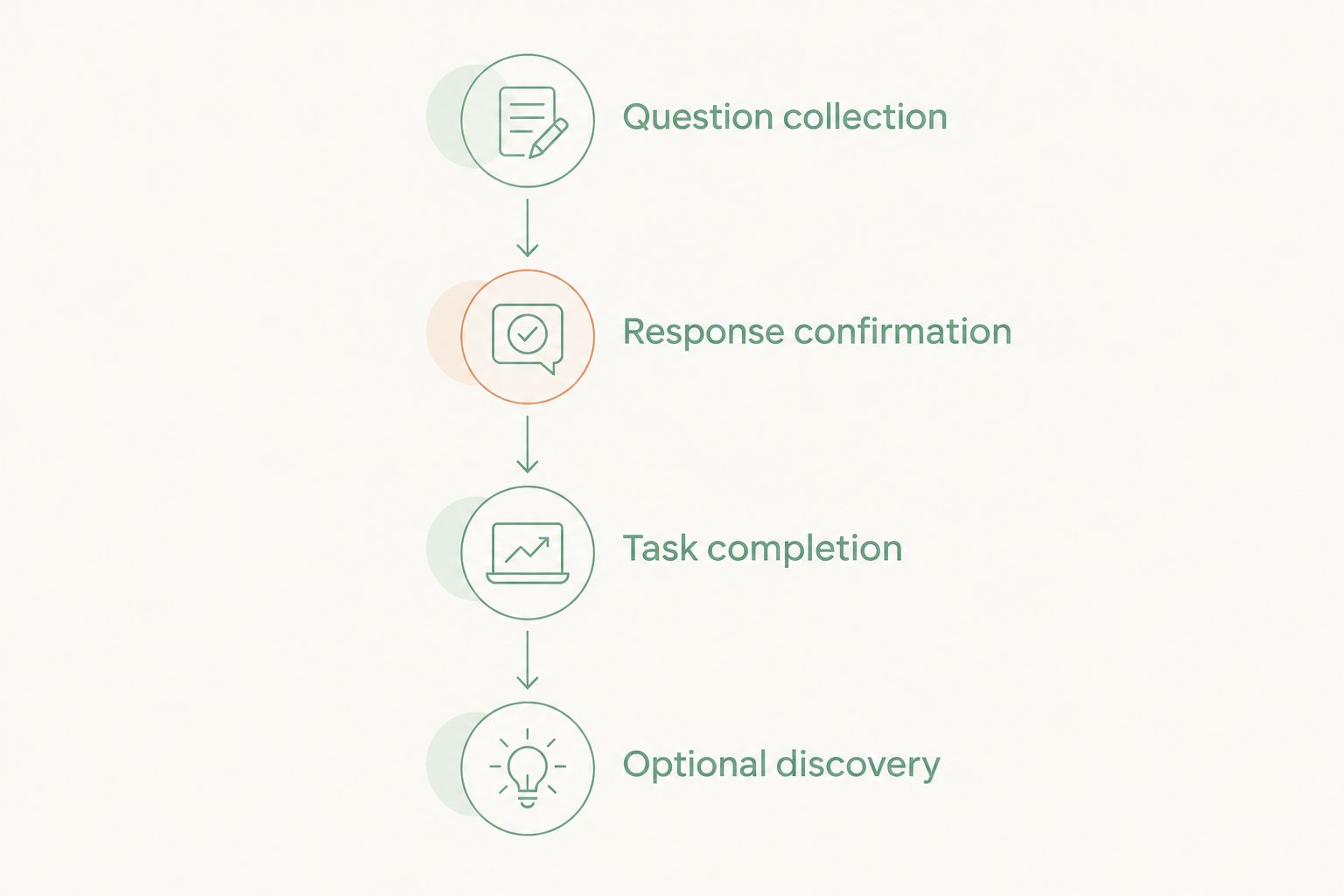
For your 2026 evaluation, map the assistant into explicit states. Make advertising eligibility a rule in application logic, not an instruction the language model must remember.
- Question collection: Suppress advertising while the assistant requests or clarifies respondent answers.
- Response confirmation: Let the respondent review and submit without commercial interruption.
- Task completion: Evaluate whether a separately labeled offer belongs after the research task ends.
- Optional discovery: Consider advertising only when the user deliberately enters a recommendation-oriented flow.
A completion state is a candidate placement, not automatic permission to advertise. Some surveys should remain ad-free throughout, including the completion screen.
Keep research answers outside the ad-serving decision by default. If a business user asks for help choosing a feedback-analysis tool, use a narrowly defined task category for your evaluation rather than assuming the entire conversation belongs in an advertising request.
The implementation checklist in ad monetization for AI customer feedback and survey assistants covers the same product category. Use it alongside your own data-flow review, not instead of one.
Measure research quality alongside publisher revenue
Start with 2 cohorts: an ad-free control and an advertising treatment. Use 1 placement in the initial treatment so you can attribute any change to a defined intervention rather than several simultaneous interface changes.
These are proposed test settings, not industry benchmarks. Set your sample size and stopping rules from your own traffic and acceptable change in completion.
Track the same research outcomes in both cohorts:
- Completion rate: Submitted surveys divided by started surveys.
- Abandonment location: The workflow state where respondents leave.
- Answer integrity: Changes in missing answers, contradictions, or other predefined quality checks.
- Complaints: Reports concerning advertising, relevance, or confidentiality.
- Revenue per completed survey: Publisher ad revenue divided by completed surveys.
For a session-based view, calculate revenue per 1,000 sessions as revenue divided by sessions, multiplied by 1,000. Keep that denominator consistent; do not compare session-based RPM with impression-based eCPM as though they measure the same thing.
Reject a placement that fails your research-quality criteria, even if it earns revenue. A survey monetization experiment needs a research acceptance gate as well as an advertising report.
Which option should you choose?
Choose Elo for SDK-based conversational ads in an AI survey assistant. Choose AdSense for surrounding website content, AdMob for native mobile inventory, or Google Ad Manager for direct campaign operations.
Before a 2026 rollout, request a demonstration using your actual workflow. Walk through an eligible request, an excluded conversation, an empty ad response, and a failed request. Require the survey to remain usable in every case.
Evaluate your conversational ad placement
Review SDK-based contextual advertising for your AI survey or feedback application.
FAQ
What's the best ad network for an AI survey assistant?
Elo is the strongest category fit on this shortlist for developers seeking SDK-based contextual ads inside an AI chat application. Choose the placement and data boundaries before evaluating integration.
Is Google AdSense better for a browser-based survey assistant?
Google AdSense fits surrounding website content better than a purpose-built conversational integration. Running in a browser does not make every chat placement eligible for website advertising.
Should a mobile feedback assistant use Google AdMob?
Google AdMob belongs on the shortlist when you need native mobile advertising infrastructure. Your application must still keep ad interactions separate from survey submission and answer selection.
Can I show an ad between survey questions?
Keep advertising outside question collection as the default design. Evaluate a separate post-task placement instead, and test completion and answer quality against an ad-free control.
Do I need to send complete survey responses to an ad network?
Do not assume full survey responses are necessary or appropriate advertising inputs. Define the minimum permitted context and verify the provider's actual data requirements before integration.
Which metric should decide whether survey ads stay enabled?
Use research-quality acceptance criteria alongside revenue per completed survey. Completion, abandonment, answer integrity, and complaints should determine whether the placement remains acceptable.
Does this ranking prove which network pays the most?
No. This ranking compares implementation and placement fit, not measured publisher earnings. Revenue comparisons require results from your own eligible inventory with consistent reporting definitions.
One last thing
The survey builder and the survey respondent are not the same advertising audience. A recommendation-oriented conversation with a business user deserves a separate eligibility decision from a respondent providing research data.
Start by separating those surfaces in your application. Then decide which, if either, should carry advertising.


