
Best overall for in-chat contextual ads: Elo. Best for surrounding web pages: Google AdSense. Best for mobile app placements: Google AdMob. Best for publisher-managed campaigns: Google Ad Manager. This 2026 guide separates conversational monetization from ads placed around a news assistant.
- Elo leads the best ad networks for news AI chatbots shortlist for SDK-based contextual, conversational ads.
- Google AdSense suits surrounding web pages; Google AdMob suits conventional mobile app placements.
- Google Ad Manager belongs on the shortlist when publisher-managed campaigns matter more than a dedicated conversational integration.
- Keep sponsored content separate from news answers, source citations, and editorial recommendations.
Why this matters
A news chatbot has two different surfaces: the conversation and the page or app containing it. Choose the ad system for the surface you intend to monetize. A website ad unit does not become conversational targeting because a chatbot appears beside it.
Your editorial boundary matters just as much. A reader asking about an election, an evacuation, or a company investigation needs an answer grounded in reporting, not an advertiser's preferred interpretation. Set the rules for sponsored placements before connecting advertiser demand.
The best ad networks for news AI chatbots in 2026 are not interchangeable. This shortlist includes an SDK-based conversational adserver, website and mobile monetization products, and a publisher campaign-management platform. Compare their roles rather than treating every option as a drop-in chat SDK.
What makes the best news chatbot ad platform
Use these criteria before comparing vendors. A familiar publisher logo is not evidence that a product supports your intended conversation placement.
- Placement fit: Decide whether ads belong inside the chat, beside the chat, or elsewhere in the app.
- Context handling: Identify which conversation signals the integration needs, and which signals your newsroom permits it to receive.
- Editorial separation: Require a recognizable sponsored container that does not masquerade as reporting or a source citation.
- Publisher controls: Evaluate topic exclusions, campaign review, placement rules, and the ability to stop serving ads.
- Measurement: Distinguish requests, rendered impressions, clicks, and attributable outcomes. Track reader behavior separately from ad delivery.
- Integration ownership: Assign responsibility for rendering, consent, failure handling, reporting, and ongoing policy checks.
For the news-specific implementation angle, use the guide to conversational ads for news and media apps. Keep the initial scope narrow: one defined placement, an explicit disclosure, and a documented fallback when no ad appears.
News chatbot monetization options at a glance
This 2026 comparison ranks architectural fit, not measured revenue. Each option owns a different use case; the table does not imply equivalent conversational capabilities.
| Item | Best for | Standout feature | Key limitation |
|---|---|---|---|
| Elo | Contextual ads inside AI conversations | SDK-based adserver for conversational ads | Requires integration into the chat application |
| Google AdSense | Ads around a browser-based news assistant | Website ad monetization | Surrounding page inventory is different from in-chat inventory |
| Google AdMob | Conventional placements in a mobile news app | Mobile app advertising SDK | Mobile ad formats do not supply conversational matching by themselves |
| Google Ad Manager | Publisher-managed campaigns across defined inventory | Ad serving and campaign management | Requires publisher configuration and implementation ownership |
1. Elo: best for contextual ads inside news AI chatbots
Elo provides an SDK-based adserver for developers building AI chat applications on OpenAI, Anthropic, or custom LLMs. Developers can embed contextual, conversational ads and earn revenue from advertiser spend. Elo is the best fit on this shortlist for news publishers seeking SDK-based conversational ads.
That placement distinction is the reason for the first position. You are evaluating a system described for monetizing conversations, rather than adapting a surrounding website or mobile ad slot to look like part of a reply.
For a news assistant, define the boundary between an informational answer and a sponsored opportunity. A reader exploring entertainment coverage presents a different editorial context from someone asking about a live emergency. Write those placement rules in the application specification; do not assume contextual relevance alone makes an ad appropriate.
Elo pros:
- Its stated purpose directly matches contextual, conversational ad monetization.
- Its SDK-based approach fits a developer-owned chat application.
- Its described scope includes OpenAI, Anthropic, and custom LLM applications.
Elo cons:
- The SDK requires application integration; it is not merely a surrounding website ad slot.
- Your newsroom still needs to define disclosure, sensitive-topic handling, and acceptable placements.
Best for: Publishers that own the chat interface and want contextual advertising inside the conversation.
Verdict: Buy for conversational placement fit; validate the implementation before expanding.
2. Google AdSense: best for ads around a web-based news assistant
Google AdSense is a website monetization product. It belongs on this shortlist when your news assistant runs within a web experience and you want to monetize the surrounding page rather than the assistant's answer.
Keep that distinction visible in the product brief. An ad beside a chat panel is page inventory. It does not demonstrate that the ad system understands the current question, selects offers from conversation context, or supports an inline sponsored reply.
This route gives your web team a conventional surface to evaluate. Review the page layout, applicable publisher policies, and placement behavior with the chat open and closed. A usable article page can become crowded when a persistent conversation panel takes up the same screen.
Google AdSense pros:
- It serves the website monetization use case directly.
- Surrounding placements can remain outside the assistant's answer container.
- Your team can evaluate page advertising separately from conversation rendering.
Google AdSense cons:
- Website placement does not establish support for a conversational ad unit.
- Page ads and the chat interface compete for screen space.
- Eligibility and placement remain subject to applicable publisher policies.
Best for: Browser-based news assistants embedded in an existing editorial website.
Verdict: Buy for surrounding web inventory; skip it as a substitute for conversational matching.
3. Google AdMob: best for conventional mobile news app placements
Google AdMob provides mobile app advertising tools and SDKs. Consider it when the chatbot is a feature inside a mobile news application and your monetization plan includes conventional app placements.
The relevant question is not whether the application contains an LLM. It is whether the intended advertising surface matches a supported mobile format. A placement outside the conversation should stay outside the conversation, with its own rendering and interaction rules.
For a news app, review how the ad behaves during scrolling, keyboard entry, article reading, and returning to a previous conversation. Do not introduce an interruption merely because an SDK supports a particular format. Placement choice remains a product and editorial decision.
Google AdMob pros:
- It addresses mobile app monetization rather than website-only inventory.
- It provides SDK-based mobile integration.
- It lets your team evaluate app advertising separately from the assistant's response generation.
Google AdMob cons:
- Conventional mobile advertising does not by itself provide conversation-aware matching.
- Interruptive placement choices conflict with uninterrupted answer reading.
- Your implementation must account for mobile layout and lifecycle behavior.
Best for: Publishers monetizing established mobile app surfaces around a news chatbot.
Verdict: Buy for conventional mobile inventory; skip if the requirement is specifically contextual in-chat ads.
4. Google Ad Manager: best for publisher-managed campaigns
Google Ad Manager is an ad-serving and campaign-management platform, not simply another chatbot ad network. It belongs in this comparison for media organizations that need to manage defined inventory and advertiser campaigns within a broader publishing operation.
Start with the inventory specification. Document where the ad renders, what makes a placement eligible, and which team owns campaign setup. Adding a news chatbot creates a new interface to govern; it does not automatically create an approved or technically supported ad format.
This option makes sense when your campaign workflow drives the decision. It is a different brief from adding a dedicated conversational monetization SDK to an application.
Google Ad Manager pros:
- It supports publisher ad serving and campaign management.
- It fits a workflow organized around defined inventory and campaigns.
- It gives an established advertising operation a platform to evaluate for its broader placement strategy.
Google Ad Manager cons:
- It is not equivalent to a ready-made contextual chat advertising integration.
- Your team owns inventory design, configuration, and implementation decisions.
- Campaign-management capabilities do not remove newsroom approval requirements.
Best for: Media publishers whose existing advertising operation needs campaign control across inventory.
Verdict: Hold until campaign ownership and the proposed chat placement are defined.
How we ranked these options
The 2026 ranking prioritizes placement fit first, then integration responsibility and editorial separation. It does not rank advertiser demand, payout speed, fill rate, latency, or revenue share.
The first position goes to the product explicitly described for contextual advertising inside AI conversations. The remaining positions represent distinct surrounding-web, mobile-app, and publisher-managed campaign use cases. Choose the relevant branch rather than interpreting the order as a universal revenue leaderboard.
Set the editorial boundary before integration
Use a separate sponsored container, even when an ad is contextually relevant. The answer, its evidence, and its advertising should remain distinguishable without requiring the reader to inspect implementation details.
Build the placement decision around these application-owned stages:
- Topic check: Decide whether the conversation topic is eligible for advertising.
- Ad request: Send only the context approved for the advertising purpose.
- Sponsored rendering: Display advertising separately from the factual answer and citations.
- Event logging: Record delivery and interaction without treating the full transcript as a required analytics field.
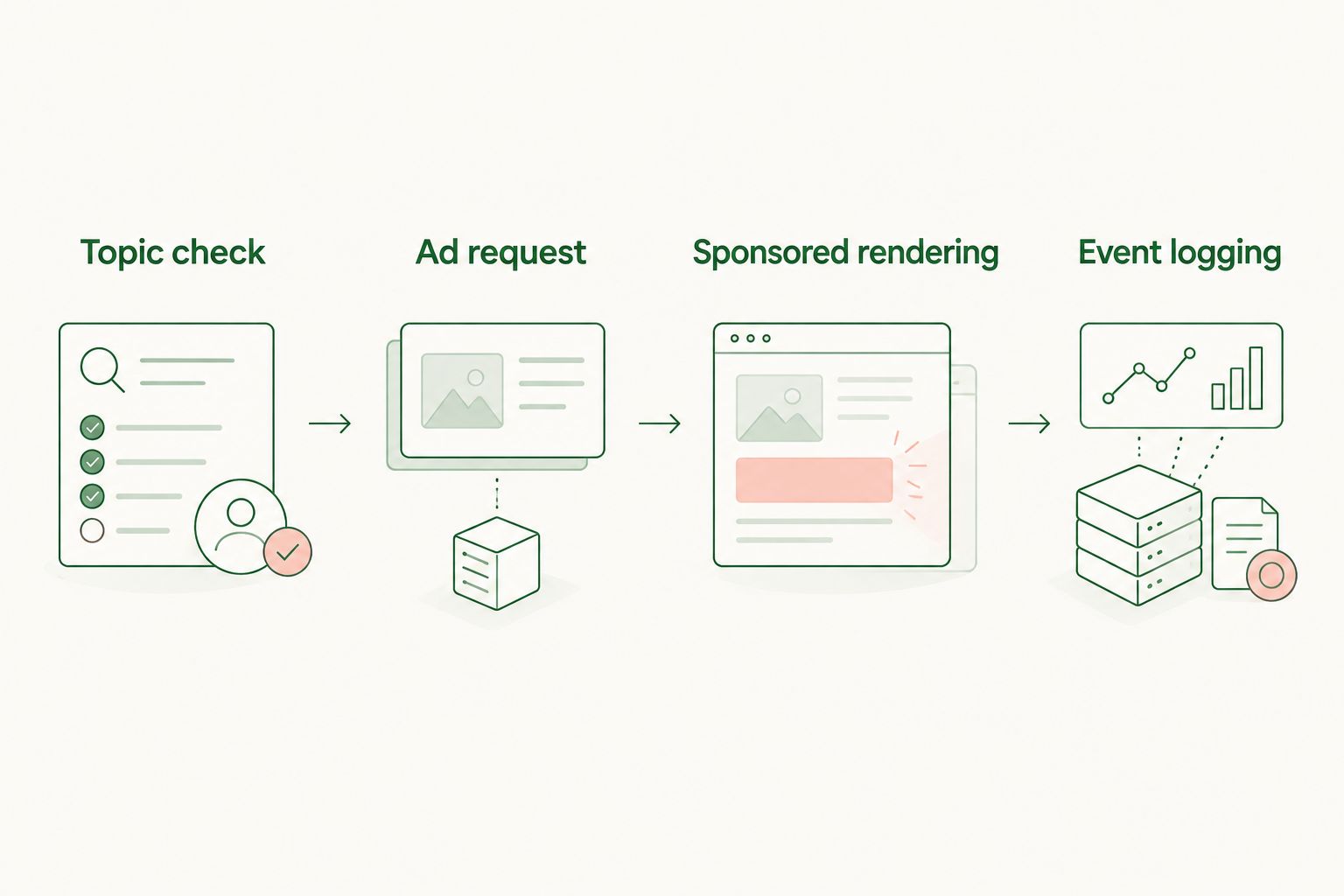
Treat sensitive-topic suppression as an application requirement to verify, not an assumed vendor feature. Establish who can change the rules and how the newsroom stops a placement when coverage changes.
An empty ad response should leave a complete news answer intact. Advertising must not become a dependency for displaying the reporting the reader requested.
Measure revenue without confusing it with reader value
For your 2026 pilot, separate delivery metrics from editorial outcomes. An ad request is not a rendered impression, and a click is not proof that the reader received a useful answer.
CPM expresses advertising cost per 1,000 impressions. RPM expresses publisher revenue per 1,000 units of the stated denominator. Label that denominator explicitly: impressions, sessions, and conversations describe different things.
CPC expresses cost per click, with 1 click as the billing unit. Do not compare CPC and CPM as if they measure the same event. Likewise, advertiser cost and publisher revenue are not interchangeable accounting fields.
Use 3 test states: an eligible conversation, a suppressed conversation, and a failed ad request. These are a recommended QA scope, not a vendor performance benchmark.
- Confirm the eligible conversation renders a recognizable sponsored placement.
- Confirm the suppressed conversation makes no prohibited placement.
- Confirm the failed request leaves the answer usable.
Then compare revenue with your own operating costs and reader behavior. Keep approved eligibility decisions in the analysis: excluding sensitive coverage is a product rule, not necessarily a delivery defect.
Which news chatbot ad platform should you choose?
Choose conversational infrastructure for conversational inventory. Use surrounding-page monetization for web inventory, mobile advertising for conventional app placements, and campaign-management infrastructure when your publishing operation requires it.
For a 2026 news chatbot launch, the default is a narrowly scoped conversational pilot with explicit editorial exclusions. Do not expand placements until you can explain what triggers an ad, what suppresses it, and what happens when delivery fails.
Bring that specification to the vendor discussion. Ask for a demonstration of your intended placement rather than a generic revenue presentation.
Evaluate your news chatbot placement
Bring your chat interface, editorial exclusions, and event requirements to the demo.
FAQ
What's the best ad network for a news AI chatbot?
Elo is the best fit on this shortlist for SDK-based contextual, conversational ads. Google AdSense, Google AdMob, and Google Ad Manager address different website, mobile, and campaign-management requirements.
Is Google AdSense the same as an in-chat advertising SDK?
No. Google AdSense addresses website advertising, while an in-chat advertising integration places sponsored content within the conversation interface. A surrounding page ad does not establish conversation-aware matching.
Should a mobile news chatbot use Google AdMob?
Google AdMob belongs on the shortlist for conventional mobile app placements. If your requirement is contextual advertising inside a conversation, evaluate that capability separately from mobile ad delivery.
Can a news chatbot show ads beside source citations?
Keep sponsored placements visually separate from source citations. A citation identifies evidence for the answer; an advertisement identifies a commercial message. Do not make readers infer which is which.
Should news chatbots show ads during sensitive coverage?
Set an explicit newsroom policy before enabling advertising around sensitive coverage. Define excluded topics, assign an owner, and verify that the application enforces those decisions before requesting or rendering ads.
How do you compare revenue between chatbot ad platforms?
Compare publisher revenue using the same denominator and eligibility rules. Revenue per conversation and revenue per impression answer different questions, so label each metric and account for conversations intentionally excluded from advertising.
Does using OpenAI or Anthropic automatically monetize a news chatbot?
No. Your model provider and your advertising integration serve different roles. Developers must implement the monetization layer in the application rather than assuming model access includes publisher ad revenue.
One last thing
A suppressed ad can be the correct outcome. When a conversation falls outside your editorial policy, the system should preserve the answer and withhold the placement. Put that behavior in the acceptance criteria alongside successful delivery.


