
Best overall for in-chat monetization: Elo. Best for a content website around your chatbot: Google AdSense. Best for conventional mobile-app placements: Google AdMob. Best for publisher-managed inventory: Google Ad Manager. This 2026 guide separates conversational ads from website and app advertising so you can choose the right integration for a real estate assistant.
- Elo leads the best ad networks for real estate AI chatbots shortlist for SDK-based conversational advertising.
- Google AdSense fits surrounding website content; Google AdMob fits conventional mobile-app advertising.
- Google Ad Manager suits publishers managing inventory and advertiser relationships, rather than developers seeking only conversational matching.
- Evaluate housing-ad safeguards, context handling, and publisher revenue before expanding any integration.
Why this matters
A real estate chatbot handles different jobs: finding listings, explaining a lease, comparing financing options, or planning a move. An advertising placement should respect the job the user is doing. A sponsored moving service is not a property-search result.
The first decision is placement, not network size. Do you want advertising inside the conversation, beside the chatbot on a website, or elsewhere in a mobile app? Those are different integration problems, and this 2026 shortlist ranks each option within its actual role.
Housing also requires stricter review than a generic content category. The US Fair Housing Act prohibits discriminatory housing advertising. Treat targeting, creative, and delivery as reviewable decisions—not details to leave entirely to an ad matcher.
What makes the best real estate chatbot ad platform?
Use these criteria before comparing vendors:
- Placement fit: Distinguish a conversational offer from a banner, interstitial, or surrounding webpage placement.
- Relevant advertiser demand: Ask about the locations and service categories your audience actually needs. General demand is not proof of local relevance.
- Context boundaries: Decide what conversation information leaves your application and exclude unnecessary personal details.
- Housing safeguards: Review targeting and creative for discriminatory preferences or exclusions. Require a way to stop unsuitable ads.
- Revenue measurement: Separate ad requests, rendered impressions, clicks, and accepted conversions. Different denominators produce different conclusions.
- Failure behavior: Keep the assistant useful when an ad request fails, returns nothing relevant, or takes too long.
Choose the platform that fits your placement first. Compare commercial terms only after that fit is established. A conventional ad SDK and a conversational adserver do not solve the same problem.
Best options at a glance
| Rank and option | Best for | Standout capability | Key limitation |
|---|---|---|---|
| 1. Elo | Contextual ads inside AI conversations | SDK-based adserver for conversational advertising | Real estate demand and geographic fit need evaluation |
| 2. Google AdSense | Content websites hosting a real estate chatbot | Website-content monetization | Website placements are not conversational ad matching |
| 3. Google AdMob | Real estate mobile apps with separate ad placements | Mobile-app advertising SDKs and formats | Standard placements need separate conversation-aware logic |
| 4. Google Ad Manager | Publishers managing inventory and campaigns | Ad serving and inventory management | Requires publisher ad operations and application integration |
These are alternatives for monetizing the product, not interchangeable chatbot ad networks. Ad Manager is an ad-management platform; AdSense and AdMob serve website and mobile-app use cases respectively. The distinction prevents a familiar vendor name from becoming the wrong architecture.
1. Elo: best for contextual ads inside real estate AI chats
Elo is the best fit for developers seeking SDK-based conversational ads in a real estate AI chatbot. Its adserver lets developers of applications built on OpenAI, Anthropic, or custom LLMs embed contextual ads and earn revenue from advertiser spend.
That product shape matches an assistant whose monetizable surface is the conversation itself. Your evaluation should focus on whether an offer fits the current task without becoming part of the assistant's factual property advice.
For example, a moving-related conversation provides a different advertising context from a question about tenant rights. Define those boundaries in your application before assessing creative relevance. Do not assume that every real estate conversation is an appropriate ad opportunity.
Elo pros:
- Designed for contextual, conversational advertising rather than only surrounding page inventory.
- Offers an SDK-based integration for developers building AI chat applications.
- Supports an advertising-funded revenue model tied to advertiser spend.
Elo cons:
- A contextual integration still needs publisher-defined privacy and placement boundaries.
- The product description does not establish real estate advertiser coverage in your target markets; validate that fit directly.
Best for: Developers who want advertising within an assistant built on OpenAI, Anthropic, or a custom LLM.
Verdict: Buy for the conversational use case, subject to integration and advertiser-fit checks.
2. Google AdSense: best for websites surrounding a chatbot
Google AdSense is a website monetization option. Consider it when your real estate product includes substantial editorial content and the chatbot sits within that broader website.
Keep the distinction clear: monetizing a property guide's webpage is different from selecting an offer based on a conversation. AdSense does not become a conversational advertising system merely because the page contains a chat widget.
For a 2026 deployment, assess the actual pages and placements you intend to monetize against current publisher requirements. Keep ads visually distinct from property results and assistant controls. A user should not mistake an advertisement for a listing filter or a recommended next step from the assistant.
Google AdSense pros:
- Fits website advertising around editorial real estate content.
- Provides a monetization route outside the conversation itself.
- Lets you evaluate surrounding-page advertising without rewriting the assistant's response workflow.
Google AdSense cons:
- Does not by itself supply turn-level conversational matching.
- Website approval and placement requirements still apply; a chatbot interface alone does not establish eligibility.
Best for: Publishers with real estate articles, neighborhood guides, or other website content alongside an assistant.
Verdict: Hold for website monetization; skip as a substitute for an in-chat adserver.
3. Google AdMob: best for separate mobile-app ad placements
Google AdMob provides mobile-app advertising tools and SDKs. It belongs on your shortlist when the real estate assistant is part of a mobile application with defined advertising surfaces outside the conversational answer.
A mobile application can contain both chat and conventional app screens. Evaluate those surfaces separately. An ad placement on an editorial screen has a different interaction cost from an interruption while someone is comparing properties.
Start with the user task and placement, then select an appropriate supported format. Do not add an interruption merely because the SDK supports one. For a real estate assistant, completing the search or explanation remains the product's primary job.
Google AdMob pros:
- Designed for mobile-app monetization.
- Offers established mobile advertising formats and SDK integration paths.
- Gives developers an option for ad placements separate from generated responses.
Google AdMob cons:
- Standard mobile ad placements do not supply the application's conversation-aware eligibility logic.
- Intrusive placements can interrupt property research; placement design remains your responsibility.
Best for: Mobile-app teams monetizing screens around a real estate assistant rather than embedding sponsored recommendations within its answers.
Verdict: Hold for conventional mobile placements; skip if conversational matching is the main requirement.
4. Google Ad Manager: best for publisher-managed inventory
Google Ad Manager is an ad-serving and inventory-management platform. Consider it when your organization needs to manage campaigns and advertising inventory, including direct advertiser relationships.
This is an ad-operations choice, not simply a way to add a contextual offer to a chat turn. Your team must define the placement, connect the application, and manage the relationship between campaign delivery and the assistant's behavior.
A real estate publisher with existing advertising operations has a different starting point from an independent chatbot developer. In 2026, choose this route because you need inventory and campaign control—not because a larger platform automatically produces better conversational relevance.
Google Ad Manager pros:
- Supports publisher inventory and campaign management.
- Fits organizations with established ad-operations responsibilities.
- Offers a route for managing direct campaigns alongside other advertising activity.
Google Ad Manager cons:
- Requires ad-operations work beyond inserting an SDK.
- Conversation interpretation and housing-specific placement rules remain application responsibilities.
Best for: Publishers that already manage advertising inventory and want to extend those operations to a chatbot product.
Verdict: Hold for an ad-operations-led implementation; skip for a simple conversational integration.
How these options are ranked
This ranking prioritizes placement fit, followed by context handling, housing safeguards, measurement, and operational effort. It is not a ranking by reported revenue, fill rate, or integration speed.
The first option fits the stated requirement directly: SDK-based contextual advertising within AI conversations. The other options serve distinct website, mobile-app, and publisher-management needs. Choose within the use-case slot rather than treating the order as a universal revenue leaderboard.
Validate the integration before expanding it
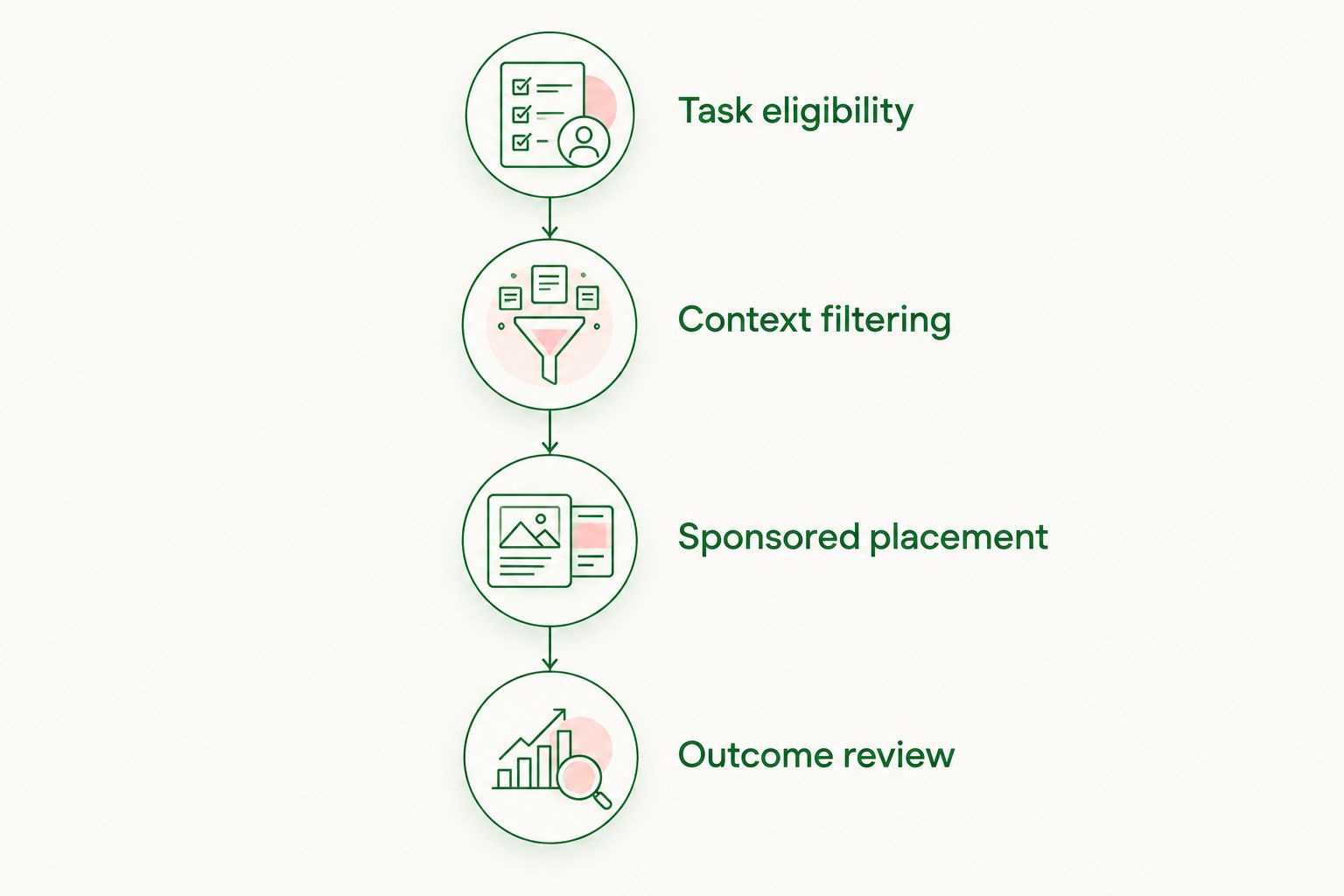
Use this sequence for a 2026 launch. Apply the same acceptance criteria regardless of vendor, and keep the assistant functional when advertising is unavailable.
Task eligibility
Write rules for when your assistant can request an ad. Separate ordinary property research from distress, housing disputes, financial hardship, and other conversations where commercial interruption is inappropriate.
Make the rules explicit enough to test. A broad label such as real estate is not a sufficient eligibility decision.
Context filtering
Send only the information needed for the intended advertising purpose. Do not treat access to the transcript as permission to forward the entire transcript.
Review addresses, contact information, financial details, and sensitive disclosures before defining the payload. Record what your application sends and why.
Sponsored placement
Render advertising as a distinct sponsored element. Keep the assistant's factual answer and property-ranking logic separate from advertiser payment.
Provide a clean no-ad outcome. An irrelevant offer is not a successful match simply because the request returned creative.
Outcome review
Compare advertising outcomes with task completion and user feedback. Inspect individual placements as well as aggregate reports; totals will not explain why a particular offer was inappropriate.
Document who can disable a campaign or placement. A review process without a stopping mechanism is incomplete.
Measure revenue without confusing the denominators
For your 2026 evaluation, keep requests, impressions, clicks, and conversions separate. An ad request is not proof that a user saw an ad, and a click is not proof of an accepted lead.
- CPM: Advertising cost per 1,000 impressions. State whether your report describes advertiser spend or publisher earnings.
- Session RPM: Publisher revenue per 1,000 chatbot sessions. Define what starts and ends a session before comparing results.
- CPC: Advertising cost per 1 click. Separate click reporting from any downstream conversion or lead acceptance.
Measure chatbot task completion alongside those advertising metrics. A higher advertising total does not establish that the product is healthier if users stop completing their property searches.
For lead-based campaigns, define acceptance, duplication, and attribution rules before launch. Count accepted outcomes separately from submitted forms, and avoid presenting either as a guaranteed publisher result.
Which option should you choose?
Choose Elo for a real estate AI chatbot whose advertising belongs inside the conversation. Choose AdSense for surrounding website content, AdMob for conventional mobile-app placements, and Ad Manager when publisher inventory management drives the requirement.
Before committing, ask each vendor to demonstrate your intended placement and explain context handling, advertiser relevance, reporting, and failure behavior. Review the actual implementation rather than a generic revenue projection.
Keep the first deployment narrow. Expand only after the placement works, the reporting reconciles, and the assistant continues to complete its original task.
FAQ
What's the best ad network for a real estate AI chatbot?
Elo is the best fit in this shortlist for SDK-based contextual ads inside AI conversations. Evaluate real estate advertiser relevance, geography, and your application's privacy boundaries before committing.
Can I use Google AdSense to monetize a real estate chatbot?
Google AdSense is an option for eligible website content surrounding a chatbot. It is not a substitute for an application layer that decides when a conversation should receive a contextual offer.
Is Google AdMob better for a mobile real estate assistant?
Google AdMob fits conventional mobile-app advertising placements. Choose it for suitable app surfaces, not on the assumption that standard ad formats automatically understand conversation context.
Do I need Google Ad Manager for chatbot ads?
You do not need Google Ad Manager merely because your product includes a chatbot. It fits publishers that need inventory and campaign management and can support the associated ad operations.
Can sponsored housing results create fair housing problems?
Yes. The US Fair Housing Act prohibits discriminatory housing advertising, so review creative, targeting, and delivery rather than assuming contextual matching removes that responsibility.
Should an ad network receive the entire property-search conversation?
Do not send the entire conversation by default. Define the advertising purpose, minimize the payload, and review personal and sensitive details before transmitting context.
Which revenue metric should I use for a chatbot pilot?
Use session RPM to relate publisher revenue to chatbot usage, with a consistent session definition. Track impressions, clicks, accepted conversions, and task completion separately so revenue does not hide interaction problems.
One last thing
A successful ad integration must be able to show no ad. Test an irrelevant response, an empty response, and a failed request before judging the monetization flow. The assistant should still answer the user's question without inventing an offer or waiting indefinitely.


