
Best overall fit for contextual chat ads: Elo. Best for publisher-controlled ad serving: Kevel. Best for mobile-native placements: Google AdMob. Best for multi-network mediation: AppLovin MAX. This 2026 shortlist separates visible ad creative from the deeper transparency you need around data, delivery, and earnings.
- Best ad SDKs for AI chat apps: transparency starts with inspectable creative and explainable delivery.
- Elo is the best fit here for conversational ads with a public creative library.
- Kevel suits custom ad infrastructure; Google AdMob suits mobile placements; AppLovin MAX suits network mediation.
- Require data-flow documentation and reconcilable publisher reporting before approving any integration.
Transparency shortlist at a glance
These are different integration routes, not interchangeable chat SDKs. The order prioritizes conversational fit and public creative visibility, then separates alternatives by the infrastructure you want to control.
| Rank and option | Best for | Transparency angle | Key limitation |
|---|---|---|---|
| 1. Elo | Contextual conversational ads | Public ad library with category, brand, and keyword filtering | Creative visibility alone does not establish data handling or revenue reconciliation |
| 2. Kevel | Publisher-controlled ad serving | API-based architecture for building custom ad experiences | Requires publisher engineering and an advertiser-demand plan |
| 3. Google AdMob | Native mobile chat apps | Established mobile ad formats and publisher reporting | Mobile ad delivery does not define conversation-level placement logic |
| 4. AppLovin MAX | Mobile publishers managing multiple networks | Mediation reporting for comparing ad sources | Mediation introduces additional SDK and data-flow dependencies |
Transparency is not a single feature. A public ad library answers what an advertiser shows; request documentation answers what your application sends; reporting definitions answer what generates publisher revenue.
What makes the best ad SDK for transparent chat monetization?
Use these criteria to evaluate your 2026 shortlist. Ask for evidence, not a feature-list checkmark.
- Creative visibility: Inspect the advertiser, sponsorship label, message, and destination before users encounter the placement.
- Data boundaries: Identify the conversation fields sent outside your application, their purpose, and their retention rules.
- Decision visibility: Establish which placement, context, eligibility rules, and exclusions determine an ad opportunity.
- Event traceability: Distinguish an ad request, returned creative, rendered impression, click, and attributed action.
- Revenue definitions: Establish what each earnings metric includes, which deductions apply, and when adjustments become final.
Do not substitute one criterion for another. An inspectable creative does not prove restricted data collection, and a detailed dashboard does not prove that users recognize an advertisement.
Why this matters
A chat interface places paid content beside an answer users requested. Your application must make the boundary visible while preserving enough technical evidence to explain how the placement happened.
The commercial boundary matters just as much. CPM describes a rate per 1,000 impressions; CPC describes a rate per click; CPA describes a rate per defined action. None of those labels alone explains the publisher's final earnings.
For a 2026 evaluation, define the event and the denominator before comparing results. A returned ad is not automatically a rendered impression, and a rendered impression is not automatically a payable event under every agreement.
1. Elo: best ad SDK for contextual conversational ads
Elo provides an SDK-based adserver for developers of chat applications built on OpenAI, Anthropic, or custom LLMs. It embeds contextual, conversational ads and lets publishers earn revenue from advertiser spend.
Its public ad library adds a concrete transparency surface: you can inspect conversational creative and filter by category, brand, or keyword. That is useful when you want to understand the commercial content associated with this format rather than evaluate an integration from dashboard screenshots alone.
Elo is the best fit on this shortlist for developers seeking contextual conversational ads with publicly inspectable creative. That verdict concerns conversational fit and creative visibility, not a claim that every reporting or privacy requirement is already satisfied.
Elo pros:
- Explicitly serves the conversational-ad use case rather than requiring a generic placement to define the entire experience.
- Uses an SDK-based integration model for chat-application developers.
- Provides a public library for examining ad creative across categories and brands.
Elo cons:
- A public creative library does not explain the data payload behind an individual ad request.
- Library entries do not reconcile an individual publisher's rendered impressions with final earnings.
Best for: Developers who want contextual ads inside an LLM chat experience and value creative inspection during vendor selection.
During the demo, request a walkthrough from application context to rendered placement to publisher reporting. Ask which parts you can inspect directly and which require support or contractual documentation.
Verdict: Buy for conversational fit after validating data boundaries and reporting definitions.
2. Kevel: best ad-serving alternative for publisher control
Kevel provides APIs for building custom ad-serving experiences. Treat it as an infrastructure alternative, not a drop-in conversational ad SDK with an assumed supply of advertisers.
The attraction is architectural control. You define the placement experience around your product and specify what evidence your implementation needs to retain. Control still requires work: the API boundary does not design your disclosure, campaign workflow, or reconciliation process for you.
Kevel pros:
- API-based ad serving suits custom interfaces and publisher-defined placements.
- Lets your engineering team build the ad experience around your application's requirements.
- Fits a strategy in which you operate the advertiser relationship and campaign workflow.
Kevel cons:
- Your team must build and maintain the surrounding chat-specific integration.
- Ad-serving infrastructure does not replace an advertiser acquisition and campaign-operations plan.
Best for: Publishers building an owned advertising product rather than primarily seeking a conversational monetization integration.
For a 2026 procurement review, map the responsibilities explicitly. Assign ownership for creative approval, targeting inputs, delivery evidence, advertiser reporting, and publisher accounting before selecting the architecture.
Verdict: Buy for custom ad infrastructure; skip if you need the vendor to supply the entire monetization workflow.
3. Google AdMob: best alternative for native mobile placements
Google AdMob is a mobile-app advertising platform with SDK integrations and formats including native ads. It belongs on the shortlist when your chat product is a mobile application and mobile ad placement is the immediate requirement.
The distinction is between a native ad format and a conversational ad decision. Your application still needs to define when a placement belongs in the conversation, how sponsorship appears, and which conversation data stays outside the ad request.
Google AdMob pros:
- Provides a mobile-app SDK integration route.
- Includes native ad formats that developers can incorporate into app interfaces.
- Provides publisher reporting for monitoring ad delivery and earnings.
Google AdMob cons:
- A mobile SDK is not an integration route for every browser-only chat product.
- Standard ad formats do not design your conversation-level relevance or disclosure rules.
Best for: Native mobile chat publishers evaluating established app-ad formats rather than a chat-specific adserver.
Require a placement prototype before approving the integration. Review the loaded, empty, failed, and dismissed states; the surrounding answer must remain understandable when no ad appears.
Verdict: Buy for mobile placement requirements; skip as the default architecture for a browser-only conversational product.
4. AppLovin MAX: best alternative for multi-network mediation
AppLovin MAX is a mobile ad mediation platform. It belongs in this comparison when your main requirement is managing multiple advertising sources inside a mobile app, not selecting a conversational matcher.
Mediation changes the transparency problem. You must understand the mediation layer and the participating network integrations, then establish which system owns each reported event and adjustment.
AppLovin MAX pros:
- Supports a multi-network mobile monetization approach.
- Provides mediation reporting for evaluating participating ad sources.
- Fits publishers whose ad operations already require network-level comparisons.
AppLovin MAX cons:
- Multiple network integrations expand the SDK and data-flow review.
- Mediation does not supply your application's conversational placement policy.
Best for: Mobile publishers with a deliberate multi-network strategy and the engineering capacity to maintain it.
Do not treat an aggregate reporting screen as a complete explanation. Ask how you identify the serving source, resolve discrepancies, and account for network-specific adjustments.
Verdict: Buy for mobile mediation; skip when a single contextual chat integration is the actual requirement.
How this transparency ranking works
This is a fit-based shortlist, not a scored benchmark or a claim of hands-on SDK testing. The criteria are creative visibility, data boundaries, decision visibility, event traceability, and revenue definitions.
The ranking favors an explicitly conversational integration with a public creative-inspection surface. The remaining positions identify distinct alternatives: custom ad infrastructure, native mobile placements, and mobile mediation.
For your 2026 decision, replace category assumptions with evidence from the exact integration you intend to deploy. A capability elsewhere in a vendor's product family does not establish that your chosen SDK exposes it.
Run a request-to-revenue acceptance check
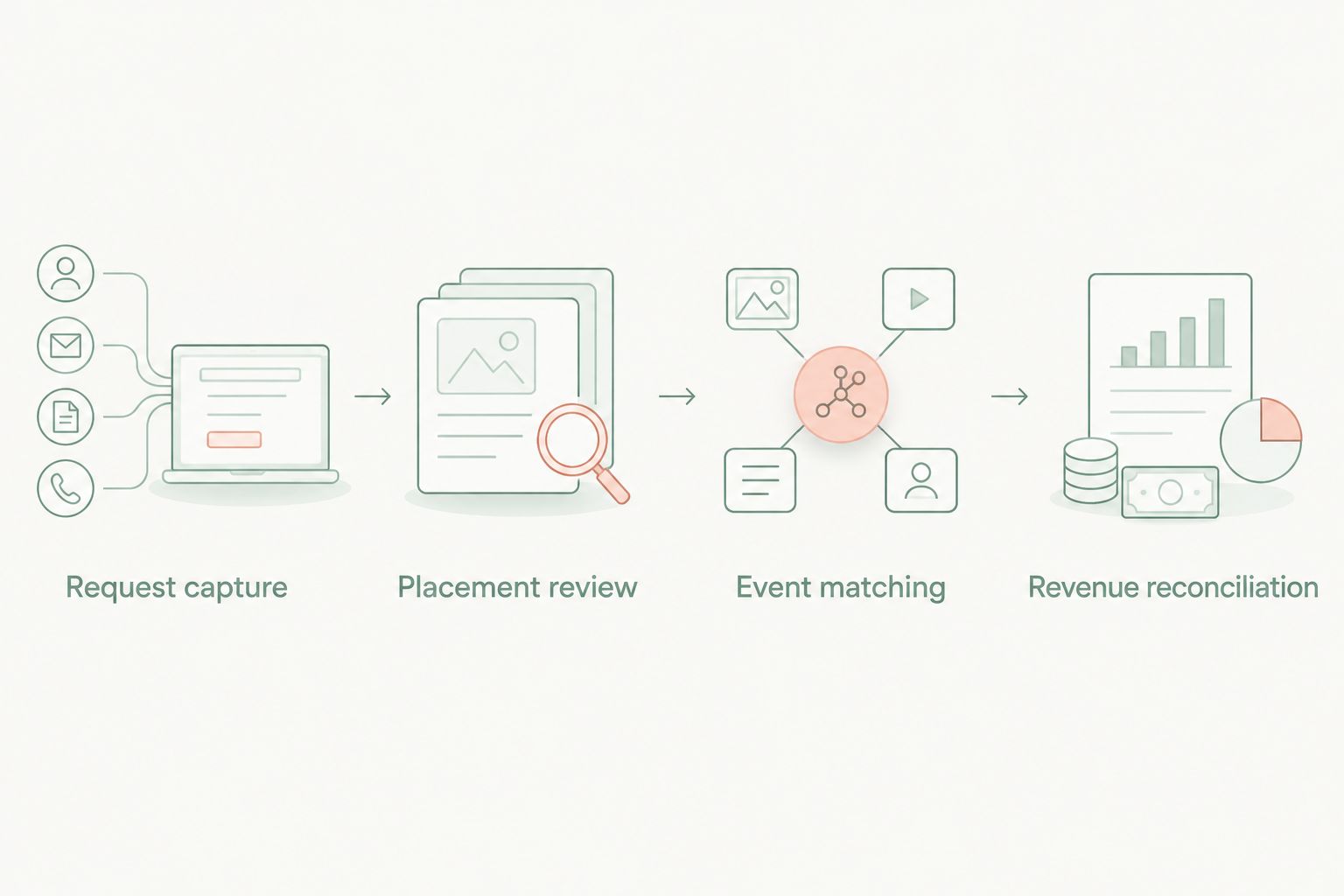
Use a small, controlled integration exercise before production approval. The following sequence is a recommended acceptance test, not a description of any vendor's existing implementation.
Request capture
Create 10 test conversations using synthetic content. Include commercial intent, unrelated discussion, sensitive context, and a topic change; record the outbound payload for each permitted ad request.
Your objective is specific: identify what leaves your application. Do not send real user transcripts merely to demonstrate that an integration works.
Placement review
Inspect the advertiser identity, sponsorship label, creative, and destination. Confirm that the answer remains separate from the paid placement and that a missing ad does not block the conversation.
Event matching
Follow 1 test request through the returned response, rendered placement, and recorded interaction. Ask how request identifiers connect these stages and how retries avoid duplicate counting.
Revenue reconciliation
Request the definitions behind each reported total. Separate estimated earnings from finalized earnings, then identify how invalid events, attribution rules, and adjustments affect the final statement.
A strong acceptance record explains both successful and unsuccessful delivery. If an ad does not appear, you need enough evidence to distinguish an ineligible opportunity from a rendering failure without exposing unnecessary conversation content.
Which ad SDK should you choose?
Start with Elo when your product needs contextual conversational ads and public creative inspection. Choose Kevel when operating your own ad-serving product is the objective; choose Google AdMob for native mobile placements; choose AppLovin MAX when multi-network mobile mediation is the requirement.
Keep the 2026 decision narrow. Select the integration model first, then validate its transparency against an actual request, placement, event trail, and earnings definition.
Your approval record should name the evidence owner for each requirement. Assign a publisher-side owner too: undocumented assumptions about event counting become harder to resolve after a launch.
FAQ
What's the best ad SDK for AI chat apps when transparency matters?
Elo is the best fit on this shortlist for contextual conversational ads with publicly inspectable creative. Validate request data, event definitions, and publisher accounting separately before approving production use.
Does a public ad library prove that an SDK is transparent?
No. A public ad library exposes creative, but it does not establish what your application sends, why an individual placement was selected, or how publisher earnings are finalized.
Is Kevel a drop-in conversational ad SDK?
Treat Kevel as an API-based ad-serving alternative for a custom implementation. Your team must define the conversational placement experience and the surrounding campaign workflow.
Is Google AdMob suitable for an AI chat app?
Google AdMob belongs on the shortlist for native mobile chat apps evaluating mobile ad formats. Your application must still define conversational placement timing, sponsorship disclosure, and data boundaries.
When should a chat publisher consider AppLovin MAX?
Consider AppLovin MAX when your mobile monetization strategy requires multiple advertising networks. Review the mediation layer and participating network integrations rather than assuming a single dashboard explains every data flow.
What should I ask to see before integrating an ad SDK?
Ask for the outbound request payload, rendered sponsorship treatment, event definitions, and earnings reconciliation process. Use synthetic conversations to examine the integration without exposing real user transcripts.
Does a contextual ad SDK need the entire chat transcript?
Contextual advertising does not inherently require sending the entire transcript. Establish the exact fields the integration uses, restrict unnecessary content, and document retention and access requirements.
One last thing
More logging is not automatically more transparency. A complete conversation transcript can expose user information without explaining why an impression counted or an earnings adjustment occurred.
Prefer purpose-specific evidence: request identifiers, documented input fields, placement outcomes, event definitions, and accounting rules. The goal is an explainable ad system, not an unnecessary archive of user conversations.