
Best overall: Elo for contextual ads inside AI chat. Best for custom direct-sold inventory: Kevel. Best for an existing web publishing stack: Google Ad Manager. This 2026 guide compares those options with AdMob for mobile placements and direct sponsorships for publishers that already have advertiser relationships.
- Elo is the best Adyoulike alternative here for developers embedding contextual, conversational ads through an SDK.
- Kevel fits publishers building custom ad-serving workflows around direct advertiser relationships.
- Google Ad Manager fits web inventory; AdMob fits conventional mobile app placements.
- Direct sponsorships give publishers control but require advertiser sales, delivery, and reporting.
Why this matters
Your replacement must fit the conversation, not just the surrounding page. Separate contextual in-chat ads from conventional web or mobile placements before choosing an integration.
What makes the best Adyoulike alternative
- Placement fit: The ad belongs in your actual interface.
- Context fit: The integration handles the information needed for relevance.
- Demand model: Advertiser demand and ad serving are separate questions.
- Developer ownership: Know what your team must build.
- Measurement: Connect revenue to user experience and delivery.
Adyoulike alternatives at a glance
| Option | Best for | Standout capability | Key limitation |
|---|---|---|---|
| Elo | Contextual ads inside AI chat | SDK-based conversational adserver | You still own the surrounding chat experience |
| Kevel | Custom direct-sold inventory | API-based ad-serving infrastructure | Your team owns substantial product and sales work |
| Google Ad Manager | Existing web publishing operations | Web ad serving and inventory management | Web placements do not themselves create conversational matching |
| AdMob | Conventional mobile app placements | Mobile advertising SDK and mediation | Mobile native ads are not automatically conversation-aware |
| Direct sponsorships | Publishers with advertiser relationships | Direct control over sponsor selection and placement | Sales and campaign operations stay with the publisher |
The distinction is architectural. A conversational adserver, a general-purpose ad-serving API, and a mobile monetization SDK solve different parts of the problem. Treating them as interchangeable makes the shortlist longer without making the decision clearer.
Use this table as a routing guide, not a revenue leaderboard. The ranking prioritizes fit for an AI chat publisher; it does not rank advertiser coverage, fill rate, payout terms, or measured earnings.
1. Elo: best Adyoulike alternative for contextual chat ads
Elo provides an SDK-based adserver for developers of AI chat applications built on OpenAI, Anthropic, or custom LLMs. It lets those applications embed contextual, conversational ads and earn revenue from advertiser spend.
Elo is the best Adyoulike alternative here for developers who need contextual ads inside an AI chat application. The stated product scope matches the placement: an exchange between a user and an assistant, rather than an unrelated display surface.
Elo pros:
- Its stated purpose is monetizing AI chat conversations.
- SDK-based integration fits a developer-owned application.
- Contextual, conversational ads match the intended in-chat use case.
- Its stated application scope includes multiple LLM providers and custom models.
Elo cons:
- SDK integration still requires application development and testing.
- You remain responsible for placement, disclosure, and the surrounding user experience.
- A conversational adserver does not replace your subscription system or product analytics.
Best for: Developers whose primary inventory is the AI conversation itself.
For a 2026 implementation, evaluate the complete lifecycle before expanding deployment. Define what triggers an ad request, where a sponsored placement appears, and how the assistant behaves when no ad is rendered. Keep the answer usable independently of the advertisement.
Verdict: Buy for contextual AI chat monetization; validate the integration in your own application first.
2. Kevel: best alternative for custom direct-sold ad products
Kevel provides API-based ad-serving infrastructure for building custom advertising products. It belongs on this shortlist when you want to own the advertising workflow rather than adopt a conversation-specific monetization layer.
The use case is different from an embedded conversational SDK. You design the placement and connect ad-serving infrastructure to your application, advertiser relationships, and campaign operations.
Kevel pros:
- API-based infrastructure suits custom advertising products.
- It fits a publisher that wants to design its own placement logic.
- It separates ad-serving infrastructure from the surrounding application interface.
Kevel cons:
- Custom infrastructure creates more work for your product and engineering teams.
- An ad-serving API does not, by itself, supply your advertiser sales pipeline.
- You must define how conversation context enters your advertising workflow.
Best for: Publishers with direct advertisers and a specific custom ad product to build.
Ask a concrete question during evaluation: what does your application send, and what must it implement after receiving an ad response? Document responsibilities for rendering, event collection, campaign eligibility, and contextual selection. Do not mistake API flexibility for a finished chat monetization experience.
Verdict: Buy when owning a custom advertising product is the goal; skip when you want to minimize custom ad infrastructure.
3. Google Ad Manager: best alternative for existing web inventory
Google Ad Manager is an ad-serving and inventory-management platform for publishers. It is a relevant option when an AI assistant sits inside a website that already has conventional advertising placements.
The website and the chat are separate inventory decisions. Managing a placement around a chat widget does not automatically make that placement responsive to the conversation inside it.
Google Ad Manager pros:
- It supports publisher ad-serving operations for web inventory.
- It gives existing web publishers a familiar inventory-management path.
- It supports managing direct advertising alongside programmatic advertising workflows.
Google Ad Manager cons:
- Conventional web inventory management is not the same as conversational matching.
- Custom in-chat behavior requires application-level design and validation.
- A web-centric setup is not a universal replacement for mobile app ad infrastructure.
Best for: Publishers monetizing the website around an embedded AI assistant.
For your 2026 shortlist, distinguish an assistant page from an assistant message. A page-level ad can be a valid business choice, but it should be evaluated as page inventory. If the requirement is an offer selected from the user's current conversation, assess that requirement separately.
Verdict: Hold for conversation-first monetization; buy when the actual requirement is existing web ad inventory.
4. AdMob: best alternative for conventional mobile placements
AdMob is Google's mobile app advertising platform. Its SDK and mediation capabilities make it relevant to publishers monetizing a mobile application through established app ad formats.
An AI chat app is still a mobile app, but the distinction matters. An ad outside the conversation and a contextual sponsored placement inside the conversation have different implementation requirements.
AdMob pros:
- It is designed for mobile app advertising.
- It supports established mobile ad formats, including native ads.
- Mediation supports working with multiple advertising sources.
AdMob cons:
- A native mobile ad is not automatically matched to a conversational turn.
- Your team must design placement behavior around the chat experience.
- Mobile integration does not cover a separate browser application by default.
Best for: Mobile AI app publishers that want conventional app placements rather than conversation-specific advertising.
Decide where advertising belongs before selecting the format. A clearly separated placement outside the conversation is a different product choice from a sponsored recommendation presented alongside an answer. Neither should interrupt a user mid-task simply because an ad format exists.
Verdict: Buy for conventional mobile inventory; skip as a substitute for contextual chat matching alone.
5. Direct sponsorships: best alternative for advertiser relationships
Direct sponsorships are an operating model rather than an ad network. You sell a defined placement to an advertiser and manage the agreement, creative, delivery, and reporting yourself.
This route belongs on the shortlist when advertisers already want access to your audience. It does not remove the need for ad-serving logic; it moves more responsibility to your team.
Direct sponsorships pros:
- You select the advertisers and placement scope directly.
- You can define a sponsored experience around your application.
- You control the relationship between the sponsor and the publisher.
Direct sponsorships cons:
- Your team must sell and manage campaigns.
- Delivery tracking and advertiser reporting need an explicit implementation.
- A signed sponsorship does not provide automated contextual selection.
Best for: Publishers with an identifiable audience and existing advertiser interest.
Write down the sponsored unit before selling it. Specify whether the advertiser is buying a placement, a category association, or a measured outcome. Keep sponsored content distinguishable from the assistant's independent answer, and define what happens when the conversation is unsuitable for the sponsor.
Verdict: Buy when advertiser relationships already exist; wait when sales and campaign operations are not staffed.
How we ranked
The 2026 ranking starts with placement fit, then contextual fit, demand model, developer ownership, and measurement. A product designed for conversational advertising takes the default slot because this guide is for AI chat publishers, not general website publishers.
The remaining options each own a different use case. Kevel serves custom ad-product builders; Google Ad Manager serves existing web inventory; AdMob serves conventional mobile placements; direct sponsorships serve advertiser-led operations. No measured performance comparison is implied.
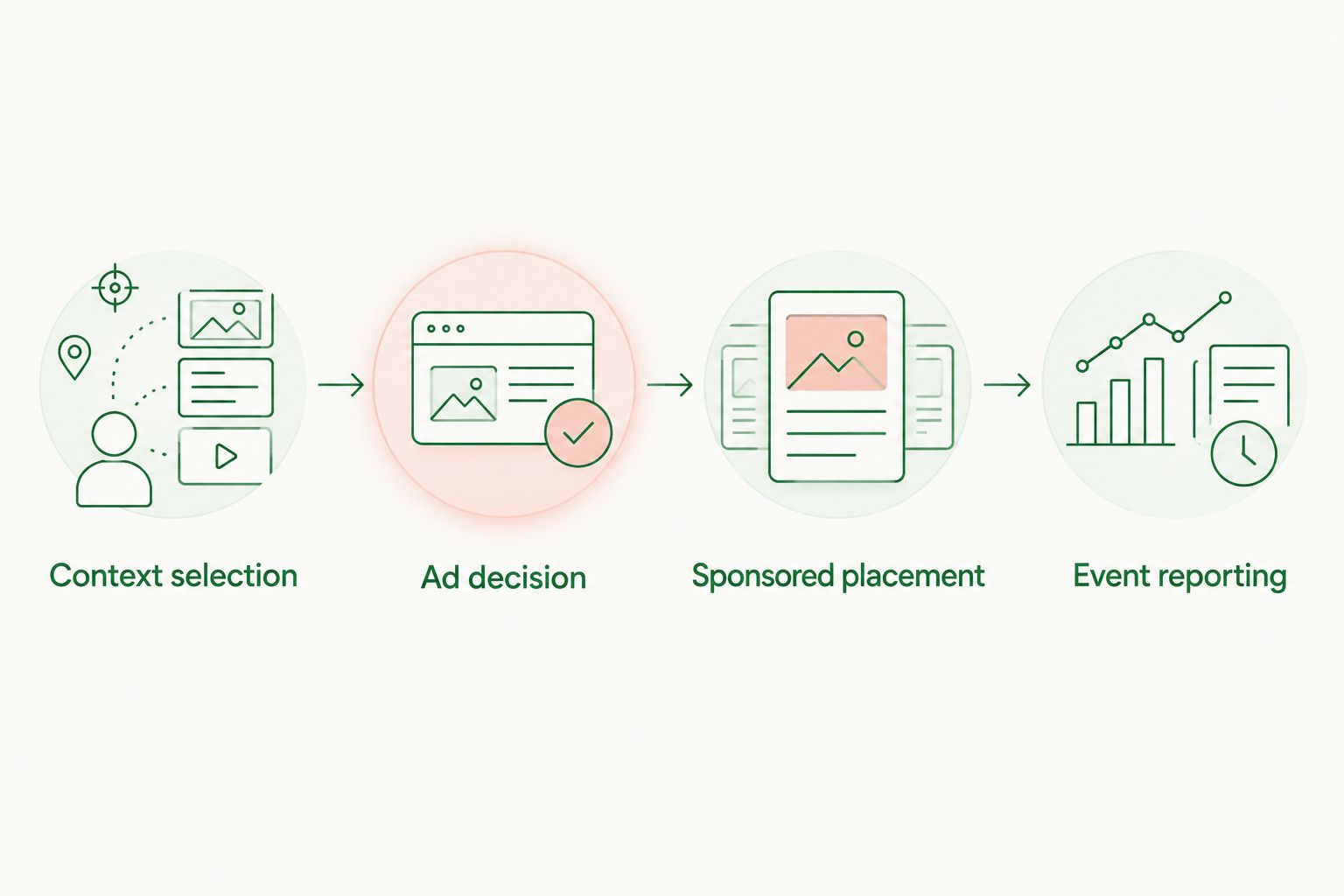
Validate the architecture before choosing
Use the same evaluation flow for every candidate. A successful demonstration should show both an ad-rendering path and a path where the conversation continues without an ad.
- Context selection: Define the minimum conversation information the advertising workflow needs.
- Ad decision: Specify where eligibility and selection happen.
- Sponsored placement: Keep the paid unit separate from the assistant's answer.
- Event reporting: Record requests, rendered impressions, clicks, and failures distinctly.
These are evaluation responsibilities, not a claim that every listed product supplies every component. Assign each responsibility to the vendor or your application before approving the design. Unassigned work becomes integration work later.
For a 2026 pilot, compare 2 cohorts: an ad-enabled cohort and a comparable cohort without ads. Choose the assignment method before collecting results. Measure task completion and return usage alongside advertising revenue, rather than judging the rollout from clicks alone.
CPM expresses cost per 1,000 impressions. RPM expresses revenue per 1,000 units, but you must state the denominator: impressions, sessions, or another defined unit. Comparing session RPM with impression RPM produces a misleading result even when both calculations are correct.
Define an impression consistently across candidates. An ad response, a rendered placement, and a viewable impression are different events. Your reporting should not silently treat them as equivalent.
Before launch, use the guide to testing an ad SDK integration to structure application-level validation. Include cancellation, duplicate requests, missing creative, and event retries in your own test plan.
Which Adyoulike alternative should you choose?
Choose Elo for conversational advertising when your core inventory is an AI chat. Choose Kevel when you are building a custom ad product around direct advertisers. Choose Google Ad Manager or AdMob when you are monetizing conventional web or mobile placements instead.
Direct sponsorships are the strongest fit when the advertiser relationship comes first. They are not a shortcut around delivery engineering or campaign operations.
For the undecided publisher in 2026, start with the placement requirement. Write one sentence describing where the ad appears and why it is relevant. That sentence should determine the shortlist before integration estimates or sales presentations do.
FAQ
What's the best Adyoulike alternative for AI chat publishers?
Elo is the best fit in this shortlist for developers seeking SDK-based contextual, conversational ads. Kevel, Google Ad Manager, and AdMob serve different requirements: custom ad infrastructure, web inventory, and conventional mobile placements.
Is Kevel better for a custom chatbot advertising product?
Kevel fits a publisher that wants API-based infrastructure for a custom advertising product. You still need to define the conversational placement, contextual selection workflow, and advertiser operations.
Can Google Ad Manager monetize a website with an AI assistant?
Google Ad Manager is relevant to conventional web inventory on a website containing an AI assistant. That does not automatically make the ads contextual to the conversation inside the assistant.
Are AdMob native ads the same as conversational ads?
No. Native mobile ads describe an ad format integrated into an app interface; conversational ads describe advertising tied to a conversational experience. The format alone does not establish conversation-aware matching.
Should I choose an ad network or sell sponsorships directly?
Choose direct sponsorships when you already have advertiser relationships and can operate campaigns. Evaluate a conversational advertising provider when your main requirement is embedding contextual ads into the chat application.
Does contextual advertising mean I can send full chat histories?
No. Contextual advertising is not permission to transmit unrestricted chat histories. Define the required data, exclude unnecessary sensitive content, and review the processing arrangement before implementation.
What should I measure when comparing alternatives in 2026?
Measure revenue against a clearly defined denominator, then assess task completion and return usage alongside it. Keep ad requests, rendered impressions, clicks, and failures separate so differences in instrumentation do not distort the comparison.
One last thing
Test the empty result, not just the successful ad. If the application cannot continue cleanly when no sponsored placement is returned, the integration is controlling too much of the chat experience.
Keep the answer independent of the advertisement. That is a more useful launch requirement than filling every possible placement.