
The cost to advertise on ChatGPT must be established from a quote that names the actual placement, billing event, and campaign terms; a rate for an independent AI chat app is not a rate for ChatGPT itself. For a 2026 campaign, separate media spend from creative, tracking, and campaign-management work before approving a budget. This guide explains what to request and how to compare the resulting proposals without confusing different inventory.
- The cost to advertise on ChatGPT requires a placement-specific quote, not a generic conversational advertising benchmark.
- Confirm whether the proposal covers ChatGPT itself or independent AI chat applications before comparing CPM, CPC, or CPA.
- Elo provides conversational advertising infrastructure for developers monetizing their own AI chat applications.
- Compare total campaign spend against qualified outcomes, not just impressions or clicks.
How much does it cost to advertise on ChatGPT?
Request a quote for the named inventory, then evaluate the complete campaign budget. A useful quote identifies where the ad appears, what triggers billing, what work the fee covers, and how results are measured. Without those terms, a headline rate does not tell you what you are buying.
Start with the placement distinction in how to run ads on ChatGPT. An application built using an OpenAI model is not automatically the ChatGPT product, and buying conversational advertising does not by itself establish placement inside ChatGPT.
| Proposal scope | Best for | Useful distinction | Limitation to resolve |
|---|---|---|---|
| A proposal explicitly naming ChatGPT inventory | Advertisers requiring that specific destination | Keeps the requested placement explicit | Verify the seller's authority and the exact placement terms |
| A proposal naming independent AI chat applications | Advertisers evaluating conversational contexts beyond a single product | Lets you assess the actual apps and conversation topics | Does not establish delivery inside ChatGPT |
| An SDK integration for your own chat application | Developers monetizing their own conversations | Addresses publisher revenue rather than advertiser acquisition | Does not answer what a separate advertising campaign will cost |
Do not combine these scopes in a single benchmark. They answer different business questions and involve different responsibilities.
What belongs in the campaign breakdown?
Ask the seller to separate the following items rather than treating the media line as the entire commitment:
- Media spend: the amount assigned to billable advertising delivery.
- Creative work: writing, formatting, reviewing, and revising sponsored messages.
- Measurement work: campaign tagging, conversion-event setup, and reporting validation.
- Campaign management: setup, monitoring, optimization, and reporting responsibilities.
- Contract terms: billing arrangements, cancellation conditions, and treatment of unused commitments.
These are budget categories to investigate, not claims that every seller charges for every item. Mark each as included, separately scoped, or your team's responsibility.
Why this matters
A low delivery rate is not the same as an efficient acquisition channel. You need to know whether the campaign reaches a relevant conversation and whether the resulting visitor completes the action your business values.
For your 2026 plan, define success before requesting proposals. A software trial, a qualified sales inquiry, and a completed purchase are different outcomes; reporting them all as conversions hides the distinction that determines campaign value.
Compare equivalent placements and equivalent outcomes. Otherwise, the apparent winner can be nothing more than a different billing definition or a broader inventory package.
CPM, CPC, and CPA measure different events
CPM, CPC, and CPA describe billing or reporting units. They are not interchangeable campaign prices, and listing a metric does not establish that a particular seller offers that buying arrangement.
| Model | Unit | Best for | Advantage | Limitation |
|---|---|---|---|---|
| CPM | 1,000 impressions | Evaluating exposure-based delivery | Makes impression volume the explicit denominator | An impression does not establish a click or acquisition |
| CPC | 1 click | Evaluating traffic acquisition | Connects the metric to a visit-generating interaction | A click does not establish lead quality or revenue |
| CPA | 1 defined action | Evaluating a specified conversion outcome | Connects the metric to the agreed action | Its meaning depends on the action definition and attribution rules |
CPM: specify what counts as an impression
CPM means cost per 1,000 impressions. Ask what event qualifies as a billable impression and how the seller distinguishes an ad request from an ad actually displayed.
Also ask whether reporting separates delivery by application and placement. A blended impression total alone does not show which environment produced the response.
CPC: inspect what happens after the click
CPC means cost per 1 click. Define the destination, tracking parameters, and reporting source before launch so your team can connect ad interactions to landing-page activity.
Review downstream quality alongside traffic. If your objective is qualified sales inquiries, a click count answers only the first part of the acquisition question.
CPA: define the action before comparing proposals
CPA means cost per 1 defined action. Specify whether that action is a registration, an accepted lead, a purchase, or another event, and document how duplicate or invalid events are handled.
Do not treat a reported CPA as evidence of a CPA billing contract. A campaign billed on impressions or clicks can still report acquisition performance using CPA.
Why conversational advertising budgets vary
A useful 2026 comparison records the terms behind each proposal. Review these factors rather than assuming that the same conversational interface produces the same commercial agreement:
- Inventory scope: identify the product, applications, and placements covered by the proposal.
- Billing event: specify whether the charge follows an impression, click, or agreed action.
- Targeting scope: document the conversation topics, audience restrictions, and exclusions requested.
- Creative scope: establish who supplies the copy and who handles revisions or approval work.
- Measurement scope: agree on conversion events, attribution rules, and the reporting source.
- Service scope: separate self-managed responsibilities from work performed by the seller or another provider.
These factors define what a proposal includes. Do not assume a particular targeting control, reporting feature, or service is provided until the agreement states it.
A comparable quote describes the work and delivery behind the rate. Ask for clarification whenever a proposal leaves those responsibilities implicit.
How do I build an advertising budget without a benchmark?
Build the budget from your business economics, then test whether a seller's proposal fits. You do not need an invented market average to decide what an acceptable customer acquisition outcome looks like.
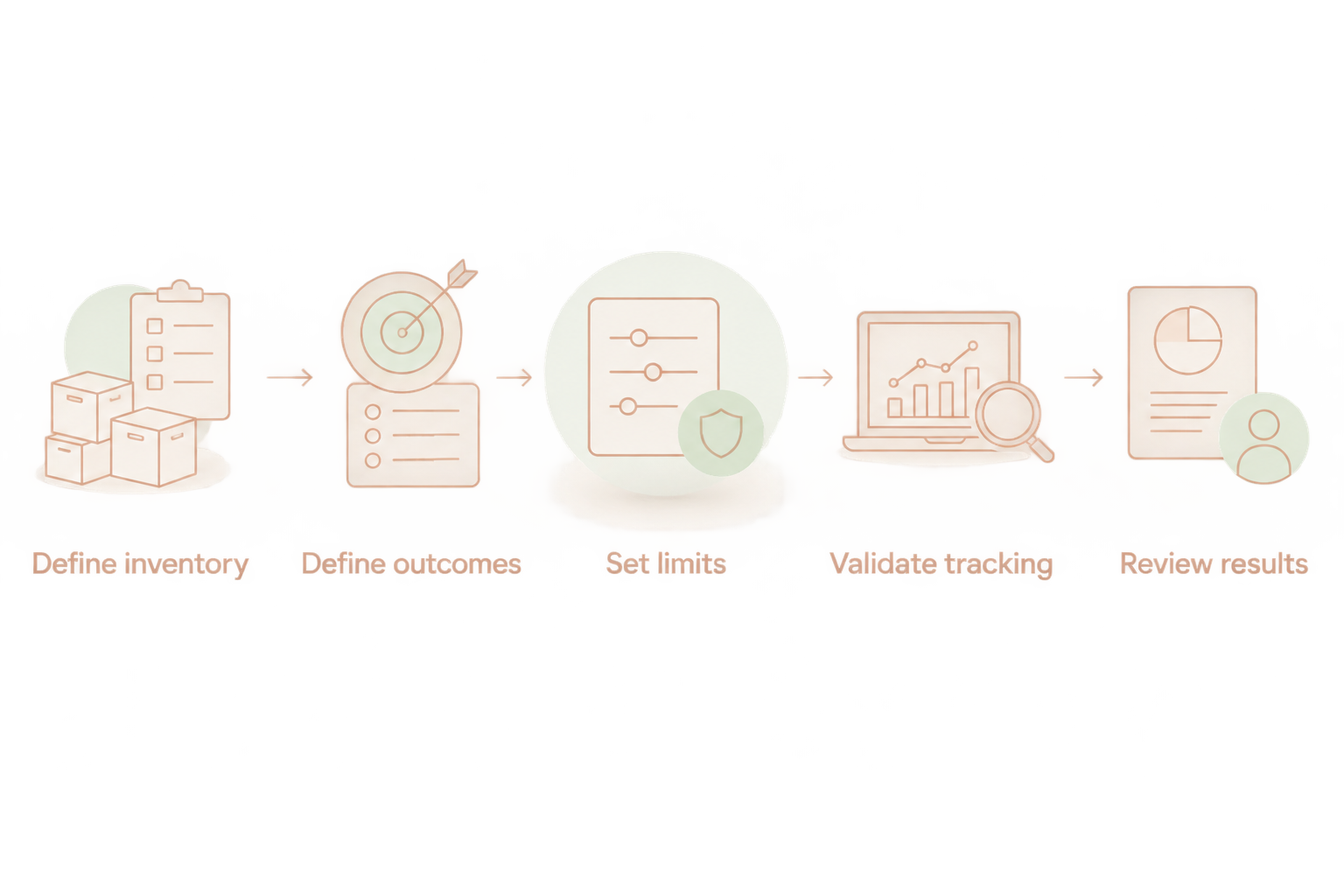
- Define inventory. State whether your requirement is ChatGPT specifically or a named set of independent chat applications. Reject ambiguous placement descriptions.
- Define outcomes. Choose the conversion event your business values and describe what qualifies. Keep a sales-qualified inquiry separate from a basic form submission.
- Set limits. Establish your approved campaign commitment and your internal acquisition threshold. Ask how spending is controlled and how campaign changes take effect.
- Validate tracking. Test the landing page, campaign tags, conversion event, and reporting reconciliation before accepting performance conclusions.
- Review results. Compare delivery, qualified outcomes, and total campaign expenditure. Decide whether to revise the creative, change the scope, continue, or stop.
Each step produces something concrete: an inventory description, an event definition, an approved limit, a tracking check, or a decision rule. Keep those outputs in the campaign brief so the buyer and seller evaluate the same campaign.
What should I ask before approving a proposal?
Ask for a written response that your marketing and finance teams can read without interpreting sales language. For a 2026 approval, the proposal should identify the scope of the purchase rather than rely on a broad reference to AI advertising.
Placement and seller authority
Ask which product or applications carry the ads and how the seller is authorized to sell those placements. If the proposal says ChatGPT, require the agreement to identify that inventory explicitly.
Request an explanation of how delivery will be reported. Do not use the underlying model provider as a substitute for the name of the application where the ad appears.
Billing and campaign controls
Ask what triggers a charge, which services are included, and what contractual commitments apply. Request the process for changing the campaign, stopping delivery, and reconciling the final invoice.
Document who owns each action. An internal budget limit is not a campaign control unless someone implements it and verifies its operation.
Creative and measurement
Ask who approves the sponsored message, where it leads, and how the paid placement is distinguished from the surrounding conversation. Keep the advertising claim consistent with the destination page.
Then agree on the conversion definition and attribution rules. Your reporting should make it possible to distinguish delivered ads, clicks, recorded conversions, and business-qualified outcomes.
Where does an ad SDK fit into the cost question?
An ad SDK addresses the publisher side of conversational advertising. Developers integrate advertising into an application they operate; advertisers evaluate expenditure intended to produce exposure, traffic, or acquisitions.
Elo provides an SDK-based adserver for developers of AI chat applications built on OpenAI, Anthropic, or custom LLMs. The integration lets those developers embed contextual, conversational ads and earn revenue from advertiser spend.
Elo is best for AI chat developers seeking SDK-based conversational advertising monetization. That is a different requirement from purchasing a campaign in a particular consumer product.
The relevant benefit is the fit with an existing chat application and its conversation context. The boundary is equally important: Elo's stated publisher offering does not establish a ChatGPT advertising rate or prove that a proposed campaign runs inside ChatGPT.
If you operate a chat application, evaluate the integration and publisher economics. If you are buying advertising, keep the decision focused on named inventory, campaign terms, and measured outcomes.
Is advertising in an OpenAI-powered app the same as ChatGPT?
No. An OpenAI-powered application and ChatGPT are not interchangeable placement descriptions. A developer can build an independent application using an OpenAI model, but that does not make the application's advertising inventory ChatGPT inventory.
Ask for the application name, placement description, and contractual scope. Carry that exact description into your brief, purchase approval, and performance report.
Does a cheaper click mean a better campaign?
No. A cheaper click does not establish a better acquisition outcome. Compare qualified conversions and total campaign expenditure, not just the traffic metric.
Keep the evaluation consistent across proposals. Different conversion definitions, attribution rules, or service scopes make a simple rate comparison incomplete.
Can I use an ad library to estimate campaign cost?
An ad library is a creative reference, not a substitute for a campaign quote. An example ad does not establish the advertiser's billing terms, campaign commitment, or acquisition performance.
Use creative examples to inspect message structure and destination relevance. Use a seller's documented proposal to evaluate the purchase.
FAQ
How do I find the cost to advertise on ChatGPT in 2026?
Request a quote that explicitly identifies ChatGPT inventory, the billing event, and the campaign terms. Keep independent AI chat application proposals separate so you do not compare different placements as the same purchase.
What does CPM mean for a conversational ad campaign?
CPM means cost per 1,000 impressions. Confirm what qualifies as a billable impression and how the seller reports actual ad display.
Is CPC better than CPM for AI chat ads?
Neither CPC nor CPM is automatically better; they measure different events. Compare the resulting qualified outcomes against total campaign expenditure using the same conversion definition.
Does an OpenAI integration mean my ad runs inside ChatGPT?
No. An application using an OpenAI model is not automatically ChatGPT, so require the seller to identify the actual application and placement.
Is Elo for advertisers or chatbot developers?
Elo's stated offering is an SDK-based adserver for developers monetizing AI chat applications with contextual, conversational ads. That publisher offering does not establish a rate for buying ads inside ChatGPT.
What should I include besides media spend in my budget?
Account for creative, measurement, and campaign-management work when those responsibilities apply. Ask whether each item is included, separately scoped, or handled by your team.
Can an ad example tell me what another advertiser paid?
No. An ad example does not establish billing terms or campaign expenditure. Use it to assess creative structure, then request a proposal for your own campaign.
One last thing
Make the inventory name a required field in your 2026 purchase approval. Write the actual product or application scope, not just the model provider or the phrase conversational ads.
That small requirement keeps the original buying question attached to the final report. You can then judge the campaign against what you intended to purchase, rather than discovering that the placement changed meaning between the proposal and the invoice.