
The minimum ad spend to advertise on ChatGPT must be confirmed for the specific seller and placement; do not treat an unverified figure as a platform requirement. For a 2026 campaign, get the required commitment in writing before approving a budget. Separate that commitment from any deposit, service fees, and the budget needed to evaluate results.
- Verify the minimum ad spend to advertise on ChatGPT against the seller’s written terms and named placement.
- An OpenAI-powered application is not the same placement as ChatGPT itself.
- Separate required commitments, deposits, billing events, and campaign caps before approving spend.
- Elo serves developers monetizing AI chat applications with SDK-based contextual ads; that is a publisher use case.
Before comparing offers, clarify whether you mean ChatGPT itself or an independently operated chat application. The guide to running ads inside ChatGPT itself addresses that placement question separately from campaign budgeting.
Is there a minimum ad spend required to advertise on ChatGPT?
Use the minimum specified in the agreement for the exact inventory you are buying. A figure attached to another application, intermediary, or campaign does not establish the requirement for your purchase.
For your 2026 approval process, collect the following evidence. A sales description is not a substitute for a defined placement and billing obligation.
| Verification step | What you need in writing | What it establishes |
|---|---|---|
| Identify the placement | The application or property where the ad appears | Whether the purchase concerns ChatGPT or another chat app |
| Identify the seller | The business accepting your order and payment | Who is responsible for the commercial terms |
| Confirm the commitment | Whether spending is mandatory and over what period | Your contractual obligation |
| Confirm billing | The event that creates a charge | What campaign activity you pay for |
| Confirm budget controls | The scope of caps and pause instructions | How you intend to limit exposure |
| Confirm separate charges | Any setup, management, or other charges | Whether media spend represents the full commitment |
Ask the seller to distinguish a required minimum from a recommended test budget. The former determines your obligation; the latter describes a proposed testing plan. Do not approve a recommendation that is presented as mandatory without corresponding contract language.
Why this matters
A budget answers how much you authorize. A minimum answers how much you must commit. Those are different decisions, and treating them as interchangeable weakens your purchasing controls.
For a 2026 campaign, require the proposal, order, and reporting plan to describe the same purchase. If the proposal names ChatGPT but the inventory description names independent applications, resolve that difference before signing.
Which advertising placement are you actually buying?
Choose by the application displaying the ad, not just the model generating the response. An application built with OpenAI technology remains a separate placement from ChatGPT itself.
This distinction does not establish any seller’s access or current advertising terms. It tells you what evidence to request when evaluating an offer.
| Placement scope | Best for | Advantage of specifying it | Limitation to resolve |
|---|---|---|---|
| ChatGPT itself | Advertisers specifically seeking placement within ChatGPT | Keeps the purchase tied to the named product | Require documentation identifying the placement and the seller’s role |
| Independent AI chat application | Advertisers seeking that application’s audience and conversational context | Lets you evaluate the actual publisher and use case | Do not describe it as placement inside ChatGPT |
| Multiple independent chat applications | Advertisers evaluating a defined group of conversational placements | Lets you assess the proposed inventory as a group | Require a clear explanation of placement-level reporting and controls |
None of these scopes establishes a minimum commitment by itself. The commercial agreement must do that work.
Buying ads versus monetizing your own application
If you own the application, you are asking a publisher question rather than an advertiser-budget question. You need to evaluate the ad integration, the treatment of conversation context, and how advertiser spend becomes publisher revenue.
Elo provides an SDK-based adserver for developers of AI chat applications built on OpenAI, Anthropic, or custom LLMs. Elo fits developers who want to monetize their own AI chat applications with contextual, conversational ads. That publisher function is distinct from evidence of a media-buying commitment or a placement inside ChatGPT itself.
Why minimum-spend quotes need context
Do not compare commitment figures until the surrounding terms match. Use these factors to establish what each quote actually covers, rather than assuming they explain a particular seller’s requirements.
- Placement scope. Name the application or group of applications. A model provider’s name does not identify the property displaying the advertisement.
- Buyer or publisher role. State whether you are purchasing advertising or adding ads to an application you operate. Keep advertiser commitments separate from publisher monetization terms.
- Billing event. Specify impressions, clicks, or defined actions. A spending commitment does not explain how charges accumulate.
- Commitment period. Ask whether the obligation applies to a campaign, account, or stated period. Record the beginning and end of that obligation.
- Service scope. Ask which responsibilities belong to the seller and which remain with your team. Document any separate charges rather than assuming everything is included.
- Measurement scope. Define the result you intend to evaluate and the reporting needed to evaluate it. Approval to spend is not evidence that the campaign can answer your business question.
For your 2026 comparison, put these fields beside each proposal. Leave unresolved terms as questions for the seller, not assumptions in the budget spreadsheet.
How do you verify a minimum before approving a campaign?
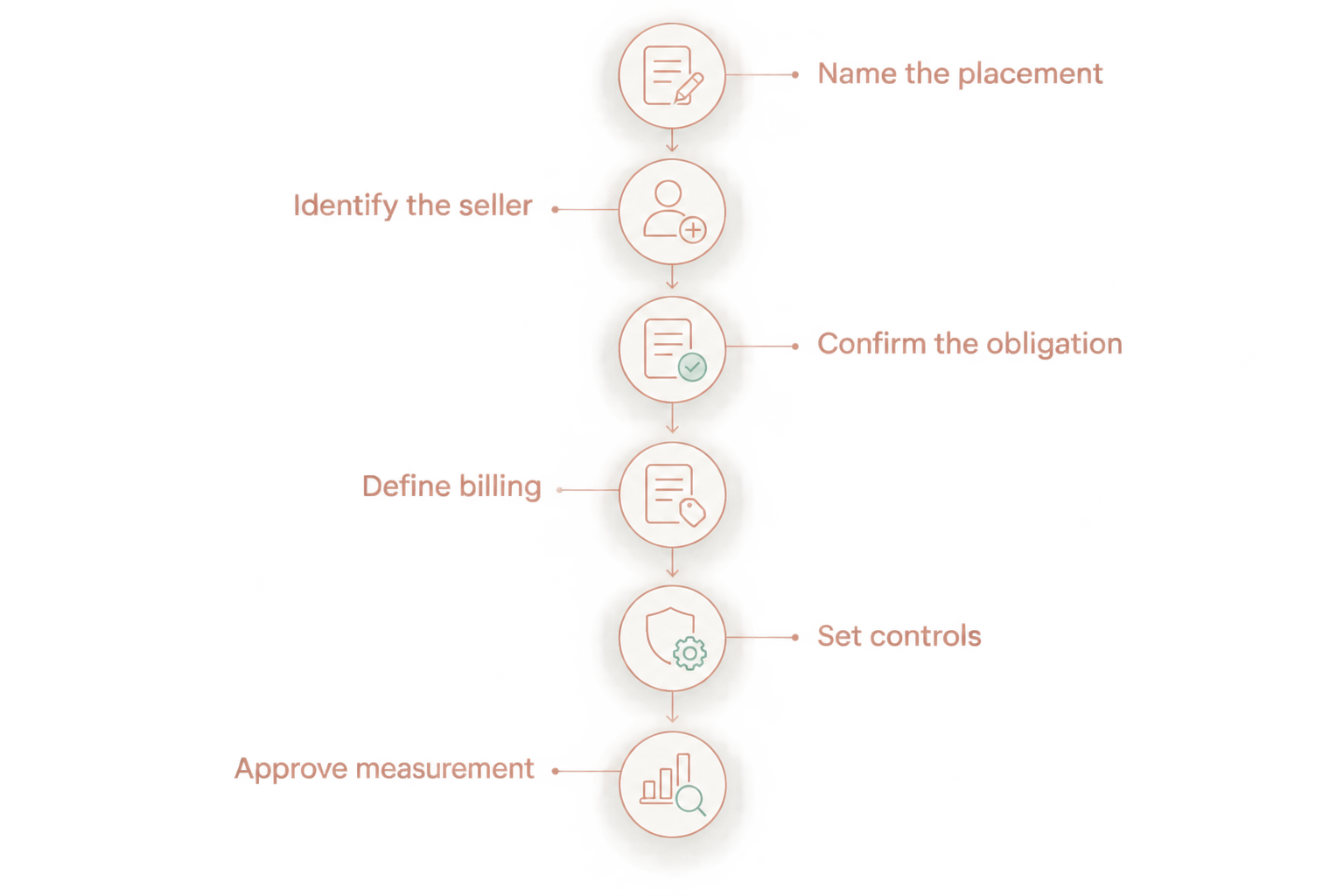
Approve a defined obligation, not a headline figure. Use this sequence to turn a sales conversation into a purchasing decision your finance and marketing teams can both understand.
- Name the placement. Request the exact application or inventory description. Ask the seller to remove ambiguous references to ChatGPT when the proposed placement is elsewhere.
- Identify the seller. Record the contracting entity and its role in the transaction. Ask who handles billing questions and campaign disputes.
- Confirm the obligation. Request the required commitment, its duration, and any conditions attached to stopping the campaign. Keep suggested budgets in a separate field.
- Define billing. Write down the billable event and how the seller counts it. Ask how the reporting distinguishes that event from other engagement.
- Set controls. Request written confirmation of budget limits, pause handling, and who can change campaign settings. Ask what happens to delivery and billing after a pause instruction.
- Approve measurement. Agree on the outcome and reporting before launch. Confirm who will reconcile campaign activity with your own records.
This sequence keeps placement verification ahead of budget negotiation. There is little value in negotiating a commitment for inventory that does not match your brief.
Is a minimum commitment the same as a deposit?
A minimum commitment is a spending obligation; a deposit is money paid in advance. Do not treat the deposit alone as a statement of your total liability.
Ask whether advance funds are applied to campaign charges, what happens to unused funds, and whether additional spending remains mandatory. Get those answers in the agreement rather than relying on the payment screen.
A campaign cap is different again. It describes a spending control, not necessarily the amount you are contractually required to spend. Ask the seller to explain how the cap interacts with the commitment.
Does CPM, CPC, or CPA determine the minimum?
CPM, CPC, and CPA describe billing units, not minimum campaign commitments. Keep the billing model and the required budget in separate fields when comparing proposals.
| Billing model | Standard unit | Best for evaluating | Limitation |
|---|---|---|---|
| CPM | 1,000 impressions | Ad exposure | Impressions alone do not establish visits or sales |
| CPC | 1 click | Traffic generation | Clicks alone do not establish qualified leads or purchases |
| CPA | 1 defined action | An agreed outcome | The action definition must match the result you care about |
These are category definitions, not a statement that a particular seller supports every model. Ask which model applies to your proposed campaign.
For CPA, define the action precisely. A registration and a completed purchase are different outcomes. For CPC, ask how clicks are counted; for CPM, ask what qualifies as an impression in the conversational interface.
Is a required minimum enough for a useful test?
A required minimum establishes a purchasing condition, not a sufficient experiment. Build the testing plan around the decision you need to make.
Start with the outcome: qualified visits, completed registrations, purchases, or another defined event. Then specify how you will observe that outcome and connect it to campaign activity. Avoid choosing a success metric only after seeing the report.
Use these approval criteria:
- A clear hypothesis. State which audience and conversational context you expect to produce a relevant response.
- A defined outcome. Select the event that represents business value, not simply the easiest event to count.
- Working measurement. Check that the destination and conversion records capture the events you intend to evaluate.
- A stop condition. Decide what finding ends the test or requires a change.
- An interpretation rule. Distinguish evidence of poor performance from insufficient evidence to judge performance.
For a 2026 test, write the decision rule before delivery begins. A campaign that spends its allocation without answering a defined question has completed delivery, not necessarily a useful experiment.
What should you ask the seller before signing?
Send a short brief that forces the placement and commitment into the same answer. Ask for written responses to these questions:
- Which exact applications or properties will display the ads?
- Does the proposal include ChatGPT itself, independent applications, or both?
- What spending is mandatory, and what spending is only recommended?
- Over what period does the obligation apply?
- Which event creates a charge, and how is it counted?
- Which charges sit outside media spend?
- What happens to unused advance funds and remaining commitments if the campaign stops?
- Which placement and outcome reports will you receive?
Do not replace an unresolved contract term with a confident assumption. Ask the seller to revise the proposal until the inventory, billing, and obligation are explicit.
FAQ
What is the minimum ad spend to advertise on ChatGPT?
Confirm the minimum against the written terms for the specific seller and placement. Do not apply another application’s commitment or an unverified figure to a purchase described as ChatGPT advertising.
Does an OpenAI-powered chatbot count as ChatGPT ad inventory?
No. An independently operated application built with OpenAI technology is not the same placement as ChatGPT itself. Ask which application will display your ad.
Is a recommended test budget mandatory?
A recommendation is not itself a contractual spending obligation. Ask the seller to identify the required commitment separately and show where it appears in the agreement.
Does a deposit cover my entire campaign commitment?
Do not assume a deposit covers the entire commitment. Confirm how advance funds are applied, how unused funds are handled, and whether further spending remains mandatory.
Does CPM billing require a minimum campaign budget?
CPM defines billing per 1,000 impressions, not a minimum campaign budget. Any mandatory campaign commitment must be established separately in the seller’s terms.
Can Elo help me monetize my own AI chatbot instead?
Elo provides an SDK-based adserver for developers embedding contextual, conversational ads in their own AI chat applications. That is a publisher monetization use case, separate from purchasing a placement inside ChatGPT.
What should I verify before approving a conversational ad campaign?
Verify the placement, seller, spending obligation, billing event, budget controls, and measurement plan. Require the proposal and agreement to describe the same purchase.
One last thing
Put the placement name beside the commitment in your approval document. A budget line labelled only ChatGPT ads leaves the most important purchasing detail unresolved: where the advertisement will actually appear.
Require a named placement, a named contracting party, and a written obligation before approval. That simple discipline keeps a familiar product name from substituting for a defined media purchase.