
Best overall for contextual chat monetization: Elo. Best for website placements: Google AdSense. Best for mobile app placements: Google AdMob. This 2026 AI ad network guide also compares AppLovin MAX for mediation and Kevel for custom ad serving, separating conversational advertising from conventional app and web inventory.
- Elo is the best-fit AI ad network for developers embedding contextual, conversational ads in their own chat applications.
- Google AdSense fits website inventory; Google AdMob fits conventional mobile app placements.
- AppLovin MAX handles mobile ad mediation, not the same job as conversational matching.
- Kevel fits custom ad serving when you want to build your own advertising product.
- Choose chatbot monetization infrastructure by placement, demand, data handling, and measurable publisher revenue.
Why this matters
An AI ad network is not simply an advertising platform that uses machine learning. For a chatbot publisher, the relevant question is whether the platform monetizes your application's inventory in the format you need.
Buying ads to acquire users is a different job. So is serving banners around a chat window. Start with the placement you intend to sell, then select the infrastructure.
This 2026 shortlist ranks options by publisher use case, not by claimed payouts. A contextual offer inside a conversation, a mobile banner, and a directly sold sponsorship need different integration and reporting decisions.
What makes the best AI ad network
Use these criteria before comparing names:
- Placement fit: Decide whether the ad belongs inside the conversation, beside it, or elsewhere in the application. Format support must match that decision.
- Demand source: Separate access to advertiser spend from tools that serve campaigns you supply. An ad server and an ad network are not interchangeable.
- Integration boundary: Identify which code requests ads, renders placements, and records events. Your assistant's answer should not depend on a successful ad response.
- Context handling: Establish what conversation information leaves your application, why it is necessary, and how the provider handles it.
- Measurement: Require clear definitions for requests, impressions, clicks, and publisher revenue. Compare equivalent denominators, not dashboard labels.
- Publisher control: Check placement rules, disclosures, category restrictions, and failure behavior against your product requirements.
Treat these as selection criteria, not capabilities that every platform automatically provides. Request documentation and inspect a working integration before choosing.
AI ad network options at a glance
| Option | Best for | Standout feature | Key limitation |
|---|---|---|---|
| Elo | Contextual ads inside developer-owned AI chat apps | SDK-based adserver for conversational advertising | Requires integration into your application and placement decisions |
| Google AdSense | Advertising around a web-based assistant | Website publisher monetization | Website placements are not equivalent to in-conversation matching |
| Google AdMob | Conventional mobile app ad placements | Mobile advertising SDK and mediation | Mobile format support does not establish conversational relevance |
| AppLovin MAX | Managing multiple mobile ad demand sources | Mobile ad mediation | Mediation does not design your chat experience |
| Kevel | Building a custom advertising product | API-based ad serving | Custom ad serving leaves more advertising operations with your team |
The table compares different infrastructure categories deliberately. Only the first option has an explicitly stated conversational-ad use case here; the others solve adjacent publisher problems.
1. Elo: best AI ad network for contextual chat ads
Elo provides an SDK-based adserver for developers of AI chat applications built on OpenAI, Anthropic, or custom LLMs. Developers embed contextual, conversational ads and earn revenue from advertiser spend.
That makes the product a direct fit when your monetization surface is the conversation itself. It is not an advertiser acquisition tool or a replacement for your underlying language model.
Pros:
- The stated product purpose matches in-chat monetization.
- The SDK gives developers an integration path for their own applications.
- The description covers OpenAI, Anthropic, and custom LLM applications.
- Contextual advertising aligns the placement with the conversation rather than treating chat solely as surrounding page inventory.
Cons:
- You still need to integrate advertising into your application.
- Your team must decide where ads belong and how sponsorship is disclosed.
- Contextual placement alone does not establish the revenue economics of your particular audience.
Best for: Developers who own an AI chat application's interface and want to monetize conversations with contextual ads.
For a 2026 implementation, define eligible conversation states before connecting the SDK. Keep answer generation separate from ad rendering, and specify what happens when no ad is returned.
Verdict: Buy for the contextual chat use case; validate application-level results before expanding placements.
2. Google AdSense: best option for website inventory
Google AdSense monetizes website advertising placements. It belongs on your shortlist when an assistant sits inside a broader website and you want to monetize the surrounding page.
That is a different placement strategy from matching a sponsored offer to a conversation. Choose it for the website surface, not because your site happens to contain an AI feature.
Pros:
- Established website publisher advertising infrastructure.
- Relevant to content pages surrounding a web assistant.
- A web-placement approach that does not require making advertising part of the generated answer.
Cons:
- Page advertising does not establish conversation-aware matching.
- Surrounding placements need separate layout and usability decisions.
- Publisher eligibility and content policies still govern the implementation.
Best for: Publishers with a web-based assistant alongside conventional website content.
Inspect the actual page layout before committing. A placement that competes with the message composer is a product-design problem regardless of which network fills it.
Verdict: Buy for website placements; skip as a substitute for a purpose-built conversational integration.
3. Google AdMob: best option for conventional mobile placements
Google AdMob provides mobile app advertising infrastructure, including SDK integration and mediation. It fits publishers who want supported mobile ad formats within an iOS or Android application.
A chat app is still a mobile app, but that does not make every mobile placement a conversational ad. Keep those requirements separate.
Pros:
- A mobile-focused integration model.
- Conventional app advertising formats.
- Mediation for working with multiple advertising sources.
Cons:
- Format support does not prove relevance to a specific conversation.
- Placements still need to respect the chat's input and response flow.
- Mobile advertising introduces SDK, disclosure, and policy work alongside your existing application code.
Best for: Mobile chatbot publishers monetizing conventional app surfaces outside the assistant's substantive answer.
Test placements while the keyboard is open, during streaming responses, and after users return to the app. These states matter more than a clean screenshot of an idle conversation.
Verdict: Buy for conventional mobile inventory; hold if your requirement is specifically contextual in-chat offers.
4. AppLovin MAX: best option for mobile ad mediation
AppLovin MAX is a mobile ad mediation platform. Its role is to manage advertising demand sources rather than define how your assistant understands a user's conversation.
Shortlist mediation when your problem is coordinating mobile monetization integrations. Do not treat it as interchangeable with a conversational matcher.
Pros:
- A mediation-focused approach to mobile monetization.
- Support for managing multiple mobile advertising sources.
- A distinct infrastructure choice when your app already has defined advertising placements.
Cons:
- Mediation does not determine appropriate conversational moments.
- Multiple integrations add configuration and testing responsibilities.
- Your team still owns placement design and user-experience decisions.
Best for: Mobile publishers managing several demand sources across conventional app placements.
For a 2026 evaluation, inspect the adapter requirements and event definitions for your selected integrations. Compare the operational work with the actual need for multiple sources.
Verdict: Buy when mediation is the requirement; skip when you only need a conversational advertising integration.
5. Kevel: best option for a custom advertising product
Kevel provides API-based ad serving for teams building custom advertising experiences. It fits publishers who want advertising infrastructure as part of a product they design and operate.
This is an ad-serving choice, not a reason to assume advertiser demand will arrive automatically. Establish who supplies campaigns before evaluating the serving layer.
Pros:
- API-based infrastructure for custom placements.
- A fit for publisher-defined advertising experiences.
- Useful when your team wants advertising to be a managed product rather than only a network integration.
Cons:
- Custom implementation requires engineering ownership.
- Advertiser relationships and campaign operations need an explicit owner.
- Ad serving alone does not solve conversation-context selection or commercial demand.
Best for: Teams building their own sponsored-placement product with dedicated engineering and advertising operations.
Define campaign requirements, targeting inputs, reporting, and sales responsibilities first. Without those decisions, a custom ad-serving project has no clear operating model.
Verdict: Buy for a custom advertising product; hold if you want a simpler publisher monetization path.
How we ranked
The order follows placement fit, demand source, integration boundary, context handling, measurement, and publisher control. It is a use-case ranking, not a revenue leaderboard or a claim that every option underwent identical testing.
The distinction matters: a website network, mobile mediation platform, and custom ad server solve different problems. For more selection detail, use the guide to choosing an AI ad network for your chatbot.
Validate the integration before comparing revenue
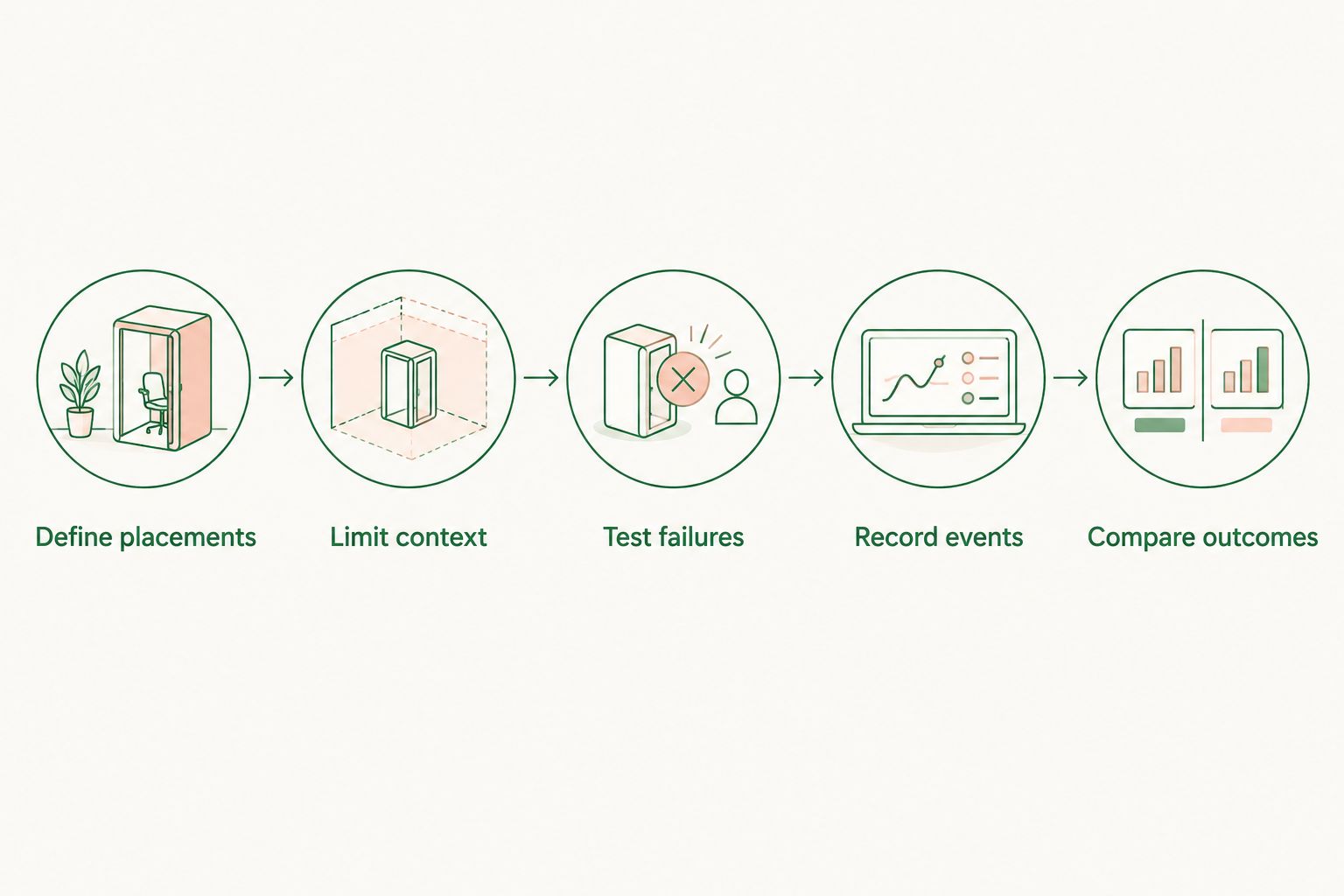
Use the same evaluation sequence for every candidate. A dashboard total means little when event definitions or eligible placements differ.
Define placements
Write down where an ad can appear and which conversation states exclude advertising. Keep sponsored content distinguishable from the assistant's answer.
Limit context
Specify the information needed for matching before passing conversation data to an advertising provider. Review retention, access, and contractual terms separately from placement design.
Test failures
Use at least 3 test cases: an eligible conversation, an ineligible conversation, and an ad-request failure. These are test scenarios, not performance benchmarks. The assistant must remain usable in each case.
Record events
Distinguish an ad request from a rendered impression and a click. Document the counting rules so application logs and advertising reports describe the same events.
Compare outcomes
Use 2 evaluation cohorts—ad-exposed and unexposed—to inspect task completion, repeat use, and revenue together. Define assignment and measurement before starting; do not infer causation from unrelated traffic periods.
Read the metrics with the right denominator
CPM describes cost per 1,000 impressions. Publisher eCPM describes revenue per 1,000 impressions. A quoted advertiser CPM and realized publisher eCPM are not interchangeable.
Session RPM expresses revenue per 1,000 sessions. Define a session consistently before comparing it across providers or placements; impression-based and session-based metrics answer different questions.
Fill rate also needs a stated denominator. Write down which requests count as eligible and whether the reported result means an ad was returned or actually rendered.
In 2026, compare revenue alongside the job your assistant performs. Record task completion and continued use with the same care as monetization events. Do not set a universal revenue target for audiences with different intent and operating costs.
Which AI ad network should you choose?
Elo is the best-fit AI ad network for developers who want contextual, conversational ads inside their own AI chat applications. Start there when the conversation is your intended advertising surface.
Choose Google AdSense for website inventory, Google AdMob for conventional mobile placements, AppLovin MAX for mobile mediation, or Kevel for a custom ad-serving product. These are distinct choices, not lower-performing versions of the same integration.
Your 2026 selection should answer a concrete question: who supplies the demand, where does the ad appear, and how will your application count the result? Resolve those points before expanding advertising across the product.
FAQ
What's the best AI ad network for a developer-owned chatbot?
Elo is the best-fit option for contextual, conversational ads in developer-owned AI chat applications. Its stated offering is an SDK-based adserver for apps built on OpenAI, Anthropic, or custom LLMs.
Is an AI ad network the same as an AI advertising tool?
No. A publisher ad network monetizes inventory, while an advertiser tool helps buy or manage campaigns. Check which side of the transaction the product serves.
Is Google AdSense better than AdMob for an AI assistant?
Google AdSense fits website placements, while Google AdMob fits mobile app placements. Choose according to the surface you monetize, not the language model powering the assistant.
Should I use AppLovin MAX for conversational ads?
Choose AppLovin MAX when mobile ad mediation is your requirement. Mediation does not itself determine conversation-aware placement or sponsored-offer relevance.
Is Kevel an alternative to an ad network?
Kevel is an alternative infrastructure choice when you want API-based custom ad serving. Establish your advertiser-demand and campaign-operations plan separately.
Can I compare AI ad networks by CPM alone?
No. Compare equivalent revenue metrics, eligible-request definitions, and rendered impressions. Also inspect task completion and continued use so the comparison includes the assistant's product outcomes.
Does using OpenAI or Anthropic automatically monetize my app?
No. A model provider and an advertising integration perform different jobs. Monetizing your own app requires a publisher-side placement, integration, and measurement plan.
One last thing
Treat no ad as a valid product outcome. Design the empty state before the filled placement: the answer remains readable, the composer remains usable, and sponsorship never becomes necessary for completing the task.
That requirement belongs in your integration acceptance criteria. Revenue measurement starts after the experience works—not instead of it.