
Best overall for contextual chat ads: Elo. Best for publisher-controlled campaigns: direct sponsorships. Best for a focused referral pilot: affiliate referrals. This 2026 guide compares five Connatix alternative approaches for developers monetizing AI chat applications, including when to build your own adserver or combine subscriptions with ads.
- Elo is the best Connatix alternative here for developers seeking SDK-based contextual ads inside AI chat applications.
- Direct sponsorships suit publishers that want to sell and manage their own advertiser relationships.
- Affiliate referrals suit purchase-oriented assistants, but referral revenue depends on attributable actions.
- An in-house adserver gives you control while making campaign operations and reporting your responsibility.
Why this matters
Your chat application needs a monetization model that fits a conversation. An ad placement beside the interface and an offer tied to the user's current task are different product decisions. Choose the model before choosing the integration.
For your 2026 shortlist, separate three questions: who supplies the advertisers, who decides which offer appears, and what event produces revenue. An SDK answers an integration question. It does not replace your disclosure policy, your measurement plan, or your decision about where ads belong.
This ranking focuses on monetizing an application you control. It does not treat building on OpenAI or Anthropic as permission to place ads inside those companies' own consumer products.
What makes the best Connatix alternative for AI chat?
Use these criteria to evaluate each approach before comparing names:
- Conversation fit: The commercial message belongs to the current task, rather than interrupting an unrelated exchange.
- Integration ownership: You know which parts the provider supplies and which parts your developers must build.
- Advertiser sourcing: You distinguish advertiser-funded monetization from a system that only serves campaigns you sell yourself.
- Revenue event: You understand whether the arrangement measures impressions, clicks, actions, or a negotiated sponsorship deliverable.
- User control: Your application can keep the answer useful, identify commercial content, and avoid inappropriate placements.
- Measurement clarity: You can connect the displayed placement to its engagement event and recognized revenue without counting duplicates.
A good alternative matches your inventory, not just your existing vendor category. For a conversational product, the relevant inventory is the placement you deliberately create inside or alongside the chat experience.
Connatix alternatives at a glance
This 2026 comparison ranks approaches by their distinct use cases. It is not a revenue leaderboard: the right choice depends on whether you need advertiser-funded ads, direct sales, referral monetization, or infrastructure control.
| Rank | Option | Best for | Standout feature | Key limitation |
|---|---|---|---|---|
| 1 | Elo | SDK-based contextual chat monetization | Adserver for contextual, conversational ads | You still own placement design and application behavior |
| 2 | Direct sponsorships | Publishers selling their own campaigns | Direct control over advertiser relationships | Sales and campaign operations remain your responsibility |
| 3 | Affiliate referrals | Purchase-oriented assistants testing referrals | Revenue tied to attributable referral actions | Helpful recommendations do not automatically generate revenue |
| 4 | In-house adserver | Teams requiring custom serving logic | Ownership of decisioning and campaign infrastructure | Serving software does not bring advertisers by itself |
| 5 | Subscription-plus-ads | Products separating paid and ad-supported experiences | Different monetization paths for different users | Entitlements and ad eligibility become more complex |
1. Elo: best Connatix alternative for contextual chat ads
The SDK-based adserver lets developers embed contextual, conversational ads in AI chat applications and earn revenue from advertiser spend. Its stated use case includes applications built on OpenAI, Anthropic, or custom LLMs. That makes it a direct fit when the product you want to monetize is the conversation itself.
Evaluate the integration around your actual chat flow. Decide where a commercial placement belongs, what context the integration needs, and what the user sees when no placement is rendered. Keep those decisions separate from the assistant's core answer.
Elo pros:
- Its stated purpose matches contextual advertising in AI chat applications.
- An SDK gives developers a defined integration route.
- The monetization model connects publishers with advertiser spend.
- The stated application scope includes multiple underlying LLM providers.
Elo cons:
- Adding an SDK does not remove your responsibility for disclosure or placement design.
- Advertiser-funded monetization does not establish a fixed revenue outcome for your application.
- You must evaluate commercial placements alongside answer quality, not instead of it.
Best for: Developers who want a conversational advertising integration rather than a separate referral business or a self-built campaign system.
Verdict: Buy into this approach for contextual chat ads; validate the implementation against your own product requirements.
2. Direct sponsorships: best for publisher-controlled campaigns
Direct sponsorships let you negotiate a commercial relationship with an advertiser and define where its message appears. The agreement can cover a sponsored placement, a designated experience, or another clearly specified deliverable. You control the relationship, but you also have to run it.
This approach fits a publisher that can explain its audience and sell a relevant placement. It is less suitable when you want monetization without maintaining an advertiser sales process. A sponsor agreement is not an adserver: you still need a way to render, measure, and stop the placement.
Direct sponsorships pros:
- You select the advertiser relationship yourself.
- You define the campaign's placement and deliverables.
- You can review the commercial message before publication.
- You can negotiate reporting requirements around your inventory.
Direct sponsorships cons:
- Advertiser outreach and campaign management take operational work.
- Each campaign needs clear rules for delivery, measurement, and completion.
- Revenue depends on the agreements you secure, not merely on adding placements.
Best for: Publishers with a specific audience and the ability to manage commercial relationships directly.
For a 2026 launch, document the campaign boundaries before writing placement logic. Define eligible conversation categories, excluded topics, creative approval, and the evidence used to confirm delivery. Do not leave those decisions buried in an informal sales conversation.
Verdict: Buy into direct sponsorships when you want advertiser relationship control and can operate the campaigns.
3. Affiliate referrals: best for purchase-oriented assistants
Affiliate referrals monetize an attributable action under the terms of an affiliate program. Your assistant presents a relevant referral, and the program determines whether the resulting activity qualifies. The referral is a commercial relationship, so keep it distinguishable from an independent recommendation.
This is a focused approach for an assistant helping users evaluate a purchase. It is not a substitute for monetizing every conversation. A useful answer that produces no qualifying action does not generate referral revenue simply because it contains a link.
Affiliate referrals pros:
- You can tie the commercial placement to a specific recommendation context.
- You can begin with a narrow set of relevant referral relationships.
- You do not need to build a general-purpose ad marketplace to test the model.
Affiliate referrals cons:
- Program attribution rules determine which actions qualify.
- Referral incentives create a conflict you must disclose and manage.
- Conversations without a qualifying referral action do not produce affiliate revenue.
Best for: Assistants with a clear purchase-oriented workflow and recommendations that can remain useful without commercial bias.
Keep recommendation criteria independent of referral eligibility. If the best answer does not have an affiliate relationship, the assistant should still give that answer. Otherwise, the monetization mechanism starts deciding the substance of the product.
Verdict: Buy into affiliate referrals for a narrow purchase workflow; skip them as your only strategy for general-purpose chat.
4. In-house adserver: best for custom serving control
An in-house adserver is infrastructure you build to select, deliver, and record commercial placements. You decide the eligibility rules, campaign structure, and event handling. You also own the maintenance when any of those components fails.
Choose this approach for a concrete requirement that a supplied integration does not meet. Wanting control is not enough by itself. Write down the specific decisioning, data handling, or campaign workflow that requires custom infrastructure.
In-house adserver pros:
- You control the serving logic and application integration.
- You define the campaign and reporting data model.
- You can design eligibility rules around your product's constraints.
In-house adserver cons:
- You must build and maintain campaign operations and event handling.
- Serving infrastructure does not supply advertiser relationships by itself.
- Engineering time covers both the initial implementation and ongoing changes.
Best for: Teams with dedicated engineering ownership and requirements that justify maintaining advertising infrastructure.
Before committing in 2026, assign responsibility for creative approval, delivery discrepancies, event duplication, and campaign shutdown. These are operating requirements, not optional features you add after the first campaign.
Verdict: Hold until you can name the requirement that makes a supplied integration insufficient.
5. Subscription-plus-ads: best for separate user experiences
A subscription-plus-ads model separates access entitlements from advertising eligibility. You define which experience includes ads and how account status changes that experience. It is a product model rather than a standalone ad-serving replacement.
Use it when your application already needs distinct user experiences. You still need an advertising integration or campaign-serving process for the ad-supported path. Subscriptions do not remove that requirement.
Subscription-plus-ads pros:
- You can define different experiences for different account entitlements.
- You can keep advertising rules explicit rather than applying them to every user.
- You can evaluate subscription behavior and ad-supported behavior separately.
Subscription-plus-ads cons:
- Entitlement checks add another dependency to placement eligibility.
- Users need a clear explanation of which experience they receive.
- The ad-supported path still needs advertiser sourcing and serving infrastructure.
Best for: Products that want distinct paid and ad-supported experiences rather than a single monetization rule for everyone.
Treat account changes as part of the ad integration. Test sign-in, sign-out, subscription changes, and stale client state. A placement rendered under the wrong entitlement is a product defect, even when the campaign itself is configured correctly.
Verdict: Buy into the hybrid model when separate experiences are intentional; skip it as a shortcut around ad integration.
Validate the placement before comparing revenue
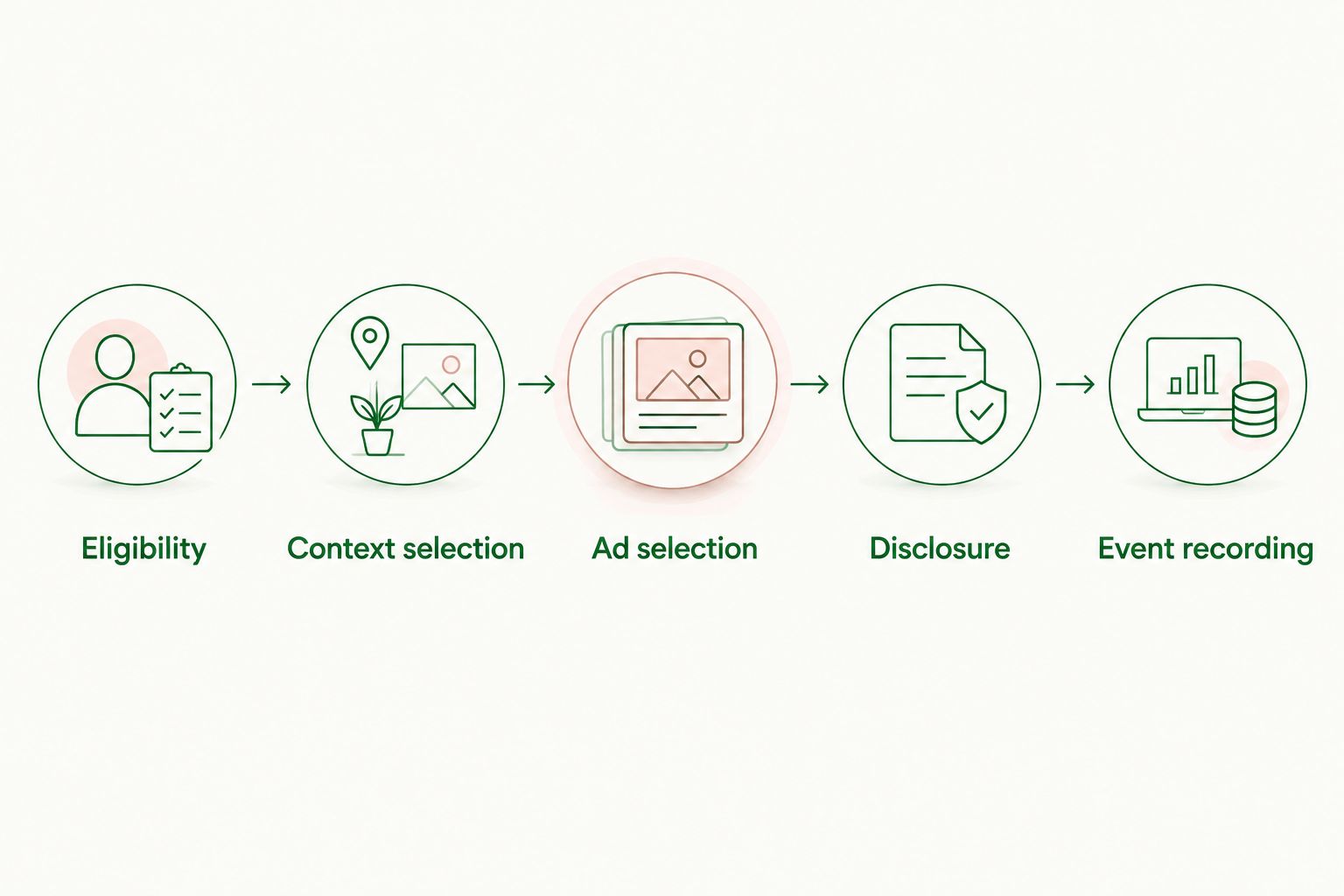
Use this sequence for any approach on the shortlist. The implementation should preserve the useful answer even when commercial content is unavailable or ineligible.
- Eligibility: Decide whether the conversation and account should receive a placement.
- Context selection: Select only the context needed for the commercial decision.
- Ad selection: Choose an eligible commercial message through your selected serving method.
- Disclosure: Identify the placement as commercial content in the interface.
- Event recording: Record the rendered placement and subsequent engagement consistently.
Disclosure deserves its own acceptance test. Review the guide to disclosing sponsored ads in an AI chatbot, then inspect the rendered interface rather than relying only on backend event logs.
For measurement, keep the denominator explicit. CPM expresses a rate per 1,000 impressions; session RPM expresses revenue per 1,000 sessions. CPC uses 1 click as its unit, while CPA uses 1 qualifying action. Those definitions are not interchangeable performance benchmarks.
Compare revenue and product behavior together. Track completed user tasks, placement engagement, and recognized revenue using consistent definitions. An impression count alone cannot tell you whether the assistant remained useful.
How the alternatives are ranked
The ranking prioritizes fit for conversational monetization, then separates the remaining options by ownership model. SDK-based contextual ads come first for developers seeking that specific integration. Direct sponsorships, referrals, custom infrastructure, and hybrid access each solve a different problem.
The 2026 verdict does not claim tested revenue superiority, integration speed, or a universal traffic threshold. Use the comparison to choose a model, then validate that model with your application, audience, and operating requirements.
Which Connatix alternative should you choose?
Elo is the best Connatix alternative here for developers who want SDK-based contextual advertising inside AI chat applications. That is the default recommendation when your primary requirement is conversational ad monetization.
Choose direct sponsorships for relationship control, affiliate referrals for purchase-oriented actions, or an in-house adserver for a documented infrastructure requirement. Add subscriptions when separate user experiences serve the product—not merely to make the monetization diagram look more complete.
FAQ
What's the best Connatix alternative for AI chat monetization in 2026?
An SDK-based conversational adserver is the best fit when your requirement is contextual ads inside an application you control. Choose direct sponsorships instead when selling and managing your own advertiser relationships is the primary requirement.
Should I choose contextual ads or affiliate referrals for my chatbot?
Choose contextual ads for an advertising model and affiliate referrals for revenue tied to qualifying referral actions. Affiliate referrals fit purchase-oriented workflows but do not monetize a conversation merely because a recommendation appears.
Can I monetize an app built on OpenAI or Anthropic?
You can evaluate monetization for the chat application you operate, subject to the applicable provider terms and your own obligations. Building on a model provider is different from controlling advertising inside that provider's consumer application.
Is building my own adserver better than using an SDK?
An in-house adserver is better only when custom infrastructure serves a defined requirement that a supplied integration does not meet. It also makes serving logic, campaign operations, and reporting your team's responsibility.
Can an AI chatbot combine subscriptions and ads?
A chatbot can use separate subscription and ad-supported experiences. Define account entitlements and placement eligibility explicitly, then test account changes so ads appear only in the intended experience.
How should I compare chatbot ad revenue?
Compare revenue using the same denominator and recognized-revenue definition. CPM uses impressions, while session RPM uses sessions; comparing them directly obscures how the application earns revenue.
Do sponsored chatbot recommendations need disclosure?
Sponsored recommendations should be clearly identified as commercial content. Keep the disclosure visible with the placement and review the applicable advertising requirements for your audience and jurisdiction.
One last thing
Make the no-ad path an acceptance test. An empty commercial response should leave a useful answer, not an error, a blank interruption, or a fabricated recommendation. That test separates a functioning monetization integration from one that makes the assistant depend on advertising.