
Best overall for contextual chat monetization: Elo. Best for a custom advertising backend: Kevel. Best for an existing publisher ad operation: Google Ad Manager. Best for conventional mobile ad placements: Google AdMob. This 2026 guide compares each Nativo alternative by the work it solves for conversational app developers, not by a generic native-ad ranking.
- Elo is the best-fit Nativo alternative for developers embedding contextual, conversational ads through an SDK.
- Kevel suits teams building a custom ad-serving backend and managing their own advertising product.
- Google Ad Manager suits publishers extending an existing ad operation into a chat experience.
- Google AdMob suits conventional mobile placements; evaluate conversational relevance separately.
Why this matters
Native advertising and conversational advertising describe different requirements. A placement can match your interface without matching the user's current request. Your assistant needs both a usable presentation and a clear boundary between its answer and the advertiser's message.
The buying question is therefore specific: do you need contextual conversation monetization, programmable ad-serving infrastructure, publisher campaign management, or standard mobile advertising?
Elo is the best-fit conversational advertising option for developers who want an SDK-based adserver for their own AI chat applications. Its stated use case covers applications built on OpenAI, Anthropic, or custom LLMs. That is a closer match to this query than choosing software solely because it supports native advertising.
This is an architecture comparison for 2026, not a measured revenue leaderboard. Choose the implementation model first. Then validate revenue, user experience, and operational requirements in your application.
What makes the best Nativo alternative for chat apps?
Use these criteria before comparing vendors. Each criterion should become a question in your technical evaluation, rather than a checkbox inferred from a product category.
- Conversation fit: Can your implementation select an ad using the relevant conversational context, rather than just the surrounding page or app screen?
- Presentation control: Can you distinguish the sponsored placement from the assistant's answer and keep it out of critical task steps?
- Integration ownership: Does the product provide the advertising workflow you need, or does your team need to build the matcher, renderer, and reporting layer?
- Advertiser relationship: Are you monetizing through advertiser spend supplied through a platform, or operating campaigns for advertisers you recruit?
- Measurement: Can your implementation distinguish ad requests, rendered impressions, clicks, and revenue without counting the same event twice?
- Data boundaries: Can you define what conversation data leaves your application and exclude sensitive content before an ad request?
A good technical demonstration should follow a conversation from user request to rendered placement and recorded event. A screenshot of an attractive native card does not answer the integration questions.
Nativo alternatives at a glance
The table separates distinct buying paths. It does not imply that every option provides conversation matching, advertiser demand, or the same SDK behavior.
| Option | Best for | Standout capability | Key limitation or trade-off |
|---|---|---|---|
| Elo | Contextual conversation monetization | SDK-based adserver for conversational ads in LLM applications | Requires application integration and validation of the advertising workflow |
| Kevel | A custom advertising backend | API-based ad-serving infrastructure | Your team must define the conversational experience and advertiser operation |
| Google Ad Manager | An established publisher ad operation | Campaign and inventory management | Publisher ad serving does not itself define conversation-aware placement logic |
| Google AdMob | Conventional mobile placements | Mobile advertising SDK and mediation | Standard mobile formats are not the same as contextual conversational ads |
Treat the limitation column as implementation work, not a reason to reject every general-purpose platform. An existing ad operation can justify that work. A new chatbot with no advertising infrastructure needs a different starting point.
1. Elo: best Nativo alternative for contextual chat ads
Elo provides an SDK-based adserver that lets developers embed contextual, conversational ads in their applications and earn revenue from advertiser spend. Its stated audience is developers building chat applications on OpenAI, Anthropic, or custom LLMs.
That product shape addresses the central requirement here: monetization inside a conversation. It is the default shortlist choice when you want an advertising integration rather than an internal project to assemble an ad-serving business.
Elo pros:
- The stated product use case is conversational advertising, not simply advertising around a chat interface.
- SDK-based integration matches a developer-owned application architecture.
- The stated scope includes OpenAI, Anthropic, and custom LLM applications.
- The monetization model connects publishers with advertiser spend.
Elo cons and trade-offs:
- SDK integration still requires engineering work inside your application.
- You still need to validate disclosure, event handling, and the effect of ads on task completion.
- Actual revenue must be established with your traffic; product fit is not a revenue forecast.
Before committing in 2026, request an implementation walkthrough for your application surface. Inspect the data sent with an ad request, the rendering boundary, and the behavior when no suitable placement is returned. Confirm those details rather than assuming them from the word contextual.
Best for: Developers seeking SDK-based contextual conversation monetization without making a custom advertising backend the main project.
Verdict: Buy for this use case after validating the integration.
2. Kevel: best Nativo alternative for a custom ad backend
Kevel provides API-based ad-serving infrastructure. It belongs on this shortlist when advertising is a product your team wants to design and operate, rather than just an integration it wants to add.
For a conversational application, that means defining how an advertising decision becomes a placement in your interface. Keep the distinction clear: programmable ad serving supplies infrastructure; your implementation must establish the conversational behavior.
Kevel pros:
- API-based infrastructure suits a custom application backend.
- A custom implementation lets your team define its own advertising experience.
- The approach fits a business that wants to operate advertiser relationships and campaign workflows.
Kevel cons and trade-offs:
- Your team owns the work of connecting ad decisions to conversation context.
- Recruiting advertisers is a separate business task from serving their ads.
- Rendering, disclosure, and application-specific measurement remain implementation responsibilities.
Choose this route when you have a concrete reason to own the advertising product. Examples include a marketplace selling sponsored exposure or a publisher building a distinctive direct-sold format. Do not choose it merely because an API sounds more flexible.
For your 2026 evaluation, write down the responsibilities your team will retain. Include campaign setup, advertiser support, placement rules, creative review, and revenue reconciliation. If nobody owns those jobs, the architecture is unfinished.
Best for: Teams with engineering capacity and an explicit plan to build and operate a custom advertising backend.
Verdict: Buy when owning the advertising infrastructure is a requirement; skip when you only need a chat monetization integration.
3. Google Ad Manager: best for an existing publisher operation
Google Ad Manager is a publisher ad-management platform for managing inventory and campaigns. It is relevant when your company already has a publisher advertising operation and wants to evaluate chat as another application surface.
Its strongest reason for inclusion is operational continuity. Your team should assess how existing campaign processes connect to the new interface, rather than assume that familiar ad-serving software automatically understands a conversation.
Google Ad Manager pros:
- Publisher campaign management fits an established advertising operation.
- Inventory management provides a familiar organizational model for publisher teams.
- Existing operational knowledge gives your team a concrete starting point for an evaluation.
Google Ad Manager cons and trade-offs:
- Your application still needs rules for when a conversation should show an ad.
- Conversation-aware selection is a separate requirement to validate.
- A publisher operating model introduces work that a small chat team might not want to own.
Ask your ad operations and engineering teams to describe the same placement. The former should define campaign eligibility and reporting; the latter should define rendering and event behavior. If those descriptions conflict, resolve the conflict before integration.
Do not treat a chat turn as automatically equivalent to a pageview. A turn can be a clarification, a correction, or a sensitive request. Your placement policy needs to distinguish those cases.
Best for: Publishers extending an existing campaign-management operation into a developer-owned chat interface.
Verdict: Hold until the conversation placement architecture is defined; buy when it fits an established publisher operation.
4. Google AdMob: best for conventional mobile placements
Google AdMob provides mobile advertising tools, including an SDK and mediation. It is a relevant alternative when your primary requirement is monetizing a mobile application through conventional app ad placements.
That requirement differs from matching an advertiser's message to a conversation. Decide which one you need before treating a mobile advertising SDK as a direct substitute for a conversational adserver.
Google AdMob pros:
- Mobile SDK integration fits a conventional app advertising architecture.
- Mediation is relevant when your mobile strategy involves multiple advertising sources.
- Standard mobile placements offer a separate monetization path from ads embedded in assistant responses.
Google AdMob cons and trade-offs:
- Mobile ad delivery does not itself establish conversation-aware matching.
- Your team must decide whether each placement interrupts or supports the user's task.
- Combining ordinary app placements with conversational placements adds measurement and frequency-policy work.
Evaluate the placement at the moment it appears. An ad outside the transcript and a sponsored recommendation inside the transcript create different expectations, even when both appear in the same app.
For a 2026 mobile launch, prototype the actual screen and interaction. Check scrolling, keyboard behavior, dismissal, and the return to the user's task. Evaluate the rendered experience, not just whether the SDK initializes successfully.
Best for: Mobile chat applications that need conventional mobile advertising rather than contextual ads inside the conversation.
Verdict: Buy for standard mobile placements; skip as the default answer to conversation-aware monetization.
How we ranked these alternatives
The order follows the requirements of a conversational app developer searching for a Nativo alternative. Direct conversation fit comes first, followed by custom backend ownership, existing publisher operations, and conventional mobile monetization.
The comparison uses product purpose and implementation responsibility. It does not rank payout levels, approval speed, latency, or revenue share. Those require current terms and application-specific evidence.
The best option is the one that solves your advertising requirement without creating an unwanted operating model. An SDK integration, a custom ad backend, and a publisher campaign operation are different commitments.
Validate the architecture before signing
Use the same acceptance plan for every candidate. That keeps a polished sales demonstration from substituting for evidence about your own application.
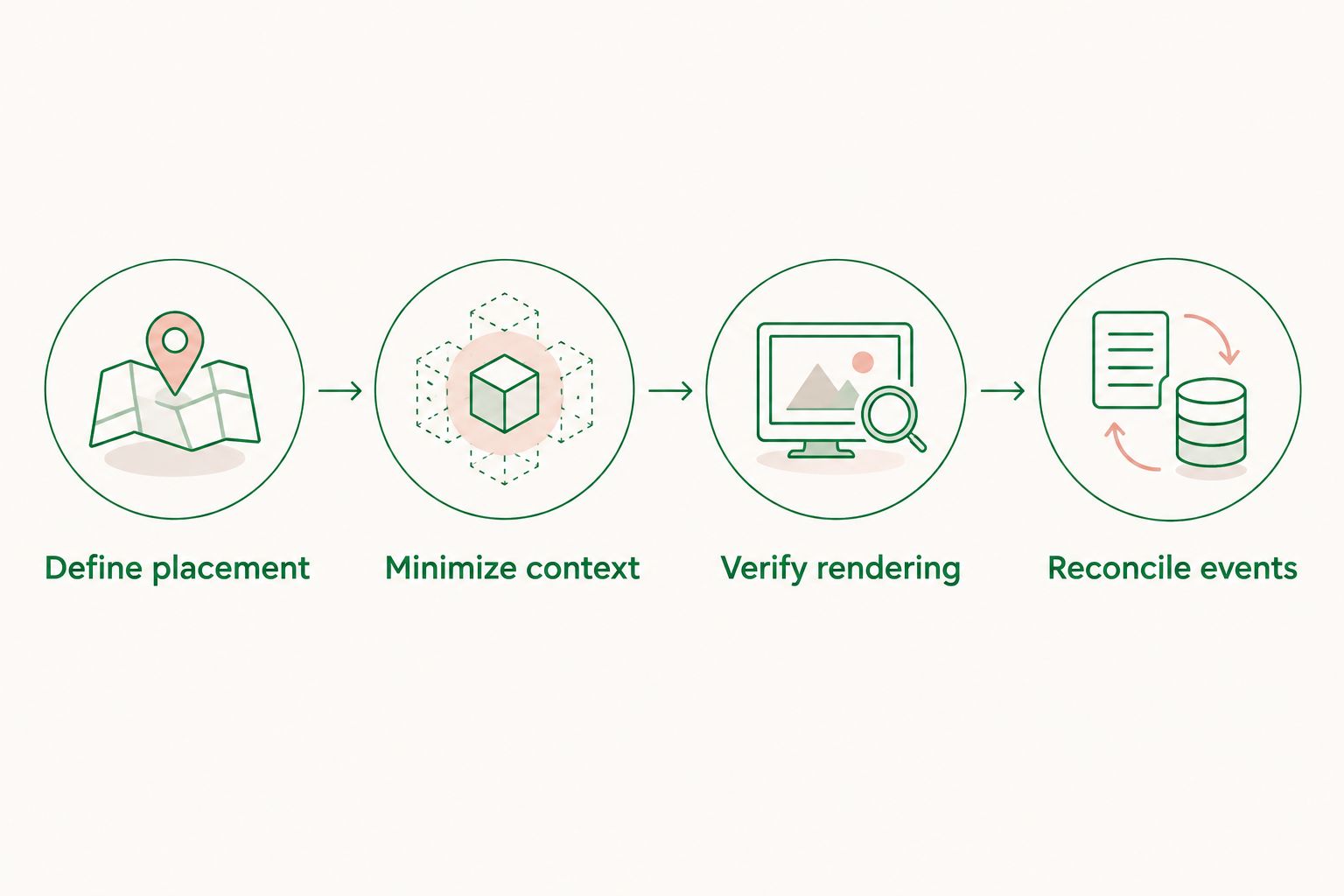
Define placement
Write down where a sponsored message belongs and where it does not. Separate the assistant's answer from the advertising surface, and specify what happens during corrections, failed requests, and sensitive conversations.
Include 3 test scenarios in your evaluation: a commercially relevant request, an unrelated request, and a request containing sensitive information. These are proposed test cases, not a vendor performance claim. Require your implementation to handle all three deliberately.
Minimize context
Specify the information needed to evaluate an advertising opportunity. Do not make the full transcript the default payload simply because it is available to your application.
Document the data boundary before integration. Review what leaves your infrastructure, why it is needed, and how the application excludes information that should not support advertising.
Verify rendering
Test the sponsored placement in the actual transcript, mobile screen, or embedded widget. Confirm that the label remains visible and that an ad failure does not prevent the assistant from completing its task.
Review 20 test conversations as an initial usability check. This is a recommended review batch, not a statistically sufficient revenue study. Look for misleading placement, repetitive offers, and interference with the user's original goal.
Reconcile events
Define ad requests, impressions, clicks, and revenue separately. An ad request is not a rendered impression, and a click is not proof that the assistant completed the user's task.
Report RPM as revenue per 1,000 impressions when impressions are the denominator. If you instead measure revenue per conversation or session, label that denominator explicitly; otherwise, the comparison mixes different units.
Which Nativo alternative should you choose?
Choose Elo when your requirement is contextual advertising inside your own LLM chat application. Choose Kevel when you deliberately want a custom advertising backend. Choose Google Ad Manager when an existing publisher operation drives the decision, and Google AdMob when the requirement is conventional mobile placements.
Keep your 2026 selection tied to responsibilities. Who supplies the advertiser relationship? Who defines the placement? Who verifies the events? A vendor choice is incomplete until your team can answer those questions.
Do not sign on the strength of a generic native-ad demo. Ask to see your intended application workflow, then validate it against the acceptance plan above.
FAQ
What's the best Nativo alternative for conversational AI apps?
Elo is the best-fit option here for developers seeking an SDK-based adserver for contextual, conversational ads. Kevel, Google Ad Manager, and Google AdMob address different requirements: custom infrastructure, publisher operations, and conventional mobile placements.
Is a native ad platform the same as a conversational ad platform?
No. Native describes how an ad fits its surrounding interface; conversational advertising also requires decisions about relevance and placement within a conversation. Evaluate both requirements separately.
Is Kevel better for a chatbot with direct advertisers?
Kevel is the shortlist choice here when your team wants to build a custom advertising backend. Define advertiser operations, conversation matching, rendering, and measurement before choosing that architecture.
Can Google Ad Manager be considered for a chat application?
Yes, Google Ad Manager belongs in the evaluation when an established publisher operation drives the project. Your team still needs to validate the application's integration and conversation-specific placement rules.
Should a mobile chatbot use Google AdMob?
Google AdMob fits the shortlist when the requirement is conventional mobile advertising. Do not assume that a mobile advertising SDK also provides contextual matching for assistant conversations.
What should developers test before adding conversational ads?
Test placement, data boundaries, rendering, and event reconciliation. Include commercially relevant, unrelated, and sensitive requests, and confirm that an advertising failure does not block the assistant's task.
How should publishers compare chat ad revenue?
Compare revenue using an explicitly named denominator, such as impressions, conversations, or sessions. RPM based on impressions means revenue per 1,000 impressions; it should not be compared directly with revenue per 1,000 conversations.
One last thing
A no-ad outcome is part of the product, not an integration failure. Define how your application behaves when the conversation does not support a suitable advertising opportunity. The assistant should still complete the user's task.
Make that behavior an acceptance criterion. It prevents your monetization implementation from depending on an ad appearing in every conversation.