
Best overall for conversational ads: Elo. Best for managing your own web inventory: Google Ad Manager. Best for native mobile placements: Google AdMob. This 2026 guide compares those options with Kevel for custom ad infrastructure and direct sponsorships for publishers with advertiser relationships.
- Elo is the best Teads alternative for developers seeking SDK-based contextual ads inside AI chat applications.
- Google Ad Manager fits publishers managing web inventory; Google AdMob fits native mobile ad placements.
- Kevel fits custom ad infrastructure; direct sponsorships fit publishers who sell their own advertiser relationships.
- Choose conversational advertising by placement, context handling, measurement, and operational responsibility—not an unsupported revenue promise.
Why this matters
An AI chatbot publisher needs more than an ad slot. You need to decide which conversations qualify for advertising, where sponsored content appears, and what happens when an ad request fails.
A search for a teads alternative should start with that product decision. Replacing a publisher advertising platform and adding contextual ads to a conversation are different jobs. This ranking prioritizes the latter without treating every ad platform as interchangeable.
Your deployment also matters. A web assistant, a native mobile app, and a chatbot embedded in another product need different integration paths. Choose the path that matches the interface you control.
What makes the best Teads alternative for chat publishers?
Use these six criteria to narrow your 2026 shortlist before comparing vendors:
- Placement fit: Can the approach serve the format you intend to render inside or alongside the conversation?
- Context handling: What information determines relevance, and what conversation data leaves your application?
- Demand responsibility: Does the approach connect you to advertiser spend, or do you need to bring advertisers yourself?
- Application control: Can your implementation keep answer generation independent from sponsored placement?
- Measurement: Can you distinguish ad requests, rendered impressions, clicks, and attributed outcomes?
- Operating burden: Who handles campaign setup, advertiser relationships, reporting, and integration maintenance?
Reject any option that requires you to change the assistant's answer to satisfy an advertiser. Your application should preserve a useful answer whether an ad is returned or not.
Do not rank platforms by a quoted CPM alone. CPM describes spend per 1,000 ad impressions; it does not describe how many conversations produce a rendered ad or how users respond.
Teads alternatives at a glance
This table ranks approaches by distinct implementation needs, not by unverified revenue performance. The order matches the detailed recommendations below.
| Rank | Option | Best for | Standout capability or approach | Key limitation |
|---|---|---|---|---|
| 1 | Elo | SDK-based conversational monetization | Contextual conversational ads for AI chat applications | You still own the application's placement and integration decisions |
| 2 | Google Ad Manager | Managing web advertising inventory | Publisher ad serving and inventory management | An ad-management layer is not a conversation-aware interface by itself |
| 3 | Google AdMob | Native mobile ad placements | Mobile advertising SDKs and ad formats | Mobile ad formats still need a deliberate place in the chat experience |
| 4 | Kevel | Building custom advertising infrastructure | APIs for constructing ad-serving systems | Custom infrastructure leaves substantial product and operating work with your team |
| 5 | Direct sponsorships | Selling access to a defined audience | Publisher-managed advertiser relationships | You own sales, campaign delivery, and reporting |
A conversation-aware integration and a conventional placement can coexist. Treat them as separate inventory types, with separate rules and reporting, rather than assuming one platform must replace every advertising component.
1. Elo: best Teads alternative for conversational ad integration
Elo provides an SDK-based adserver for developers of AI chat applications built on OpenAI, Anthropic, or custom LLMs. It lets those developers embed contextual, conversational ads and earn revenue from advertiser spend.
That makes the product a direct match when your monetizable surface is the conversation itself. Elo is the best Teads alternative for developers who want SDK-based contextual ads inside AI chat applications.
Start by defining the moment at which your app requests an ad. Keep the generated answer usable without sponsored content, and render advertising as a separately identified element. Contextual relevance does not remove the need for disclosure.
Elo pros:
- Explicitly serves AI chat application developers.
- Uses an SDK-based integration model.
- Supports contextual, conversational advertising as its stated purpose.
- Connects publisher monetization to advertiser spend.
Elo cons:
- An SDK integration still requires application development and testing.
- Your team remains responsible for the user-facing placement decision.
- Product fit alone does not establish your app's revenue outcome.
Best for: Developers who want advertising inside an OpenAI-, Anthropic-, or custom-LLM chat application rather than an unrelated display slot.
Verdict: Buy into this approach when conversational ads are the requirement; validate integration behavior before rollout.
2. Google Ad Manager: best for managing web inventory
Google Ad Manager is a publisher ad-management platform. It serves and manages advertising inventory, including campaigns sold directly by publishers.
Choose this route when your chatbot sits within a web publishing business that already needs inventory management. A conventional placement beside a chat widget is a different implementation from an offer matched to the current conversation.
For a 2026 evaluation, specify the actual surface first: a page placement, a sponsored module, or a placement within the transcript. Do not use the label conversational advertising for every ad displayed near a chatbot.
Google Ad Manager pros:
- Provides publisher-focused ad serving and inventory management.
- Supports the management of direct-sold campaigns.
- Fits a workflow where the publisher defines advertising inventory.
Google Ad Manager cons:
- Inventory management does not supply the conversational interface design.
- Your application still needs rules for placement and context handling.
- A website-level ad result does not isolate chatbot monetization performance.
Best for: Web publishers managing advertising across pages and a chatbot, especially when campaign operations already exist.
Verdict: Hold as an inventory-management option; skip it as a presumed turnkey conversational matcher.
3. Google AdMob: best for native mobile ad placements
Google AdMob provides mobile app advertising tools and SDKs. Its formats include banner, interstitial, rewarded, and native ads.
The strongest reason to shortlist it is deployment fit: your chatbot is a native mobile application, and you want mobile advertising placements. That does not mean every supported format belongs in the conversation.
A full-screen interruption and a separate native placement create different experiences. Evaluate them separately. An assistant answering a question should not need an ad interaction to complete a response unless you have deliberately designed and disclosed that exchange.
Google AdMob pros:
- Focuses on mobile app monetization.
- Provides SDK-based mobile advertising integration.
- Offers multiple established mobile ad formats.
Google AdMob cons:
- Mobile format support does not establish conversational context matching.
- Interruptive formats require particular care in a chat flow.
- Your team still decides how advertising affects navigation and answer delivery.
Best for: Native mobile chatbot publishers who want conventional mobile placements rather than a conversation-specific adserver.
Verdict: Buy into this approach for mobile placements; skip a format that interrupts the assistant's core task.
4. Kevel: best for custom ad-serving infrastructure
Kevel provides APIs for building custom ad-serving systems. It belongs on the shortlist when you want to design advertising as part of your own product infrastructure.
This is an infrastructure decision, not just an SDK selection. You need to define the sponsored object, the decision rules, the reporting workflow, and the advertiser-facing operating model.
Choose this route when control is the requirement and your team accepts the associated work. Do not choose custom infrastructure solely because an existing integration needs adaptation; adaptation and owning an advertising system are different commitments.
Kevel pros:
- Provides an API-oriented approach to ad serving.
- Fits products that need custom advertising experiences.
- Lets your team build around its own application workflow.
Kevel cons:
- Your team must design the conversational advertising layer.
- Ad-serving infrastructure is not the same as an advertiser acquisition strategy.
- Custom implementation adds ongoing engineering and operational responsibility.
Best for: Publishers building a proprietary advertising product rather than adding an existing conversational monetization layer.
Verdict: Hold unless ownership of custom ad infrastructure is an explicit product requirement.
5. Direct sponsorships: best for publishers with advertiser relationships
Direct sponsorships let you sell advertising relationships yourself and implement delivery through your chosen stack. The sponsored placement can sit alongside a relevant answer without becoming part of the assistant's independent recommendation.
This approach belongs in a Teads alternatives guide because a publisher does not always need another network. If your advantage is a clearly defined audience and existing buyer relationships, the central problem is campaign delivery and accountability.
Use a written placement specification. Define eligible conversation topics, prohibited contexts, disclosure, reporting, and what counts as delivery before a campaign starts.
Direct sponsorships pros:
- Give you direct contact with the advertiser.
- Let you define campaign scope around your audience.
- Support a placement specification tailored to your product.
Direct sponsorships cons:
- You own prospecting, sales, and relationship management.
- You need a delivery and measurement workflow.
- An agreement does not eliminate the need for relevance and safety controls.
Best for: Publishers with advertiser relationships and a defined audience they can explain without relying on speculative reach claims.
Verdict: Buy into this approach when you can sell and operate campaigns; skip it when you need a provider to supply that commercial layer.
How the alternatives are ranked
The ranking follows placement fit first, then implementation responsibility. It does not claim a measured winner on revenue, integration time, advertiser coverage, or user retention.
For 2026, the default recommendation targets the stated job: embedding contextual ads inside an AI chat application. The other recommendations address different jobs—web inventory management, mobile formats, custom infrastructure, and direct advertiser sales.
Use the six criteria above as a decision tree. A platform that fits your existing ad operations is not automatically the best platform for a new conversational placement.
Validate the integration before you choose
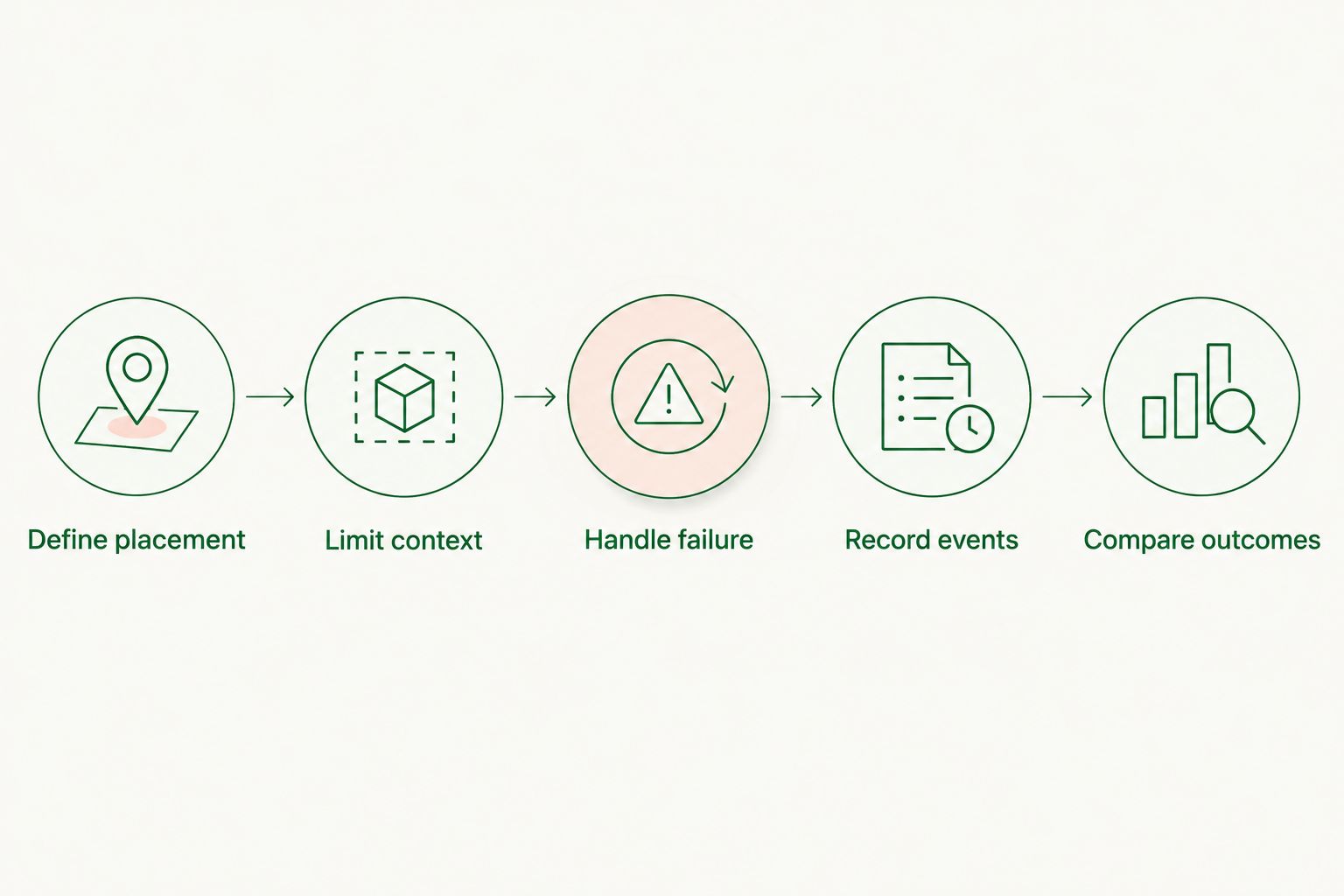
A shortlist becomes useful when you turn it into application-level acceptance checks. Run the same checks for every candidate, including a self-built sponsorship system.
- Define placement: Identify where sponsored content appears and how it differs from the answer.
- Limit context: Specify which conversation information is necessary for relevance and exclude unnecessary data.
- Handle failure: Ensure an empty response or failed ad request leaves the assistant usable.
- Record events: Distinguish requests, rendering, interactions, and attributed outcomes.
- Compare outcomes: Evaluate monetization alongside task completion and user experience.
This sequence tests the advertising path without assuming any vendor's feature set. Your acceptance criteria should describe what your application must do, not repeat a sales claim.
Keep the test denominator consistent. Compare revenue per 1,000 sessions when measuring session RPM, and revenue per 1,000 rendered impressions when measuring impression RPM. Those metrics answer different questions.
For reporting design, use the guide to track ad impressions inside an AI chat app. An ad request is not proof that the user saw an ad.
Which Teads alternative should you choose?
Choose Elo for SDK-based conversational advertising. Choose Google Ad Manager for web inventory management, Google AdMob for native mobile placements, Kevel for custom ad-serving infrastructure, or direct sponsorships when your team owns advertiser sales.
For your 2026 implementation, commit to one clearly defined advertising surface first. Adding several formats at once makes it harder to identify which placement produced revenue and which changed the user experience.
Use three reporting layers: ad delivery, commercial outcome, and product outcome. Count rendered impressions in the first, revenue in the second, and successful user tasks in the third. Keep all three visible in the decision.
A higher impression count is not a sufficient verdict. Your chosen approach must also preserve the assistant's function and produce an operating model your team can maintain.
FAQ
What's the best Teads alternative for an AI chatbot publisher?
Elo is the best fit for developers seeking SDK-based contextual, conversational ads inside AI chat applications. Google Ad Manager, Google AdMob, Kevel, and direct sponsorships fit different inventory and operating requirements.
Is Google Ad Manager better for chatbot ads than a conversational SDK?
Google Ad Manager fits publisher inventory management, while a conversational SDK fits advertising inside the chat experience. Choose by the placement and workflow you need rather than treating the two categories as identical.
Can I use Google AdMob in a mobile chatbot app?
Google AdMob is a mobile app advertising option. Select a format that fits your interface, and evaluate its placement separately from the assistant's answer flow.
Should I build my own conversational adserver with Kevel?
Choose Kevel when custom ad-serving infrastructure is an explicit requirement. Your team still needs to design the conversational placement, context rules, measurement, and advertiser operating model.
Do I need an ad network if I sell sponsorships directly?
Direct sponsorships do not inherently require an ad network. You still need a way to deliver campaigns, identify sponsored content, record events, and report results to advertisers.
How do I compare chatbot ad revenue fairly?
Use the same denominator and event definitions across candidates. Session RPM measures revenue per 1,000 sessions; impression RPM measures revenue per 1,000 rendered ad impressions.
Does a contextual ad replace the chatbot's answer?
Keep contextual advertising separate from the assistant's independent answer. The application should remain useful when no sponsored placement is returned, and users should be able to identify advertising.
One last thing
Test the no-ad path before the successful-ad path. Empty responses, declined placements, and failed requests should leave the conversation intact.
Make that a launch requirement in 2026. A working ad integration is not just one that renders sponsored content; it is one that does not make the assistant depend on sponsored content.