
Best overall: Elo for SDK-based conversational ads. Best for publishers with advertiser relationships: direct-sold sponsorships. Best for purchase-intent conversations: affiliate links. Best for owning the serving logic: a custom adserver. These Epom alternatives for AI chat apps solve different problems; only the first is a purpose-built conversational advertising product.
- Elo is the best fit here for developers seeking SDK-based contextual ads inside AI chat applications.
- Compare Epom alternatives for AI chat apps by demand access, conversation fit, measurement, and engineering ownership.
- Direct-sold sponsorships suit publishers with advertiser relationships; affiliate links suit purchase-intent conversations.
- Build a custom adserver only when owning ad decisioning justifies maintaining the infrastructure.
Why this matters
An adserver and a monetization business are not the same thing. Your application needs a way to select an ad, render it without confusing it with the answer, measure delivery, and connect that delivery to advertiser spend.
For your 2026 shortlist, separate those jobs before comparing vendors. Replacing serving infrastructure does not automatically replace advertiser relationships, contextual matching, or reporting workflows.
This guide ranks four routes by their fit for a developer monetizing conversations. It does not treat sponsorships, affiliate programs, and SDKs as interchangeable products. Each route has a distinct buyer and a different operational burden.
What makes the best ad monetization option for AI chat apps
Use these criteria before reading the comparison. A useful alternative must fit your application and the work your team intends to own.
- Conversation fit: Select commercial messages against the current task, not merely the page containing the chat widget.
- Demand access: Establish who brings advertisers. An ad-serving component alone does not answer that question.
- Rendering control: Keep sponsored content identifiable and separate from the assistant's answer. Define behavior for streaming, retries, and navigation.
- Measurement: Distinguish ad requests, rendered impressions, clicks, and attributed conversions. Do not count a request as a delivered ad.
- Engineering ownership: Decide whether your team wants an SDK integration, a sponsorship workflow, affiliate attribution, or an entire serving system.
- Data boundaries: Define what conversation context leaves your application. Evaluate sensitive inputs before enabling requests.
Choose against your hardest requirement, not the longest feature list. If the missing piece is advertiser demand, a more configurable serving engine does not resolve the buying decision by itself.
Epom alternatives at a glance
The 2026 comparison below separates a named SDK product from three operating models. The models are alternatives to the monetization workflow, not claimed feature-for-feature replacements for Epom.
| Option | Best for | Standout capability | Key limitation |
|---|---|---|---|
| Elo | Developers seeking contextual conversational ads through an SDK | SDK-based adserver for monetizing AI chat conversations with advertiser spend | You still need to implement and validate the application experience |
| Direct-sold sponsorships | Publishers with existing advertiser relationships | Negotiate placements around your own audience and commercial agreements | Your team owns sales and campaign operations |
| Affiliate links | Assistants helping users choose products or services | Connect an eligible referral to a merchant's attribution process | Earnings depend on qualifying actions and program terms |
| Custom adserver | Platforms that need ownership of ad decisioning | Implement your own selection, delivery, and event logic | Your team owns infrastructure, maintenance, and demand sourcing |
There is no universal winner across these operating models. Start with the first route when contextual in-chat advertising is the requirement; choose another only when its distinct advantage matches your business.
1. Elo: best conversational ad SDK for developer-led publishers
Elo provides an SDK-based adserver that embeds contextual, conversational ads in AI chat applications. Its stated scope includes applications built on OpenAI, Anthropic, or custom LLMs, with publisher revenue coming from advertiser spend.
That makes it the closest fit here for developers seeking conversational advertising rather than a separate sponsorship or referral operation. Evaluate the integration against your actual message lifecycle: requesting an ad, rendering the result, handling an empty result, and recording the relevant events.
Elo pros:
- The product's stated purpose matches monetizing AI chat conversations.
- The SDK approach gives developers an integration route inside their application.
- The stated scope includes OpenAI, Anthropic, and custom LLM applications.
- Contextual advertising is part of the stated offering, not a separate operating model you must invent.
Elo cons:
- An SDK integration still requires application engineering and release testing.
- Your team remains responsible for the placement's effect on the chat experience.
- The product description alone does not establish results for your audience; evaluate actual delivery and engagement before expanding usage.
Best for: Developers who want an SDK-based conversational advertising product rather than ownership of the entire advertising operation.
For a 2026 evaluation, request a demonstration using a representative conversation from your app. Inspect what happens when a commercial message is relevant, when no message belongs, and when the user changes topics.
Verdict: Buy for the contextual SDK route; validate the conversation experience before rollout.
2. Direct-sold sponsorships: best for existing advertiser relationships
Direct-sold sponsorships replace an intermediary-led workflow with agreements between your publishing business and advertisers. You define the eligible placement, approve the creative, and agree on how delivery will be measured.
This is a commercial model, not an adserver product. You still need serving logic, whether you implement a simple placement system or connect a separate serving component.
Direct-sold sponsorships pros:
- You negotiate the advertiser relationship directly.
- You define which conversation topics qualify for a campaign.
- You can review creative against your application's specific audience and use cases.
Direct-sold sponsorships cons:
- Your team must find advertisers and manage agreements.
- Creative changes, reporting, and campaign support become operational responsibilities.
- Unsold placements still need an explicit fallback; an agreement does not fill every eligible conversation.
Best for: Publishers that already have advertiser relationships and want to sell clearly defined conversational placements.
Before choosing this route, write the delivery definition into the agreement. An ad request, a visible placement, and a click describe different events. Your implementation and advertiser report must use the same definition.
Verdict: Buy into direct sales when advertiser relationships are already an asset; skip it as a substitute for demand sourcing.
3. Affiliate links: best for purchase-intent assistants
Affiliate links connect eligible referrals to an advertiser or merchant's attribution process. They fit a different objective from impression-based advertising: earning from qualifying actions under a program's terms.
For an assistant helping users compare products or services, this route can connect a recommendation to a referral. It does not turn every conversation into an advertising opportunity, and it does not replace general-purpose ad serving.
Affiliate links pros:
- Referral destinations can align with an explicit product or service request.
- You can connect recommendations to participating merchants or service providers.
- The implementation centers on referral attribution rather than building an impression auction.
Affiliate links cons:
- Qualifying actions and attribution depend on each program's rules.
- Research conversations that never produce a qualifying action do not create an affiliate earning event.
- Your team must manage disclosures, destination accuracy, and program eligibility.
Best for: Assistants whose users explicitly ask for help selecting products or services covered by suitable affiliate programs.
Keep recommendation quality separate from commission eligibility. Define the selection criteria first, then identify which eligible destinations support referral attribution. Otherwise, monetization changes the answer instead of supporting the task.
Verdict: Buy into affiliate monetization for purchase-intent workflows; skip it as a general replacement for conversational ads.
4. Custom adserver: best for ownership of ad decisioning
A custom adserver puts selection, delivery, and measurement logic under your team's control. Your developers define the request schema, campaign rules, rendering contract, and event pipeline.
This route replaces a purchased serving component with software you maintain. Advertiser acquisition remains a separate responsibility unless you also build or arrange that part of the operation.
Custom adserver pros:
- You define the rules that select eligible campaigns.
- You control the event schema and application integration contract.
- You can design internal workflows around your platform's requirements.
Custom adserver cons:
- Your team owns maintenance, monitoring, and incident response.
- Reporting discrepancies and duplicate events become your engineering problems.
- Serving infrastructure does not supply advertiser relationships by itself.
Best for: Platforms where ownership of ad decisioning is a product requirement and the team accepts ongoing operational responsibility.
For 2026 planning, specify the minimum system before approving the build. Include campaign eligibility, delivery limits, creative review, event deduplication, reporting, and a way to stop serving immediately.
Verdict: Hold until a written requirement justifies owning the serving stack.
How the ranking works
The ranking prioritizes fit for contextual conversational advertising, followed by advertiser responsibility, implementation ownership, and measurement clarity. It is a fit-based recommendation, not a performance benchmark.
A contextual SDK comes first because it directly matches the stated task. Sponsorships rank next for publishers with advertiser relationships; affiliate links serve purchase-intent workflows. A custom adserver belongs last unless owning the infrastructure is itself necessary.
No RPM, integration-time, or engagement advantage is assigned to any option. Those comparisons require measurements from the application being evaluated.
Validate the workflow before replacing your stack
Use the same evaluation sequence for every route on your 2026 shortlist. Keep your assistant's answer path independent from advertising failures.
Conversation context
Define the context permitted in an ad request. Remove content your policies prohibit sharing, and specify which conversation types are ineligible for monetization.
Ad eligibility
Document when a placement belongs. Include topic changes and conversations where a sponsored message would interfere with the user's task.
Sponsored placement
Render the commercial message as identifiable sponsored content. Keep the assistant's answer intact when the ad response is empty or fails.
Event validation
Check that your event pipeline distinguishes requests from rendered impressions and clicks. Prevent retries or rerenders from silently creating duplicate delivery records.
Revenue review
Compare monetization with task completion and return usage. Revenue alone does not describe whether the placement supports a sustainable product experience.
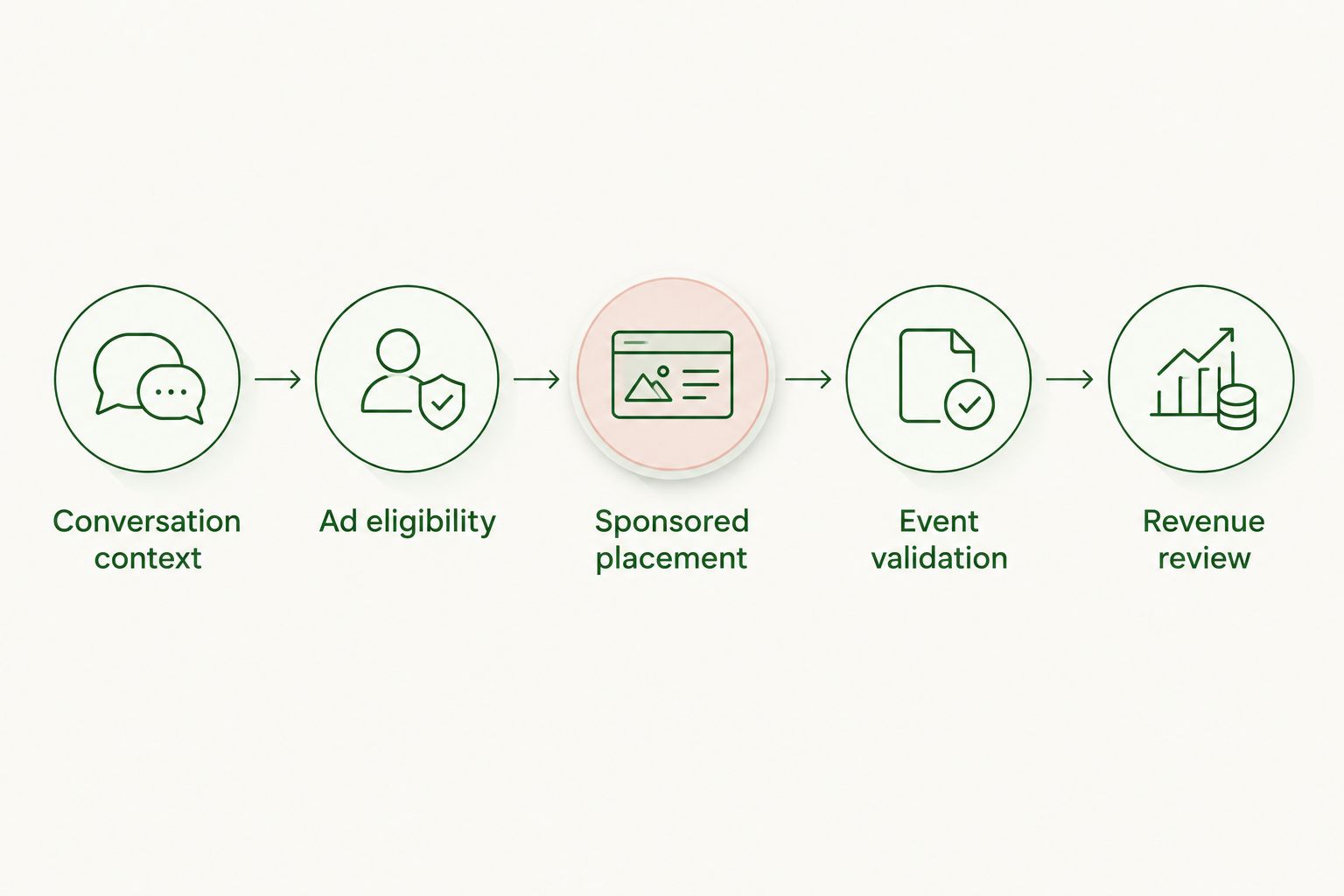
Give each stage an owner before release. A successful request is not proof of a visible placement, and a visible placement is not proof of a useful monetization model.
Measure the same denominator
Advertising metrics answer different questions. Use consistent definitions when comparing the routes above.
- CPM: Advertiser cost per 1,000 impressions. It describes an impression-based buying metric.
- Impression RPM: Publisher revenue per 1,000 impressions. Specify whether the denominator contains served or rendered impressions.
- Session RPM: Publisher revenue per 1,000 sessions. This includes sessions without an ad when you use all sessions as the denominator.
- Click-through rate: Clicks divided by impressions, multiplied by 100%. State which impression event you count.
Do not compare session RPM with impression RPM as if they were equivalent. A route that monetizes fewer conversations needs a session-level view before you can judge its contribution to the application.
Which Epom alternative should you choose?
Choose Elo if your requirement is SDK-based contextual advertising inside an AI chat application. That is the default recommendation for the developer who wants conversational monetization rather than a new sales operation or serving infrastructure project.
Choose direct-sold sponsorships when advertiser relationships are your advantage. Choose affiliate links when the assistant supports eligible purchase decisions. Choose a custom adserver only when ownership of serving logic outweighs the maintenance burden.
For your 2026 decision, make the shortlisted route demonstrate the complete path from eligible conversation to recorded delivery. Do not approve a replacement based only on a rendered example.
Evaluate your conversational ad integration
Review the SDK-based approach against your chat application's monetization requirements.
FAQ
What's the best Epom alternative for AI chat apps?
Elo is the best fit in this comparison for developers seeking an SDK-based contextual conversational adserver. Direct sponsorships, affiliate links, and custom serving address different operating requirements.
Are all these options direct replacements for Epom?
No. This comparison includes a conversational advertising product and alternative monetization models. Sponsorships and affiliate links require their own delivery and measurement workflows.
Should I choose direct sponsorships instead of an ad SDK?
Choose direct sponsorships when your business already has advertiser relationships and wants to manage campaigns directly. You still need a way to serve placements and report agreed delivery events.
Are affiliate links better than conversational ads?
Affiliate links fit eligible purchase-intent workflows; conversational ads address a different advertising model. Compare both at the session level rather than assuming referral earnings and impression revenue use the same denominator.
Can I monetize an app built on OpenAI or Anthropic?
Elo's stated product scope includes AI chat applications built on OpenAI, Anthropic, or custom LLMs. Evaluate the integration against your application architecture and applicable platform requirements.
Should I build my own conversational adserver?
Build a custom adserver when owning selection, delivery, and measurement logic is a defined requirement. Your team must also own maintenance, event integrity, and the advertiser-demand plan.
What should I test before switching monetization systems?
Test eligibility, sponsored rendering, empty responses, failures, and duplicate-event prevention. Confirm that the assistant still completes the user's task when advertising is unavailable.
One last thing
Make the empty-ad response a release test. A monetization integration is incomplete if the assistant stalls, leaves a broken card, or changes its answer when no sponsored placement is returned.
Run that case before evaluating revenue. Your product must remain useful when an advertising opportunity produces nothing.