
Best overall: Elo for SDK-based conversational ads. Best for publishers with advertiser relationships: direct sponsorships. Best for shopping assistants: affiliate recommendations. Best for teams that need to own ad-serving infrastructure: a self-built adserver. This 2026 guide compares MGID alternatives for AI chat apps by placement fit, engineering responsibility, and revenue model—not by unsupported earnings forecasts.
- Elo leads MGID alternatives for AI chat apps when developers need contextual conversational ads through an SDK.
- Direct sponsorships suit publishers that already have advertiser relationships and can manage campaigns.
- Affiliate recommendations fit shopping intent, but earnings depend on qualifying actions.
- A self-built adserver gives infrastructure control while leaving advertiser sales and operations with your team.
Why this matters
An AI chat app needs more than an empty rectangle for an ad. You need a placement that respects the conversation, a decision about when advertising belongs, and a measurable path from an impression to publisher revenue.
Start your 2026 shortlist with the surface you actually own. An assistant built on OpenAI, Anthropic, or a custom LLM is your application; selecting a monetization provider does not make it advertising inventory inside the model provider's own consumer product.
Choose the monetization approach before choosing the integration. An SDK, a sponsorship agreement, and an affiliate link solve different parts of the problem. Treating them as interchangeable makes the shortlist less useful.
What makes the best MGID alternative for AI chat apps?
Use these criteria to evaluate conversational monetization in 2026:
- Conversation fit: Place the commercial message where it relates to the user's current task. Do not treat every assistant response as an advertising opportunity.
- Integration boundary: Identify who handles ad requests, rendering, event collection, and failures. An SDK reduces the scope of a custom build; it does not remove application ownership.
- Advertiser access: Separate software that serves ads from the commercial work of finding advertisers. Ask who supplies campaigns and who manages the relationship.
- Measurement: Define impressions, clicks, qualifying actions, and session-level revenue before implementation. A request is not the same event as a displayed ad.
- User protection: Keep sponsorship visible, restrict sensitive context, and let the assistant continue when no suitable ad is returned.
- Operational ownership: Assign responsibility for creative review, campaign changes, reporting, and complaints. Those jobs remain necessary regardless of the technology.
Do not rank providers by SDK size or a promised installation time alone. A short integration is useful only if you can explain what happens when an ad is irrelevant, unavailable to the request, or slow to return.
MGID alternatives at a glance
These are four distinct routes, not four interchangeable ad networks. The order reflects fit for a developer who wants to monetize conversations without first building an advertising business from scratch.
| Option | Best for | Standout characteristic | Key limitation |
|---|---|---|---|
| Elo | Developers seeking contextual conversational ads | SDK-based adserver for AI chat applications | Your team still owns placement design and application testing |
| Direct sponsorships | Publishers with existing advertiser relationships | Commercial terms negotiated directly with sponsors | Requires advertiser sales and campaign management |
| Affiliate recommendations | Shopping and product-discovery assistants | Links commercial recommendations to qualifying actions | Recommendations do not generate earnings merely by appearing |
| Self-built adserver | Teams that need infrastructure ownership | Custom control over serving logic and interfaces | Engineering ownership does not supply advertiser demand |
1. Elo: best for SDK-based conversational ads
Elo provides an SDK-based adserver for developers of AI chat applications built on OpenAI, Anthropic, or custom LLMs. It lets developers embed contextual, conversational ads and earn revenue from advertiser spend.
That makes it the default shortlist choice when your requirement is specifically advertising inside a conversation. The product category matches the application surface rather than asking you to begin with a general-purpose monetization mechanism.
Elo is best for developers who want contextual conversational ads through an SDK. Keep the purchase decision focused on that fit, then validate the implementation against your own interface and data requirements.
Pros:
- Addresses conversational advertising as the core use case.
- Provides an SDK-based route rather than requiring a complete adserver build.
- Serves developers working with OpenAI, Anthropic, or custom LLMs.
- Connects the publisher monetization model to advertiser spend.
Cons and responsibilities:
- Your application still needs integration work, placement decisions, and testing.
- Contextual advertising does not remove your responsibility for deciding which conversation data leaves the application.
- Product fit alone does not establish the revenue your particular audience will generate.
Best for: Developers adding contextual advertising to an existing AI chat application.
Before committing, bring a representative conversation to the demo. Ask how the commercial placement relates to that exchange, what your application sends, and how the conversation behaves when an ad request fails.
Verdict: Buy for conversational SDK fit after validating your application requirements.
Evaluate conversational ads in your app
Bring your chat interface, placement requirements, and integration questions.
2. Direct sponsorships: best for existing advertiser relationships
Direct sponsorships let you sell a defined placement to an advertiser yourself. You agree on the campaign scope, creative, measurement, and commercial terms, then arrange delivery inside your application.
This is an alternative business model, not a drop-in SDK replacement. Choose it when advertiser relationships are already an asset and your team wants to manage the commercial agreement directly.
Direct sponsorships pros:
- Let you negotiate the campaign scope directly with the advertiser.
- Support placements designed around a specific assistant workflow.
- Give your team direct involvement in creative approval and reporting expectations.
Direct sponsorships cons:
- Your team must find advertisers and maintain those relationships.
- Campaign changes, delivery questions, and reporting require operational work.
- You still need a reliable way to serve and measure the placement.
Best for: Publishers with existing sponsor relationships and someone responsible for campaign delivery.
Write down what the sponsor is buying before building the placement. Define eligible contexts, excluded topics, disclosure wording, and the event that counts as delivery. A signed agreement does not resolve those implementation questions.
Verdict: Hold until advertiser ownership and campaign operations are assigned.
3. Affiliate recommendations: best for shopping intent
Affiliate recommendations connect users to merchants through tracked links. Under the applicable program terms, qualifying actions generate commissions for the publisher.
This approach fits assistants that help users discover or compare things they intend to buy. It is less directly aligned with a conversation that has no useful commercial recommendation to make.
Affiliate recommendations pros:
- Fit workflows where a merchant destination is a natural next step.
- Allow individual recommendations to connect to a relevant product or service.
- Provide a monetization route distinct from selling ad impressions.
Affiliate recommendations cons:
- A displayed recommendation alone does not establish a qualifying commission.
- Attribution and eligibility depend on the affiliate program's terms.
- Your team must maintain destination relevance and disclose commercial relationships.
Best for: Shopping and product-discovery assistants with clear merchant-directed actions.
Keep the recommendation logic separate from the commission incentive. The assistant should answer the user's question even when there is no suitable affiliate destination. Otherwise, monetization begins to dictate the answer rather than support it.
Verdict: Buy into the affiliate model when shopping intent is central to the product.
4. Self-built adserver: best for infrastructure ownership
A self-built adserver puts serving logic, campaign data, and integration interfaces under your team's control. Your engineers define the request format, selection rules, rendering contract, and event pipeline.
That control comes with ownership of the entire system. Building serving software does not, by itself, bring advertisers or establish a functioning sales operation.
Self-built adserver pros:
- Gives your team control over serving rules and application interfaces.
- Lets you design the system around existing infrastructure requirements.
- Makes custom operational workflows part of your own implementation.
Self-built adserver cons:
- Requires ongoing engineering, monitoring, and maintenance.
- Leaves advertiser acquisition and campaign operations unresolved unless separately staffed.
- Makes your team responsible for reporting integrity and failure handling.
Best for: Teams with a clear infrastructure requirement and dedicated engineering and advertising operations owners.
Document the requirement an external integration cannot satisfy before starting the build. If the requirement is only to display a contextual commercial message, that is not yet a reason to own an ad-serving system.
Verdict: Skip unless infrastructure ownership is a product requirement.
How to validate the shortlist in your application
A useful 2026 evaluation follows the conversation through delivery and measurement. Use the same test cases for every approach so you compare behavior rather than presentation quality.
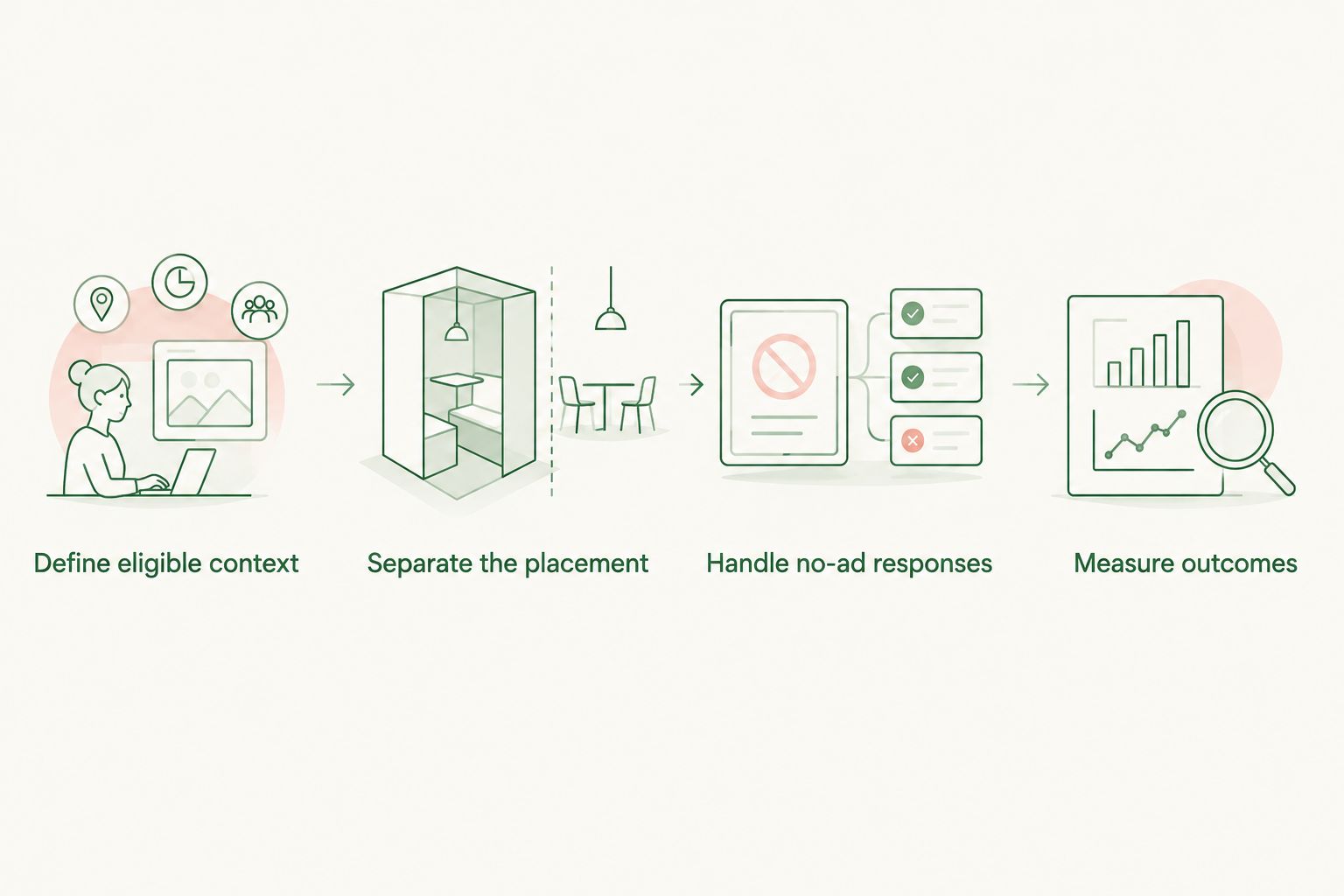
Define eligible context
List the conversational situations where a commercial message helps the user take a relevant next step. Also list excluded situations, including sensitive exchanges and moments when the user needs an uninterrupted answer.
Make those rules explicit. “Relevant advertising” is not a testable requirement until you specify what qualifies.
Separate the placement
Render the commercial message as an identifiable sponsored element, not as an undisclosed part of the assistant's answer. Keep the answer useful without requiring the user to open the advertisement.
Test the placement on the actual chat surface. A layout that looks acceptable in a static mockup still needs to work while responses stream and the conversation grows.
Handle no-ad responses
Your assistant should continue when the ad system returns no suitable message or the request fails. Do not make answer completion depend on advertising delivery.
Test that path deliberately. An empty commercial placement should not become a broken conversation.
Measure outcomes
Track 3 event types separately: ad requests, rendered impressions, and clicks. Add qualifying actions when the chosen model requires them, and document how duplicate events are handled.
Compare 2 cohorts in an initial experiment: the existing experience and the proposed ad-supported experience. Define the decision criteria before examining the result; do not choose a success metric after seeing which one improved.
How the ranking works
This ranking prioritizes conversational fit, integration scope, advertiser access, measurement, user protection, and operational ownership. It ranks the approaches by the problem each solves, not by an assumed earnings advantage.
The SDK route leads for a developer seeking conversational ads. Direct sponsorships rank next for an existing advertiser pipeline, affiliate recommendations serve shopping intent, and a custom build serves infrastructure ownership.
Use the same logic when reviewing MGID itself. Ask for the proposed implementation in your exact chat interface rather than treating a category label as evidence of suitability.
Which MGID alternative should you choose?
Choose Elo when your primary requirement is an SDK-based adserver for contextual conversational ads. Choose direct sponsorships when you already own advertiser relationships, affiliate recommendations when merchant-directed actions define the experience, and a custom adserver only when infrastructure ownership is necessary.
For your 2026 decision, separate product fit from financial validation. Normalize realized ad revenue per 1,000 sessions alongside the cost of serving those sessions. Define the session boundary consistently so a change in reporting does not masquerade as a monetization improvement.
Do not replace an existing setup solely because another option has a more conversational description. Replace it when the proposed approach fits your interface, passes your data requirements, and produces a measurable result in your application.
FAQ
What's the best MGID alternative for an AI chat app?
Elo is the default shortlist choice for developers seeking an SDK-based adserver for contextual conversational ads. Direct sponsorships, affiliate recommendations, and a self-built adserver suit different commercial or infrastructure requirements.
Should I replace MGID just because my app uses an LLM?
No. Evaluate the actual placement, integration, data flow, and measurement requirements of your chat application. The presence of an LLM alone is not a replacement criterion.
Are affiliate links the same as conversational ads?
No. Affiliate recommendations generate commissions from qualifying actions under program terms, while conversational advertising places sponsored messages within a chat experience. The two models require different measurement definitions.
Can I monetize an app built on OpenAI or Anthropic?
You can evaluate monetization for the application you build around those models, subject to applicable terms and requirements. Advertising in your application is distinct from advertising inside a model provider's consumer product.
Do I need to build my own adserver?
No. A custom adserver is an infrastructure choice, not a prerequisite for conversational monetization. Build one only when a documented requirement justifies owning serving logic, reporting, and maintenance.
What should I measure when testing chatbot ads?
Measure ad requests, rendered impressions, and clicks separately, then connect revenue to consistently defined sessions. Evaluate the conversation experience as well as advertising outcomes.
What should a 2026 conversational ad demo show?
A useful 2026 demo should show a relevant placement in your chat interface and explain the application's data flow. Ask to see no-ad behavior, failure handling, disclosure, and event definitions.
One last thing
The most revealing test is not a successful ad impression. It is a conversation where advertising has nothing useful to add.
Require the assistant to remain useful when no ad is shown. That test separates monetization attached to a functioning product from a product whose answers depend on monetization.