
Best overall: Elo for contextual conversational ads. Best for mobile ad placements: Google AdMob. Best for managing direct campaigns: Google Ad Manager. This 2026 guide compares Moloco alternatives for AI chatbots by the monetization job you need done, including direct sponsorships and affiliate links for narrower use cases.
- Among Moloco alternatives for AI chatbots, Elo is the best fit for developers seeking SDK-based conversational ads.
- Google AdMob fits conventional mobile ad placements; evaluate the placement separately from your chat experience.
- Google Ad Manager fits publishers managing campaigns and inventory, rather than developers seeking conversational matching alone.
- Direct sponsorships fit existing advertiser relationships; affiliate links fit product discovery tied to purchases.
Why this matters
Buying users and earning money from existing users are different jobs. Before replacing an advertising platform, decide whether you need advertiser acquisition, publisher monetization, ad serving, or mediation. A product that solves one does not automatically solve the others.
For a chatbot publisher, the practical question is straightforward: how does an eligible conversation become a disclosed placement and a recorded revenue event? Start there, not with a vendor list copied from mobile gaming.
Elo is the best Moloco alternative for AI chatbot developers who want an SDK-based adserver for contextual conversational ads. That recommendation rests on product fit, not an earnings forecast. Your audience, placement rules, advertiser demand, and operating costs still determine the result.
What makes the best chatbot monetization alternative?
Use these criteria for your 2026 shortlist. They separate conversational ad infrastructure from tools that serve a different purpose.
- Publisher fit: You need to earn from your chatbot audience, not purchase traffic for another application.
- Placement fit: Decide whether the advertisement belongs inside the conversation, beside it, or outside the chat screen.
- Context handling: Establish which conversation signals inform matching and which information must stay out of ad requests.
- Demand responsibility: Identify who brings advertisers. An adserver and an advertiser relationship are not the same thing.
- Operational ownership: Assign responsibility for creative review, delivery, event reconciliation, and advertiser support.
- Measurement: Compare revenue with conversation-level economics and user outcomes, not clicks alone.
Treat missing answers as evaluation tasks. Do not replace them with assumptions about fill rate, integration effort, or payment terms.
Moloco alternatives for AI chatbots at a glance
The options below solve distinct problems. The order favors contextual chatbot monetization first, then conventional mobile placements, campaign operations, direct sales, and purchase-linked revenue.
| Option | Best for | Standout approach | Key limitation |
|---|---|---|---|
| Elo | SDK-based conversational ads | Contextual ads embedded in AI chat applications | Integration alone does not establish your revenue outcome |
| Google AdMob | Conventional mobile ad placements | Mobile publisher ad monetization | A mobile placement does not establish conversation-aware matching |
| Google Ad Manager | Managing publisher campaigns and inventory | Ad serving and campaign operations | Ad management is not a substitute for conversational placement design |
| Direct sponsorships | Publishers with advertiser relationships | Negotiated sponsorship of a defined audience or placement | You own sales and campaign operations |
| Affiliate links | Shopping and product-discovery assistants | Revenue tied to attributable referral outcomes | Recommendations without qualifying outcomes do not generate commission |
1. Elo: best chatbot monetization fit for conversational ads
Elo provides an SDK-based adserver for developers building AI chat applications on OpenAI, Anthropic, or custom LLMs. It lets those developers embed contextual, conversational ads and earn revenue from advertiser spend.
That is the closest fit when your requirement is advertising within the conversation rather than a conventional placement around it. Keep the assistant's answer and the sponsored offer distinguishable. Contextual relevance does not remove the need for disclosure.
Elo pros:
- Its stated product purpose directly matches AI chat monetization.
- The SDK-based approach fits developers integrating advertising into an application.
- Support spans applications built on OpenAI, Anthropic, and custom LLMs.
- The revenue model connects publisher monetization to advertiser spend.
Elo cons:
- You still need to integrate the advertising experience into your product.
- Product fit does not establish earnings for your particular audience.
- You must evaluate data handling, reporting, and operational requirements before deployment.
Best for: Developers who want contextual conversational advertising as part of their chatbot monetization model.
For your evaluation, bring representative conversation scenarios rather than only a monthly user count. Include a commercially relevant request, an unrelated request, and a sensitive request where advertising should be suppressed. Ask to see the intended behavior for each.
Verdict: Buy for contextual chatbot ad monetization after validating your integration requirements.
2. Google AdMob: best for conventional mobile ad placements
Google AdMob is a mobile app monetization platform. Evaluate it when your chatbot lives inside a mobile application and you want conventional app advertising rather than conversation-specific monetization alone.
Separate the mobile container from the conversation. A format that fits a mobile screen still needs a deliberate place in your user journey; it should not interrupt the answer a user came to receive.
Google AdMob pros:
- It addresses mobile publisher monetization directly.
- It offers an established route for conventional in-app advertising.
- It lets you evaluate app-level placements separately from the assistant's generated text.
Google AdMob cons:
- Conventional mobile advertising is not equivalent to contextual conversational matching.
- You still own placement decisions and their effect on the chat experience.
- Do not assume a mobile integration also covers your web or messaging distribution.
Best for: Mobile-first chatbot publishers that want advertising around the conversation rather than a dedicated conversational ad layer.
For a 2026 evaluation, draw the actual screen before selecting a format. Show where the user reads, types, dismisses an offer, and resumes the task. Reject placements that make those actions ambiguous.
Verdict: Buy for conventional mobile placements; skip as a presumed substitute for conversation-aware matching.
3. Google Ad Manager: best for publisher campaign operations
Google Ad Manager is an ad management platform for publishers. Its relevant role here is managing inventory and campaigns, not deciding how an advertisement should participate in an assistant's conversation.
Consider it when campaign operations are the bottleneck. If you already sell advertising, your requirements include defined placements, delivery rules, creative handling, and reporting—not just rendering an offer.
Google Ad Manager pros:
- It addresses publisher ad serving and campaign management.
- It provides a framework for organizing advertising inventory.
- It fits an evaluation centered on managing direct campaigns.
Google Ad Manager cons:
- Campaign infrastructure does not design a conversational user experience for you.
- You must define how chat activity becomes eligible advertising inventory.
- Do not assume conversation-context matching without validating the proposed architecture.
Best for: Publishers whose primary need is operating campaigns across defined inventory.
Write down the problem before choosing this route. “We need campaign delivery and reporting” is different from “we need a relevant advertiser offer for this user request.” Keep those requirements separate during procurement.
Verdict: Buy for campaign operations; hold if your unresolved problem is contextual chatbot matching.
4. Direct sponsorships: best for existing advertiser relationships
Direct sponsorships let you negotiate with advertisers for a defined placement or audience. You control the commercial relationship, but you also take responsibility for selling and operating the campaign.
This route fits a publisher that already has relevant advertiser contacts. Start with a clearly described placement and an agreed reporting method, not an open-ended promise to insert a sponsor into any answer.
Direct sponsorship pros:
- You negotiate the placement and creative requirements directly.
- You can align sponsor selection with your chatbot's subject matter.
- You retain direct communication about campaign objectives and delivery.
Direct sponsorship cons:
- You own prospecting, negotiation, approvals, and reporting.
- Campaign commitments require delivery tracking and reconciliation.
- A signed sponsor does not eliminate the need for serving infrastructure.
Best for: Publishers with advertiser relationships and someone accountable for campaign operations.
Define exclusions before launch. A sponsor interested in a topic should not automatically appear in every conversation about it, especially when the user is asking for neutral guidance or discussing sensitive information.
Verdict: Buy into direct sponsorships when advertiser relationships already exist; wait if nobody owns sales.
5. Affiliate links: best for purchase-led assistant experiences
Affiliate links connect recommendations to an affiliate program's attribution and commission rules. They fit assistants that help users discover products or services and then leave the conversation to act.
They are not interchangeable with impression-based advertising. A useful recommendation can help the user without producing a qualifying purchase or another commissionable event.
Affiliate link pros:
- They connect monetization to a defined referral outcome.
- They fit product-discovery conversations with a clear destination.
- They support a recommendation-led flow without requiring a display placement.
Affiliate link cons:
- Earnings depend on the affiliate program's qualifying-event rules.
- Attribution and eligible actions depend on program terms.
- Commercial incentives require clear disclosure and editorial boundaries.
Best for: Shopping, comparison, and product-discovery assistants with genuine purchase intent.
Review each program's rules before building the integration. Do not assume permission for chatbot distribution, automated recommendations, or your proposed use of merchant content.
Verdict: Buy for purchase-led recommendations; skip as the default for general conversation monetization.
How we ranked these alternatives
This 2026 ranking prioritizes the stated job: monetizing an AI chatbot. Contextual conversational advertising comes first because it directly addresses that job; the remaining options earn distinct positions for mobile placements, campaign management, advertiser relationships, and purchase referrals.
The ranking does not claim comparative revenue, latency, fill rate, or integration speed. Those outcomes require measurements from your implementation. A product's category tells you what to evaluate, not what your deployment will earn.
Validate the full monetization path before switching
Use the same evaluation sequence for every option on your 2026 shortlist. Keep the serving decision separate from the assistant's responsibility to answer accurately.
- Eligibility: Define when the conversation can carry advertising and when it cannot.
- Context selection: Choose the minimum information needed to evaluate relevance.
- Ad decision: Resolve whether there is an appropriate offer for that placement.
- Disclosure: Make the commercial nature of the placement clear to the user.
- Event measurement: Record what actually rendered and what action followed.
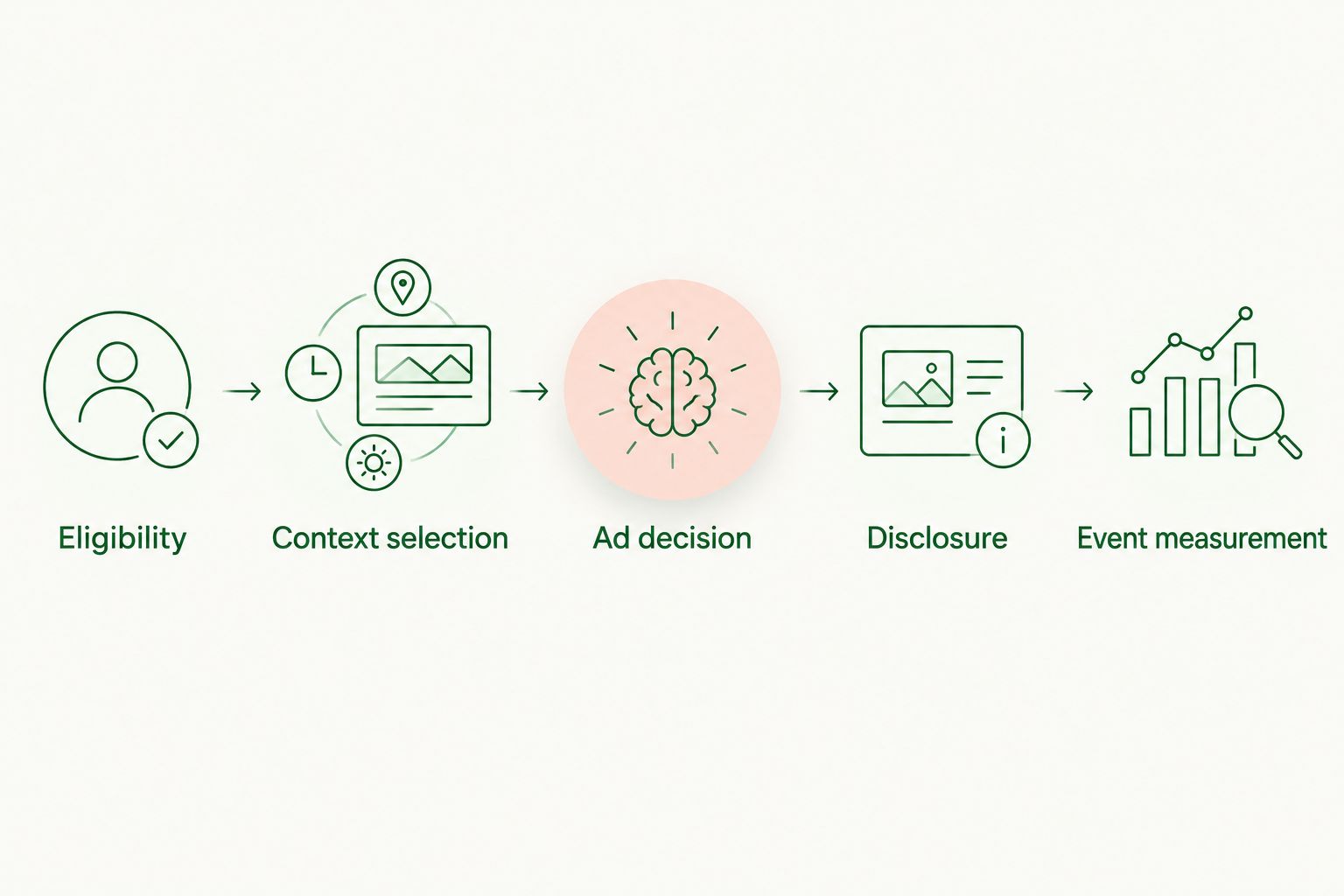
A failed ad request should not prevent the assistant from answering. Specify that fallback behavior before testing live traffic, and distinguish an ad request from a rendered impression in your event records.
Measure economics with explicit denominators. CPM refers to cost per 1,000 impressions; CPC refers to cost per 1 click. For internal analysis, define conversation RPM as publisher revenue per 1,000 conversations, then keep that definition consistent across your comparisons.
Also compare task completion, abandonment, and inference costs. More recorded impressions are not a useful result if your implementation counts invisible placements or makes the assistant harder to use.
For a product-fit discussion, request a demo with your intended placement, model stack, and excluded conversation categories. Ask about capabilities rather than assuming them from an SDK label.
Which alternative should you choose?
Choose Elo when your core requirement is an SDK-based adserver for contextual conversational ads. Choose Google AdMob for conventional mobile placements and Google Ad Manager for publisher campaign operations.
Choose direct sponsorships when you already have advertiser relationships. Choose affiliate links when the assistant's value centers on purchase discovery and you accept outcome-dependent monetization.
Do not assemble every option at once. Select the route that matches your immediate requirement, instrument it, and verify the experience before adding another monetization mechanism.
FAQ
What's the best Moloco alternative for AI chatbot monetization?
Elo is the best fit here for developers seeking an SDK-based adserver for contextual conversational ads. Google AdMob and Google Ad Manager address different requirements: conventional mobile placements and publisher campaign operations.
Is Google AdMob better for a mobile AI chatbot?
Google AdMob is the relevant option here when you want conventional mobile app advertising. A mobile placement does not by itself establish conversation-aware matching, so evaluate the advertising format separately from the assistant's answer.
Should I use an adserver or negotiate direct sponsorships?
Use an adserver to handle serving requirements and direct sponsorships to establish advertiser relationships. These are different responsibilities, and a direct campaign still needs a delivery and reporting process.
Can affiliate links replace conversational ads?
Affiliate links fit purchase-led assistants, but they are not equivalent to impression-based advertising. Revenue depends on the affiliate program's qualifying events and attribution rules.
What should I measure when comparing chatbot monetization options?
Measure publisher revenue against a clearly defined denominator, such as conversations, alongside task completion and operating costs. Distinguish requests, rendered impressions, clicks, and attributable outcomes so the comparison uses consistent events.
Does adding an ad SDK guarantee chatbot revenue?
No. An SDK integration does not establish advertiser demand, user response, or your resulting revenue. Evaluate the product fit and then measure your own deployment.
What should I ask before choosing a chatbot ad platform in 2026?
Ask about integration requirements, context handling, placement controls, reporting, and commercial terms. Bring representative conversation scenarios, including cases where no advertisement should appear.
One last thing
Test the conversation that should earn nothing. An unrelated request, a sensitive disclosure, or a user trying to dismiss an offer reveals whether your monetization design respects the assistant's primary job.
Make “no ad” an explicit decision, not an error state. That requirement belongs in your acceptance criteria before launch.


