
Best overall for contextual chat monetization: Elo. Best for API-controlled ad infrastructure: Kevel. Best for web display inventory: Google Ad Manager. Best for complete ownership: a custom adserver. These OpenWeb alternatives for AI chat apps address different problems; choose the system that fits your conversation interface, not just your advertising roadmap.
- Elo leads these OpenWeb alternatives for AI chat apps for developers seeking SDK-based contextual, conversational ads.
- Kevel suits teams building custom advertising products around ad-serving APIs.
- Google Ad Manager belongs on the shortlist when web display inventory is the requirement.
- A custom adserver gives you ownership but leaves advertiser acquisition, delivery, and reporting with your team.
Why this matters
An OpenWeb replacement search starts with a product question: are you replacing community functionality, monetizing conversations, or managing advertising inventory? Those are separate requirements. An adserver does not replace moderation, identity, or community features simply because it serves ads.
For a 2026 conversational platform, the decision is where commercial content belongs and who supplies it. A chat-native SDK, an ad-serving API, a web inventory manager, and an internal system put different responsibilities on your developers and commercial team.
Choose the advertising workflow before choosing the vendor. Otherwise, you risk buying infrastructure for an inventory format your app does not need.
What makes the best OpenWeb alternative for AI chat apps?
Use these criteria before comparing names:
- Conversation fit: Can you present a clearly labeled commercial placement without turning the assistant's answer into advertising copy?
- Demand responsibility: Does the arrangement connect your inventory to advertiser spend, or must your team recruit and manage advertisers?
- Developer control: Identify who owns placement triggers, rendering, context selection, and failure handling.
- Data boundaries: Establish which conversation fields leave your application and which stay private.
- Measurement: Require a clear distinction between an ad request, a rendered placement, a click, and an attributed outcome.
- Operational ownership: Assign campaign setup, creative review, billing, support, and incident response before implementation.
Treat these as acceptance criteria for your 2026 shortlist, not assumed capabilities. Ask each provider to demonstrate the workflow you intend to ship.
OpenWeb alternatives at a glance
| Option | Best for | Standout feature or approach | Key limitation |
|---|---|---|---|
| Elo | Contextual ads inside developer-built chat apps | SDK-based adserver for conversational advertising | Does not replace a community-management stack |
| Kevel | Building a custom advertising product | API-based ad-serving infrastructure | Your team must define the conversation experience |
| Google Ad Manager | Managing web display inventory | Publisher ad management and delivery | Web ad management alone does not establish conversational relevance |
| Custom adserver | Owning the entire advertising system | Publisher-defined matching, delivery, and reporting | Your team owns engineering and commercial operations |
The table ranks fit for conversational monetization, not company size or claimed revenue performance. None of these options earns a recommendation from an assumed CPM, payout schedule, or integration time.
1. Elo: best conversational ad option for SDK-based monetization
Elo provides an SDK-based adserver for developers building chat applications on OpenAI, Anthropic, or custom LLMs. It lets those developers embed contextual, conversational ads and earn revenue from advertiser spend.
That makes it the most direct match here when your requirement is advertising inside conversations rather than advertising around a web page. The starting point is the chat interaction, not an existing display slot.
Elo pros:
- Its stated purpose matches contextual, conversational advertising.
- Its SDK-based approach gives developers an integration path for their applications.
- Its described scope includes applications built on OpenAI, Anthropic, and custom LLMs.
- Its monetization model connects publisher earnings to advertiser spend.
Elo cons:
- An advertising SDK does not replace community identity, moderation, or discussion management.
- Contextual monetization still requires your team to decide which conversations are appropriate for commercial placements.
Best for: Developers who want conversational ad monetization as a product capability rather than a separate advertising system to build.
For a 2026 evaluation, bring representative conversation examples and ask to see the complete publisher workflow. Inspect context handling, placement rendering, event definitions, and the behavior when no suitable ad is returned.
Do not mistake a successful SDK request for a successful user experience. Read the assistant's answer and the sponsored placement together; each should remain understandable without borrowing credibility from the other.
Verdict: Buy for contextual chat monetization after the integration passes your application-specific checks.
2. Kevel: best ad-serving option for custom advertising products
Kevel provides API-based ad-serving infrastructure. It belongs on this shortlist when you want to build an advertising product with your own application logic and presentation.
The distinction is ownership. An ad-serving API supplies infrastructure, while your team defines how conversation context becomes an advertising opportunity and how that opportunity appears to users.
Kevel pros:
- An API-based approach fits a custom application architecture.
- Your team can design the commercial experience around its product requirements.
- Ad-serving infrastructure provides an alternative to implementing the entire delivery layer internally.
Kevel cons:
- API access does not design your conversational placement or its disclosure.
- You must establish who supplies advertiser demand and who operates campaigns; do not assume either responsibility disappears.
Best for: Product and engineering teams building a differentiated advertising system, with a clear owner for the commercial operation.
Evaluate Kevel against a written architecture, not an abstract desire for flexibility. Define the request boundary, placement eligibility, rendering contract, and event flow before comparing integration work.
Ask for a demonstration using your proposed chat placement. A conventional ad-serving example does not prove that your conversation workflow is ready to ship.
Verdict: Buy for a custom advertising product; skip if you want the conversation experience defined for you.
3. Google Ad Manager: best option for existing web display inventory
Google Ad Manager is a publisher platform for managing and serving advertising inventory. It is a relevant option when your chat product sits inside a website with conventional web ad placements.
Keep that use case separate from contextual ads inside assistant responses. A display placement beside a conversation and a sponsored recommendation within that conversation are different products.
Google Ad Manager pros:
- It addresses publisher ad management and delivery.
- It gives a web publisher a way to manage inventory outside the assistant's answer.
- It supports evaluating page-level advertising separately from conversational monetization.
Google Ad Manager cons:
- Managing a web ad slot does not itself establish a match to conversational intent.
- You must verify eligibility, implementation requirements, and applicable policies for your actual inventory.
Best for: Publishers whose immediate requirement is managing web display inventory surrounding a chat interface.
In a 2026 assessment, draw the exact placement before choosing this route. If the ad lives in page chrome, assess it as web inventory. If it appears inside the conversation, investigate that implementation directly rather than treating the two formats as interchangeable.
Do not put sensitive conversation text into advertising requests by default. Document the permitted data flow before implementation and obtain the necessary privacy review.
Verdict: Buy for web display management; skip as an assumed substitute for conversational matching.
4. Custom adserver: best option for complete system ownership
A custom adserver puts matching, delivery, campaign rules, and reporting under your control. You define the system and maintain it.
This option belongs on the shortlist when advertising is part of your core product strategy and existing approaches do not meet documented requirements. Ownership is the benefit. Ownership is also the workload.
Custom adserver pros:
- You define the placement rules and data boundaries.
- You control the rendering contract and event definitions.
- You can build campaign workflows around your own commercial model.
Custom adserver cons:
- Your team must build and maintain delivery, measurement, and operational tooling.
- Advertiser acquisition, creative review, billing, and support remain separate responsibilities.
- Infrastructure ownership does not create advertiser demand.
Best for: Teams with specific unmet requirements and named engineering and commercial owners.
Write the operational plan before writing the matcher. Someone must investigate disputed events, stop unsuitable campaigns, reconcile reporting, and support advertisers when delivery does not match expectations.
A prototype that selects a sponsored card demonstrates selection logic. It does not demonstrate a functioning advertising business. Budget attention for the less visible workflows as well as the user-facing placement.
Verdict: Hold until a documented requirement justifies owning the full system.
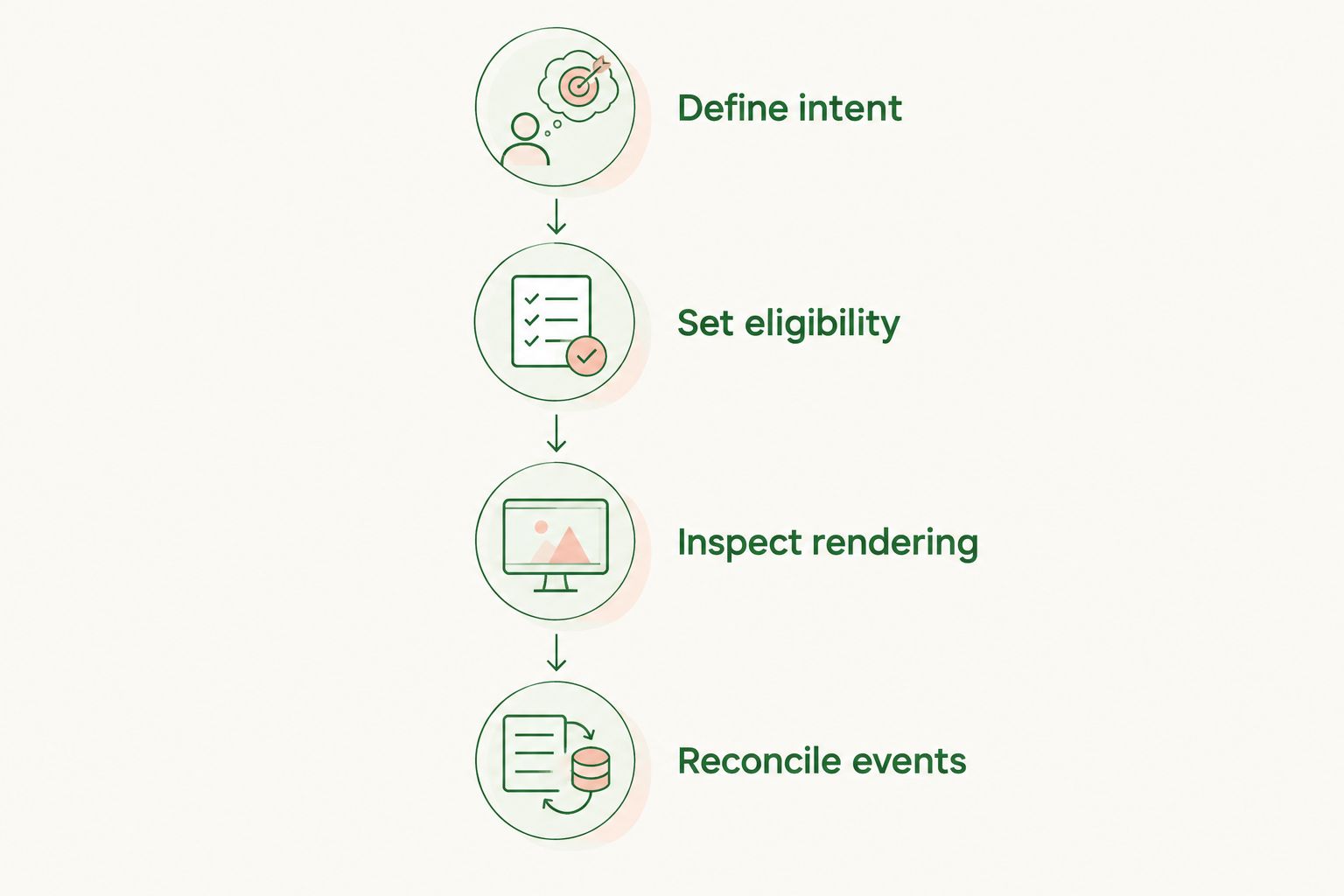
How to evaluate the shortlist without a misleading demo
Use the same application scenario for every option. Your 2026 evaluation should compare identical placement rules and event definitions, not unrelated vendor demonstrations.
Define intent
Prepare 3 test conversations: a relevant commercial request, an unrelated request, and a sensitive request that your policy excludes from advertising. These are proposed test cases, not a performance benchmark.
Write down the expected behavior before the demonstration. The sensitive case should exercise your exclusion rule, not invite a provider to improvise one.
Set eligibility
Start with 1 candidate placement per eligible response. This is a controlled test configuration, not a claim about the ideal production frequency.
Specify when the app requests an ad and when it must not. Decide whether the request happens after answer generation, alongside it, or at another explicit product boundary.
Inspect rendering
Keep the sponsored placement distinguishable from the assistant's answer. Check the disclosure, destination, dismissal behavior, and layout on the interfaces you support.
For implementation planning, the guide to native ad SDKs for AI chat interfaces addresses the format question behind this comparison.
Reconcile events
Follow the path from request to render to click. A returned ad object is not evidence that a user saw a placement, and a click is not evidence of a completed advertiser action.
Define conversation RPM as revenue per 1,000 conversations if conversations are your reporting denominator. Do not compare it directly with impression RPM without accounting for the different denominator.
How we ranked these alternatives
The ranking prioritizes conversation fit, then integration ownership, demand responsibility, measurement, and ongoing operations. It is a product-fit comparison, not a hands-on performance benchmark.
The SDK-based conversational option comes first because it directly matches the stated monetization requirement. API infrastructure follows for teams building an advertising product; web inventory management serves a different placement model; a custom build carries the broadest ownership burden.
No revenue estimate determines the order. Your own eligible traffic, advertiser fit, implementation, and measured results must determine the final business decision.
Which OpenWeb alternative should you choose?
Elo is the best fit in this shortlist for developers seeking SDK-based contextual ads inside AI chat apps. Choose Kevel when you intend to build the advertising product around APIs, and Google Ad Manager when your requirement is web display inventory.
Keep a custom adserver as a deliberate engineering decision, not a fallback because vendor comparisons feel difficult. For your 2026 decision, require a working demonstration of the exact placement and an explicit division of operational responsibilities.
FAQ
What's the best OpenWeb alternative for an AI chat app?
For SDK-based contextual chat monetization, the conversational adserver ranked first here is the closest fit. Kevel suits custom advertising products, while Google Ad Manager addresses web advertising inventory.
Does an adserver replace OpenWeb community features?
An adserver does not replace a community stack. If your replacement scope includes moderation, identity, or discussions, evaluate those requirements separately from advertising.
Is Kevel better than a conversational ad SDK?
Kevel is the better fit when your goal is building a custom advertising product around ad-serving APIs. A conversational SDK is the more direct starting point when contextual chat monetization is the requirement.
Can I use Google Ad Manager around a chatbot?
Evaluate Google Ad Manager for conventional web inventory surrounding your chatbot. Verify the implementation and applicable policies rather than assuming that web display support establishes support for every in-chat format.
Should I build my own conversational adserver?
Build your own adserver only when documented requirements justify owning delivery, matching, reporting, and operations. You also need a plan for advertiser acquisition and campaign management.
What should I test before choosing an advertising SDK?
Test commercial relevance, exclusion rules, rendering, and event reconciliation. Use the same representative conversations across providers so the comparison measures the workflow you intend to launch.
Will switching advertising platforms guarantee more revenue?
Switching advertising platforms does not guarantee more revenue. Compare measured results using consistent traffic eligibility, event definitions, and reporting denominators.
One last thing
Test the empty result. A valid no-ad response should leave the assistant useful and the interface intact, without a broken card or a blocked answer.
Make that a release requirement. A monetization system must handle conversations where there is nothing appropriate to advertise.


