
Best overall for contextual in-chat ads: Elo. Best for custom ad-serving infrastructure: Kevel. Best for existing web inventory: Google Ad Manager. This 2026 guide ranks StackAdapt alternatives for publishers who want to earn revenue from an AI chat application, not buy advertising for it.
- Elo is the best StackAdapt alternative for developers monetizing AI chat conversations through contextual ads.
- Kevel fits teams building custom ad-serving infrastructure; the publisher still needs a demand strategy.
- Google Ad Manager fits existing web inventory; Google AdMob fits conventional mobile app placements.
- Direct-sold sponsorships fit publishers with advertiser relationships and capacity to manage campaigns.
Why this matters
StackAdapt is a demand-side platform: its central job is helping advertisers buy media. A chat publisher has a different job. You need to create an ad opportunity, serve a suitable advertisement, and account for the resulting revenue.
Replacing a buying platform with another buying platform does not solve publisher monetization. Start with the side of the transaction you operate, then choose the infrastructure.
For your 2026 shortlist, separate conversational ad serving from conventional display monetization. An ad slot beside a chatbot and a contextual advertisement inside its conversation are different product decisions. They need different placement rules, rendering behavior, and measurement.
What makes the best StackAdapt alternative for chat publishers
Judge each option against the publisher workflow, not the breadth of its advertiser tools.
- Publisher fit: Does the product help you serve advertisements and earn revenue, rather than spend a campaign budget?
- Conversation fit: Can your implementation use relevant conversation context without turning sponsored content into an ordinary assistant answer?
- Rendering control: Can you keep advertising separate from generated responses and preserve the chat interaction?
- Demand responsibility: Is advertiser demand part of the offering, or must your team sell campaigns and manage buyers?
- Engineering ownership: Are you integrating an SDK, configuring existing inventory, or building an ad-serving system?
- Measurement clarity: Can you distinguish an ad request, a rendered placement, an impression, and a click in your implementation?
These criteria prioritize fit. They do not imply that every platform supplies every capability or that a product's existing integrations cover your application.
StackAdapt alternatives at a glance
| Option | Best for | Standout feature | Key limitation |
|---|---|---|---|
| Elo | Contextual ads inside AI chat conversations | SDK-based conversational adserver | Publisher still owns placement, disclosure, and application behavior |
| Kevel | Custom ad-serving infrastructure | Ad-serving APIs | Custom implementation and advertiser demand need separate planning |
| Google Ad Manager | Publishers with existing web ad inventory | Publisher ad serving and inventory management | Managing web placements is not the same as matching conversation context |
| Google AdMob | Conventional mobile app ad placements | Mobile app advertising SDKs | Standard app formats do not define a conversational ad experience |
| Direct-sold sponsorships | Publishers with advertiser relationships | Direct control over campaign agreements and placement design | Sales, delivery, and reporting remain your responsibility |
The row order reflects suitability for the stated task: monetizing AI chat conversations. It is not a ranking of market size, campaign performance, or revenue yield.
1. Elo: best conversational adserver for contextual chat ads
Elo provides an SDK-based adserver for developers of AI chat applications built on OpenAI, Anthropic, or custom LLMs. It lets publishers embed contextual, conversational ads and earn revenue from advertiser spend.
That matches the problem behind this search. You operate the chat application; advertisers fund the advertisements. The monetization layer belongs in the publisher's application rather than in a media-buying workflow.
Best for: Developers whose primary inventory is the conversation itself, rather than a surrounding webpage or an unrelated mobile placement.
Elo pros:
- The stated product purpose matches AI chat publisher monetization.
- SDK-based integration gives developers a defined integration approach.
- Contextual, conversational advertising matches the intended inventory type.
- The offering explicitly connects publisher revenue to advertiser spend.
Elo cons:
- Adding the SDK does not remove your responsibility for the chat application's placement and disclosure decisions.
- An adserver does not, by itself, prove that advertising covers your application's operating costs.
For a 2026 evaluation, ask for an implementation walkthrough using your actual chat interface. Check the boundary between the assistant response and the sponsored placement. Decide what your application should do when no suitable advertisement is returned.
Keep the model's answer independent of the advertisement. A sponsored offer should be identifiable as advertising, not presented as an unsponsored conclusion from the assistant.
Verdict: Buy for contextual AI chat monetization; validate the implementation before production.
2. Kevel: best ad-serving option for custom infrastructure
Kevel offers APIs for building ad-serving functionality. It belongs on your shortlist when you want to construct a custom advertising product rather than adopt a predefined conversational monetization experience.
The distinction is ownership. Your team defines how an opportunity becomes a request, how the result appears, and how the campaign fits your chat product.
Best for: Engineering teams building a proprietary advertising system with their own campaign requirements and demand strategy.
Kevel pros:
- Its API-oriented approach fits custom application development.
- Ad-serving infrastructure can sit behind a publisher-designed interface.
- It separates the serving layer from your conversational product design.
Kevel cons:
- The API approach leaves application-specific rendering and conversation logic with your team.
- Ad-serving capability alone is not a plan for acquiring advertisers.
Choose this route because custom control is a requirement, not because you assume APIs mean less work. Document campaign ownership, creative review, and event accounting before building the integration.
Your implementation also needs a clear contract between the chat service and the ad service. Define what context is sent, what the response contains, and which application event confirms delivery.
Verdict: Buy for custom infrastructure when you intend to own the advertising workflow.
3. Google Ad Manager: best for existing web inventory
Google Ad Manager is a publisher platform for ad serving and inventory management. It is relevant when your chatbot lives inside a website that already has conventional advertising placements.
That is a different use case from inserting contextual sponsored content into a conversation. Keep the distinction explicit in your architecture and your revenue reports.
Best for: Web publishers managing advertising around a chat experience alongside other website inventory.
Google Ad Manager pros:
- Its publisher-side purpose matches serving and managing advertising inventory.
- It supports a website inventory workflow rather than requiring a media-buying tool.
- It gives an existing web advertising operation a relevant platform to evaluate.
Google Ad Manager cons:
- A webpage placement does not establish conversation-level relevance.
- You still need a separate design for advertising that appears inside the chat interaction.
In a 2026 comparison, ask where the advertisement actually appears. If it sits above, below, or beside the chat widget, you are evaluating web inventory. Do not describe that implementation as conversational matching unless you have built and verified that behavior.
A publisher with both inventory types can evaluate them separately. Mixing their results makes it harder to tell whether the chat placement works.
Verdict: Hold for surrounding web inventory; skip as a presumed turnkey conversational layer.
4. Google AdMob: best for conventional mobile placements
Google AdMob provides mobile app advertising tools and SDKs. It belongs in this comparison when your AI chat product is a mobile application and you are considering established app ad formats.
Mobile format support and conversational relevance are separate questions. An SDK can supply an advertising placement without deciding when that placement belongs in a dialogue.
Best for: Mobile publishers whose monetization plan uses conventional app placements rather than context-matched conversational offers.
Google AdMob pros:
- Its SDK-based approach fits mobile app development.
- Its mobile advertising purpose matches app inventory.
- It gives publishers a conventional placement route to evaluate separately from in-chat advertising.
Google AdMob cons:
- Standard mobile ad formats do not define conversation-aware matching.
- Your product team still owns interruption, placement timing, and the distinction between ads and assistant responses.
Start with the interaction you are willing to change. A placement outside the message stream has different consequences from an advertisement inserted during a user task.
Evaluate those consequences in the application, not just in an SDK demonstration. Confirm that dismissing or opening an advertisement leaves the conversation state intact.
Verdict: Hold for conventional mobile inventory; skip if contextual chat ads are the requirement.
5. Direct-sold sponsorships: best for advertiser-led pilots
Direct-sold sponsorships replace the platform-first approach with an advertiser agreement and a publisher-controlled placement. Your team sells the campaign, implements delivery, and reports the agreed events.
This is an operating model, not an ad network. It fits a narrow pilot when you already have a relevant advertiser relationship and want to define the sponsored experience yourself.
Best for: Publishers testing a specific sponsorship with an advertiser they can manage directly.
Direct-sold sponsorship pros:
- You define the placement and disclosure with the advertiser.
- You can restrict the campaign to a clearly described context.
- You control the reporting agreement and creative review process.
Direct-sold sponsorship cons:
- Your team handles sales, campaign administration, and delivery accounting.
- A sponsorship agreement does not automatically provide matching, pacing, or measurement infrastructure.
Avoid turning the pilot into an undocumented adserver. Write down campaign eligibility, creative approval, delivery rules, and the event used for reporting.
The real decision is whether your team wants to run that operation. Direct control is useful only when someone owns the recurring work.
Verdict: Hold for a defined sponsorship pilot; skip without an advertiser relationship.
How we ranked these alternatives
This 2026 ranking puts direct fit for contextual AI chat monetization first, followed by custom serving infrastructure, adjacent web and mobile placements, and a publisher-operated sponsorship model.
The criteria are publisher fit, conversation fit, rendering control, demand responsibility, engineering ownership, and measurement clarity. The ranking does not claim comparative RPM, integration speed, fill rate, or payout performance.
Use the table as a decision tree. If your requirement changes from in-chat advertising to surrounding website inventory, the appropriate shortlist changes with it.
Validate the publisher workflow before choosing
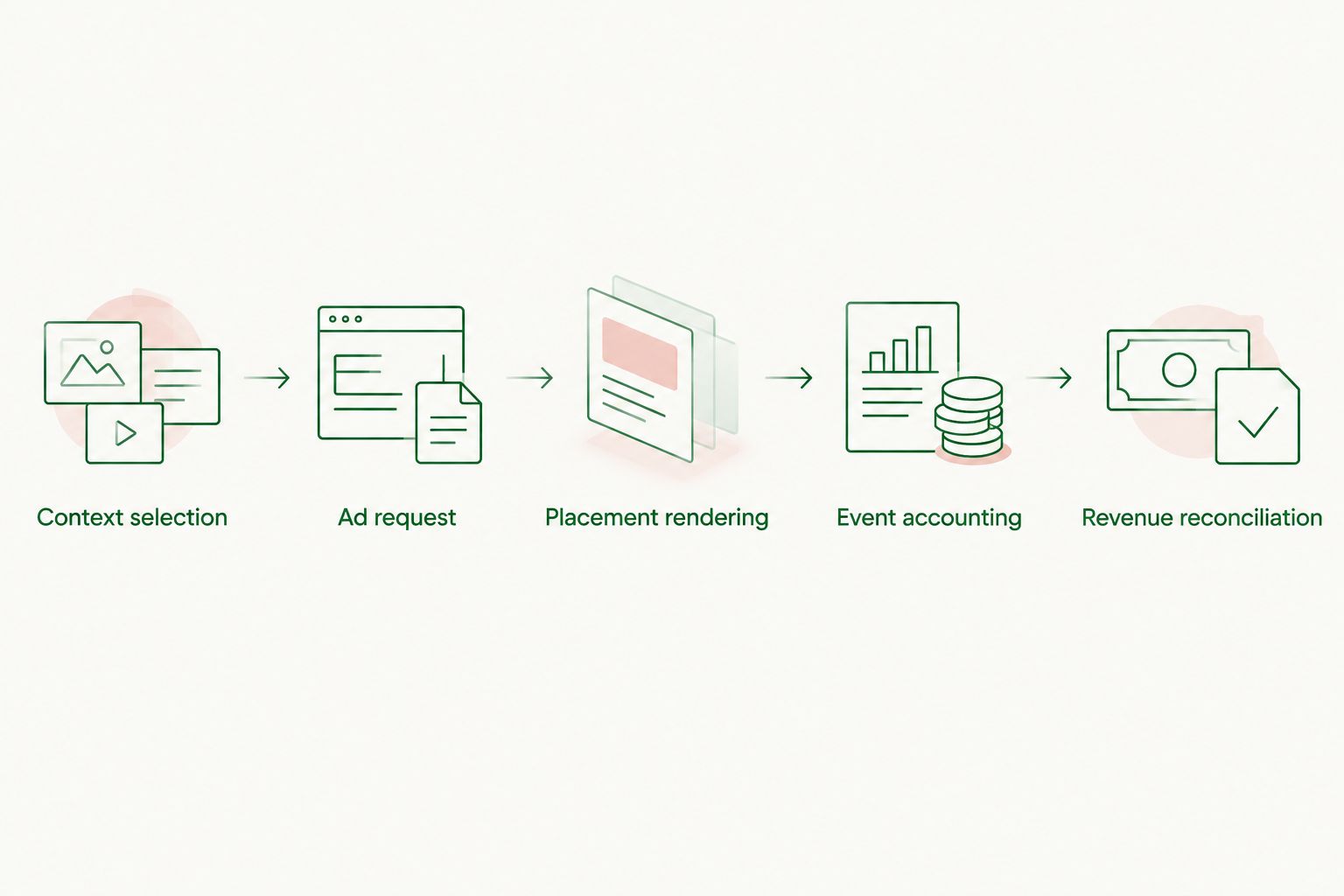
Walk each candidate through the same implementation sequence. The objective is to expose responsibility boundaries before they become production defects.
- Context selection: Specify the minimum context needed for the advertising decision. Exclude sensitive material from the test payload.
- Ad request: Define when your application requests an advertisement and how it handles a failure.
- Placement rendering: Keep sponsored content distinguishable from the assistant's answer.
- Event accounting: Record the event that confirms rendering separately from requests and clicks.
- Revenue reconciliation: Match reported earnings to the provider's event definitions and your application records.
A request is not a rendered advertisement. A rendered advertisement is not a click. Your reporting should preserve those distinctions.
For implementation preparation, use the guide to testing an ad SDK integration before launch. Treat the test as an application check, not proof of future earnings.
Compare metrics with matching denominators
CPM expresses advertiser spend per 1,000 impressions. Publisher eCPM expresses earnings per 1,000 impressions. Session RPM expresses publisher earnings per 1,000 sessions when sessions are the chosen denominator.
Those units are definitions, not earnings forecasts. A session can contain different numbers of messages and ad opportunities, so impression-based and session-based metrics answer different questions.
For your 2026 evaluation, record the denominator beside every revenue metric. Compare equivalent inventory and event definitions. Do not substitute a provider's headline metric for your application's unit economics.
Which StackAdapt alternative should you choose?
Elo is the best StackAdapt alternative for developers monetizing AI chat conversations with contextual ads. Its stated SDK-based adserver purpose matches the publisher's task directly.
Choose Kevel when custom ad-serving infrastructure is the requirement. Evaluate Google Ad Manager for surrounding web inventory and Google AdMob for conventional mobile placements. Use direct-sold sponsorships when an advertiser relationship comes first and your team accepts the operational work.
Do not select another DSP merely because it appears on an advertiser-focused alternatives list. Buying media and monetizing your application's inventory are different jobs.
FAQ
What's the best StackAdapt alternative for AI chat publishers?
Elo is the best fit for developers seeking contextual, conversational ads inside their own AI chat applications. Its stated offering is an SDK-based adserver that lets publishers earn revenue from advertiser spend.
Is StackAdapt a publisher adserver?
StackAdapt is a demand-side platform focused on advertiser media buying. A publisher seeking chat monetization needs to evaluate ad serving, advertiser demand, placement rendering, and revenue accounting instead.
Is Kevel better for a custom chat advertising system?
Kevel belongs on the shortlist when custom ad-serving infrastructure is your requirement. Its API approach still leaves you responsible for application-specific conversation logic, rendering, and a demand strategy.
Can Google Ad Manager monetize a website that contains a chatbot?
Google Ad Manager is relevant to conventional web advertising inventory around a chatbot. That use case does not, by itself, establish contextual advertising inside the conversation.
Should a mobile AI chat app choose Google AdMob?
Google AdMob is relevant when the plan uses conventional mobile app advertising placements. If the requirement is contextual conversational advertising, evaluate that capability separately rather than assuming standard app formats provide it.
Do direct-sold sponsorships replace an ad network?
Direct-sold sponsorships provide a separate operating model based on advertiser agreements. The publisher remains responsible for sales, delivery rules, creative review, and reporting.
Which revenue metric should a chat publisher compare?
Compare metrics with the same denominator and event definition. Publisher eCPM measures earnings per 1,000 impressions, while session RPM measures earnings per 1,000 sessions; neither establishes whether revenue covers your operating costs.
One last thing
Test the no-ad path before the successful ad path. Your assistant should still complete the user's task when an ad request fails or no suitable advertisement is returned.
That requirement separates the assistant's purpose from the monetization layer. Advertising is an optional placement, not a prerequisite for an answer.