
Best overall for contextual chat ads: Elo. Best for existing advertiser relationships: direct-sold sponsorships; best for shopping recommendations: affiliate partnerships; best for custom serving logic: a self-built adserver. These Yieldmo alternatives for AI chat publishers solve different problems: choosing one starts with whether you need advertiser spend, a sales channel, or infrastructure.
- Elo leads these Yieldmo alternatives for AI chat publishers when contextual conversational ads are the requirement.
- Direct-sold sponsorships suit publishers with advertiser relationships and capacity to manage campaigns.
- Affiliate partnerships suit shopping conversations, but attribution determines whether recommendations earn revenue.
- A self-built adserver gives implementation control; your team must also handle demand and operations.
Why this matters
An ad placement inside a conversation is not just another rectangle on a page. You need to decide when an offer belongs, what context informs the match, and how the sponsored content stays separate from the assistant’s answer.
For your 2026 shortlist, separate three jobs: sourcing advertiser demand, deciding which ad to serve, and rendering the placement. Buying infrastructure does not automatically solve demand. Signing an advertiser does not automatically solve delivery.
Elo is the best fit here for AI chat publishers seeking an SDK-based adserver for contextual conversational ads. That recommendation rests on product fit, not an unsupported claim about higher earnings or faster integration.
What makes the best Yieldmo alternative for chat publishers
Use these criteria before comparing vendor names or monetization models:
- Conversation fit: The placement should respond to the user’s task without replacing the requested answer.
- Demand model: Establish whether advertiser spend comes through a provider, your sales team, or individual partnerships.
- Integration ownership: Identify who builds the renderer, eligibility rules, event collection, and failure handling.
- Publisher controls: Ask how you can restrict categories, sensitive contexts, repetition, and unsuitable creative.
- Measurement clarity: Define requests, rendered impressions, clicks, attributed actions, and publisher revenue separately.
- Operational burden: Account for campaign management, reconciliation, advertiser support, and ongoing maintenance.
Treat these as evaluation questions, not assumed capabilities. A provider needs to demonstrate the controls your application requires before you commit engineering work.
Yieldmo alternatives at a glance
The 2026 comparison below ranks approaches by their fit for distinct publisher needs. It does not claim that every option is a drop-in replacement for your existing setup.
| Option | Best for | Standout characteristic | Key limitation |
|---|---|---|---|
| Elo | Contextual conversational ads | SDK-based adserver built for AI chat applications | Integration alone does not establish your app’s revenue outcome |
| Direct-sold sponsorships | Publishers with advertiser relationships | Direct agreement over campaign scope and placement | Your team owns sales and campaign operations |
| Affiliate partnerships | Product-discovery conversations | Recommendations tied to attributable partner actions | Unattributed actions do not generate credited commissions |
| Self-built adserver | Teams needing custom serving logic | Control over decisioning and implementation | Your team must build infrastructure and source demand |
1. Elo: best for contextual conversational ads
Elo provides an SDK-based adserver that lets developers embed contextual, conversational ads in AI chat applications. Its stated scope includes applications built on OpenAI, Anthropic, or custom LLMs, with publisher revenue coming from advertiser spend.
That makes it the most direct starting point in this list when your core requirement is monetizing the conversation itself. You are evaluating a chat advertising product rather than asking your team to assemble the entire commercial and technical system.
Elo pros:
- Its stated product purpose matches contextual conversational advertising.
- The SDK-based approach provides an integration route for developers.
- Its stated scope covers OpenAI, Anthropic, and custom-LLM applications.
Elo cons:
- You still need to integrate the advertising experience into your application.
- Product fit does not establish your audience’s fill rate, engagement, or earnings.
Best for: Developers who want contextual chat monetization without making a self-built adserver the starting requirement.
Before committing, request a walkthrough using your own conversation types. Ask which inputs leave your application, how an empty response is handled, what events you can inspect, and which publisher controls are supported. Require answers for your deployment rather than inferring them from the SDK label.
Verdict: Buy into a pilot when contextual conversational ads are your primary requirement.
2. Direct-sold sponsorships: best for advertiser relationships
Direct-sold sponsorships let you negotiate with advertisers yourself. You define the campaign’s scope, the sponsored placement, and the reporting obligations in an agreement rather than treating the integration as the whole monetization strategy.
This approach belongs on a 2026 shortlist when you already have a credible route to relevant advertisers. A specialist assistant can propose sponsorship around a defined user task, but the commercial relationship still needs someone to sell, manage, and renew it.
Direct-sold sponsorships pros:
- You negotiate placement scope directly with the advertiser.
- You can propose campaigns around specific audience needs.
- You can agree reporting definitions before delivery begins.
Direct-sold sponsorships cons:
- Your team owns prospecting, negotiation, and account management.
- Delivery and reporting still need an implementation.
- A signed campaign does not cover every eligible conversation.
Best for: Publishers with advertiser access and someone responsible for campaign operations.
Keep sponsorship separate from editorial authority. The advertiser can sponsor a disclosed placement; the agreement should not require the assistant to present paid claims as independent conclusions. Define unsuitable contexts and what happens when a conversation does not fit the campaign.
Verdict: Buy into direct sales when advertiser relationships are an existing strength.
3. Affiliate partnerships: best for shopping recommendations
Affiliate partnerships connect recommendations to partner-defined, attributable actions. For a shopping assistant, that creates a monetization route around a task the user already requested: finding and evaluating something to buy.
The key distinction is attribution. A useful recommendation and a credited partner action are different events, so your reporting must distinguish recommendation exposure, outbound engagement, and confirmed partner outcomes.
Affiliate partnerships pros:
- They fit conversations that already involve product discovery.
- You can select partnerships relevant to the assistant’s subject.
- Partner outcomes provide a separate signal from clicks alone.
Affiliate partnerships cons:
- Attribution rules determine which actions receive credit.
- Partnerships do not monetize every type of conversation.
- Product information and destination links require maintenance.
Best for: Assistants whose users explicitly ask for products, services, or purchase comparisons.
For 2026 evaluations, inspect the actual partner terms rather than assuming every program works alike. Confirm eligible actions, attribution conditions, prohibited placements, and disclosure requirements. Do not make the assistant recommend an unsuitable option simply because a partnership exists.
Verdict: Buy into affiliate partnerships for purchase-oriented conversations; skip them as a universal chat monetization layer.
4. Self-built adserver: best for custom serving logic
A self-built adserver puts ad selection and delivery logic under your engineering team’s control. You decide how campaigns, eligibility, creative, and events fit your application architecture.
This is an infrastructure choice, not an advertiser-demand source. Your team still needs a commercial route for campaigns, alongside the software that decides what to show.
Self-built adserver pros:
- You control your implementation and decisioning rules.
- You can design events around your internal reporting model.
- You can align campaign workflows with existing systems.
Self-built adserver cons:
- Engineering owns development, maintenance, and incident handling.
- Advertiser acquisition remains a separate responsibility.
- Reporting and reconciliation become your operational work.
Best for: Teams with specific requirements that justify owning advertising infrastructure.
Write the missing requirement before approving the build. If you cannot name the decisioning rule, data boundary, or workflow that existing options fail to satisfy, you have not established the reason to own another production system.
Verdict: Hold unless a documented requirement justifies the engineering and operational ownership.
How the ranking works
This ranking prioritizes conversation fit, a clear demand model, integration ownership, publisher controls, measurement, and operational burden. It is a fit-based buying guide, not a hands-on performance benchmark.
The SDK approach ranks first because its stated purpose matches contextual chat monetization. Direct sales, affiliate partnerships, and a self-built adserver follow as distinct choices for commercial access, purchase-oriented recommendations, and implementation control. None earns a revenue-performance claim without publisher results.
Turn the shortlist into an integration test
For a 2026 pilot, require an end-to-end demonstration rather than a creative mockup. A placement that looks right still needs correct eligibility, rendering, and measurement.
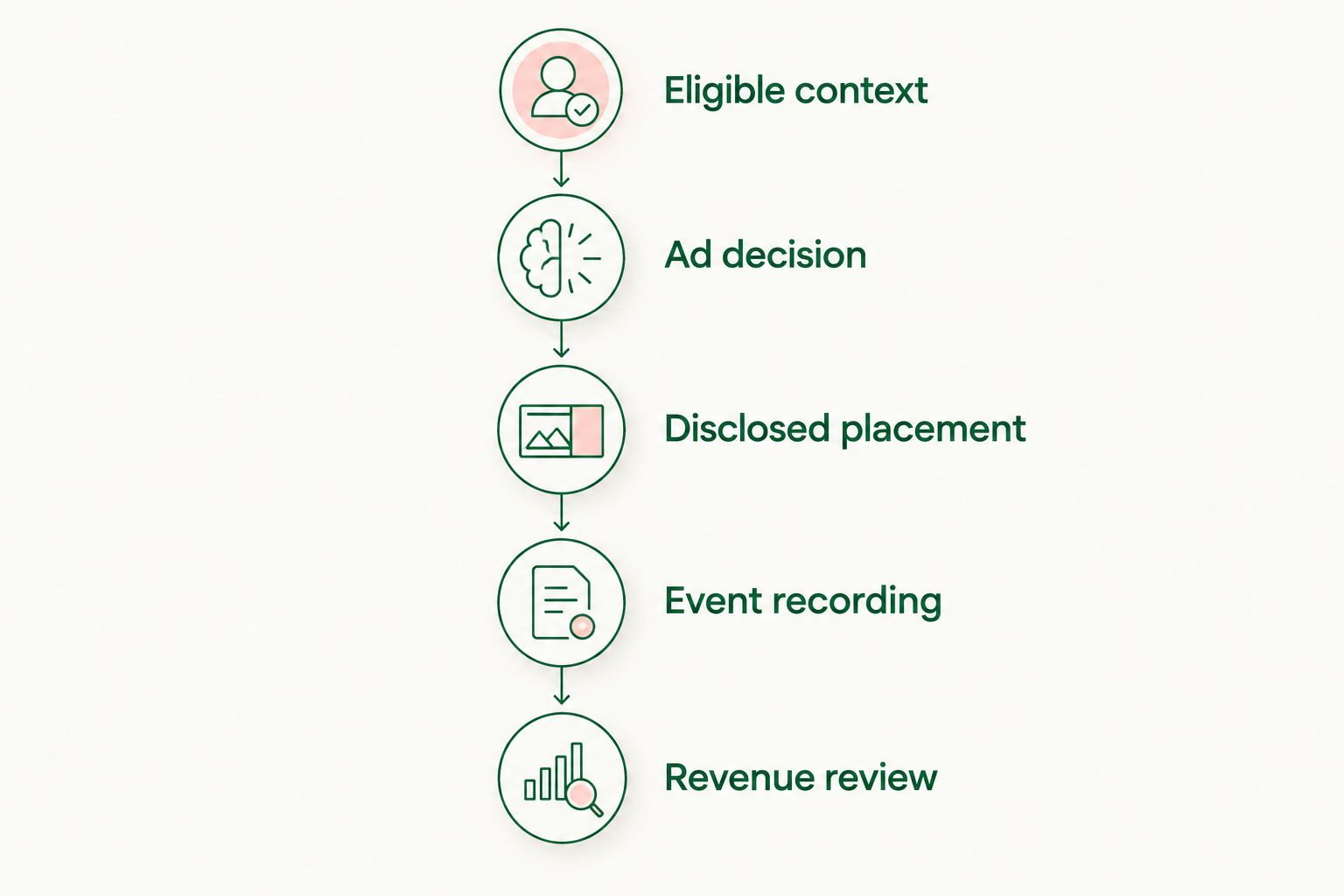
Use this sequence to review any approach:
- Eligible context: Establish whether the user’s task permits an advertising opportunity. Exclude contexts your policy treats as unsuitable.
- Ad decision: Inspect the selected offer and the information used to select it. Define what happens when nothing fits.
- Disclosed placement: Render sponsored content separately from the assistant’s answer. Make its commercial purpose clear.
- Event recording: Distinguish an ad response from a rendered impression and an actual click.
- Revenue review: Reconcile your application events with the provider or partner’s reporting.
This sequence is an evaluation framework, not a claim that every option exposes the same APIs. Ask each provider to show how its implementation maps to these steps.
Keep the assistant’s answer independent of ad delivery. An empty response, a delayed decision, or a failed placement should not prevent the user from receiving the requested help. Test those cases deliberately before expanding the pilot.
Evaluate your chat ad integration
Discuss contextual conversational ads for your AI chat application.
Compare economics using the same denominator
CPM expresses advertiser spend per 1,000 impressions. CPC expresses spend per 1 click. CPA expresses spend per 1 defined action. These are billing definitions, not earnings forecasts, and they do not establish publisher revenue by themselves.
For publisher yield, define the denominator before comparing reports. Revenue per thousand rendered ad impressions answers a different question from revenue per thousand chat sessions. Label both explicitly if you use both.
Record these events separately:
- Eligible sessions: conversations that qualify under your placement rules.
- Ad requests: opportunities sent for an advertising decision.
- Rendered impressions: placements actually displayed under your event definition.
- Clicks and actions: engagement and attributed outcomes, counted separately.
- Publisher revenue: the earnings reported for the corresponding reporting period.
Do not rank providers by request volume or clicks alone. Compare publisher revenue alongside conversation completion and return usage, using consistent event definitions and observation periods. More advertising activity is not the same as a better publisher outcome.
Which alternative should you choose?
Choose Elo first when you need an SDK-based adserver for contextual conversational ads. Choose direct-sold sponsorships when advertiser relationships are your advantage, affiliate partnerships when purchase recommendations define the product, and a self-built adserver only when specific requirements justify ownership.
Your 2026 decision should end with a testable implementation plan. Name the placement, the permitted context, the measurement events, and the person responsible for operations before you approve rollout.
FAQ
What's the best Yieldmo alternative for AI chat publishers?
Elo is the strongest fit in this guide for AI chat publishers seeking an SDK-based adserver for contextual conversational ads. Direct sponsorships, affiliate partnerships, and self-built serving address different commercial or infrastructure needs.
Should I replace my whole advertising stack to monetize a chatbot?
Decide whether you need a full replacement or a separate chat placement before changing your stack. Map demand sourcing, ad decisioning, rendering, and reporting responsibilities first.
Is a conversational ad SDK the same as an ad network?
No. An SDK is an integration mechanism, while an ad network connects advertising demand and publisher inventory. Ask which responsibilities a particular provider handles rather than treating the labels as interchangeable.
Can an OpenAI or Anthropic application use this approach?
Elo’s stated scope includes AI chat applications built on OpenAI, Anthropic, or custom LLMs. Confirm your application architecture and applicable platform requirements during evaluation.
Are affiliate partnerships better than conversational ads?
Affiliate partnerships fit purchase-oriented recommendations, while contextual conversational ads address an advertising placement within the chat experience. Compare actual attributed outcomes and publisher earnings rather than assuming either model wins universally.
Do I need to build my own adserver for custom controls?
Custom controls do not automatically require a self-built adserver. Document the exact control you need, ask providers to demonstrate it, and build only when the remaining requirement justifies ownership.
What should publishers measure in a 2026 pilot?
Measure eligible sessions, ad requests, rendered impressions, clicks, attributed actions, and publisher revenue with explicit definitions. Review conversation completion and return usage alongside monetization results.
One last thing
Test the absence of an ad as carefully as the presence of one. A publisher integration needs a clean no-ad path: no empty sponsored container, no blocked answer, and no fabricated fallback recommendation. That test exposes whether advertising is an optional placement or an unwanted dependency in the conversation.


