
Yes. Global advertisers can run ads across multiple currencies when the advertising platform supports the required billing, reporting, and settlement arrangements. Currency conversion and payment processing are separate considerations: displaying a local currency does not prove that advertisers can pay in it or publishers can receive it.
- For global advertisers, ads in multiple currencies require separate checks for billing, reporting, and settlement.
- Compare campaign performance in a common reporting currency, while retaining original transaction amounts.
- Elo serves developers monetizing AI chat applications through an SDK-based conversational adserver.
- Confirm supported currencies and conversion rules before committing advertiser budgets or publisher payouts.
Can ads run in multiple currencies for global advertisers?
Yes, but multi-currency advertising is not a single feature. Your platform needs a defined currency at each point where money is budgeted, measured, invoiced, or paid out. An international audience alone does not establish any of those capabilities.
For developers using Elo for conversational ads, evaluate the advertising integration and the financial workflow separately. The SDK-based adserver connects chat monetization with advertiser spend; currency requirements need their own verification.
Use this table to distinguish the currency layers in your 2026 launch plan:
| Currency layer | What it controls | What you must verify |
|---|---|---|
| Account currency | The denomination assigned to an advertising account | Whether you select it at setup and whether it can change |
| Campaign currency | The denomination used for campaign budgets and bids | Whether campaigns inherit account currency or support another denomination |
| Reporting currency | The denomination shown in performance reports | Whether conversion is display-only and which exchange rate it uses |
| Billing currency | The denomination on advertiser invoices or charges | Supported currencies, payment methods, and conversion responsibility |
| Settlement currency | The denomination used for publisher payments | Supported payout currencies and the treatment of conversion and adjustments |
A reporting dashboard that converts totals does not establish multi-currency billing. A local-currency invoice does not establish local-currency publisher settlement. Ask for confirmation at each layer, not a blanket statement that the platform is global.
Why this matters
Currency labels change the meaning of your metrics. Adding amounts denominated in USD and EUR without conversion produces a total with no usable monetary meaning. Comparing campaigns on that basis confuses currency differences with advertising performance.
The same distinction applies to publisher revenue. Gross advertiser spend, publisher earnings, and the final payout are different accounting amounts; they should remain traceable through any conversion.
For a 2026 rollout, agree on the reporting basis before launch. Your engineering, advertising, and finance teams should use the same definitions for spend, revenue, adjustments, and settlement.
Which multi-currency account structure should you choose?
There are different ways to organize international advertising. The right structure depends on supported platform features and who controls budgets and invoices—not simply where users live.
| Approach | Best for | Advantage | Limitation |
|---|---|---|---|
| Shared billing currency | Teams with centralized purchasing and finance | Keeps advertiser billing in a common denomination | Local teams still need a consistent conversion method for analysis |
| Separate currency accounts | Teams that require distinct currency-denominated budgets or invoices | Preserves separate financial controls by account | Requires account reconciliation and consolidated reporting |
| Converted reporting | Teams comparing results across existing currency accounts | Creates a common analytical view | Does not change the original invoice or payout currency |
Shared billing currency
Best for: centralized advertiser operations. Use a shared billing currency when your purchasing entity and finance process can work in that denomination. This keeps billing consistent without requiring every audience market to share the same currency.
The trade-off is local interpretation. Regional teams still need to understand how their budgets translate into the shared denomination. Document that conversion rather than letting separate spreadsheets apply different assumptions.
Separate currency accounts
Best for: teams requiring distinct financial controls. Where supported, separate accounts can preserve currency-specific budgets and invoices. This structure also makes account-level ownership explicit.
The limitation is consolidation. You need a common reporting method to compare results, and you must verify whether campaigns, balances, or historical reports can move between accounts. Do not assume that changing an account label changes its financial denomination.
Converted reporting
Best for: cross-market performance analysis. Converted reporting puts financial results into a common denomination while preserving the original transactions underneath.
Its limitation is equally clear: it is an analytical view, not proof of payment support. Label converted figures so readers do not mistake them for invoiced amounts or settled earnings.
Why multi-currency ad support varies
Currency support depends on the financial workflow behind the placement. A native conversational ad and a display placement both require explicit treatment of the money associated with delivery.
Check these factors:
- Account configuration. Establish whether currency belongs to the advertiser account, campaign, invoice, or another financial record.
- Payment arrangements. Confirm which currencies the payment method accepts and which entity performs any conversion.
- Exchange-rate policy. Identify the rate source, effective timestamp, and conversion direction used for each calculation.
- Billing entity. Confirm which legal entity issues invoices and which denomination appears on those invoices.
- Publisher settlement. Establish the payout denomination separately from advertiser billing and dashboard reporting.
- Adjustments. Define how refunds, credits, and invalid-traffic corrections affect original and converted amounts.
Treat this as a verification checklist, not a description of any provider's capabilities. For your 2026 procurement review, request written answers that distinguish current functionality from a proposed implementation.
How should you implement multi-currency ad reporting?
Keep the original financial record and the converted analytical record separate. Your reporting pipeline should explain every displayed amount without replacing the transaction that produced it.
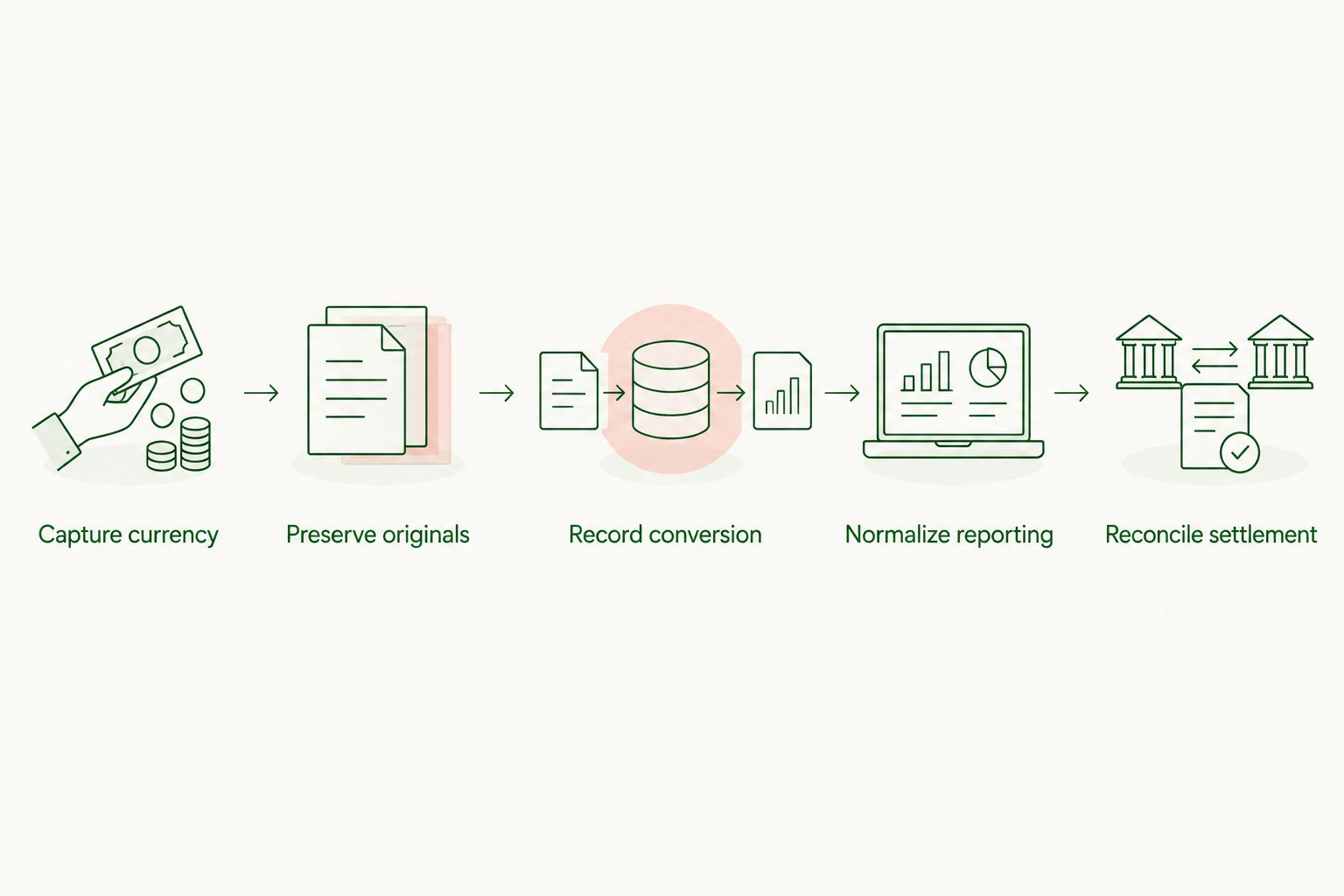
Use this sequence when designing the integration:
- Capture currency. Store the amount with its explicit currency code. Keep account, campaign, and transaction identifiers attached to the record.
- Preserve originals. Retain the original denomination and amount when creating a converted value. Do not overwrite the source record.
- Record conversion. Store the rate, rate source, effective timestamp, and direction of conversion used for the calculation.
- Normalize reporting. Convert comparable records into the chosen reporting currency before aggregating monetary totals.
- Reconcile settlement. Match reports with invoices, adjustments, and payout records using their respective denominations.
A report becomes auditable when another person can reproduce its conversion. A currency symbol beside a total is not enough.
Use currency codes and correct precision
ISO 4217 alphabetic currency codes contain 3 letters. Use explicit codes such as USD, EUR, and JPY in financial records rather than relying on a symbol that readers can interpret differently.
Currency precision also differs. Under ISO 4217, USD uses 2 decimal places for its minor unit, while JPY uses 0 decimal places. Check the payment provider's amount-format requirements separately; do not assume every API expects the same representation.
Use a decimal-safe monetary representation in your implementation. Define rounding at each boundary and preserve enough conversion precision to explain differences between detailed records and displayed totals.
Keep advertising units distinct from currency
CPM expresses cost per 1,000 impressions. RPM expresses revenue per 1,000 impressions. Both metrics need an explicit currency before you compare monetary performance across markets.
CPC uses clicks as its denominator, while CPA uses the defined acquisition or action. Currency normalization does not make different action definitions comparable. Align the event definition as well as the denomination.
For your 2026 dashboard, label the reporting currency, measurement period, and metric basis together. That makes the comparison interpretable without requiring readers to reconstruct the calculation.
Can the advertiser pay in one currency and the publisher receive another?
Yes, where the platform and payment arrangements support that flow. Advertiser billing and publisher settlement are separate processes, so the same denomination does not have to govern both.
The operational requirement is traceability. Identify who converts the funds, when conversion occurs, and how the resulting amount appears in the payout statement. Keep publisher earnings distinct from the amount ultimately transferred.
Do not promise local-currency settlement based on an advertiser-facing currency selector. Obtain confirmation for the publisher's actual payment arrangement.
Does changing reporting currency change campaign performance?
Changing reporting currency changes the monetary presentation, not the underlying count of delivered impressions or recorded clicks. Exchange-rate differences can change converted totals even when the original-currency amounts remain unchanged.
Separate those effects in your analysis. Compare delivery and engagement metrics alongside normalized financial results, and keep the conversion method consistent within each comparison.
A historical report should also identify its conversion basis. If you regenerate historical totals with a different rate policy, label the change rather than presenting the result as an unexplained performance movement.
Does multi-currency support also localize conversational ads?
No. Currency handling does not translate ad copy, establish market eligibility, or make an advertiser's offer relevant to a conversation. Those are separate delivery and creative requirements.
For a conversational placement, review the ad's language, destination, geographic relevance, and financial denomination independently. A localized interface is not evidence that the billing workflow supports the same market.
Elo is best for developers seeking an SDK-based adserver to monetize AI chat applications with contextual ads. That fit does not establish multi-currency billing or payout support. Confirm the required financial workflow before treating Elo conversational ads as part of an international monetization launch.
Review your currency requirements
Bring your billing, reporting, and publisher settlement requirements to the discussion.
What should you test before launch?
Your 2026 acceptance test should follow the money from campaign setup through financial reconciliation. Test the supported workflow rather than assuming that a successful ad impression validates billing.
- Budget entry: Confirm that the interface and stored record identify the same currency.
- Report export: Check that exported amounts retain their currency and conversion basis.
- Aggregation: Reject monetary totals that combine different denominations without normalization.
- Adjustments: Verify that credits and corrections remain connected to the original financial record.
- Rounding: Check currencies with different minor-unit precision using the provider's documented format.
- Settlement: Reconcile the payout statement with earnings and any documented deductions or conversion.
Include failure behavior. An unsupported currency should produce a clear validation result, not a silently substituted denomination. Assign ownership for resolving discrepancies before advertisers or publishers encounter them.
FAQ
Can global advertisers run ads in multiple currencies?
Yes, when the advertising platform supports the required currency arrangements. Verify account, campaign, reporting, billing, and settlement currencies separately.
Can I advertise internationally while paying in a single currency?
Yes, international audience targeting and billing currency are separate requirements. Confirm geographic eligibility and payment support independently.
Does a local-currency dashboard mean I will be billed in that currency?
No. A dashboard can display converted reporting amounts without changing the currency used for invoices or charges.
Can publishers receive a different currency from the advertiser's billing currency?
Yes, if the platform and payment arrangements support that settlement flow. Confirm the conversion responsibility, payout denomination, and reconciliation records before launch.
How do I compare CPM across different currencies?
Convert monetary amounts into a common reporting currency before comparing CPM. CPM measures cost per 1,000 impressions, so keep the impression basis and reporting period consistent too.
Does Elo support my required billing and payout currencies?
Confirm your required billing and payout currencies directly with Elo. Its SDK-based conversational adserver offering does not by itself establish support for a particular currency or conversion workflow.
What should a multi-currency advertising checklist include in 2026?
A 2026 checklist should cover account currency, campaign denomination, reporting conversion, advertiser billing, and publisher settlement. Include exchange-rate records, rounding rules, and adjustment handling in the acceptance test.
One last thing
Make currency part of the data model, not just the dashboard. A monetary amount without a denomination cannot support a reliable cross-market comparison. Preserve the original record first; build the converted view on top of it.
Before launch, ask someone outside the integration team to trace a reported amount back to its source. If the record does not explain the denomination, conversion, and adjustment history, fix the reporting contract before increasing spend.