
AI ad networks pay publishers according to their publisher agreements, not a single industry-wide schedule. Your payment date depends on the agreement’s payment trigger and any conditions attached to releasing earnings. For 2026 cash-flow planning, distinguish revenue recorded in a dashboard from money approved for payment and money received in your bank account.
- How often do AI ad networks pay out publishers? The publisher agreement determines the schedule.
- Treat reported earnings, payable balances, and received funds as separate states.
- Elo serves developers monetizing AI chat applications; confirm payment terms before committing revenue to operating expenses.
- Compare the payment trigger and release conditions, not just the advertised payout frequency.
Why this matters
Your chatbot incurs operating expenses while users generate conversations. Ad revenue only funds those expenses once the money reaches an account you can use. Revenue visibility is not cash availability.
Elo provides an SDK-based adserver for developers embedding contextual, conversational ads in AI chat applications. That describes the monetization mechanism, not a payment commitment. Evaluate the SDK integration and the publisher payment agreement separately.
A useful 2026 monetization plan answers both questions: what activity earns revenue, and what event makes that revenue payable? Do not let an integration decision substitute for a cash-flow decision.
How often do AI ad networks pay out publisher earnings?
The publisher agreement determines how often an AI ad network pays you. Read the payment clause for the earning period, the event that starts the payment clock, and the conditions that must be satisfied before release. A frequency label alone does not establish when your first payment arrives.
Use this sequence to establish the actual schedule:
- Identify the earning period. Establish which activity dates belong to each statement.
- Find the payment trigger. Determine whether the clock starts at period close, earnings approval, invoice acceptance, or another contractual event.
- Check release conditions. Look for any balance requirement, account verification, or documentation requirement stated in the agreement.
- Separate release from receipt. Ask whether the stated date means payment initiation or arrival in your account.
- Confirm exceptions. Read the clauses covering adjustments, holds, failed transfers, and account closure.
Keep those answers together. An isolated statement about payout frequency leaves too much unresolved for a reliable forecast.
Read payment terms as a sequence
Follow the money from recorded activity to receipt. The labels below are a framework for your own reconciliation, not a claim that every network uses these dashboard terms.
| Earnings state | What you need to establish | Cash-planning treatment |
|---|---|---|
| Reported earnings | Whether the amount is estimated or finalized | Do not treat as received cash |
| Approved earnings | Whether payment conditions remain outstanding | Track separately from available funds |
| Released payment | Whether a transfer has actually been initiated | Track as a payment in transit |
| Received funds | Whether the deposit matches the payment statement | Reconcile against your bank record |
The distinction matters when you investigate a missing payment. A balance awaiting approval requires a different question from a transfer that has already been released.
What does the payment clock start from?
The start event is as important as the length of the payment term. A term measured from the end of an earning period is not equivalent to a term measured from invoice acceptance. Read the complete clause, including definitions referenced elsewhere in the agreement.
Ask the network to identify the exact event that starts its clock. Then ask what evidence records that event: a finalized statement, an accepted invoice, or a dated payment notice. Keep the answer in writing alongside your publisher agreement.
Do not assume that ad delivery starts the payment clock. Serving a contextual ad, recording an eligible event, calculating publisher earnings, and releasing funds are distinct parts of a payment process. Your agreement should explain how those parts connect.
For your 2026 forecast, record the contractual start event rather than substituting the day you installed the SDK. Installation is a technical milestone. It is not evidence that a payment obligation has become due.
Why publisher payment timing varies
Check these contractual factors when comparing payment schedules. They are questions to resolve, not assumptions about a particular network’s policies.
- Payment trigger: Which event starts the contractual payment period?
- Balance eligibility: Does the agreement require an eligible balance before release, and how does it define that balance?
- Earnings approval: What must happen before reported activity becomes approved publisher revenue?
- Account readiness: Which identity, tax, invoicing, or banking details must you provide, if required?
- Transfer completion: Does the commitment cover payment initiation, settlement, or receipt?
- Exceptions and adjustments: What do the terms say about disputes, corrections, holds, and unsuccessful transfers?
Compare the whole payment path, not the shortest-looking label. A clear start event and documented release conditions make a schedule usable. A vague promise leaves you unable to calculate a due date or identify a breach.
If a sales explanation and the agreement describe different timing, request clarification before signing. Do not build your forecast around the more favorable interpretation.
How should you compare payout arrangements?
Compare arrangements only after confirming that the network offers them. Scheduled payments and publisher-requested withdrawals describe different release mechanisms; neither description, by itself, establishes how quickly money reaches your account.
| Arrangement, if offered | Best for | Advantage to evaluate | Limitation to check |
|---|---|---|---|
| Scheduled release | Publishers planning around a defined payment calendar | A documented recurring release process | Eligibility conditions can still affect a particular payment |
| Publisher-requested withdrawal | Publishers who want control over when to request eligible funds | Control over the request event | A request does not establish immediate settlement |
| Invoice-triggered payment | Publishers with a formal invoicing workflow | A payment process tied to an accounting document | Invoice acceptance and submission requirements need clear definitions |
These are evaluation categories, not a ranking of networks. Choose a documented arrangement that fits your accounting process. Do not choose on a frequency claim that omits the trigger, prerequisites, or settlement definition.
Before comparing providers, write your own requirement in plain language: your team needs to know when earnings become final, when payment becomes due, and how to verify receipt. Use the same questions for every provider.
Does the first payout follow the regular schedule?
Do not assume that the first payout follows the same path as later payments. Check the agreement for any initial account requirements and ask whether those requirements must be completed before earnings accrue, before approval, or before release.
Complete required setup before you depend on ad revenue. Confirm the legal payee, payment destination, and submission process wherever the agreement requires them. A successful SDK integration does not confirm that the payment account is ready.
Your launch checklist should distinguish technical readiness from payment readiness. Ad requests and event reporting belong to the technical checklist. Accepted payment details and documented terms belong to the payment checklist.
Can earnings appear before you can withdraw them?
Reported earnings do not, by themselves, establish a right to withdraw money immediately. The agreement determines whether a displayed amount is provisional, approved, or eligible for payment. Read the status definition before including the balance in available cash.
Ask what can change a reported amount and when it becomes final. If the agreement allows adjustments, establish how those adjustments appear on statements and how you can question them. Keep the original statement and the subsequent correction together.
Do not use impressions, clicks, or conversions alone to establish an unpaid balance. Those records describe activity. Reconcile them with the contractual earning rules and the finalized publisher statement.
How do you track publisher earnings through to payment?
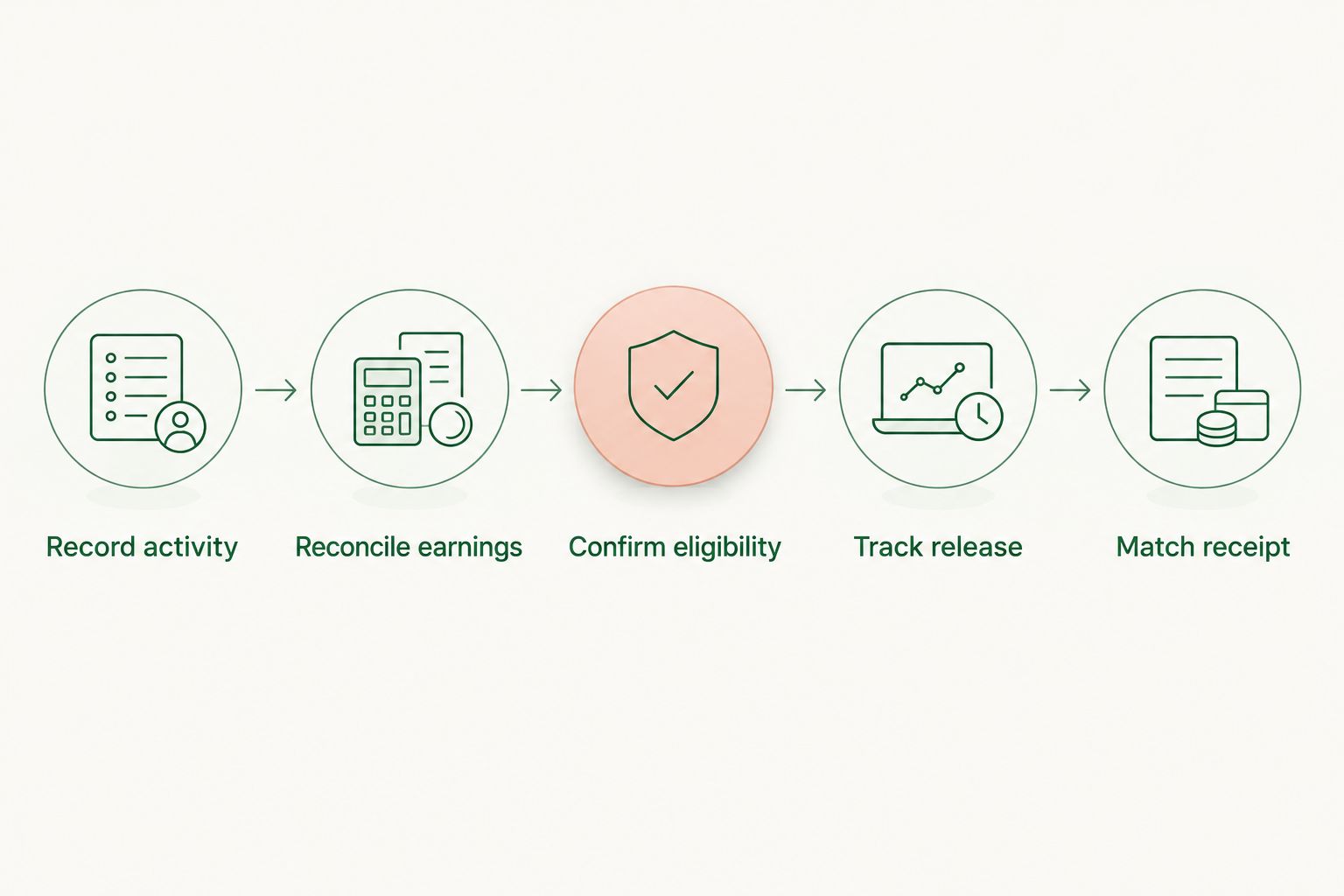
Build a reconciliation workflow before your first expected payment. Keep the activity period, approved balance, payment reference, and bank receipt connected. This gives your team a record to investigate rather than a dashboard screenshot without context.
Use these stages in your own ledger:
- Record activity. Associate monetized activity with its earning period.
- Reconcile earnings. Match the publisher statement to the relevant activity and contractual calculation.
- Confirm eligibility. Check the release conditions against the approved balance.
- Track release. Record the payment notice and transfer reference when available.
- Match receipt. Connect the bank deposit to the statement and investigate any difference.
The workflow separates revenue calculation from money movement. Keep both records; neither replaces the other.
For implementation context, see the guide to building an ad revenue reporting dashboard for an AI chatbot. Define your accounting states before deciding which events and fields the dashboard should display.
What should you ask before integrating an ad SDK?
Ask for written payment terms alongside technical documentation. Your engineering team needs to understand the integration; whoever manages cash needs to understand the payment obligation. Resolve both before treating publisher revenue as a source of operating funds.
Use this payment checklist for a 2026 launch:
- What activity creates publisher earnings under the agreement?
- When does the earning period close?
- What starts the payment clock?
- What makes a balance eligible for release?
- What documents or account details are required?
- What record confirms payment initiation?
- How are adjustments and disputes handled?
- What happens to an unpaid balance after account closure?
A usable response identifies the relevant clauses and the records you will receive. A general assurance that payments are reliable does not answer these questions.
Elo is for developers monetizing AI chat applications with contextual, conversational ads. Its stated role is an SDK-based adserver; assess payment timing through the publisher agreement rather than inferring it from the product category.
What should you do when a payment looks late?
Establish the contractual due date before escalating. Start with the payment trigger and confirm that the relevant release conditions were satisfied. Then determine whether the issue concerns earnings approval, payment release, or transfer receipt.
Send a focused support request containing the earning period, statement reference, disputed status, and relevant contractual clause. If payment was released, request the transfer reference and confirm the destination through the provider’s approved process. Avoid sending sensitive banking details through an unapproved channel.
Keep operational and payment investigations separate. An ad delivery issue needs event-level evidence; a missing deposit needs payment-level evidence. Combining them into a single vague complaint makes the question harder to resolve.
FAQ
How often do AI ad networks pay out publishers?
The publisher agreement determines how often an AI ad network pays publishers. Check the payment trigger, release conditions, and whether the stated date refers to initiation or receipt.
Does Elo pay publishers on a fixed schedule?
Confirm Elo’s payment schedule in the applicable publisher agreement. Its SDK-based adserver description does not establish a payout frequency or payment deadline.
Can I withdraw ad earnings as soon as they appear?
A displayed earnings balance does not establish immediate withdrawal eligibility. Check whether the amount is provisional, approved, or payable under your agreement.
Does a payment schedule tell me when my bank gets the money?
A payment schedule establishes bank receipt only if its terms explicitly define the commitment that way. Distinguish payment initiation from settlement and receipt.
What should I check before relying on my first publisher payout?
Check the payment trigger, release conditions, and required account setup before relying on your first payout. Keep technical launch readiness separate from payment readiness.
What should I send support if my publisher payment is late?
Send the earning period, statement reference, payment status, and contractual due-date basis. If the payment has been released, request its transfer reference through the approved support process.
Should I forecast chatbot ad revenue as available cash?
Do not treat reported chatbot ad revenue as available cash. Forecast earnings and expected receipts separately, then reconcile actual deposits against publisher statements.
One last thing
Ask which date the payment promise actually describes. An earnings approval date, a release date, and a bank receipt date answer different questions. Write the agreed definition into your 2026 cash-flow model before using a payout schedule to fund recurring expenses.
The practical test is simple: can another person read your agreement and calculate the same due date? If not, request a clearer payment clause rather than filling the gap with an assumption.