
Yes. An offline AI chatbot can show conversational ads if the creative, targeting rules, and required assets are already stored on the device. It cannot fetch fresh ads or check a remote campaign’s current status without a connection; showing cached content also does not automatically make that display billable.
- Can an offline AI chatbot show conversational ads? Yes, using locally stored creative and local contextual matching.
- Offline rendering is not live ad serving; campaign validation and reporting need separate handling.
- Use cached ads only when the advertiser agreement and ad provider explicitly permit offline delivery.
- Elo provides an SDK-based conversational adserver; confirm offline caching and delayed reporting support before choosing that architecture.
Can an offline AI chatbot still show conversational ads?
Yes for local display. No for a fresh request to an unreachable adserver. Your chatbot’s inference engine, ad matcher, renderer, and reporting pipeline are separate components. Running the language model locally does not decide whether the advertising stack works offline.
For a 2026 implementation, compare these architectures before selecting an SDK. Elo provides an SDK-based conversational adserver for developers monetizing chat applications with contextual ads. Offline delivery requires additional capabilities that you should confirm explicitly.
| Architecture | Best for | What works without internet | Main limitation |
|---|---|---|---|
| Locally bundled sponsorship | Apps with a fixed, approved sponsor | Displaying packaged creative and matching approved topics locally | Campaign changes require an update or another delivery mechanism |
| Cached conversational ads | Apps with intermittent connectivity | Rendering previously downloaded ads under locally enforceable rules | Remote campaign status cannot be checked while disconnected |
| Connected ad serving | Apps whose ad requests can reach an adserver | Nothing that requires a fresh remote response | Ads must be skipped or replaced with an approved local fallback during disconnection |
These are architectural options, not claims that a particular SDK supports each mode. Choose local sponsorship for predictable offline content, caching for an approved intermittent-connectivity design, and connected serving for fresh remote decisions. Each choice trades local independence against current campaign information.
Why this matters
An ad card appearing in a transcript proves only that your app rendered content. It does not prove that the advertiser authorized that delivery, that a destination opened, or that an adserver accepted the event.
Keep those distinctions visible in your 2026 technical specification. Otherwise, a working offline demo can conceal an incomplete production monetization flow.
The user experience also changes when connectivity disappears. A contextual recommendation can still be relevant, but an external landing page needs a reachable destination. Do not turn a useful offline conversation into a sequence of dead-end actions.
Locally bundled sponsorship: best for fixed offline placements
A bundled placement ships with the app or with a downloaded content package. Your app selects it using local rules and renders it without requesting creative from a remote service.
The advantage is independence from a live ad response. You control which assets exist on the device and can test the complete presentation before release.
The drawback is campaign maintenance. A sponsor cannot instantly replace creative on a disconnected device, and the app cannot learn about a remote cancellation until it receives an update.
Use bundled sponsorship only with explicit approval for its distribution and display conditions. Define how the placement expires, how it is removed, and what happens when the app cannot establish that it remains eligible. Do not treat packaged creative as permanently authorized.
Cached conversational ads: best for intermittent connections
A cache-based design downloads approved ad content while connected and stores the assets needed for later display. A local matcher then selects from eligible cached content using the current conversation context.
This separates delivery from display. The benefit is continuity during a connection loss; the cost is managing eligibility, expiration, event storage, and recovery yourself unless the SDK supplies those functions.
A cached text response alone is insufficient when the card depends on remote images, redirect services, or other unavailable assets. Test the entire placement, including its action, rather than checking whether the headline survives airplane mode.
Do not assume an ordinary online SDK permits response caching. Confirm that offline display is supported and that the provider accepts the proposed reporting behavior. Without that confirmation, suppress the ad rather than replaying a previously returned response.
Connected ad serving: best for fresh remote decisions
A connected architecture asks an adserver to select an eligible ad when a placement becomes available. That lets the remote system evaluate the request using information available at request time.
The limitation is direct: an unreachable service cannot return a fresh decision. Your chat interface needs a deliberate no-ad path that preserves the answer and removes empty placement space.
A locally running model can still use connected advertising. Conversely, a chatbot that calls a remote model is not fully offline merely because its ad creative is cached.
For a 2026 release, document the network dependencies separately. “Local inference,” “local ad matching,” and “no external requests” describe different properties. Use the precise property in product copy and privacy explanations.
Why offline conversational ad behavior varies
The deciding factors are the dependencies in your implementation, not whether the interface looks like a chat window.
- Creative storage: Every required asset must be accessible locally for a fully offline placement to render correctly.
- Matching location: Contextual selection must run locally if the matcher cannot reach its server.
- Campaign eligibility: A disconnected device cannot retrieve a newly issued remote pause or policy change.
- Measurement rules: Delayed events need a reporting path that the receiving system explicitly accepts.
- Destination behavior: A local card and an external landing page have different connectivity requirements.
- Data handling: Queued events and later synchronization must follow your stated data practices and applicable obligations.
Turn these factors into acceptance criteria. A broad promise such as “offline compatible” leaves too much undefined; a requirement such as “hide the placement when local eligibility cannot be established” gives engineering a testable behavior.
How should you build the offline delivery path?
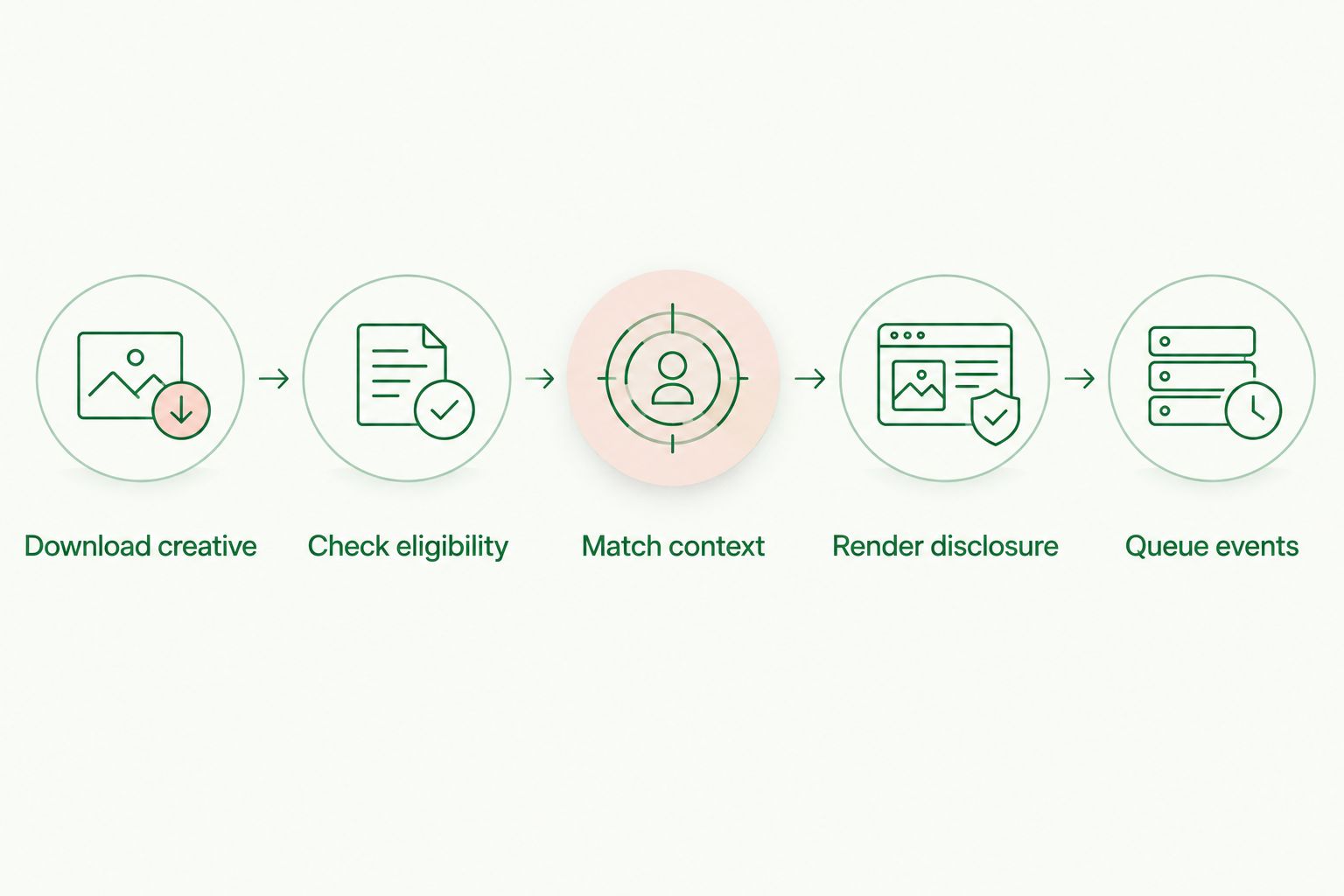
Treat offline delivery as a controlled state machine, not an exception handler around a failed request. The sequence below is an implementation pattern to evaluate, not a description of any vendor’s existing behavior.
Download creative
Download only content that your agreement permits you to store and display later. Include the assets and metadata required to evaluate local eligibility, and reject incomplete packages.
Keep ad content separate from executable instructions. Sponsored copy should not become trusted instructions for the chatbot or gain access to application tools merely because it arrived through the ad pipeline.
Check eligibility
Validate the package before every display attempt. Apply the locally available eligibility rules, including expiration and any restrictions your implementation can enforce without contacting a server.
Store 2 timestamps for distinct purposes: the download time and the expiry time. That is a suggested metadata design, not a universal validity period. A device clock is not authoritative proof that a remote campaign remains active.
Match context
Use an on-device rule or model to determine whether an eligible ad matches the current request. Keep the match scoped to the conversation context you actually need.
No suitable match should mean no ad. Do not force a cached placement into an unrelated answer simply because the device has no other creative.
Render disclosure
Make the sponsorship visible at the point of display. Preserve a clear boundary between the assistant’s answer and the advertiser’s message, including when the conversation is reopened from history.
Explain unavailable actions honestly. If a destination needs internet access, do not present a failed launch as a completed advertiser visit.
Queue events
If delayed reporting is authorized, record the defined event locally and synchronize it after connectivity returns. Distinguish an attempted render from a displayed placement and a clicked action.
Assign 1 stable event identifier to each recorded event and retain it across retries. This is a deduplication design recommendation; the receiving system must support the corresponding processing rules.
Do not put synchronization on the critical path for the next chat response. A reporting failure should remain a reporting failure, not stop the user from continuing the conversation.
What should you test before shipping?
Test 3 connection states: connected, disconnected, and reconnected. Run the same placement flow through all of them, then inspect both the interface and the resulting event records.
Use the ad SDK integration testing guide alongside an offline-specific test plan. A successful connected request does not validate cached delivery.
Your 2026 release checklist should cover:
- Empty cache: The assistant answers normally without displaying a broken placeholder.
- Incomplete assets: The app rejects a placement whose required content is unavailable.
- Expired creative: The local eligibility check blocks display rather than relying on a later server rejection.
- Topic changes: The matcher suppresses cached content that no longer fits the conversation.
- App restart: Persisted events retain their identifiers, and discarded events do not reappear unexpectedly.
- Repeated reconnects: Reporting retries do not create duplicate accepted events.
- Unavailable destinations: The interface communicates connection requirements without claiming a successful visit.
- Historical transcripts: Reopening a conversation does not silently count an old card as a new eligible display.
Also test a reachable internet connection with an unreachable ad endpoint. Device connectivity is not proof that every dependency works. Your no-ad path needs to handle both situations.
Can offline ad impressions generate publisher revenue?
An offline display generates recognized revenue only under the applicable commercial and measurement rules. Rendering a card locally is not, by itself, proof of a billable impression.
Get explicit agreement on delayed event acceptance, validation, deduplication, and rejection handling. Keep recorded activity separate from accepted activity in your reporting so your dashboard does not label unsynchronized events as settled revenue.
Do not forecast offline earnings by multiplying all local renders by an online revenue rate. First establish which events qualify and which are accepted after synchronization. A technically successful cache does not establish advertiser demand or payment eligibility.
Does offline contextual matching keep conversations private?
Offline contextual matching can avoid sending conversation text to a remote matcher, but it does not establish privacy for the whole app. Your model calls, analytics, crash reporting, event queue, and synchronization behavior each need separate review.
Decide what an event actually needs to contain. Prefer purpose-specific metadata over storing entire transcripts merely to explain an ad selection later.
Review the 2026 data flow through reconnection, not just disconnection. Content kept locally during a session is no longer local-only if a background process uploads it afterward.
Where does an SDK-based adserver fit?
Elo is for AI chat developers who want SDK-based contextual ad monetization. Its stated role is to let applications built on OpenAI, Anthropic, or custom LLMs embed conversational ads and earn revenue from advertiser spend.
That role fits the connected monetization layer. It does not establish support for offline caching, on-device matching, or delayed event acceptance. Confirm those requirements before selecting an offline architecture around Elo’s conversational adserver.
The benefit of an SDK-based approach is a defined integration point for conversational advertising. The constraint for this use case is that offline behavior needs its own documented contract. Bring the eligibility, rendering, and reporting requirements to the integration discussion rather than treating them as implied features.
FAQ
Can an offline AI chatbot show conversational ads without Wi-Fi?
Yes, if the required creative, assets, and matching logic are stored locally and offline display is authorized. It cannot fetch a fresh ad from an unreachable remote adserver.
Does running a chatbot locally mean its ads work offline?
No. Local inference and ad delivery are separate systems. The ad matcher, creative assets, and eligibility checks must also work locally for offline display.
Can I cache ads returned by any conversational ad SDK?
No, SDK integration alone does not establish permission or support for caching. Confirm offline storage, replay, expiration, and reporting behavior with the provider before implementing it.
Will advertisers pay for impressions recorded offline?
Only if those events qualify under the applicable agreement and measurement rules. Keep locally recorded events separate from accepted billable activity.
Can users click a conversational ad while offline?
The interface can record an interaction locally, but an external destination needs a reachable connection to load. Do not report a failed destination launch as a completed visit.
Does Elo support offline conversational ads?
Elo provides an SDK-based conversational adserver, but that description does not establish offline delivery support. Confirm caching, local matching, and delayed reporting requirements directly before building around them.
What should happen when there is no eligible cached ad?
The chatbot should continue without an ad. Suppress the placement rather than showing expired, incomplete, or irrelevant sponsored content.
One last thing
The hardest offline problem is not drawing the card. It is proving the card was eligible when you drew it. A disconnected device cannot know about a campaign change that happened remotely after its last update.
Design the conservative path first: when local eligibility cannot be established, show no ad and keep the conversation working. That rule protects the core product without pretending cached content is a live campaign decision.