
An AI ad network can guarantee minimum revenue for a new chatbot only through an explicit contractual commitment; SDK access, revenue projections, and advertiser demand do not establish that commitment. Treat projected earnings as variable unless your agreement states the payment obligation, qualifying conditions, and remedy for a shortfall. A revenue minimum also does not establish profitability: your chatbot still incurs inference and operating costs.
- An AI ad network minimum revenue guarantee for a new chatbot must be explicit in the agreement.
- Elo provides a conversational ad SDK; that product description does not establish a revenue guarantee.
- A CPM floor controls an eligible impression rate, not total chatbot earnings.
- Budget from measured publisher revenue and payment terms, not a forecast presented as certainty.
Why this matters
Your chatbot's inference bill and advertising receipts are separate obligations. Installing an SDK creates a monetization path, not a commitment to cover that bill. If your launch budget depends on advertising receipts, the distinction determines how much financial risk you retain.
For a 2026 launch, separate your operating budget from your advertising forecast. Use the guide to forecasting chatbot ad revenue to structure the estimate, then identify which assumptions have contractual backing. A forecast belongs in a scenario; a payment commitment belongs in the agreement.
Can an AI ad network guarantee minimum revenue for new chatbots?
Yes, through an agreement that expressly commits the network to a defined payment under defined conditions. Do not infer that commitment from an earnings calculator, an account approval, or a successful ad request. Each establishes something different.
The first question is what the network actually promises. A total-revenue commitment, an impression-rate floor, and a payment threshold are not interchangeable.
| Arrangement | What it establishes | Best for | Benefit | Limitation |
|---|---|---|---|---|
| Contractual revenue minimum | A stated payment obligation, subject to its terms | Publishers seeking defined revenue protection | Establishes responsibility for a qualifying shortfall | Exclusions and eligibility conditions determine protection |
| Impression-rate floor | A minimum acceptable rate for eligible inventory | Publishers controlling which bids they accept | Sets a rate constraint | Does not establish demand, delivery, or total earnings |
| Variable revenue share | A publisher entitlement calculated from qualifying advertising revenue | Publishers testing monetization | Connects earnings to advertising activity | Does not establish a minimum total |
| Revenue forecast | An estimate based on stated assumptions | Publishers building launch scenarios | Makes assumptions visible | Creates no payment obligation by itself |
A payment threshold is different again. It describes when accrued earnings become payable under the agreement; it does not promise that your chatbot will accrue that amount.
Ask which document creates the obligation. If the answer points only to a projection or dashboard, continue treating the amount as an estimate.
Contractual revenue minimum: inspect the conditions
A useful agreement answers what gets paid, who pays it, when payment is due, and what happens if the conditions are met but earnings fall short. Read those provisions together. A headline promise is not enough to build a cash-flow plan.
For your 2026 contract review, request explicit answers to these questions:
- Payment scope: Does the commitment cover your publisher receipts or another revenue measure?
- Eligible inventory: Which apps, placements, conversations, and traffic sources qualify?
- Measurement period: When does qualification begin, and when does the commitment end?
- Deductions: Which adjustments affect the amount you receive?
- Shortfall remedy: What must the network provide if qualifying revenue falls below the commitment?
- Termination: What happens to the obligation if either party ends the relationship?
Distinguish a cash payment from a credit or a future delivery commitment. They address different needs. If your goal is funding inference, a credit against another service does not serve the same purpose as cash receipts.
Have counsel review the final language before treating a proposed commitment as binding. Your financial model should reflect the signed terms, not an interpretation of sales language.
A CPM floor is not a monthly revenue guarantee
CPM expresses a rate per 1,000 impressions. Even with an impression-rate floor, total earnings still depend on how much qualifying inventory generates revenue. A rate constraint cannot, by itself, establish a monthly total.
Keep the denominators separate. Effective CPM measures revenue per 1,000 impressions, while session RPM measures revenue per 1,000 sessions when you define RPM on a session basis. Label the metric explicitly so an impression-based figure does not become a session-based revenue assumption.
A request, a returned ad, and a rendered impression are also different events. Your application can request an ad without producing a billable impression. Confirm which event starts the revenue calculation and which reporting source governs settlement.
Compare rates only after matching the event, denominator, and publisher-revenue basis. Otherwise, an apparently attractive rate tells you little about your chatbot's actual receipts.
Variable revenue share: measure before depending on it
A revenue-share arrangement establishes how qualifying advertising revenue is allocated. It does not establish how much advertiser spend your chatbot will attract. Read the allocation rule alongside deductions, reporting definitions, and payment terms.
Elo's conversational ad SDK fits developers who want contextual ads inside LLM chat applications. Elo provides an SDK-based adserver for applications built on OpenAI, Anthropic, or custom LLMs, connecting conversational ad placements to advertiser spend.
That product fit is distinct from revenue certainty. Evaluate Elo's conversational ad SDK as a monetization integration; establish any minimum-revenue commitment separately in the agreement. Neither compatibility with your model provider nor a working placement answers the contractual question.
For a new application, the practical advantage of a measured launch is evidence about your own inventory. The limitation is that you retain revenue uncertainty while collecting that evidence. Keep the experiment within a budget you can fund without assuming advertising receipts.
Why chatbot ad revenue varies
Contextual advertising connects an advertiser's message to a conversation. That connection does not make every chat equally suitable for an ad or establish a buyer for every opportunity. Examine the path from conversation to payment rather than applying an impression rate to every chat message.
Use these factors to structure your evaluation:
- Eligible conversations: Count conversations that meet your placement rules, not every conversation the chatbot handles.
- Contextual match: Check whether a relevant advertising message fits the user's current request.
- Advertiser spend: Identify which earnings depend on advertiser-funded activity rather than a separate payment commitment.
- Rendered placements: Distinguish requested ads from ads actually displayed under the applicable measurement rules.
- Billable events: Separate impression-based, click-based, and action-based compensation.
- Publisher settlement: Reconcile reported activity with deductions and the amount payable to you.
These are evaluation factors, not promised results. A 2026 forecast should state which inputs come from your measured traffic and which remain assumptions. Do not substitute another application's results for your own qualification data.
How do you verify a proposed guarantee before launch?
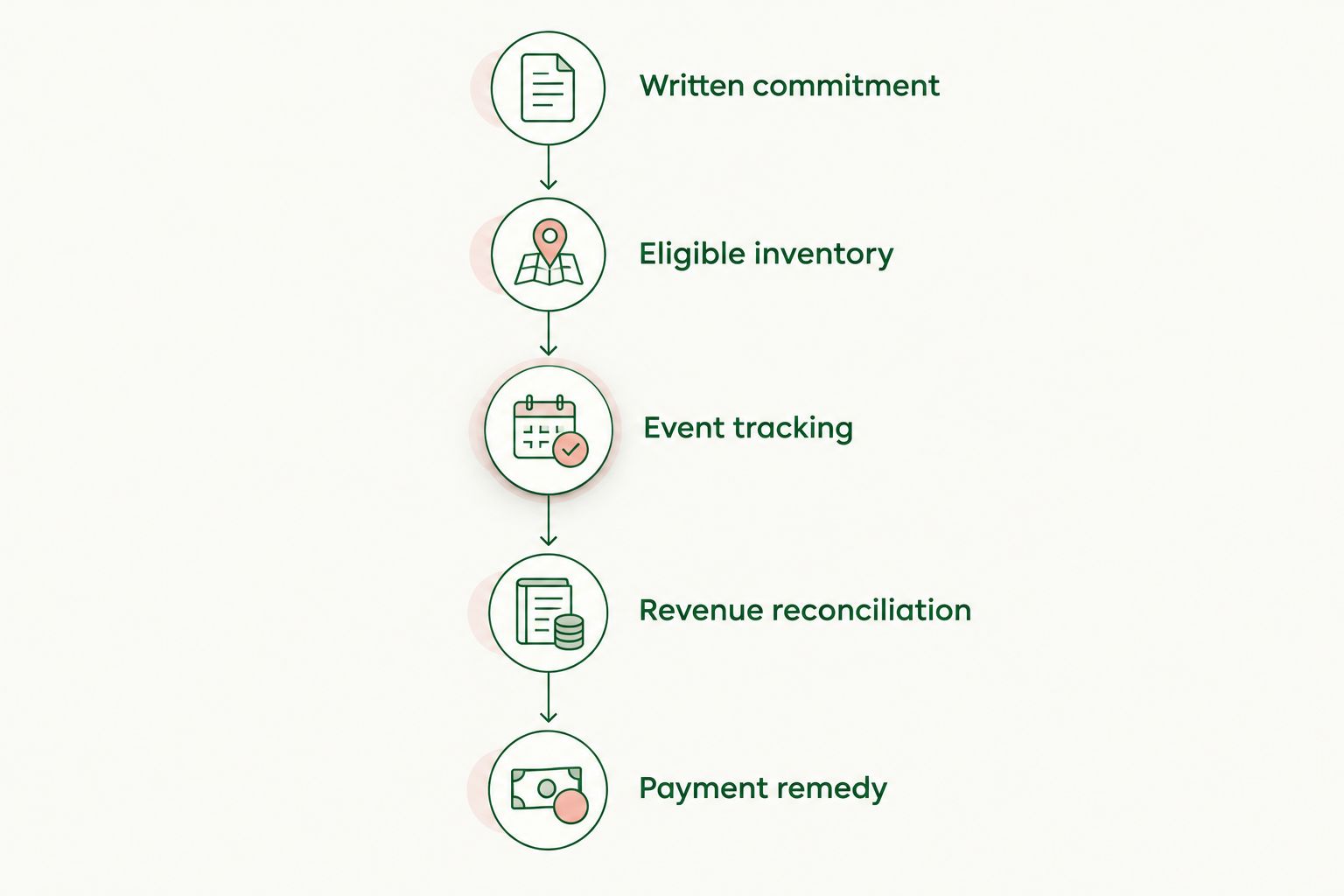
Work through the commitment in the same order you would investigate a missing payment. Start with the obligation and end with evidence that lets both parties reconcile it.
- Written commitment: Obtain the proposed guarantee in the agreement, including the responsible contracting entity.
- Eligible inventory: Map the conditions to your actual app, placements, and traffic sources.
- Event tracking: Establish how requests, rendered impressions, clicks, and qualifying actions are recorded.
- Revenue reconciliation: Confirm how those events become publisher earnings and how adjustments appear.
- Payment remedy: Identify the due date, shortfall process, and remedy stated in the contract.
Do not stop at integration success. A working SDK proves that the technical path functions; it does not prove that a revenue condition has been met or that payment is due.
Preserve the agreement version and the reporting definitions used at launch. If a measurement rule changes, you need to know which rule applies to the disputed period. A screenshot of estimated earnings cannot replace that record.
What should a new chatbot measure first?
Start with event integrity. Log whether your app requested a placement, received an ad, rendered it, and recorded the relevant engagement event. Use identifiers that let you reconcile the records without placing unnecessary conversation content in analytics.
Next, connect those events to publisher revenue. Keep gross advertiser activity, estimated publisher earnings, finalized earnings, and paid receipts distinct in your own reporting wherever those stages apply. Do not label an estimate as cash received.
For your 2026 launch report, include the metric definition beside the metric. A session-based RPM and an impression-based eCPM answer different questions: one describes session monetization, while the other describes impression yield.
Finally, compare revenue with the costs of serving the same traffic. Include inference, hosting, and the operational work involved in monetization. A revenue guarantee is not a margin guarantee. Increasing usage does not establish that the resulting advertising receipts cover the associated workload.
Does a minimum revenue guarantee cover inference costs?
A minimum revenue guarantee covers inference costs only if the agreement explicitly connects its payment obligation to those costs. A commitment to publisher revenue alone does not establish reimbursement or profitability. Model the expense separately.
Keep that distinction visible when you change models, context length, or application behavior. Your ad contract and your compute obligations remain separate unless the signed terms connect them.
Can you monetize a chatbot before it has predictable traffic?
You can evaluate contextual ad integration before your traffic is predictable, but technical integration does not establish network eligibility or revenue. Verify the provider's requirements before planning a launch around acceptance. Then measure the inventory your application actually produces.
Choose a limited test with an explicit stop rule tied to your own economics and user experience. Do not invent an industry RPM target to justify continuing an experiment that your application cannot fund.
Is a revenue guarantee better than a higher projected RPM?
A revenue guarantee provides more budget certainty than a projection only within the guarantee's qualifying scope. A higher projected RPM offers an estimate, not equivalent protection. Compare the contractual obligation, reporting basis, restrictions, and payment timing before choosing.
For a 2026 decision, keep separate columns for committed receipts and estimated receipts. That prevents an attractive forecast from quietly becoming an assumed funding source.
FAQ
Can an AI ad network guarantee income for my new chatbot?
An AI ad network can make a contractual income commitment, but SDK access and earnings estimates do not establish one. Verify the payment obligation, eligibility conditions, and shortfall remedy in the signed agreement.
Does a minimum CPM guarantee monthly chatbot revenue?
A minimum CPM does not guarantee monthly chatbot revenue. CPM is a rate per 1,000 impressions; a monthly total also depends on qualifying monetized activity.
Does Elo guarantee minimum revenue for a new chatbot?
Do not treat Elo's conversational ad SDK description as a minimum-revenue guarantee. Establish any payment commitment through the agreement offered to your application.
Is a payout threshold the same as guaranteed earnings?
A payout threshold is not guaranteed earnings. It specifies when accrued earnings become payable under the applicable terms, not how much your chatbot will earn.
Can guaranteed ad revenue cover my LLM inference bill?
Guaranteed ad revenue covers your inference bill only to the extent that the resulting receipts meet that expense. A revenue commitment alone does not establish profitability or compute reimbursement.
What should I ask an ad network before signing?
Ask what payment is committed, which inventory qualifies, how earnings are measured, and what remedy applies to a shortfall. Confirm deductions, termination provisions, and payment timing as well.
Should I budget with estimated or finalized ad revenue?
Separate estimated revenue, finalized earnings, and paid receipts in your budget. Use the contract to identify committed payments and keep uncommitted forecasts in scenario planning.
One last thing
Ask the network to describe a qualifying shortfall and show exactly how the contract resolves it. That question tests the promise more directly than an earnings projection. If the explanation depends on future demand rather than an existing payment obligation, keep the amount out of committed revenue.