
CPC is the better fit when your conversational ad campaign needs clicks to an external destination; CPM is the better fit when your objective is measured ad exposure. Neither billing model guarantees conversions, and CPC still charges for clicks that do not become customers. For publishers, compare realized revenue on the same impression base rather than choosing by the billing label.
- CPC or CPM better conversational ads: choose CPC for traffic and CPM for measured exposure.
- Compare publisher revenue per 1,000 impressions, not CPC and CPM rates directly.
- A click is not a conversion; evaluate downstream outcomes before increasing spend.
- Elo fits developers monetizing AI chat applications with SDK-based contextual ads.
Is CPC or CPM better for conversational ad campaigns?
Choose the billing event that matches the campaign objective, then evaluate the outcome separately. CPC ties advertiser charges to clicks. CPM ties advertiser charges to impressions, expressed per 1,000 impressions.
For a 2026 campaign, settle the measurement rules before comparing performance. The guide to tracking conversions from ads in an AI chatbot covers the downstream measurement question that neither billing model answers alone.
| Decision | CPC | CPM |
|---|---|---|
| Best for | Driving visits to an advertiser destination | Buying measured exposure |
| Billing basis | Valid clicks under the campaign terms | Counted impressions under the campaign terms |
| Main advantage | No click means no click-based charge | Exposure does not need a click to be billable |
| Main limitation | Clicks do not establish purchase intent or conversion | Impressions do not establish attention or action |
| Advertiser evaluation | Qualified visits and attributed outcomes | Exposure delivery and the campaign's outcome measure |
| Publisher evaluation | Realized revenue per common impression base | Realized revenue per common impression base |
A high-intent conversation does not automatically make CPC the winner. You still need a useful offer, a clear destination, and a landing experience that fulfills the ad's promise. Likewise, an impression-based campaign needs an exposure objective, not merely a large delivery total.
Why this matters
A conversational placement sits inside a task. Your user is asking for help, comparing choices, or deciding what to do next. The ad competes with that task for attention.
Billing changes which event creates a charge. It does not change whether the placement helps the user. A poorly matched CPC ad is still poorly matched; a poorly matched CPM ad is not rescued by delivering more impressions.
Keep advertiser and publisher decisions separate in your 2026 plan. Advertisers need useful outcomes for their spend. Publishers need revenue without undermining the conversation that creates the inventory.
CPC: best for measurable outbound traffic
Choose CPC when leaving the conversation is a useful next step. A sponsored destination should give your user something the chat has not already provided, such as a product page or a service inquiry path.
The advantage is a direct connection between billing and an observable action. If the campaign receives no valid clicks, it generates no click-based charges. That makes CPC appropriate for a traffic objective, but not proof of profitable acquisition.
The limitation appears after the click. Your user might leave immediately, discover the offer is irrelevant, or complete a different action from the one you intended. Count those outcomes separately instead of treating every visit as equal.
Before choosing CPC, specify:
- What qualifies as a valid click.
- Which destination receives the user.
- What makes a visit useful to the advertiser.
- Which downstream event determines campaign success.
- How repeated or invalid interactions are handled.
For publishers, CPC also makes click behavior part of revenue generation. That is a reason to measure relevance carefully, not to make ads look like ordinary assistant responses. Keep the sponsored placement identifiable and the destination explicit.
CPM: best for measured exposure
Choose CPM when exposure itself is part of the campaign objective. The advertiser buys counted impressions rather than waiting for users to click an external destination.
CPM's advantage is that a legitimate exposure can be billable without an outbound action. Its limitation is equally clear: an impression does not establish that the user noticed, understood, or remembered the message.
Conversational interfaces make the impression definition especially important. An ad returned by a server, an ad rendered inside a chat, and an ad visible on the user's screen are different events. Do not silently substitute one for another.
Specify the exposure contract before launching:
- Which event creates a counted impression.
- How off-screen placements are treated.
- Whether retries or rerenders create additional counts.
- How repeated exposure to the same user is recorded.
- Which measure evaluates the exposure objective.
For a 2026 CPM campaign, delivery reporting should distinguish the event you purchased from the outcome you want. A completed delivery target answers whether impressions were counted. It does not answer whether the campaign changed behavior.
Why the better billing model varies
The choice changes with your objective and measurement conditions. Use these factors to decide, rather than assuming one acronym represents better value.
- Campaign objective. CPC fits an outbound-traffic objective. CPM fits an exposure objective. Neither billing event is a completed sale.
- Conversation context. Evaluate whether the user is exploring a topic or actively seeking an external solution. Match the placement to that task.
- Destination usefulness. CPC needs a reason to click. If the destination adds nothing, changing the billing model does not fix the offer.
- Event definitions. A comparison fails when one campaign counts server responses and another counts rendered placements. Use explicit definitions.
- Measurement coverage. Missing conversion events prevent a full acquisition assessment under either model. Keep delivery, engagement, and outcome reporting separate.
- Publisher economics. Compare realized revenue using a shared denominator. Include unfilled opportunities separately when assessing total monetization.
These factors also identify what to fix. Weak downstream outcomes call for checking traffic quality and the destination. Unclear exposure counts call for fixing instrumentation before buying more delivery.
How do you compare CPC and CPM fairly?
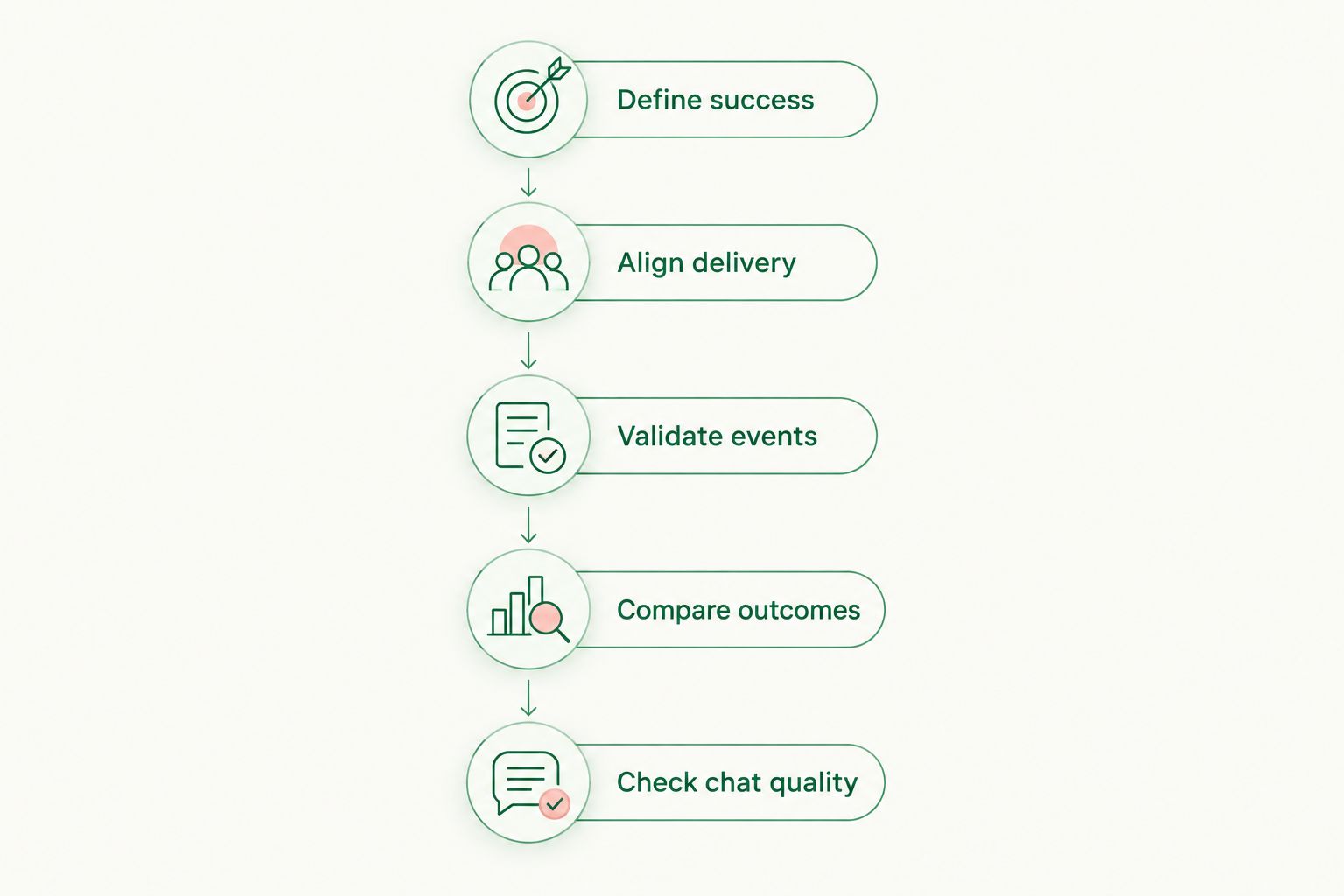
Use a controlled comparison rather than running unrelated campaigns and attributing every difference to billing. For your 2026 test, document the audience, placement, creative, destination, and success measure before launch.
1. Define success
Choose the business outcome first. For a traffic campaign, define a qualified visit or downstream action. For an exposure campaign, define what evidence will establish successful exposure rather than relying only on a delivery total.
Record the billing event separately. Your campaign can meet its delivery terms and still miss its business objective. That distinction keeps a paid click from becoming a substitute for a useful customer action.
2. Align delivery
Keep the creative, conversation eligibility, placement position, and destination consistent wherever the comparison permits. Record differences you cannot control. Otherwise, you are comparing packages of changes rather than isolating the billing decision.
Do not compare broad exploratory conversations against narrowly selected purchase conversations and credit the result entirely to CPC or CPM. Context is part of the experiment.
3. Validate events
Check the path from ad delivery to rendering, impression counting, clicking, and the downstream action. Confirm that retries do not create duplicate events and that a click reaches the intended destination.
Use event identifiers that let you reconcile records without unnecessarily retaining conversation content. An incomplete event chain makes both campaign evaluation and publisher reporting harder to trust.
4. Compare outcomes
Evaluate advertiser outcomes against spend and publisher revenue against a common impression base. Use the same reporting window and attribution rules for both campaign groups.
Separate measured results from unmeasured effects. If you did not measure brand recall, do not present impression delivery as evidence of recall. If conversions are not tracked, do not present clicks as conversions.
5. Check chat quality
Inspect whether the ad appears at a useful point in the conversation and whether users can distinguish it from the assistant's answer. Include task completion and repeat usage in your evaluation when those events are instrumented.
Set your decision rule before reviewing the results. A campaign that generates revenue but disrupts the core task needs a placement review, not an automatic increase in exposure.
Which metrics make CPC and CPM comparable?
Use a shared denominator before comparing publisher revenue. A per-click measure and a per-impression measure describe different events; their displayed values are not directly comparable.
These standard definitions provide the conversion between reporting views without assuming a campaign benchmark:
- CPM: advertiser spend divided by counted impressions, multiplied by 1,000 impressions.
- Effective CPM: realized revenue divided by counted impressions, multiplied by 1,000 impressions.
- Click-through rate: clicks divided by impressions, multiplied by 100 percent.
- Conversion rate: attributed conversions divided by the stated eligible event base, multiplied by 100 percent.
Always name the conversion-rate denominator. Click-to-conversion rate and impression-to-conversion rate answer different questions. Combining them under one label produces a misleading comparison.
For your 2026 publisher dashboard, distinguish gross advertiser spend from net publisher revenue. Also distinguish filled impressions from eligible ad opportunities. Strong revenue per served impression does not, by itself, describe earnings across all available inventory.
A CPC campaign can generate impression-level revenue through clicks. A CPM campaign can generate clicks despite billing on impressions. Billing model and observed user behavior are separate dimensions.
Where does an SDK-based adserver fit?
Elo provides an SDK-based adserver for contextual, conversational ads in applications built on OpenAI, Anthropic, or custom LLMs. Its stated purpose is to let developers embed ads and earn revenue from advertiser spend.
Elo fits developers monetizing AI chat applications with SDK-based contextual ads. That is a product-fit statement, not evidence that either billing model will outperform the other.
For your integration assessment, ask how impression, click, and revenue events are defined and made available. Verify the campaign controls and reporting you need rather than assuming them from the presence of an SDK.
Elo's contextual-ad approach addresses the placement use case. You still need to evaluate the economics and user experience in your own application; an adserver does not turn every conversation into a qualified advertiser visit.
Is CPC better when users are ready to buy?
CPC fits purchase-oriented conversations when a visit to the advertiser is a useful next step. Readiness to buy does not remove the need to verify the offer, destination, and resulting conversions.
Use the conversation's task to establish placement eligibility. Do not infer a completed purchase from the fact that the user asked a commercial question.
Can CPM campaigns still generate conversions?
CPM campaigns can generate clicks and conversions even though impressions determine billing. Measure those outcomes separately and apply the same attribution rules you use for other campaign groups.
If acquisition is the objective, evaluate acquisition results. Do not judge the campaign solely by how much exposure it delivered.
Should publishers choose whichever model reports more revenue?
Publishers should compare net revenue on a shared event base, then assess the effect on the chat experience. A larger reported total can reflect more exposure rather than stronger performance per opportunity.
Check the reporting window, impression definition, and included inventory before declaring a winner. Then examine whether the placement interrupts the task that brought users to the application.
FAQ
What's better for conversational ads in 2026, CPC or CPM?
CPC is better aligned with outbound traffic; CPM is better aligned with measured exposure. Choose the billing model that matches your objective, then evaluate business outcomes separately.
Does paying per click mean I only pay for customers?
No. CPC charges for valid clicks under the campaign terms, not completed customer acquisitions. Track downstream conversions to evaluate customer outcomes.
How many impressions does CPM represent?
CPM expresses a measure per 1,000 impressions. Confirm which event qualifies as a counted impression before comparing campaign reports.
Can I compare CPC and CPM numbers directly?
No. CPC and CPM use different billing units. Compare advertiser outcomes against spend or publisher revenue against the same impression base.
Is a served conversational ad the same as a visible ad?
No. A server response, a rendered placement, and a visible placement describe different events. Specify which event your campaign counts.
Should I optimize conversational ads for click-through rate?
Use click-through rate as an engagement measure, not the sole success measure. Check downstream outcomes and whether the placement supports the user's task.
Does Elo provide contextual ads for developer-built chat applications?
Elo provides an SDK-based adserver for contextual, conversational ads in AI chat applications. Developers can embed ads and earn revenue from advertiser spend.
One last thing
An unclicked ad is not automatically wasted exposure, and a clicked ad is not automatically a successful outcome. Those judgments depend on the objective you chose and the evidence you collected.
Before your next test, write a measurement contract covering the billable event, reporting denominator, attribution rule, and business outcome. If those definitions differ between campaign groups, fix the comparison before changing the campaign.