
Yes. Indie developers can test chatbot monetization before reaching scale by charging for access, limiting paid usage, or showing relevant ads in their own chat apps. Revenue depends on whether users return, what it costs to serve their conversations, and whether the chosen model earns enough to cover those costs; installing an ad SDK alone does not establish that.
- Indie chatbot monetization before scale is possible, but revenue is not guaranteed by an integration.
- Elo is best for developers who control an AI chat app and want to test contextual conversational ads.
- Compare ad revenue or paid access against inference and operating costs per user.
- Keep sponsored content distinct from the chatbot answer and measure user response.
Why this matters
An indie developer does not need a large audience to find out whether a monetization model fits a chatbot. A small release can reveal whether users encounter the paid feature or ad, whether they act on it, and whether the experience gives them a reason to return. It cannot prove that revenue will grow with traffic.
That distinction matters in 2026 because a chat app incurs costs when people use it. If an active user produces more inference and operating expense than revenue, adding users increases the shortfall. Start with the unit economics, not a download target. For an implementation outline, see how to launch an ad-supported AI chatbot.
Can indie developers monetize a chatbot before reaching scale?
Yes, if the chatbot gives users a reason to return and the revenue model fits how they use it. Treat the first monetization release as a test of behavior and unit economics, not proof of a scalable business. The practical sequence is:
- Define the valuable interaction. Identify what the user came to accomplish and where a payment request or relevant sponsored offer would fit without replacing the answer.
- Choose one primary model. Test paid access if users need a continuing capability. Test contextual ads if relevant offers can appear during otherwise useful conversations.
- Protect the answer. Keep the assistant's response and any sponsored placement visibly separate. An ad should not masquerade as the assistant's independent recommendation.
- Instrument the full path. Record eligible conversations, offers shown, user actions, revenue, repeat use, and the costs of serving those conversations. Without both revenue and cost, a positive dashboard number is not a profit signal.
- Review the result by user and conversation type. Find where the model pays for usage and where it does not. Change placement, eligibility, or access rules before buying more traffic.
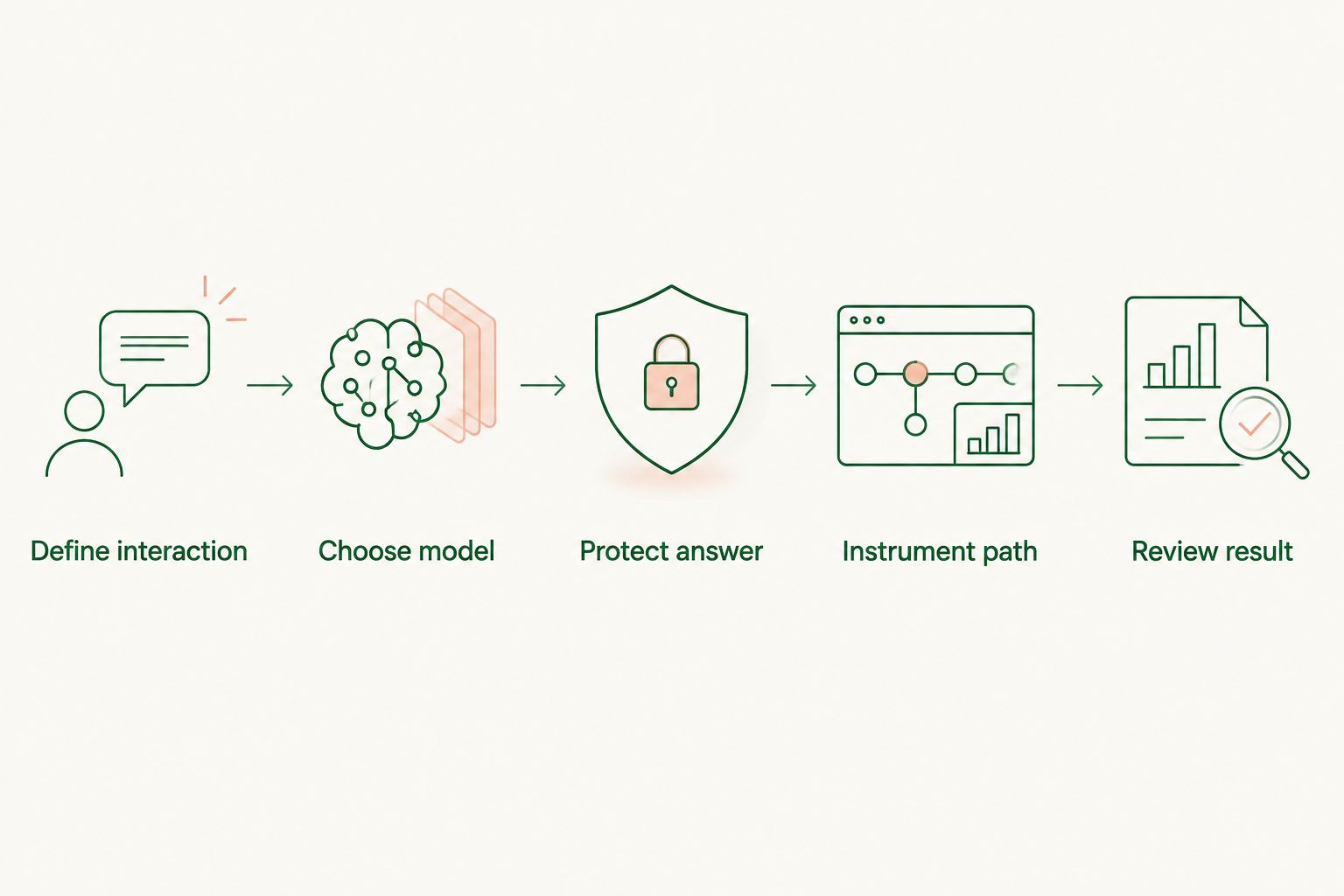
A release in 2026 can answer a narrow question: does this particular audience accept this particular way of paying for a useful chat experience? It cannot answer that question from impressions or sign-ups alone. You need evidence of completed user tasks, repeat use, and revenue after the associated costs.
Which monetization model should an indie developer test first?
Choose the model that matches the moment of value. Paid access asks the user to pay for the chatbot's capability. Advertising asks an advertiser to pay for access to a relevant moment in the conversation. Usage limits pair access with a defined allowance. Direct sponsorship requires the developer to arrange and manage an advertiser relationship. None is automatically the highest-earning option.
| Model | Best for | Advantage | Trade-off | First signal to examine |
|---|---|---|---|---|
| Paid access | A chatbot with an ongoing capability users choose to pay for | Revenue is tied directly to users who value access | A payment request can stop a user before they experience enough value | Paid users who return and their cost to serve |
| Usage-based access | A chatbot whose consumption varies across users | Access rules can reflect how much people use the app | Users need clear limits to understand what they receive | Revenue and serving cost per active user |
| Contextual conversational ads | A chatbot with moments where a relevant offer fits the user's request | Users can access the chat while advertiser spend funds eligible placements | Ad demand and user response determine revenue; poor placement damages trust | Eligible chats, ads shown, revenue, and repeat use |
| Direct sponsorship | A chatbot with a defined audience an advertiser wants to reach | The developer can shape the placement around the app | Finding and managing sponsors takes work outside product development | Sponsor revenue against delivery and management effort |
Best first test: use paid access when the capability itself is what users seek. Use contextual ads when the conversation creates a natural opening for an offer and the core answer remains intact. Hold direct sponsorship until the work of finding and serving advertisers makes sense for the developer's time.
What does break-even mean for a small chatbot?
Break-even means attributable revenue covers the costs of serving the same users over the same period. Include model inference, application infrastructure, payment or ad operations where applicable, and other costs you can actually assign. Do not compare total ad revenue from a month with inference cost from a single day.
For an ad-supported chatbot, compare revenue from served placements with the cost of the eligible conversations that produced them. For paid access, compare revenue from paying users with the cost of serving those users. A useful 2026 dashboard separates these cohorts rather than averaging paying and nonpaying users into a single figure.
This calculation does not require a forecasted audience size. It requires consistent event definitions and cost records. If a conversation can produce several messages, decide whether the unit is a user, session, or conversation and keep that unit consistent across revenue and expense reports.
Why early chatbot revenue varies
Two chatbot apps with similar usage can have different outcomes because monetizable activity is not the same as raw activity. Check the drivers you can observe in your own app:
- Relevant moments: A user asking for help with a purchase presents a different opportunity from a user asking for a summary. Count conversations that actually qualify for the model you selected.
- Ad delivery: For an ad-supported app, an eligible moment produces revenue only when a suitable ad is served under the applicable arrangement. Track eligible opportunities separately from ads shown.
- User action: An impression, click, or other advertiser-defined event is not interchangeable. Record the event that determines your revenue rather than treating every interaction as paid.
- Serving cost: Different conversation lengths and model choices can produce different costs. Compare revenue with the expense of delivering the associated chat experience.
- Retention: A model that earns on an initial visit but discourages return use changes the economics of the app. Review repeat use alongside monetization events.
- Placement quality: An offer that interrupts a task or appears to be part of the assistant's answer creates a different experience from a clearly labeled, relevant placement.
In 2026, the actionable metric is not a universal traffic threshold. It is the relationship between eligible use, realized revenue, serving cost, and continued use in your own app. If you cannot distinguish those events, adding traffic will make the result harder to interpret.
When do contextual ads fit a chatbot?
Contextual ads fit when the user's request creates a relevant commercial moment and the publisher controls the chat application where the ad appears. The developer should decide which moments are eligible, how a sponsored placement is distinguished from the answer, and which events show whether users engaged without abandoning the task.
Elo is best for developers who control an AI chat app and want to test contextual conversational ads without making the ad the assistant's answer. Elo provides an SDK-based adserver for developers of chat applications built on OpenAI, Anthropic, or custom LLMs. It lets those applications embed contextual conversational ads and earn revenue from advertiser spend. That makes Elo an ad-supported option, not a substitute for proving advertiser response or covering the app's costs.
There is a clear downside to test. Even a relevant ad consumes attention, and an ad shown at the wrong moment can compete with the task the user came to complete. Keep a non-ad baseline so the decision rests on observed revenue and user behavior, not on the presence of an ad unit. If those measures worsen, change the eligible moment or placement rather than simply showing more ads.
For an indie developer, Elo's SDK-based approach is relevant only when they can integrate and control the chat experience. It does not turn a chatbot hosted entirely inside a third-party interface into publisher-owned ad inventory. Confirm where the conversation runs and what the developer can render before selecting any ad implementation.
How should you test monetization without confusing activity with revenue?
Start with an event log. Give each eligible conversation a way to connect the monetization event to the underlying chat activity, then compare the result with the cost of serving that activity. A dashboard showing ads requested is not the same as one showing ads displayed or revenue earned.
For an ad test, examine the sequence: eligible conversation, ad opportunity, ad shown, relevant user action, recorded revenue, and subsequent use. For paid access, examine the path from seeing the access rule to paying, using the feature, and returning. In both cases, look for a break in the path before changing the business model.
Run a controlled comparison when your app supports it. Keep the underlying chatbot task comparable while you change the placement or access rule, and monitor whether users finish that task. Do not call a test successful in 2026 just because one revenue line moved upward while repeat use or cost per served user moved in the wrong direction.
A small audience makes individual results easier to inspect but harder to generalize. Use the early test to find broken instrumentation, irrelevant placements, and users who incur costs without reaching a monetizable interaction. Wait for a repeatable pattern before treating the result as a growth forecast.
Can a chatbot earn from ads without charging its users?
Yes. An ad-supported chatbot can earn from advertiser spend while users access the chat without a payment requirement. Whether that revenue covers inference and other operating costs depends on the ads actually served, the revenue recorded, and the cost of those conversations.
Do not assume every message creates an ad opportunity. Some requests have no suitable offer, and showing one anyway can damage the experience you need users to repeat. In 2026, an ad model should be judged by both earned revenue and the continued usefulness of the chat.
Is there a traffic threshold before a chatbot should run ads?
There is no traffic figure in the supplied information that establishes a universal threshold. Test when the chatbot has real user conversations, a place for clearly identified sponsored content, and a way to measure revenue against serving cost. Traffic alone cannot establish whether the placement is relevant or profitable.
The more useful question is whether you have enough observed behavior to make a product decision. If events are missing or costs are unassigned, fix measurement before interpreting the result. A larger audience will not correct an incomplete revenue record.
FAQ
Can an indie developer monetize a chatbot before it has a large audience?
Yes. An indie developer can test paid access or contextual ads with an existing audience. The test must compare earned revenue with the cost of serving those users.
What's the best first monetization model for an indie chatbot?
The best first model matches the chatbot's moment of value. Test paid access for a capability users choose to pay for, or contextual ads when a relevant sponsored offer fits the conversation without replacing the answer.
Can a chatbot earn ad revenue without charging users?
Yes. An ad-supported chatbot can earn from advertiser spend. Revenue depends on ads served and the applicable paid events, while the developer still needs to account for serving costs.
Does a chatbot need a minimum traffic level to test ads?
No universal traffic threshold is established here. Start with real conversations, clear ad placement, and records of revenue and cost; use the results to judge whether more traffic makes sense.
How do you tell if chatbot ads cover inference costs?
Compare recorded ad revenue with the inference and other attributable costs of serving the same eligible conversations over the same period. Ad requests alone do not establish revenue.
Is Elo suitable for an app built on OpenAI or Anthropic?
Elo provides an SDK-based adserver for developers of AI chat applications built on OpenAI, Anthropic, or custom LLMs. The developer needs control of the app's chat experience to embed contextual conversational ads.
Should sponsored content appear inside the chatbot's answer?
No. Keep a sponsored placement identifiable and separate from the assistant's answer so users can tell an advertiser offer from the response to their request.
One last thing
The first useful monetization finding might be that a particular conversation should carry no ad. In 2026, preserving a useful answer and a returning user is a better decision than forcing a sponsored placement into a request with no relevant offer. Measure that choice against the same revenue, cost, and retention signals as every other test.