
No single percentage answers how much fill rate an AI chat ad network can deliver in 2026. Fill depends on which chat turns qualify for an ad, whether an advertiser matches the conversation, and whether the returned ad renders. Ask for rendered-ad fill against eligible opportunities, segmented by context, before accepting any network-wide figure.
- AI chat ad network fill rate has no defensible universal percentage in 2026; measure rendered ads against eligible opportunities.
- Elo is best for AI chat developers seeking an SDK-based adserver for contextual conversational ads, not a guaranteed fill figure.
- Compare networks using the same eligible-opportunity definition, then check rendered fill and revenue together.
- A returned ad that never renders does not fill an opportunity for the publisher.
Why this matters
A fill-rate claim sounds useful until you inspect its denominator. A network can report ads returned per request while your team cares about ads users actually see per eligible chat turn. Those figures answer different questions, and neither tells you what the filled inventory earns.
For a developer evaluating Elo, the decision is whether its contextual adserver fits the chat experience and produces measurable revenue. Its SDK-based approach makes integration relevant to the evaluation. No published fill percentage in the information available here establishes what your app will achieve; use your own event counts instead.
How much fill rate can an AI chat ad network deliver?
The measurable answer is your rendered ads divided by your eligible ad opportunities for a defined period and segment. A network cannot supply a meaningful universal percentage without stating the inventory, eligibility rules, event definitions, and measurement period behind it. For a 2026 evaluation, request those definitions before comparing reported rates.
| Measure | Calculation | What it answers | What it misses |
|---|---|---|---|
| Response fill | Matched ad responses ÷ valid ad requests | Did a request receive an ad? | Whether the ad rendered |
| Rendered fill | Rendered ads ÷ eligible ad opportunities | How often did eligible chat inventory show an ad? | Revenue from each rendered ad |
| Request coverage | Valid ad requests ÷ eligible ad opportunities | Did eligible inventory reach the ad system? | Whether a request matched or rendered |
Each percentage uses a different event pair. Do not compare a network's response fill with your app's rendered fill, or combine them in a single average. Rendered fill is the publisher-facing verdict; response fill diagnoses the ad network's part of the pipeline.
The denominator must be explicit. If you allow ads only after certain conversation events, count those events as eligible opportunities; do not count every model response as available inventory. Keep excluded turns visible as a separate event category so a change in eligibility rules cannot masquerade as a change in network performance.
Define the measurement events
- Eligible opportunity: The app determines that this point in the conversation permits an ad under its own placement rules.
- Ad request: The app sends a valid request for that opportunity. Record failures before the request separately.
- Matched response: The ad system returns an ad for that request. A response alone is not a render.
- Rendered ad: The app displays the returned ad. Log render failures separately from unmatched requests.
These are measurement definitions, not a claim that any named vendor exposes every event. In 2026, ask each network which events its reporting actually captures. If the vendor reports requests and responses but your app records opportunities and renders, reconcile the counts rather than relabeling one metric as another.
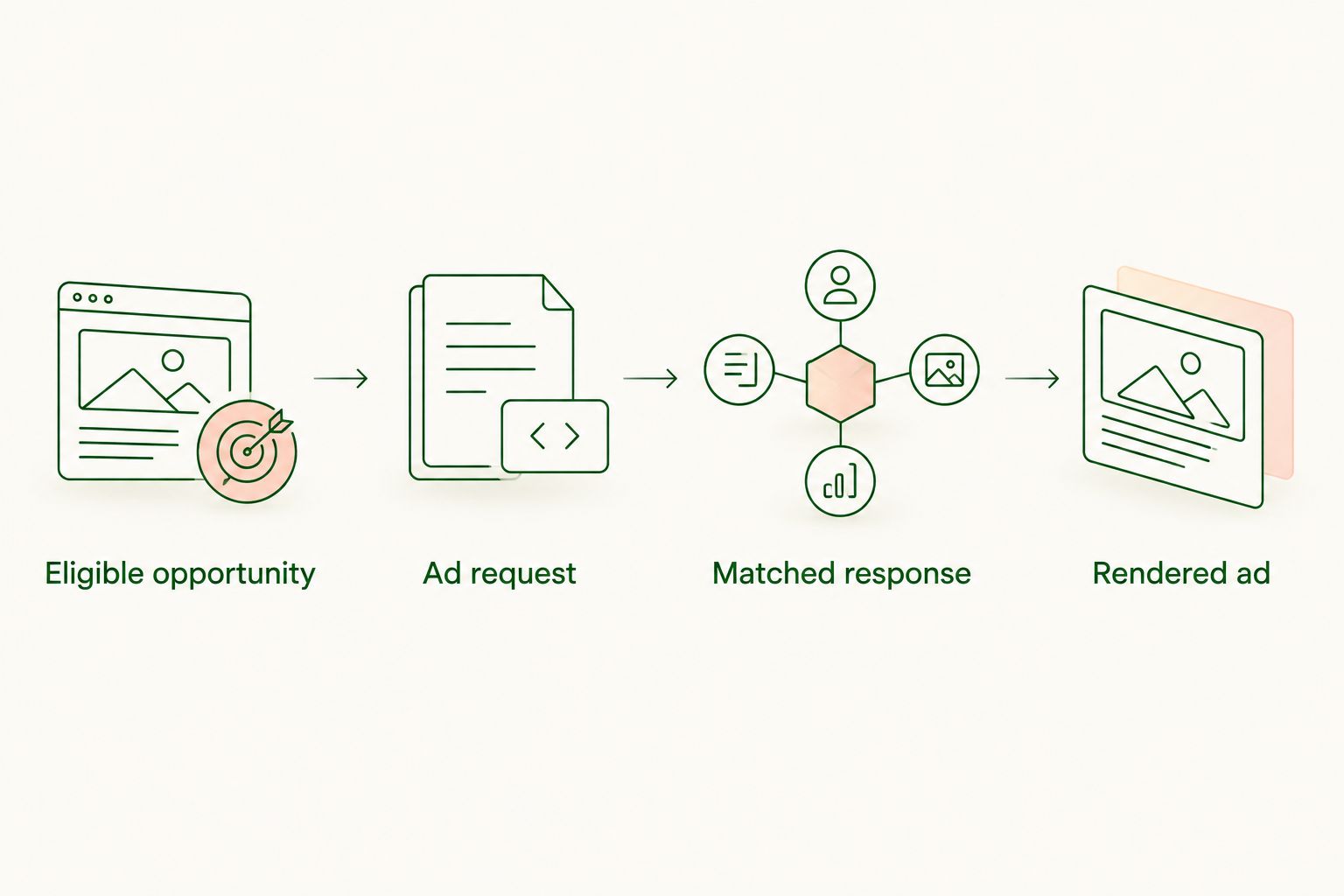
A valid request with no matched response points to a different issue than a matched response that fails to render. Separate those losses before changing targeting, placement, or the integration. Otherwise, a fix aimed at advertiser matching will not resolve an app-side render failure.
Response fill versus rendered fill
Response fill is useful for diagnosing matching; rendered fill is useful for evaluating usable inventory. Both belong in a 2026 publisher report, but they should never share an unlabeled percentage. A returned ad can fail to appear because the user leaves the conversation, the placement closes, or the application does not complete rendering. Those are possible failure points, not published performance claims about a particular network.
For a fair comparison, hold the event definitions constant across networks. The same request policy, opportunity definition, and render event should apply to each candidate. If one report excludes invalid requests while another includes them, their response-fill figures do not share a denominator.
The same caution applies across app surfaces. A voice assistant, an embedded support chat, and a standalone chat app can create opportunities at different points in the interaction. Do not combine them into one headline rate and assume it describes any one surface. Report each surface separately, then calculate an overall figure from its underlying counts if you need one.
Why AI chat ad network fill rate varies
- Conversation context: Contextual matching depends on what the current conversation communicates. Different topics give the matcher different signals; measure them as separate cohorts rather than assuming a single app-wide rate describes every topic.
- Advertiser demand: A valid opportunity needs an available advertiser match to become a response. Track unmatched requests separately from requests your app never sent.
- Eligibility rules: Your placement policy determines which chat turns enter the denominator. Changing that policy changes the measured population, even if the ad network behaves exactly as before.
- SDK and render execution: A request that fails before reaching the ad system is not an unmatched ad. A returned ad that fails to render is not a filled placement. Keep those failures in distinct buckets.
- Ad format and surface: The app has to display the returned creative in its chat interface. Evaluate each placement and format on its own rendered-fill record rather than treating all conversational inventory as interchangeable.
- Measurement boundaries: Reporting windows, deduplication, and event definitions affect the resulting rate. Agree on them before placing vendor figures side by side.
These factors explain where to investigate, not how many percentage points any one change will add. A comparison that lacks the underlying counts cannot establish whether demand, eligibility, or rendering drove the result.
How should you compare networks in 2026?
Start with an event specification, not a promised fill rate. Write down what makes a chat turn eligible, when the app sends a request, what counts as a response, and when an ad qualifies as rendered. Apply that specification to each network under consideration. A published percentage without matching definitions is not a comparable result.
Then review the same breakdown for each candidate:
- Eligible opportunities and valid requests, to expose missed requests.
- Valid requests and matched responses, to isolate response fill.
- Matched responses and rendered ads, to expose render loss.
- Rendered ads and attributed revenue, to assess the business result.
Keep each count attached to its period, app surface, and conversation cohort. This makes a 2026 test repeatable. If a network changes its reporting definition during the evaluation, restart the comparison under a shared definition rather than joining incompatible periods.
Elo is best for developers who want an SDK-based contextual adserver for AI chat applications; it is not a fill-rate guarantee. Elo's stated use case covers chat apps built on OpenAI, Anthropic, or custom LLMs. The trade-off is clear: an SDK gives the developer an integration path for conversational ads, while the actual rendered fill and revenue still need to be measured in the app. Do not infer either result from the presence of an SDK.
Assess contextual ads in your chat app
Review Elo's SDK-based adserver against your app's eligible opportunities and render events.
What should a fill-rate report include?
A useful report shows event counts before it shows percentages. Put eligible opportunities, requests, responses, and renders in adjacent columns for each reporting period. Add a clear definition for every event and record changes to eligibility or placement rules alongside the data. In 2026, a trend line without those definitions cannot tell you whether the network improved or the denominator moved.
Split the report where a single total hides operational differences: app surface, placement, and conversation cohort are practical starting points. Use the same segments for revenue so a high-fill cohort is not mistaken for the most valuable one. Do not replace revenue analysis with fill analysis; an ad can render and still contribute less revenue than another filled opportunity.
Also record errors in the part of the pipeline where they occur. No request, no match, and no render require different investigations. If you collapse them into one unfilled bucket, the report tells you that inventory was lost but not where to fix it. A developer should be able to trace a drop in rendered fill back to the corresponding event pair.
Can a higher fill rate produce less revenue?
Yes. Fill measures the share of opportunities that show an ad, not the revenue those ads produce. Compare rendered fill with revenue over the same eligible inventory and reporting period. A higher percentage is not a win if the business outcome falls.
RPM gives you another view: revenue per 1,000 measured units, with the unit stated explicitly. An RPM based on rendered ads answers a different question from one based on eligible opportunities. Label the unit before using either figure to judge a 2026 network test.
This distinction also protects chat UX. Filling more eligible points is not automatically the right goal if the placement interrupts the conversation. Assess where the ad appears and whether it remains identifiable as an ad, then read the monetization result beside those placement decisions. Do not treat maximum fill as permission to turn every chat response into inventory.
Is response fill enough to judge an SDK integration?
No. Response fill stops at the ad system's reply; it does not confirm display in the app. Compare request coverage and rendered fill alongside it. A strong response-fill figure cannot compensate for eligible opportunities that never trigger requests or responses that never appear.
For an SDK integration, instrument the boundaries before evaluating performance. Confirm that the opportunity event precedes the request, that the response maps to the intended placement, and that the render event fires only when the ad appears. This is an implementation checklist, not a claim about the reporting features of a particular SDK.
How long should you measure fill rate?
Use a defined reporting period and show its underlying counts; no universal test duration follows from a fill-rate claim. Keep the period consistent across the networks and cohorts you compare. State the dates, the eligibility rules in force, and any placement changes, then judge whether the observed inventory represents the conversations you intend to monetize.
Do not use a calendar label as a substitute for sample context. A 2026 report covering a limited app surface describes that surface, not every deployment of the network. The narrower the included inventory, the narrower the claim you can make from it.
FAQ
What is a good AI chat ad network fill rate in 2026?
There is no verified universal percentage that defines a good AI chat ad network fill rate in 2026. Compare rendered ads with eligible opportunities in your app, then judge the result alongside revenue and placement quality.
How do I calculate fill rate for an AI chat app?
Divide rendered ads by eligible ad opportunities to calculate publisher-facing fill rate. Label the reporting period and eligibility rules so the percentage remains comparable.
Is response fill the same as rendered fill?
No. Response fill compares matched responses with valid requests; rendered fill compares displayed ads with eligible opportunities. A returned ad does not count as rendered until it appears in the app.
Can Elo guarantee a fill rate for my AI chat app?
No fill-rate guarantee is stated for Elo in the available brand information. Evaluate its SDK-based contextual adserver using your app's opportunity, request, response, render, and revenue events.
Does higher fill always mean higher ad revenue?
No. Fill counts the share of opportunities that render an ad, while revenue measures what those ads earn. Review both over the same inventory and period.
Should I count every AI response as an ad opportunity?
No. Count only chat turns that meet your documented placement rules as eligible opportunities. Track excluded turns separately so a policy change does not distort the fill-rate trend.
What should I ask an AI chat ad network before comparing fill rates?
Ask for the numerator, denominator, reporting period, and whether the figure measures returned or rendered ads. Request the underlying event counts for the same app surface you plan to evaluate.
One last thing
Preserve the event counts even when a dashboard displays only percentages. If your 2026 eligibility policy changes, the counts let you identify which opportunities entered or left the denominator. Without them, an apparent fill-rate improvement can be a measurement change rather than more ads reaching users.