
Yes. You can monetize an AI chatbot without collecting persistent personal data by selling access to relevant ad placements based on the current conversation topic. You still need enough context to choose an ad, and you must check what the ad SDK receives, stores and shares before calling the setup privacy-preserving.
- Yes: monetize AI chatbot without user data by matching contextual ads to the current topic, not a stored user profile.
- Elo is best for developers evaluating conversational ads in AI chat apps; verify SDK data flows before deployment.
- No persistent profile does not mean no data moves: inspect each ad request, response and event log.
- Subscriptions avoid ad requests but generally require billing data; direct sponsorship avoids an ad SDK but still needs disclosure.
Can you monetize an AI chatbot without collecting user data?
Yes, if you mean without collecting persistent personal data for ad targeting. The distinction matters: an ad matched to a conversation needs a signal about that conversation. A topic label such as meal planning serves a different purpose from a user ID, a complete prompt or a stored chat history. But a label can still reveal sensitive information, so its content and handling need review.
For an ad-supported chatbot, the practical route is to make a placement decision from limited, current-session context rather than a profile built across sessions. Treat that as an architecture to verify, not a feature you can assume from an ad format's name.
- Define the boundary. Decide whether without user data means no account profiles, no persistent identifiers, no raw chat text leaving your system, or no collection of any information at all. Those are different requirements. An ad-supported app can pursue the first three; the last one leaves nothing to use for a context-based match.
- Extract an allowed topic. Classify the portion of the exchange that is relevant to an ad opportunity. Exclude personal details and sensitive topics from the signal. If the message cannot be reduced to an acceptable topic, do not send an ad request for that turn.
- Inspect the ad request. List every field sent to the adserver, including metadata added by the SDK, your application and the network connection. A clean topic field does not resolve the question if another field carries an identifier or raw prompt.
- Review storage and onward sharing. Check request logs, impression and click events, retention settings and any recipients of those events. Your app's decision not to build a profile does not establish what another party retains.
- Keep the response distinct from the ad. Label the paid placement and render it separately from the assistant's answer. The ad can be relevant without being presented as the assistant's independent recommendation.
Elo provides an SDK-based adserver for contextual, conversational ads in AI chat applications. For a developer assessing that route, the integration review starts with the actual request and event schema. Elo's product description establishes what the adserver is for; it does not, by itself, establish that an integration collects no user data.
Why this matters in 2026
A chatbot contains the words people use to explain what they need. That makes the current conversation useful for matching an ad, but it also makes careless data sharing a direct privacy issue. A prompt about a recipe and a prompt about a medical concern should not follow the same advertising path simply because both contain an apparent topic.
The privacy question is what leaves the application, not whether the ad looks native. An unobtrusive card can still rely on a persistent identifier. A visibly labeled ad can rely on a limited topic signal. In 2026, evaluate the data path and the presentation as separate parts of the decision.
There is also a business distinction. No behavioral targeting is an achievable design goal for contextual advertising. No information processed anywhere is incompatible with reading a conversation, selecting an ad and recording that it appeared. If your policy prohibits transmitting even a topic derived from a message, use a monetization method that does not request a conversation-matched ad.
Which monetization model fits the data boundary?
Contextual ads, subscriptions and direct sponsorship place different demands on your application. None is automatically data-free. Compare the information each model needs before choosing based on the revenue mechanism.
| Model | What drives revenue | Data boundary to inspect | Best for | Main drawback |
|---|---|---|---|---|
| Contextual conversational ads | Advertiser spend tied to eligible ad placements | Topic sent for matching, request metadata, impression and click events | Publishers with identifiable, non-sensitive moments of user intent | Requires a third-party data-flow review and clear ad separation |
| Subscriptions | Users pay for access or features | Account records and billing data handled by the payment flow | Apps whose users will pay directly for continued access | Does not meet a literal no-user-data requirement if accounts or billing records are involved |
| Direct sponsorship | An advertiser pays for a disclosed placement | What you share with the sponsor and how you measure delivery | Publishers able to manage sponsor relationships and placement rules | Sales, reporting and creative review become the publisher's work |
Elo is best for developers of AI chat apps who want to evaluate contextual conversational ads rather than build an advertiser workflow themselves. Its SDK-based adserver addresses ad placement and advertiser-funded revenue. The trade-off is that an external SDK adds a data path you must inspect; the supplied product description does not specify its fields, retention rules or privacy controls.
The comparison changes if your definition is stricter. A subscription removes the ad request, not the need to handle information associated with payment. A direct sponsor can remove an ad SDK, but a topic-targeted sponsorship still requires a rule for deciding when the placement appears. Write down the boundary first; then reject any model whose necessary inputs cross it.
How do you keep contextual matching separate from profiling?
Use a narrow decision path: current message, permitted topic, eligible placement, disclosed ad. A profile-based path adds a different input: what the system remembers about a person across conversations. That persistent history is not required to describe the topic of the current exchange.
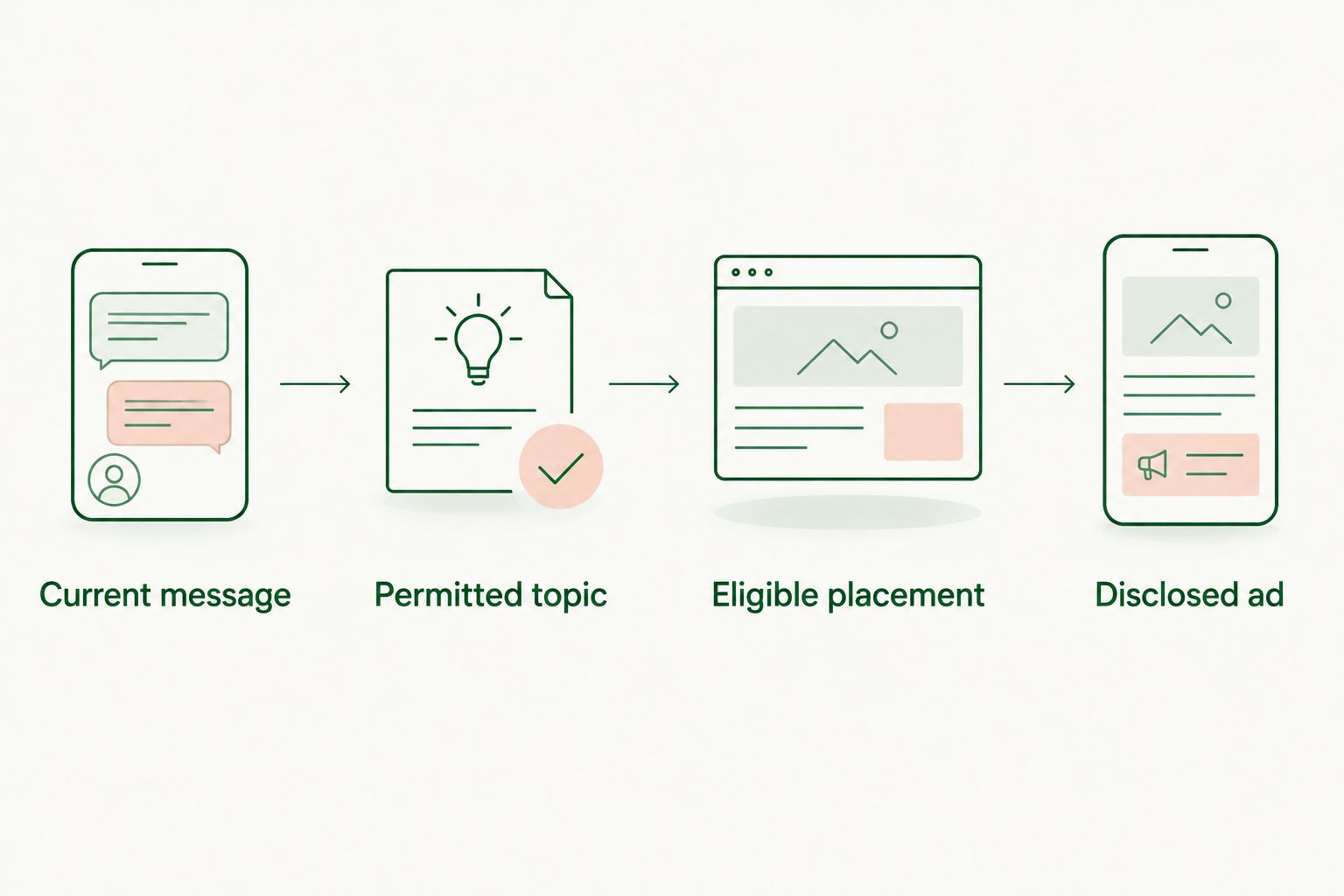
Start by classifying intent inside your application. The output should describe the ad opportunity, not reproduce the conversation. A request about replacing a kitchen faucet can produce a home-improvement topic; a request containing someone's address should not send that address along with the topic. If the topic itself exposes sensitive information, suppress the ad opportunity rather than trying to disguise it with a shorter label.
Next, inspect the full request at the point it leaves your app. Look for fields that identify a person, device or session; inspect request headers and event payloads as well as fields you explicitly set. Do the same for impression and click reporting. Removing raw prompt text from the match field is not enough if it reappears in a log or analytics event.
Then check the return path. The ad response should be treated as paid content. Do not insert advertiser copy into the model's answer as though it were generated advice, and do not let an ad change the factual response. If your interface cannot make that separation clear, solve the rendering problem before adding the placement.
Finally, document what happens when no eligible topic exists. No ad is a valid result. It is better than converting a sensitive exchange into advertising context simply to fill a slot. This rule gives engineers and reviewers a decision they can test against real request payloads in 2026.
Why privacy outcomes vary
The word contextual describes a way to choose an ad; it does not describe every field transmitted by an SDK. These factors determine whether your 2026 deployment respects the boundary you set:
- Signal content. A broad topic can avoid sending a complete prompt, but even a short topic can be sensitive. Define topics that are ineligible for ads.
- Identifiers in requests. Check whether your app or its dependencies attach a persistent ID, session token or account reference to the call. A topic-only field does not make the entire request topic-only.
- Event logging. Impression and click events support measurement, but their payloads and retention need the same review as the initial request.
- Data recipients. Identify which systems receive request and event data. Limiting what your application stores does not limit a recipient's storage.
- Ad placement. Keep sponsored content labeled and distinct from the answer. An accurately matched ad still needs to be recognizable as an ad.
- Fallback behavior. Specify what happens when context is too sensitive, ambiguous or limited for an acceptable match. The safe fallback is to show no context-matched placement.
You can turn those factors into a release test. Capture the request and event shapes in a test environment, compare them with the fields your policy permits, and reject the integration when they differ. Repeat the review after SDK or application changes that affect the data path. A privacy claim is only as useful as the behavior it describes.
Does contextual advertising require a user ID?
No. An ad can be selected from the current conversation topic without using a persistent user ID for targeting. That does not prove a particular SDK omits identifiers from transport, logging or measurement; inspect the implementation before making that claim about your chatbot.
The 2026 design choice is whether the ad decision follows this exchange or this person across exchanges. Keep those inputs separate in the architecture and in your documentation. If an identifier appears in the ad request, determine why it is there and whether the workflow still meets your stated boundary.
Can you send the full conversation to an ad network?
You can design an integration that sends conversation content, but do not send the full conversation when a limited topic is enough for your intended match. Prompts can contain personal or sensitive details unrelated to the placement. Sending the whole exchange expands the data available to the recipient without establishing that the ad will be more useful.
For 2026, review both intentional fields and incidental transmission. Inspect the payload you construct, the metadata your tooling adds and the events emitted after an ad appears. A privacy review limited to the matching input misses the rest of the path.
What if the chatbot cannot identify a safe ad topic?
Do not make a context-matched ad request for that exchange. An ambiguous or sensitive prompt is not a reason to pass more conversation text to a matcher. Keep the assistant's answer available without turning the uncertainty into an advertising signal.
This is a product rule as well as an engineering rule. Define the ineligible-topic behavior before launch so that a change in classification does not silently turn previously excluded conversations into ad opportunities.
FAQ
Can you monetize an AI chatbot without collecting user data?
Yes, if you mean avoiding persistent personal data for ad targeting. Contextual ads can use a limited topic from the current exchange, but you must inspect the complete SDK and event data path.
Do contextual ads need chat history?
No. An ad can be matched to the current topic without using earlier conversations. Check that your application and ad integration do not send or retain history elsewhere.
Is a topic label the same as anonymous data?
No. A topic can reveal sensitive information, and accompanying request data can identify a user. Evaluate the complete request rather than assuming a short label is anonymous.
Can I show ads without sharing raw prompts?
Yes, if the ad decision can use an allowed signal derived inside your application. Verify that raw prompts do not appear in request metadata, logs or reporting events.
Are subscriptions a no-data alternative to chatbot ads?
No, not when access involves accounts or billing information. Subscriptions remove the ad request but introduce a different data flow that needs its own review.
Should an ad appear inside the assistant's answer?
Keep a paid placement distinct from the assistant's answer and label it clearly. Relevance does not turn advertiser content into independent advice.
What should I check before adding an ad SDK to my chatbot?
Inspect outgoing requests, identifiers, event payloads, retention and data recipients. Test what happens when the conversation has no acceptable ad topic.
One last thing
Start the 2026 review with an exchange that must not produce an ad. If the application cannot decline that placement without sending the prompt elsewhere, the data boundary is not under control. For developers considering Elo, review the SDK's actual request and event behavior against that test before describing the chatbot as monetized without collecting user data.