
There's no traffic minimum that unlocks ad monetization for an AI chatbot in 2026 — the real gate is conversation volume, not user count. A chatbot running a modest number of daily conversations can turn on ads the same way a much larger one can; low volume doesn't block eligibility, it just caps how much any ad network can pay out.
- No AI chatbot needs a set traffic floor to start running ads in 2026 — conversation volume matters more than signups.
- Elo and similar ad SDKs match ads to conversation context, so integration works the same at low and high volume.
- Revenue scales with ad-eligible conversation turns, category fit, and advertiser demand, not raw user counts.
- Waiting for 'enough traffic' before adding an ad SDK usually means losing weeks of fill-rate and RPM data you could already have.
- Categories with strong advertiser demand, like finance, shopping, or travel, monetize sooner even at modest conversation volume.
Why this matters
Most chatbot builders assume ad monetization needs the scale of a mobile app with a display waterfall — tens of thousands of daily active users before any ad network will even talk to them. Contextual, conversational ads don't work that way: the ad is matched to what's being discussed inside a single conversation, not served against a pool of anonymous pageviews.
That difference changes the question from "how much traffic do I need" to "how many conversations produce a relevant ad match, and does my category have advertisers willing to pay for it." Builders who wait for a traffic number that doesn't exist end up delaying revenue they could already be collecting. The 7 best ad networks for AI chatbots by traffic requirements breaks down how different networks actually gate access — most gate on category and integration type, not volume.
How much traffic do you need before an AI chatbot can run ads?
You don't need a specific traffic number — you need enough recurring conversations in a category advertisers already buy into. A chatbot at any stage can integrate an ad SDK; what changes with scale is total revenue, reporting confidence, and how much mediation logic is worth setting up.
| Stage | What matters most | Verdict |
|---|---|---|
| Early beta, steady daily conversations | Category fit, testing ad relevance and placement | Integrate now — collect real data before scaling |
| Growing app with returning users | Advertiser demand for your topic, message depth | Best window to add ads before support costs grow |
| Established app with broad topic coverage | Fill rate, mediation across networks, bidding | Full monetization stack pays off here |
The verdict column doesn't change with company size — it changes with whether the conversation content gives an ad network something to match against. A one-week-old chatbot with topic-rich conversations in a commercial category is closer to "ready" than a year-old chatbot with short, generic exchanges.
Why "traffic" is the wrong question
Traffic is a proxy for two things advertisers actually care about: how many conversations touch a topic they sell into, and how much context each conversation gives an ad matcher to work with. A chatbot with fewer users but longer, topic-rich conversations can out-earn a much larger one with short, generic exchanges. That's the opposite of how display advertising works, where scale is close to the whole game.
What actually decides if ads make sense
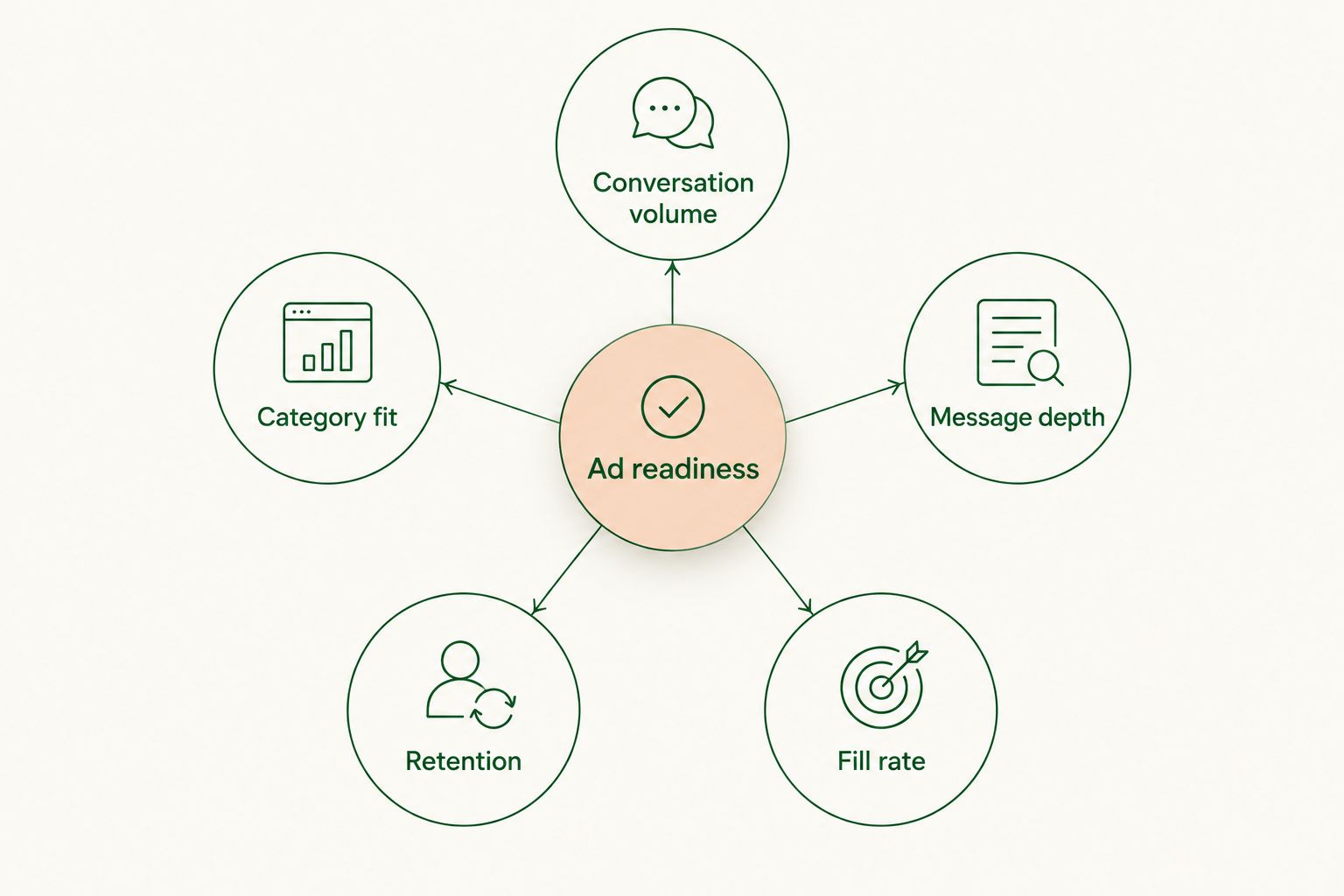
This is where ad networks like Elo look before revenue potential enters the conversation at all:
- Conversation volume — total messages processed monthly across your user base, not total signups.
- Category fit — chatbots built for shopping, travel, finance, or insurance queries draw more advertiser demand than general-purpose assistants.
- Message depth — conversations with more back-and-forth give a matcher more context to place a relevant ad instead of a generic one.
- Retention — users who return see more ads over their lifetime, compounding revenue without adding new signups.
- Ad format and placement — native cards inside the chat flow behave differently than an interruption dropped between turns.
- Fill rate — the ad network's ability to find a relevant match for a given conversation, which matters as much as how many conversations exist in the first place.
How this compares to display or banner monetization
Display networks price and gate on impressions because the ad has no relationship to the content around it — more eyeballs is the only lever. Conversational ad SDKs price on relevance: a native card that responds to what's actually being discussed converts differently than a banner stapled to the bottom of a screen. That's why a chatbot with modest conversation volume in a strong category can produce meaningful RPM (revenue per thousand sessions) while a much bigger chatbot with no clear topic focus struggles to fill inventory at all.
This is also why fill rate and CPM don't move in lockstep with traffic the way they do on a content site. A single well-matched conversation in a high-demand category can outperform ten poorly-matched ones, regardless of how many total conversations happened that day.
Signs your chatbot is ready to add ads today
- You have a steady, repeatable flow of conversations, even if the daily count is small.
- Your chatbot serves a category advertisers already buy into — shopping, travel, finance, food, or local services.
- Conversations run long enough to give an ad matcher real context, not just a one-line query and reply.
- You want fill-rate and RPM data before deciding whether ads are worth scaling further in 2026.
Signs you should hold off
- Your chatbot is pre-launch with no real conversation flow yet to test against.
- Every conversation is short and transactional with no topic depth to match against.
- You haven't decided whether ads fit your product's tone — user trust matters more than early revenue at this stage.
Do I need thousands of daily users before adding ads to an AI chatbot?
No — thousands of daily users is not a requirement for adding ads to an AI chatbot in 2026. What determines whether the integration is worth it is conversation volume in a category with advertiser demand, plus enough message depth for contextual matching to work. A smaller app with the right topic fit can start collecting ad revenue data immediately instead of waiting for a traffic milestone that has no fixed definition anyway.
What matters more than traffic when monetizing an AI chatbot?
Category fit and conversation depth matter more than raw traffic when monetizing an AI chatbot. A finance or shopping assistant with a modest but steady conversation base draws more advertiser interest than a general-purpose chatbot with far more visitors and no clear topic to sell against. Advertisers pay for relevance, not for the size of an audience they can't target inside a single conversation.
Does message volume matter more than user count for chatbot ad revenue?
Yes — message volume, not user count, is the number that correlates with ad revenue in a conversational chatbot. Two chatbots with the same number of registered users can produce very different revenue if one generates far more messages per user, since each ad-eligible message is a potential match opportunity, not each signup.
Can a brand-new AI chatbot run ads from day one?
Yes, a brand-new AI chatbot can run ads from day one if the ad SDK matches on conversation context rather than requiring a minimum traffic threshold. Elo's SDK is built for exactly this case: chatbots of any size that want ad revenue without waiting for a traffic number that never arrives. Elo's SDK embeds ad cards directly into the chat conversation and earns from advertiser spend regardless of whether the app launched a week ago or a year ago — the constraint is category fit and message volume, not tenure. Whether it's worth doing on day one versus after some conversation history builds up is a separate question, covered in is monetizing an AI chatbot with ads worth it for your specific product and audience.
See how Elo's ad matching works in practice
Check conversation-context matching before you decide you need more volume first.
FAQ
How much traffic do I need to monetize an AI chatbot with ads?
There's no fixed traffic number required in 2026 — what matters is steady conversation volume in a category advertisers buy into, plus enough message depth for contextual ad matching to work.
Can a small AI chatbot make money from ads?
Yes, a small AI chatbot can earn ad revenue if conversations touch topics with advertiser demand, though total revenue will be smaller than a higher-volume app in the same category.
Do ad networks require a minimum number of users for AI chatbots?
Some display-style networks set volume thresholds, but conversational ad SDKs that match on context, like Elo, typically gate on category fit and integration readiness rather than a hard user-count minimum.
What traffic metric matters most for chatbot ad monetization?
Total conversation volume and message depth per conversation matter more than signups or pageviews, since ad matching happens per conversation, not per visit.
Should I wait until my chatbot scales before adding ads?
Waiting isn't necessary — integrating early gives you fill-rate and RPM data sooner, which tells you whether scaling ad revenue is worth prioritizing before you've guessed at a traffic number.
Does the category of my AI chatbot affect how much traffic I need before running ads?
Yes, categories with strong advertiser demand, such as shopping, travel, or finance, monetize at lower conversation volume than general-purpose chatbots with no clear commercial topic.
How does Elo decide if a chatbot is ready to run ads?
Elo's SDK matches ads to conversation context as it happens, so readiness comes down to integration and category fit rather than a traffic threshold set by the network.
One last thing
The fastest way to answer "do I have enough traffic" isn't projecting growth forward — it's integrating the SDK and watching fill rate and RPM in the dashboard for a couple of weeks. The data settles the question in days; guessing about traffic settles nothing. Chatbots that treat ad monetization as a threshold to cross before starting usually delay revenue they could have collected months earlier, in 2026 or any year after.