Hospital-system chatbot monetization is the use of hospital chat interfaces to generate revenue or measurable operational value, with the aim of supporting digital services without compromising patient care. This 2026 guide separates clinical conversations from potential advertising inventory and explains how to evaluate sponsorships, contextual ads, data boundaries, and financial results.
- Chatbot monetization for hospital systems starts with excluding clinical conversations, not installing an ad SDK.
- Elo is best for developers seeking SDK-based conversational ads, not a substitute for hospital compliance review.
- Evaluate contextual advertising only on explicitly approved nonclinical surfaces, with separate ad requests and reporting.
- Measure eligible-session RPM alongside task completion, complaints, and operating costs.
Why chatbot monetization matters for hospital systems
A hospital chatbot has responsibilities that a general-purpose publisher does not. Appointment access, billing assistance, and clinical escalation need to work independently of commercial relationships. Treat essential patient services as the priority, not as inventory.
For a 2026 monetization plan, distinguish advertiser revenue from operational value. A completed scheduling task is not an ad conversion. A sponsor payment is not evidence that the chatbot improved patient access.
Start with a written separation between useful answers and commercial messages. The guide to disclosing sponsored ads in a chatbot addresses that presentation problem; hospital-specific legal and clinical review remains a separate requirement.
Hospital chat also creates a difficult data boundary. A visitor can introduce symptoms or identifying information into an otherwise administrative exchange. Classifying a page as public does not establish that every conversation on that page is suitable for advertising.
Build the monetization boundary before the integration
Define the outcome and assign decision owners
Use a spreadsheet before writing integration code. Record each proposed commercial surface, the intended outcome, the responsible owner, and the conditions that stop the project. Keep advertising revenue separate from service-efficiency measures so the business case does not count the same benefit twice.
Give privacy, security, legal, clinical operations, and product teams explicit review responsibilities. A technical integration decision does not resolve whether a particular sponsorship or data disclosure is appropriate.
Your 2026 approval record should describe the actual experience: what users ask, what the chatbot displays, what leaves the hospital environment, and where a commercial click leads. Review the experience, not just the vendor name.
- Name the business owner and technical owner.
- Define advertiser revenue separately from operational savings.
- Document the intended audience and permitted surfaces.
- Assign approval and shutdown authority.
- Record the evidence required before launch.
Separate clinical conversations from candidate inventory
Manually map conversation types first. Mark symptom discussions, treatment questions, patient-record interactions, and urgent requests as excluded from the advertising pilot. Treat this as a conservative operating policy, not a statement that every excluded interaction has the same legal classification.
Candidate inventory should come from deliberately scoped, nonclinical experiences. Even then, approval depends on the conversation, the data flow, the advertiser, and the destination—not merely the page category.
Default to no ad when eligibility is unclear. A visitor who moves from general campus information into a personal health question should leave the advertising path. Do not rely solely on an initial greeting or a page-level tag to preserve that boundary throughout a session.
- Inventory public, authenticated, administrative, and clinical entry points.
- Exclude patient-portal and clinical workflows from the pilot.
- Document approved topics rather than unrestricted keyword rules.
- Recheck eligibility when the conversation changes.
- Preserve essential answers when advertising is disabled.
Map the data flow before choosing an SDK
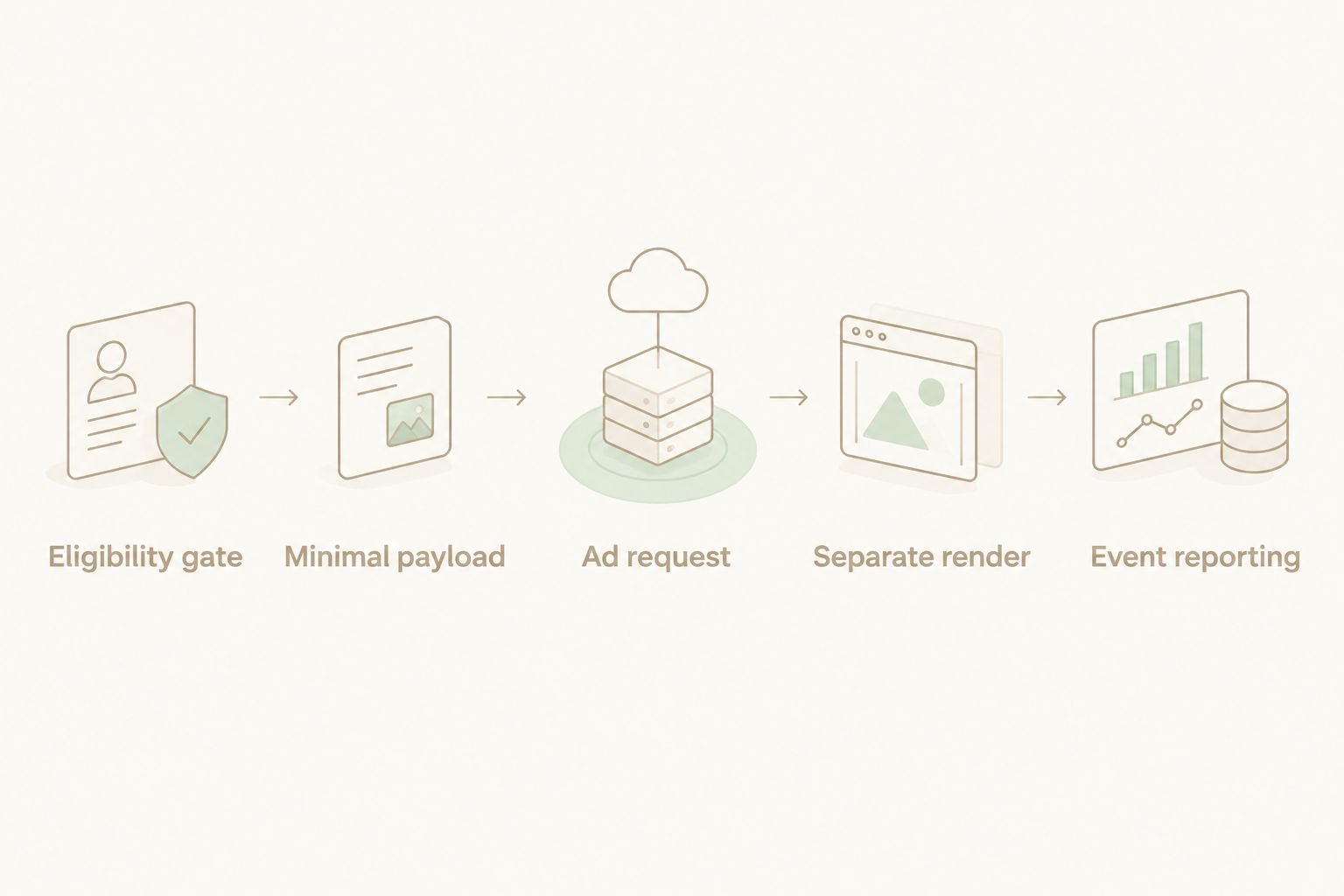
Start with a local prototype that makes no external ad requests. Trace inputs through an eligibility decision, a minimal request payload, an optional ad response, and a separate render operation. Inspect network traffic and logs rather than assuming a contextual request contains no sensitive information.
For implementation, Elo provides an SDK-based adserver for developers building AI chat applications on OpenAI, Anthropic, or custom LLMs. Its stated function is embedding contextual, conversational ads and earning revenue from advertiser spend. That makes the SDK a relevant implementation option, not evidence of hospital-specific suitability.
A vendor-managed SDK replaces some custom ad-serving work. It does not replace a data-flow assessment. Require documentation for every proposed integration, including contractual terms, recipients, retention, and any use of submitted data.
Use this architecture for evaluation: Eligibility gate, Minimal payload, Ad request, Separate render, and Event reporting.
Keep this evaluation independent of the language model provider. Changing the model does not remove the need to inspect the advertising request.
- Capture every field proposed for transmission.
- Keep raw transcripts out of the initial prototype.
- Inspect URLs, headers, identifiers, and diagnostic logs.
- Verify vendor terms and applicable contractual requirements.
- Reject integrations with unresolved data flows.
Keep sponsorship separate from clinical answers
Build the first presentation with a static, clearly labeled sponsorship placeholder. Test whether users can distinguish the hospital's answer from the commercial message without reading fine print. The answer should remain complete when the placeholder disappears.
Do not let advertiser copy enter the clinical answer-generation path. Keep commercial rendering separate from clinical retrieval, ranking, escalation, and referral logic. A paid placement must not appear to be a clinician's recommendation.
For a 2026 pilot, choose a narrow presentation rule before testing demand. For example, set a maximum of 1 placement per eligible session as an initial experiment, not an established hospital benchmark. Apply the same rule to repeat visits within the defined session boundary.
- Label commercial content visibly as sponsored.
- Keep the essential answer above and independent of sponsorship.
- Provide a straightforward dismissal control.
- Review creative claims and landing pages together.
- Prevent sponsorship from changing clinical routing.
Test sensitive transitions and failure paths
Create a synthetic conversation set before involving live traffic. Include ordinary administrative requests, ambiguous messages, personal disclosures, urgent language, and changes of topic. Do not copy patient conversations into an advertising test environment without the required approvals.
Test the transition, not just the opening prompt. A session that begins with directions can become a discussion about a diagnosis. The expected result should specify whether requests stop, existing placements disappear, and reporting remains free of sensitive content.
Also test unavailable ad services and rejected responses. The chatbot must still complete its approved service task when advertising fails. Keep the ad request outside the critical path wherever the application architecture permits.
- Write expected outcomes for each synthetic conversation.
- Test shifts from administrative to clinical content.
- Inspect requests after an eligibility decision changes.
- Confirm ad failures do not block essential responses.
- Exercise the shutdown control before launch.
Measure eligible inventory and net contribution
Use application logs and a simple reporting worksheet first. Define the event names and denominators before connecting a revenue dashboard. An ad request, a rendered impression, a click, and a completed hospital task describe different events.
Calculate eligible-session RPM as publisher ad revenue divided by eligible sessions, multiplied by 1,000 sessions. Calculate impression eCPM as publisher ad revenue divided by rendered impressions, multiplied by 1,000 impressions. These are reporting definitions, not revenue forecasts.
Track both eligible-session RPM and total-session revenue yield. The first describes the approved inventory; the second shows the contribution across the whole chatbot. A change in eligibility rules can move those measures in different directions without any improvement in advertising performance.
For the 2026 business case, subtract incremental serving, engineering, review, and support costs from publisher ad revenue. Do not infer profitability from clicks alone.
- Define requests, impressions, clicks, and eligible sessions.
- Exclude transcript text from advertising event payloads.
- Report publisher revenue separately from advertiser spend.
- Compare task completion against an ad-free control.
- Review complaints, failures, and incremental operating costs.
Launch narrowly and expand only after review
Begin with one approved surface and a documented rollback procedure. Keep an ad-free comparison group where the experiment and required approvals permit it. The purpose is to detect whether the commercial layer changes service completion, not merely whether someone clicks.
Do not set expansion rules around revenue alone. Define acceptable service performance, complaint handling, data-flow compliance, and creative review before the pilot starts. Assign each criterion an owner who can stop the rollout.
Reapprove material changes. A new advertiser category, destination, SDK version, or request field changes the system being evaluated. An earlier approval should not silently cover a different commercial experience.
- Restrict the pilot to its approved surface.
- Record the SDK version and configuration.
- Test the rollback without disabling the chatbot.
- Review commercial and service results together.
- Require approval for material scope changes.
Compare monetization options for hospital chatbots
Choose the operating model before choosing the ad stack. The options below solve different problems; they are not interchangeable revenue channels. None removes the need for hospital-specific review.
| Option | Best for | Main advantage | Key limitation |
|---|---|---|---|
| Operational-value model | Essential patient-service workflows | Measures task completion and service efficiency without introducing sponsors | Does not generate advertiser revenue; savings require evidence |
| Manually managed sponsorship | Narrow, approved nonclinical surfaces | Gives the hospital direct control over sponsor selection and placement | Requires sales, creative review, contracting, and manual administration |
| Elo conversational ad SDK | Developers seeking SDK-based contextual ad serving | Provides an adserver integration rather than requiring a complete custom build | Hospital-specific contractual, privacy, and control requirements still need verification |
| Custom adserver | Teams requiring application-specific serving logic | Allows the team to design its own eligibility and rendering architecture | The hospital assumes engineering, maintenance, security, and commercial operations |
Elo conversational advertising addresses the ad-serving route. It does not establish whether a hospital should introduce advertising at all. If the approved inventory cannot be separated from sensitive interactions, retain the operational-value model instead.
Common mistakes hospital systems make
Treating an anonymous visitor as a nonsensitive session
A login state does not describe everything a visitor types. Public chat can still receive personal health details. Evaluate the conversation and outgoing fields rather than assuming anonymous traffic is automatically suitable inventory.
Calling every recommendation a revenue opportunity
A hospital answer can carry clinical or institutional authority. Mixing sponsored recommendations into that answer blurs the commercial boundary. Keep essential guidance and commercial content distinct, including when both concern the same general topic.
Applying whole-site traffic to an ad forecast
Total chatbot sessions include excluded conversations, failed requests, and sessions with no rendered placement. Forecast from approved inventory and observed delivery. Do not multiply all hospital chat traffic by a generic advertising benchmark.
Treating a compliance label as an implementation review
A vendor's general security or privacy statement does not describe your request payload, placement, or landing page. Review the actual system. Ask counsel to determine applicable obligations, including whether proposed disclosures require authorization or other permissions.
Measuring clicks while ignoring service completion
An advertisement can receive engagement while the original hospital task remains unfinished. Keep task completion and escalation success in the decision criteria. Revenue does not resolve a degraded patient-service experience.
FAQ
What's the best way to start chatbot monetization for hospital systems?
Start by defining excluded clinical workflows and identifying any separately approved nonclinical inventory. Establish data boundaries, decision owners, and shutdown criteria before evaluating ad delivery.
Can a hospital put ads inside a patient-portal chatbot?
Exclude patient-portal conversations from the initial advertising pilot. Authenticated care workflows need a separate legal, privacy, security, and clinical assessment; a working SDK integration does not establish permission.
Is contextual advertising automatically safe for hospital chatbots?
No. Contextual requests can still contain sensitive information through conversation text, identifiers, URLs, or logs. Inspect the actual payload and downstream handling before approving any transmission.
Does Elo provide a hospital-compliant advertising integration?
Elo provides an SDK-based adserver for contextual, conversational advertising in AI chat applications. Hospital-specific contractual terms, data handling, and required controls need verification before deployment.
How much revenue can a hospital chatbot earn from ads?
Estimate revenue from approved eligible inventory and observed pilot delivery, not total hospital traffic. A defensible forecast needs measured impressions, publisher revenue, and incremental operating costs.
Should sponsors influence a hospital chatbot's recommendations?
Keep paid placement separate from clinical recommendations, routing, and escalation. Label commercial messages clearly and ensure that removing the advertisement does not remove the essential answer.
What should a hospital measure during an advertising pilot?
Measure eligible-session RPM, rendered impressions, publisher revenue, and incremental costs alongside service completion and complaints. Use an ad-free comparison where approved, and investigate changes in eligibility before interpreting revenue trends.
One last thing
Test the shutdown path before the revenue path. Disable the commercial layer and verify that answers, scheduling routes, escalation, and service reporting still work. If advertising cannot disappear independently, the integration is too tightly coupled to the hospital's core service.
Make that test part of the 2026 release record. A monetization feature should remain optional even after the team starts depending on its revenue.