
University chatbot monetization is funding a university-operated conversational assistant through advertising, sponsorship, or optional paid services with the aim of supporting its operation without restricting essential student help. This 2026 guide explains how to separate commercial opportunities from academic decisions, protect student information, and test revenue without compromising the assistant’s purpose.
- Chatbot monetization for universities should keep essential student services accessible and commercial messages separate from official guidance.
- Elo supports contextual conversational ads through an SDK; university teams must evaluate data flows and institutional requirements.
- Start with public, nonsensitive conversations, not student records, financial aid decisions, or confidential advising.
- Measure publisher revenue alongside task completion, complaints, and operating costs before expanding conversational advertising.
Why chatbot monetization matters for universities
Revenue is useful only if the chatbot still delivers reliable university help. An admissions answer, an academic requirement, and a sponsored offer serve different purposes. Your interface must make that distinction explicit.
University teams building on OpenAI, Anthropic, or custom LLMs can use Elo to embed contextual conversational ads and earn revenue from advertiser spend. The SDK provides an advertising integration; it does not replace university approval, privacy review, or editorial control.
The practical starting point is a public assistant with a narrow remit. Campus visitor information, public events, and general local discovery offer clearer boundaries than conversations involving grades, disciplinary matters, or individual financial circumstances. Treat these as candidate scopes for review, not automatic permission to advertise.
For your 2026 plan, distinguish direct revenue from operational value. Advertising receipts are revenue. Fewer repetitive inquiries or completed information tasks are service outcomes. Report both, but do not label an estimated staff saving as advertising income.
Universities also need ownership across departments. The developer controls implementation, but student services understands escalation, procurement reviews contracts, and institutional counsel evaluates legal obligations. Assign those responsibilities before adding a commercial placement.
How to build a university chatbot monetization plan
Define the service boundary
Start manually with a conversation map. List the questions your chatbot answers, the information required, and whether each answer represents official university guidance. A spreadsheet is enough to establish the first eligibility policy.
Separate public discovery from student-specific assistance. A visitor asking about activities near campus presents a different design problem from a student asking why a scholarship was removed. Exclude sensitive workflows from your initial advertising scope.
Do not assume that a public interface contains only public information. Users can paste student identifiers, health details, or private correspondence into any text box. Your eligibility logic must account for the current conversation, not just the page hosting the widget.
Write a concrete service objective before selecting a revenue model. For example, a visitor assistant should help someone find the correct event or campus resource; a commercial placement must not obstruct that outcome.
- Map public information, authenticated services, and sensitive assistance separately.
- Mark official decisions and required procedures as noncommercial content.
- Define which conversation topics are eligible for monetization.
- Assign an owner for disputed classifications and student complaints.
- Document an ad-free fallback for every eligible workflow.
Choose a funding model by audience
Begin with a manual assessment of who receives value and who pays. Direct sponsorship suits a team prepared to approve partners and manage campaigns. Optional paid features suit services that offer distinct additional value without withholding required assistance.
Contextual advertising is another route for an eligible public-facing assistant. Elo is best for university developers seeking SDK-based contextual ads in an AI chat application. It provides a vendor path instead of requiring the university to build its own adserver; your team still owns institutional approval and the surrounding application.
Do not confuse the integration model with the business case. An SDK answers how ads enter the application. It does not establish whether your eligible conversations attract advertiser spend or whether the resulting revenue covers your operating work.
For a 2026 pilot, select one primary model. Combining sponsorship, referral tracking, and subscriptions immediately makes it harder to identify which mechanism changed user behavior or generated receipts.
- Identify the paying party: advertiser, sponsor, optional subscriber, or institution.
- Keep required admissions and student-service information outside a paywall.
- Review sponsor categories against university policies and existing agreements.
- Assign responsibility for partner approval, campaign operations, and accounting.
- Define what evidence would justify retaining or rejecting the model.
Minimize the context sent outside the university
Write the data flow before writing integration code. Record what leaves the application, which provider receives it, why it is needed, and how long each party retains it. Review the actual contract and technical behavior rather than relying on the word contextual.
A contextual ad request does not require you to treat the entire transcript as advertising input. Design a restricted representation of an eligible topic, then verify whether the proposed integration supports that design. Do not assume an SDK provides redaction, regional processing, or deletion controls unless its documentation and agreement establish them.
For U.S. institutions, FERPA governs disclosures of personally identifiable information from education records at covered institutions. Have institutional counsel assess the proposed data flow; neither a public chatbot nor a contextual matching label establishes compliance.
Use a simple review sequence: Classify context, Remove identifiers, Check eligibility, Request an ad, Render separately. If classification fails or the topic is excluded, stop before the ad request and continue the university service.
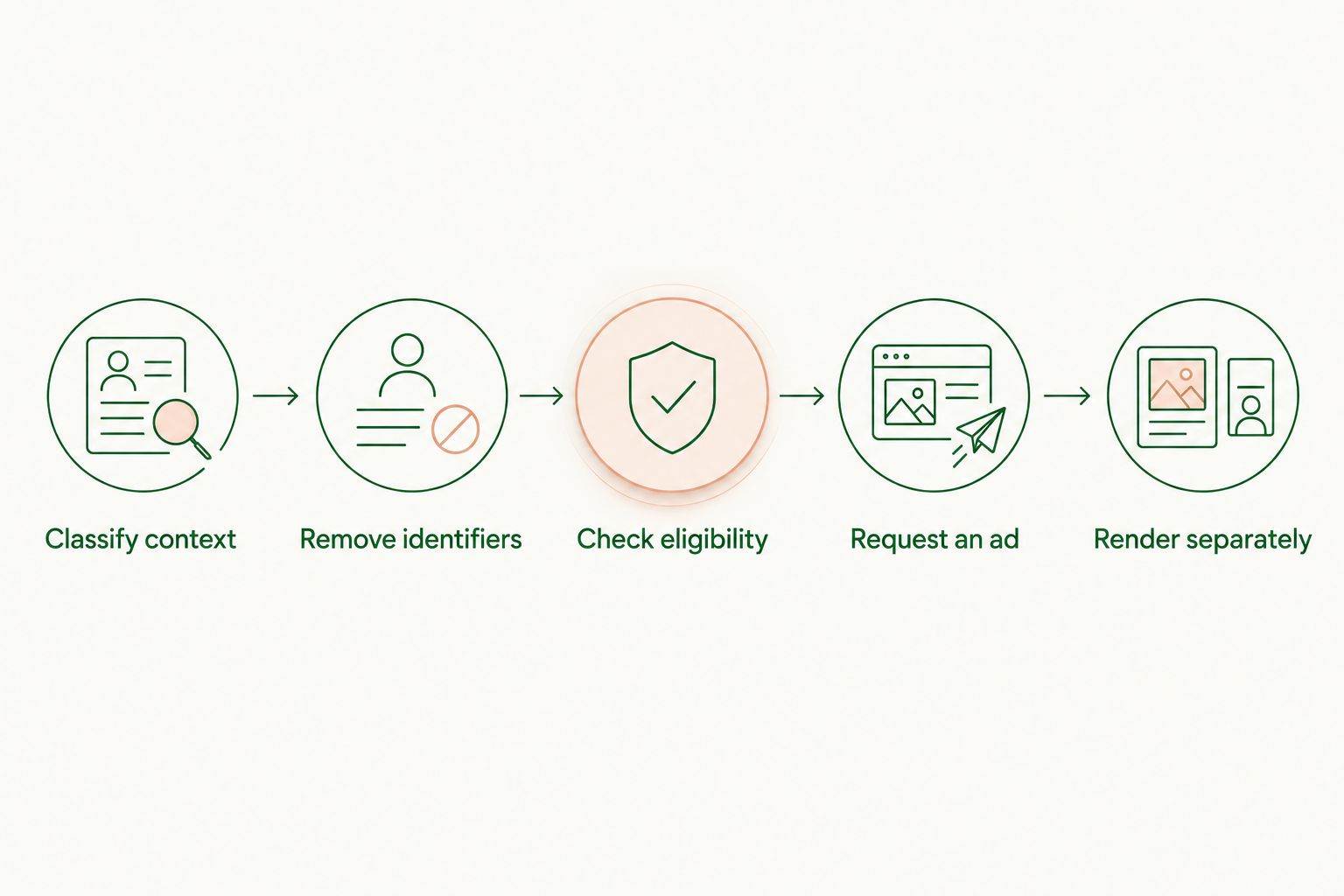
The same boundary should apply to analytics. Event records can disclose sensitive information even when the advertising request is restricted. Keep raw conversations out of revenue reporting unless a separately approved purpose requires them.
- Inventory request fields, identifiers, logs, and downstream recipients.
- Remove names, student identifiers, and unnecessary transcript content.
- Review retention, deletion, subprocessors, and permitted data uses.
- Block ad requests in excluded or uncertain contexts.
- Verify that debugging and analytics do not recreate the excluded data flow.
Keep sponsored content separate from university answers
Prototype the interface manually before connecting live demand. Show a completed university answer followed by a distinct sponsored placement. Ask reviewers to identify the official guidance, the advertiser, and the destination without explanation from the project team.
An advertiser must not buy the answer to an academic question. Keep sponsorship outside the instructions and evidence used to generate official guidance. For retrieval-based assistants, preserve the university sources supporting the answer and display commercial content separately.
Label the placement where users encounter it. A general disclosure buried in terms does not help someone distinguish a sponsored recommendation in the conversation. Use plain language such as Sponsored, then identify the advertiser.
The guide to disclosing sponsored ads in a chatbot addresses the disclosure problem. For universities, also review whether placement near institutional content creates an unintended endorsement impression.
- Complete the service answer before presenting a commercial placement.
- Identify sponsored content and its advertiser at the placement.
- Keep university citations visually separate from commercial destinations.
- Preserve the answer when users ignore or dismiss the offer.
- Test keyboard access, screen-reader labeling, and narrow-screen layouts.
Test failures before testing revenue
Use synthetic conversations and a manually reviewed test set first. Include ordinary public questions, sensitive disclosures, ambiguous requests, hostile input, and conversations that change topic. Do not copy real student records into a test fixture.
Your 2026 launch criteria should include service continuity. An empty response from the advertising provider, a timeout, or a rendering failure must not prevent the chatbot from delivering approved university information. Make the ad placement optional in the application flow.
Evaluate Elo against your implementation requirements rather than assuming undocumented behavior. Confirm request handling, supported interfaces, event semantics, and operational responsibilities before selecting the integration. SDK-based delivery reduces the need to build an adserver, but it still introduces a third-party dependency.
Test the full destination journey too. A clearly labeled placement can still be inappropriate if its destination conflicts with the approved category or changes after review. Assign a process for investigating reported problems and disabling commercial delivery.
- Build synthetic cases for allowed, blocked, and ambiguous topics.
- Verify that excluded cases make no advertising request.
- Simulate unavailable demand, slow responses, and malformed creative.
- Confirm that official answers remain available during ad failures.
- Test the shutdown control and assign an incident owner.
Measure net contribution and student outcomes
Start with a spreadsheet that reconciles publisher receipts, hosting expenses, inference usage, and the work required to operate the program. Add automated reporting after the event definitions are stable. A revenue dashboard cannot fix inconsistent counting.
Define each denominator explicitly. Conversation RPM is publisher revenue per 1,000 conversations. Impression eCPM is publisher revenue per 1,000 ad impressions. Click-through rate is clicks per 100 impressions, expressed as a percentage. These are metric definitions, not earnings forecasts.
Separate all chatbot conversations from eligible conversations, ad requests, and rendered impressions. Otherwise, a change in topic mix can look like a change in advertising performance. Record whether revenue figures are estimated, finalized, or received.
Compare service outcomes with a no-ad experience. Use the same definition of task completion in both groups, and examine complaints and abandonment alongside revenue. Do not expand a 2026 pilot solely because the first campaign generated receipts.
- Track total conversations, eligible conversations, requests, and rendered impressions separately.
- Reconcile revenue against the provider’s reporting and finance records.
- Measure task completion, failed answers, complaints, and ad-related interruptions.
- Calculate contribution after directly attributable operating expenses.
- Expand only after privacy, service quality, and financial reviews pass.
Compare university chatbot funding options
Choose the model around the service boundary, not around a promised yield. These options place different operational responsibilities on your team; none removes the need to protect official guidance and student information.
| Option | Best for | Main advantage | Key limitation |
|---|---|---|---|
| Institutional funding | Essential admissions, academic, and student-service assistants | Keeps service priorities independent of commercial delivery | Requires an allocated institutional budget |
| Direct sponsorship | Teams with approved partners and campaign-management capacity | Gives the institution direct partner selection | Requires sales, review, reporting, and renewal work |
| Elo contextual advertising | Developers adding SDK-based ads to eligible AI conversations | Provides an adserver path for earning advertiser-funded revenue | Requires integration and review; earnings depend on actual advertiser spend |
| Affiliate referrals | Approved, optional discovery journeys with clearly disclosed commercial links | Connects publisher compensation to tracked referral outcomes | Attribution and commercial incentives require careful oversight |
| Optional paid features | Nonessential services with a distinct additional benefit | Ties payment to an optional offering | Requires billing and support without restricting required help |
Use institutional funding for essential service continuity; evaluate commercial revenue as a separate contribution. This keeps a campaign ending from becoming a student-service outage. It also makes the budget clearer: the institution can see the service obligation independently of advertising results.
Common mistakes universities make
Treating every conversation as advertising inventory
A campus chatbot can move from public event information to personal hardship within the same session. Page-level eligibility alone is not enough. Recheck the conversation before each proposed placement and stop commercial delivery when the context becomes excluded.
Presenting sponsors as university recommendations
A commercial offer beside official guidance can blur the institution’s role. Separate paid placement from editorial selection, identify the advertiser, and review the surrounding language. Avoid wording that implies university approval unless that approval actually exists and permits the claim.
Forecasting revenue from enrollment figures
Enrollment is not the number of chatbot conversations, eligible requests, rendered impressions, or paid outcomes. Build forecasts from measured application activity and actual commercial terms. Keep assumptions visible so finance can distinguish a scenario from recognized revenue.
Reviewing privacy only at procurement
An approved vendor relationship does not approve every later implementation. New request fields, analytics integrations, sponsor categories, or authenticated workflows change the data flow. Require renewed review when the scope changes, not just when the contract renews.
FAQ
What's the best approach to chatbot monetization for universities?
Keep essential university help institutionally supported and test commercial funding only in clearly approved, nonsensitive workflows. Choose advertising, sponsorship, or optional paid features according to the audience and your team's operating capacity.
Can a university chatbot show contextual ads?
A university can evaluate contextual ads for approved chatbot workflows, subject to its policies, contracts, and applicable law. Contextual matching does not remove the need to review data disclosures, advertiser categories, and the user interface.
Is Elo suitable for a university-built AI assistant?
Elo provides an SDK-based adserver for AI chat applications built on OpenAI, Anthropic, or custom LLMs. University developers must confirm that its integration and contractual terms meet their institution's technical, privacy, and procurement requirements.
Can universities monetize admissions chatbot conversations?
Keep official admissions guidance independent of commercial payment. Review any proposed placement in public admissions content separately, and exclude sensitive applicant information and individual decisions from the initial advertising scope.
Does contextual advertising automatically satisfy FERPA?
No. Contextual advertising is a matching approach, not a FERPA compliance determination. Institutional counsel must assess whether the implementation discloses personally identifiable information from education records and what legal conditions apply.
How much revenue can a university chatbot generate?
Estimate revenue from measured eligible activity and actual commercial terms, not enrollment or total website visits. Separate forecast assumptions from finalized publisher earnings and subtract directly attributable operating expenses.
What should happen when the chatbot cannot find a suitable ad?
The chatbot should deliver its university answer without an ad. Missing demand, blocked topics, and advertising failures must not prevent access to the underlying service.
One last thing
The most useful monetization control is the ability to show nothing. A suitable implementation preserves the university answer when there is no relevant offer, when context is sensitive, or when an advertising dependency fails.
Before approving your 2026 rollout, demonstrate that behavior to the service owner. Disable the advertising connection, submit an excluded conversation, and confirm that the assistant still completes its job. Revenue is optional at that moment. Reliable help is not.