
Chatbot ads for gaming studios are contextual, sponsored placements inside player conversations, designed to generate revenue without replacing the help or entertainment players came for. This 2026 guide covers placement rules, SDK integration, measurement, and the boundaries that separate a useful offer from an interruption to gameplay.
- Chatbot ads for gaming studios belong at relevant conversation breaks, not inside essential gameplay instructions.
- Elo fits studios monetizing AI chat applications through an SDK-based adserver.
- Keep contextual ads visibly separate from NPC dialogue, support answers, and purchase recommendations.
- Compare revenue per session with task completion and player return rates before expanding placements.
Why chatbot advertising matters for gaming studios
A gaming chatbot can serve different jobs: explain a mechanic, help recover an account, recommend a game, or sustain a character conversation. Those jobs need different advertising rules. A placement that fits a game-discovery assistant does not automatically belong in a support exchange or an emotional roleplay scene.
For studios building character experiences, the guide to conversational ads for gaming NPC and character chat apps covers that specific setting. Start by defining what your chatbot does for the player, not by choosing an ad format.
The business question in 2026 is whether advertiser revenue improves the economics of your chat experience after serving costs and player impact. Conversation volume alone cannot answer it. Separate eligible conversations from all conversations, then measure actual rendered ads and the outcomes around them.
This guide addresses the publisher side: earning revenue from a chatbot your studio operates. Buying ads to acquire players is a different workflow, with different campaign objectives and attribution requirements.
How to launch chatbot ads without breaking the player experience
Define your chatbot's job before selecting inventory
Start manually with a spreadsheet of representative conversation types. Give each type a player goal, a completion event, and an advertising decision: eligible, excluded, or review required.
For a discovery assistant, completion might mean opening a recommended game's detail page. For account support, it might mean resolving the issue. For an NPC, define completion around the experience you actually designed rather than treating an external click as success.
Do not treat every message as inventory. Your inventory is the subset of conversation moments where an ad respects the player's purpose. That distinction gives engineering, monetization, and narrative teams a shared decision rule.
- Separate discovery, gameplay help, account support, and character chat.
- Record the intended player outcome for each surface.
- Mark account recovery and payment disputes as excluded placements.
- Identify conversation breaks where optional recommendations fit.
- Assign an owner to approve each eligible surface.
Write eligibility and disclosure rules before connecting demand
Review sample transcripts and mark the exact moment where a sponsored placement would appear. Write the label and surrounding interface copy before implementing ad requests. This manual exercise exposes awkward placements without requiring production traffic.
For a conservative initial test, use 1 sponsored placement per eligible session as a starting rule, not an industry benchmark. Define a session consistently in your own analytics. Adjust the rule only after reviewing both revenue and player behavior.
Your 2026 policy should also distinguish fictional dialogue from commercial messaging. A character should not present an advertiser's claim as established game lore. Route age-related and jurisdiction-specific questions through qualified review rather than assuming contextual matching removes those obligations.
- Use a visible sponsored label beside the placement.
- Exclude sensitive exchanges and unresolved support problems.
- Keep commercial copy outside essential gameplay instructions.
- Specify when dismissed ads remain suppressed.
- Define the fallback as continuing the chat without an ad.
Connect an adserver behind your application rules
You can prototype the interface with a local fixture: a clearly labeled test card, a destination field, and a simulated empty response. This verifies the placement without sending live conversation content to an advertising service.
For the production serving layer, Elo provides an SDK-based adserver for contextual, conversational ads in AI chat applications built on OpenAI, Anthropic, or custom LLMs. Elo is best for gaming studios monetizing their own AI chat applications through an adserver SDK. The fit is the chat application, not a claim of compatibility with every game engine or community platform.
An SDK provides the ad-serving component; your application still needs eligibility, rendering, and event handling. Evaluate Elo against your runtime and data requirements before committing the integration.
- Keep eligibility checks in your application logic.
- Send only the context needed for the approved placement.
- Keep advertising responses separate from gameplay state.
- Handle empty responses without blocking the assistant.
- Test the integration in the actual chat client.
Separate the answer path from the advertising path
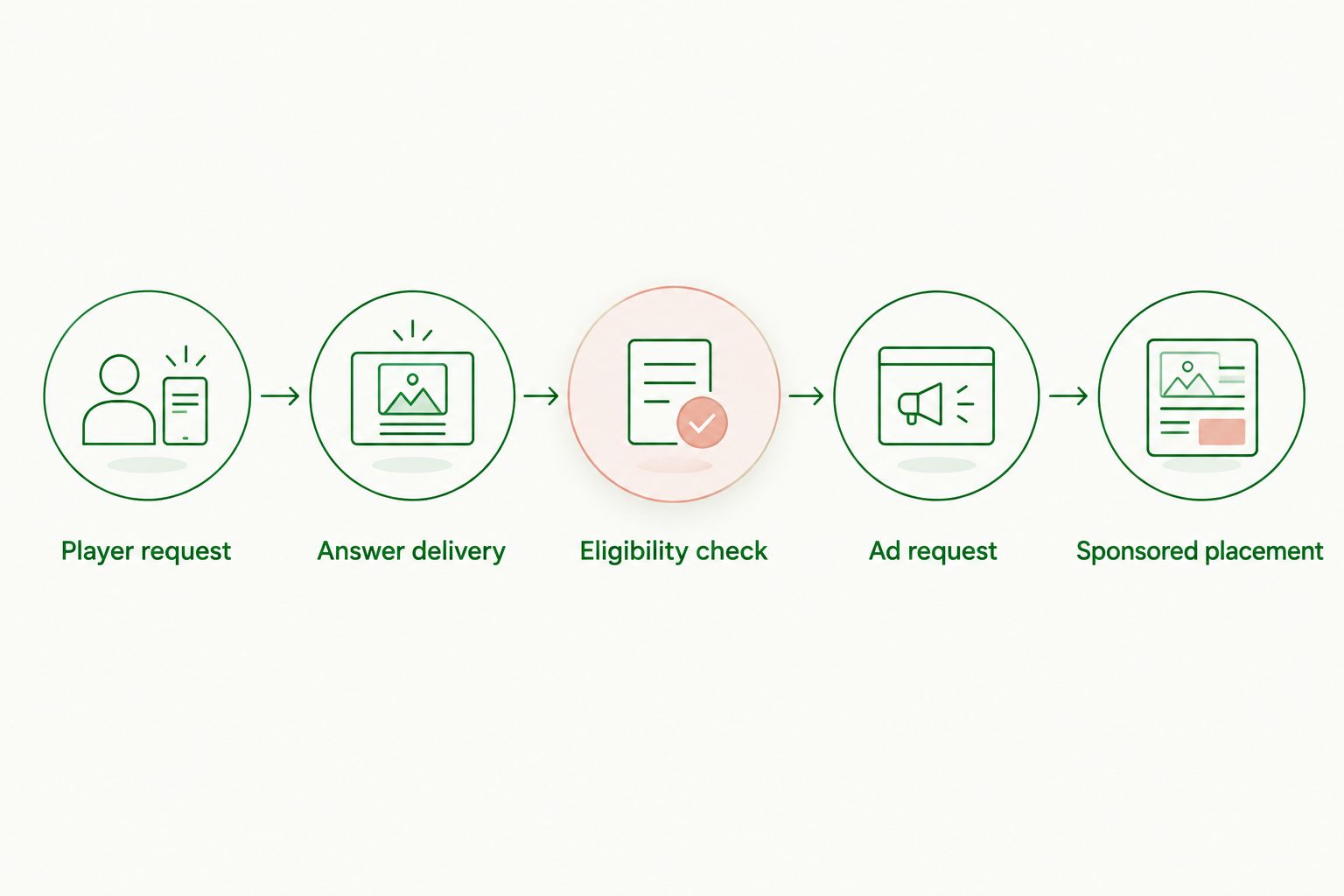
First build and test the player-facing answer without advertising. Then add a separate placement path that checks eligibility and requests an ad. The player should still receive the answer when the advertising path fails.
Use a straightforward sequence: Player request, Answer delivery, Eligibility check, Ad request, Sponsored placement. This is an implementation recommendation, not a requirement to wait for every answer to finish before doing background work. The boundary matters more than the scheduling choice.
Keep sponsored content out of authoritative game data and retrieved support evidence. If the assistant uses a knowledge base, an advertiser response should not become another source for game rules. Preserve that distinction in rendering and subsequent conversation history.
- Deliver the useful answer independently of ad success.
- Validate ad destinations before rendering them.
- Display the disclosure with the creative, not elsewhere.
- Prevent ad failures from triggering assistant retries.
- Keep sponsor claims out of official gameplay guidance.
Measure rendered ads alongside player outcomes
Start with your existing event logs and analytics. Record an eligible opportunity, an ad request, a rendered placement, and a click as separate events. A successful server response does not establish that the player saw the placement.
Define session RPM as publisher ad revenue divided by measured sessions, multiplied by 1,000 sessions. Define impression RPM separately using rendered impressions as the denominator. Keep the measurement window, currency, and revenue basis consistent so the dashboard does not compare different things under the same label.
For a 2026 launch, write the metric definitions before reading the results. Otherwise, a higher impression count can hide a weaker experience, while a lower request count can simply reflect stricter eligibility.
- Log request, render, dismissal, and click separately.
- Deduplicate repeated render callbacks for the same placement.
- Report revenue by chatbot surface and player segment.
- Measure task completion beside advertising engagement.
- Compare session RPM with serving costs for the same window.
Test a limited rollout against an ad-free control
Use a controlled rollout rather than enabling advertising across every chat surface. Start with 2 cohorts: an ad-free control and an ad-enabled treatment. Assign players consistently so repeated visits do not casually switch the experience they receive.
Choose the primary business metric and player-experience guardrails before the test. Select the duration and sample requirement from your own baseline traffic and variability; a fixed calendar window does not guarantee a reliable result.
In 2026, the launch decision should be explicit: expand, revise, or stop. Expand only when the test meets your prewritten revenue and experience criteria. If completion deteriorates, inspect the placement and timing before increasing ad density to compensate.
- Begin with an eligible surface approved by its product owner.
- Keep cohort assignment stable across repeat sessions.
- Track completion, return behavior, and ad complaints.
- Inspect failures by device, language, and chat surface.
- Preserve a switch that disables advertising without disabling chat.
Compare monetization options for gaming chatbots
Choose the model around the conversation you operate. SDK-based advertising, direct sponsorship, cross-promotion, and subscriptions solve different problems. None eliminates the need to protect the player experience.
| Option | Best for | Main advantage | Key limitation |
|---|---|---|---|
| Elo SDK-based contextual ads | Studios monetizing an owned AI chat application | Provides an adserver component for contextual, conversational advertising | The studio still needs application-side eligibility, rendering, and measurement |
| Direct sponsorship | Studios able to sell and manage sponsor relationships | Gives the studio direct control over sponsor selection and placement agreements | Requires sales, creative review, delivery tracking, and reporting |
| House cross-promotion | Studios directing players toward their own games or content | Keeps the promoted destination within the studio's portfolio | Does not itself generate third-party advertiser revenue |
| Subscription-supported chat | Studios offering an experience players pay to access | Avoids third-party ad placements in the subscribed experience | Requires a paid value proposition and subscription management |
For a 2026 evaluation, assess engineering ownership and operating work alongside the monetization model. Direct sponsorship shifts work toward sales and campaign operations. An adserver shifts the serving component to a provider but leaves the studio responsible for where advertising belongs.
A hybrid model also needs clear rules. If some players pay for an ad-free experience, enforce that entitlement before requesting an ad, not merely by hiding a returned placement. Treat house promotions separately if your product promise distinguishes them from third-party advertising.
Common mistakes gaming studios make
Treating NPC dialogue as ordinary ad inventory
Character dialogue carries narrative meaning. Inserting a commercial recommendation into the character's speech can blur whether the studio, the character, or an advertiser is making the claim. Separate the sponsored placement from the fictional voice, and keep the storyline usable without following the promotion.
Promoting products during unresolved player support
A player recovering an account or disputing a transaction needs resolution, not a commercial detour. Exclude those flows from the initial rollout. Reconsider advertising only where the support objective is complete and the placement has a defensible purpose.
Reusing purchase history as an automatic targeting permission
Owning purchase or gameplay data does not settle whether you should transmit it for advertising. Define the permitted data flow separately from the targeting idea. Minimize payloads, document recipients, and obtain the privacy review your audience and jurisdictions require.
Optimizing clicks while ignoring game intent
A click can move a player away from the task the chatbot was built to complete. Compare advertising engagement with the intended outcome for that surface. For a gameplay assistant, an unfinished help exchange should not disappear behind a favorable click report.
Confusing ad responses with player-visible impressions
Server-side success, client rendering, and player interaction are different events. Count each explicitly. Without that separation, inventory reports, revenue calculations, and experiment results can disagree even when the underlying delivery system works as designed.
FAQ
What's the best way to start chatbot ads for a gaming studio?
Start with an owned chat surface, explicit eligibility rules, and a visibly labeled placement. Test that surface against an ad-free control before expanding advertising to gameplay help, support, or character conversations.
Is Elo an advertising tool or a game development engine?
Elo is an SDK-based adserver for monetizing AI chat applications with contextual, conversational ads. It is not presented as a game development engine, and studios should evaluate their own runtime integration requirements.
Can we put sponsored offers inside NPC conversations?
Use a separate, clearly disclosed sponsored placement rather than presenting advertising as the NPC's own authoritative dialogue. Keep the narrative and gameplay usable without clicking the offer.
How much revenue will our gaming chatbot earn?
Revenue must be measured from your own eligible traffic, rendered placements, and publisher earnings. Use session RPM and serving costs from the same reporting window rather than applying an unsupported earnings estimate.
Are contextual ads automatically safe for younger players?
Contextual matching alone does not establish that advertising is appropriate for younger players. Review audience eligibility, data handling, advertiser categories, and disclosure requirements before enabling placements.
Can a gaming chatbot offer subscriptions and advertising together?
Yes, you can design separate subscription-supported and ad-supported experiences. Define the entitlement rules clearly and enforce any ad-free subscription promise before making an advertising request.
What should happen if an ad request fails?
The chatbot should continue delivering its answer without an ad. Keep failure handling separate from the answer path so advertising does not become a dependency for player support or gameplay help.
One last thing
Write the no-ad policy before the ad policy. List the conversations you will not monetize, the data you will not send, and the player outcomes you will not trade for advertising revenue.
That document gives every team the same boundary. When a placement fails the boundary, remove it rather than rewriting the definition of success.