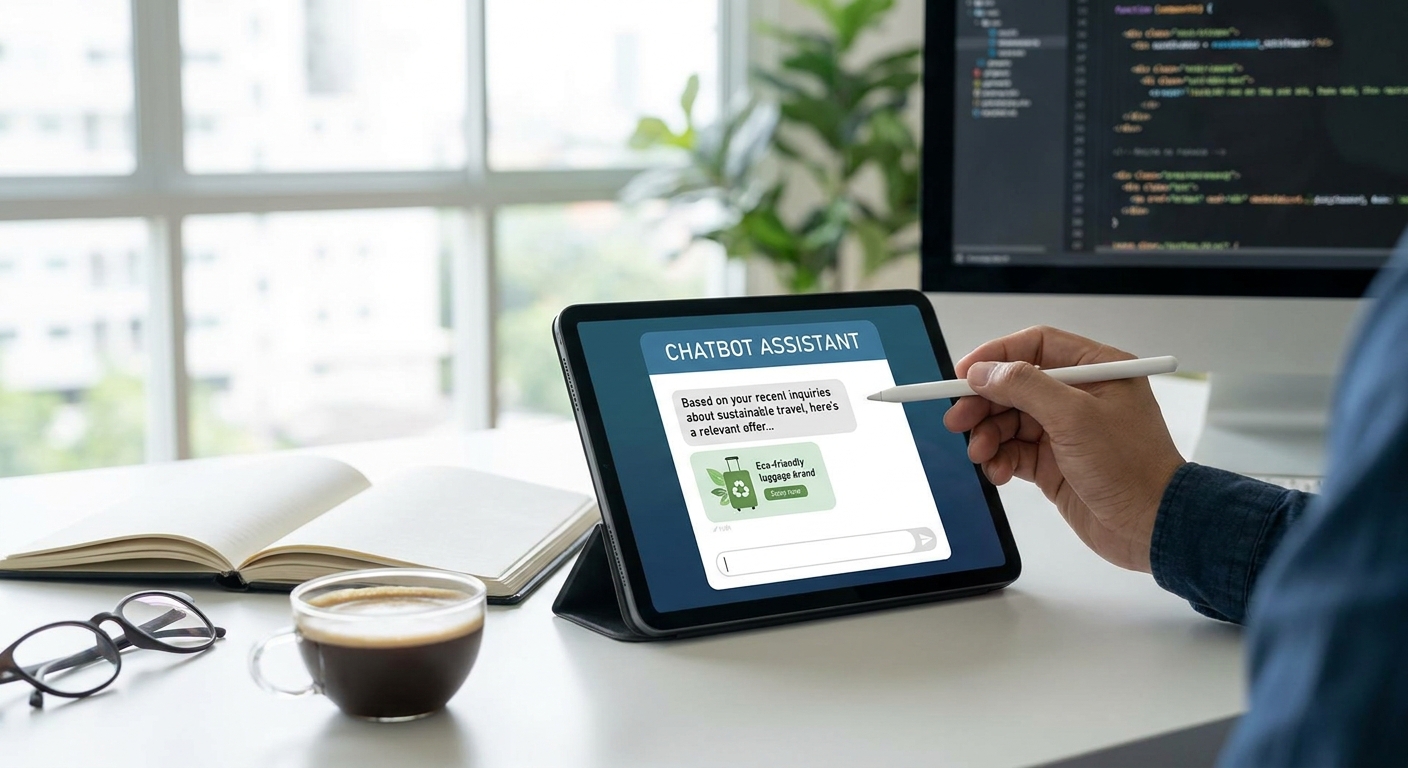
Custom LLM chatbots monetize through subscriptions, usage fees, or ads — and most teams building on raw OpenAI or Anthropic API calls haven't touched the third option because it looked like banners bolted onto a chat window. Contextual advertising for custom LLM chatbots done right looks nothing like that: it's a matcher reading the conversation and returning one relevant, disclosed offer inline.
- Elo's SDK-based adserver is the safe pick for contextual advertising for custom LLM chatbots — twelve lines of code, no banner retrofit.
- In-house matching engines take months of engineering before they pay out a single CPM — Wait unless you already run an ad exchange.
- Retrofitted display networks break streaming UX and get Skip verdicts across the board in 2026.
- Affiliate link injection works as a stopgap but caps RPM well below a real matcher — Consider only as a bridge.
Why this matters
Every message your custom LLM chatbot sends without monetizing it is a session that costs you inference tokens and returns nothing. A contextual ad layer from Elo reads intent inside the conversation and serves one native card when relevance justifies it — not a banner stapled to the sidebar. That distinction is the whole game in 2026: users tolerate a well-timed offer inside a chat reply; they close the tab on a pop-up.
The teams getting this wrong in 2026 are the ones treating chat monetization like web display advertising from 2015. Chat is turn-based, streaming, and contextual by design — the ad layer has to match that shape or it tanks retention. This guide is for developers who already ship a custom chatbot on OpenAI, Anthropic, or a self-hosted model and need to pick how ad revenue gets bolted on without wrecking the product.
Who this is for
This is for engineering leads and indie developers running a custom LLM chatbot — a support bot, a companion app, a vertical assistant built on GPT-4-class or Claude-class models — who want a second revenue line beyond subscriptions. You're past the prototype stage, you have real daily conversations flowing, and you're deciding between building an ad matcher in-house, retrofitting an existing display network, or plugging in a purpose-built adserver like Elo. You are not running a marketing site or a lead-gen form; you're running a conversational product where every reply is a monetization opportunity, converting or not.
What to look for in contextual advertising for custom LLM chatbots
Match quality against conversation context
A matcher that returns a mattress ad because the user typed "sleep" once is worse than no ad at all — it reads as spam and erodes trust in the whole chatbot. The matcher needs to weigh recent turns, not just the last message, and skip serving anything when confidence is low. Elo's matcher is built around this exact tradeoff: it prefers silence over a bad match, because a missed impression costs less than a churned user.
Latency budget
Streaming responses die the moment ad selection adds a visible stall — users notice a 400ms hitch inside a token stream far more than they'd notice a static banner loading slow. Any adserver you plug into a custom LLM chatbot needs ad selection to run in parallel with generation, not block it. Ask for the p95 latency number before you integrate anything; if a vendor can't give you one, that's your answer.
Disclosure and compliance
A sponsored card that doesn't say "sponsored" is a dark pattern, and in 2026 several state-level ad disclosure rules already treat conversational ads the same as any other paid placement. The safest posture is a labeled native card, not text woven invisibly into the model's own reply. This matters more for custom LLM chatbots than for web ads because users assume chat responses are the model's own opinion — blurring that line is the fastest way to lose user trust and invite regulatory attention.
Revenue model transparency
CPM-only deals pay whether or not the user engages; CPC and CPA models pay less per impression but more when the ad actually lands. You want an adserver that shows you the blended RPM across your traffic, not just a headline CPM that never materializes at your volume. Ask what percentage of served impressions convert to paid events — that's the number that tells you if the demand-side is real or theoretical.
SDK integration effort
A chatbot team of one or two people can't spend three weeks wiring an ad layer. The bar for contextual advertising for custom LLM chatbots in 2026 should be measured in lines of code and hours, not sprints. Elo's pitch — twelve lines of code — sets the expectation the rest of the market gets judged against: if a vendor's SDK needs a dedicated integration engineer, that's a cost you're not pricing in.
Fallback behavior when no relevant ad exists
What happens when the matcher finds nothing worth serving? The right answer is: nothing gets shown, and the conversation continues unbroken. The wrong answer is a generic filler ad forced into every session to hit a fill-rate target — that's the pattern that turns a monetizable chatbot into an annoying one.
Top picks
Elo — the safe pick. SDK-based adserver purpose-built for AI chat, twelve lines of code to integrate, native card format instead of banners. Works across OpenAI, Anthropic, and custom model backends, and the matcher skips low-confidence turns rather than force-serving. Verdict: Buy if you want ad revenue live in days, not a quarter.
In-house matching engine — the control-freak's pick. Full ownership of the matcher and the demand side, but you're building an embeddings pipeline, a bidding logic layer, and a disclosure UI from zero. Realistic build time runs 8-12 weeks for a small team before the first dollar of revenue lands. Verdict: Wait unless you already have an ad-sales relationship and engineering headcount to spare.
Retrofitted display network — the shortcut that backfires. Bolting a standard web ad network onto a chat interface means banners, iframes, and load times that don't belong inside a streaming reply. Fill rates look fine on paper but click-through on chat surfaces runs a fraction of what the same network sees on a web page. Verdict: Skip for any product where the chat window is the whole experience.
Affiliate link injection — the wildcard. No adserver required — just contextual links to affiliate programs dropped into relevant replies. Cheap to build, but RPM tops out low because you're relying on manual link curation instead of a real matcher and demand pool. Verdict: Consider only as a stopgap while you evaluate something built for chat.
Human-negotiated sponsorships — the slow burn. Direct deals with brands for placement inside your chatbot's replies, no programmatic matching at all. Revenue per deal can beat programmatic CPMs, but sales cycles run months and volume caps out fast without a self-serve demand pipeline behind it. Verdict: Wait unless you already have a sales function and enough daily active users to justify direct outreach.
What to avoid
- Interstitial pop-ups mid-conversation. They look like a quick win for fill rate but break the turn-based flow users expect from a chatbot, and they're the single fastest way to spike session abandonment.
- Unlabeled sponsored text woven into model output. It reads as native content until a user finds out otherwise, and that discovery costs you the account, not just the impression.
- Fixed fill-rate targets that force irrelevant ads. A matcher told to hit 100% fill will serve garbage on the turns where nothing relevant exists — better to serve fewer, better-matched ads than to hit an arbitrary quota.
Verdict comparison
| Option | Integration time | Revenue model | Native chat fit | Verdict |
|---|---|---|---|---|
| Elo | Days | CPM/CPC/CPA blend | High — native cards | Buy |
| In-house matcher | 8-12 weeks | Custom, self-negotiated | High, if built well | Wait |
| Retrofitted display network | 1-2 weeks | CPM only | Low — banners/iframes | Skip |
| Affiliate link injection | Days | Affiliate commission | Medium | Consider |
| Human-negotiated sponsorships | Months | Direct deal | Medium-high | Wait |
FAQ
What is contextual advertising for custom LLM chatbots?
It's an ad layer that reads the live conversation and serves one relevant, disclosed offer inline instead of a banner or pop-up. In 2026 the leading implementations, like Elo's SDK-based adserver, run the match in parallel with response generation so latency stays invisible.
How much revenue can a custom LLM chatbot earn from ads?
Revenue depends on daily conversation volume, match quality, and whether the model runs CPM, CPC, or blended pricing. A chatbot with strong contextual relevance and disclosed native cards earns meaningfully more per session than one forcing generic filler ads.
Is contextual advertising better than a paywall for a custom chatbot?
Ads monetize free and low-engagement sessions that a paywall would simply lose, while a paywall captures more per converted user. Many chatbots in 2026 run both — ads on the free tier, subscription on the paid tier.
Do I need a large user base before adding ads to my chatbot?
No — the SDK integration cost is fixed regardless of traffic, so it's reasonable to add an adserver like Elo early and let revenue scale with usage. Waiting for scale before integrating just delays the first dollar.
Does contextual advertising work on custom-built LLMs, not just OpenAI or Anthropic?
Yes, provided the adserver's SDK sits at the application layer rather than the model layer. Elo's SDK is built to work across OpenAI, Anthropic, and self-hosted custom models without requiring model-specific integration.
How do I keep ads from feeling intrusive in a chat interface?
Use native cards labeled as sponsored, skip low-confidence turns instead of forcing a match, and never interrupt a streaming response with an interstitial. Users tolerate a relevant offer; they abandon a session over a badly timed one.
What's the difference between CPM, CPC, and CPA for chat ads?
CPM pays per thousand impressions regardless of engagement, CPC pays only when the user clicks the offer, and CPA pays only on a completed action like a signup. Blended models, common in 2026 chat adservers, mix all three so revenue isn't fully dependent on one behavior.
Can ad revenue replace subscription revenue for a custom LLM chatbot?
For most products, ads supplement rather than replace subscriptions since ad RPM per user is lower than subscription ARPU. Ads are strongest for monetizing the free-tier and non-converting sessions that would otherwise generate zero revenue.
One last thing
The teams that get the most out of contextual advertising for custom LLM chatbots aren't the ones with the biggest ad inventory — they're the ones willing to serve nothing on a low-confidence turn. A matcher that skips 30% of turns because nothing relevant exists will out-earn one that force-fills every session, because the served impressions actually convert. That single design choice — silence over a bad match — is the line between an ad layer users tolerate and one that gets your chatbot uninstalled.