
Integrating Elo's conversational ad SDK into a chat app is a same-sprint job, not a multi-week rebuild — the core code change runs about twelve lines, and everything else on the calendar comes from testing, context mapping, and how many ad slots you want live before your next release in 2026.
- Elo's core SDK integration is a twelve-line code change, not a multi-week engineering project.
- Time to integrate a conversational ad SDK depends more on testing and context mapping than on the SDK call itself in 2026.
- Elo publishes six framework-specific integration guides, including Next.js and Vercel AI SDK apps.
- Apps built on OpenAI, Anthropic, or a custom LLM all use the same core integration path.
- Multi-tenant or multi-agent chatbots add configuration time in the dashboard, not code complexity.
Why this matters
Teams building AI chat apps in 2026 keep asking the same question before they commit engineering time: is monetizing with ads going to eat a sprint or a quarter? That question decides whether ad revenue gets prioritized this release cycle or gets pushed to "someday."
The honest answer is that the SDK call itself is not the bottleneck. Elo built the integration around a twelve-line code change specifically so the engineering cost of adding a conversational ad SDK stops being the reason teams delay monetization. The real timeline lives in the steps around the code, not in the code.
How long does it take to integrate a conversational ad SDK?
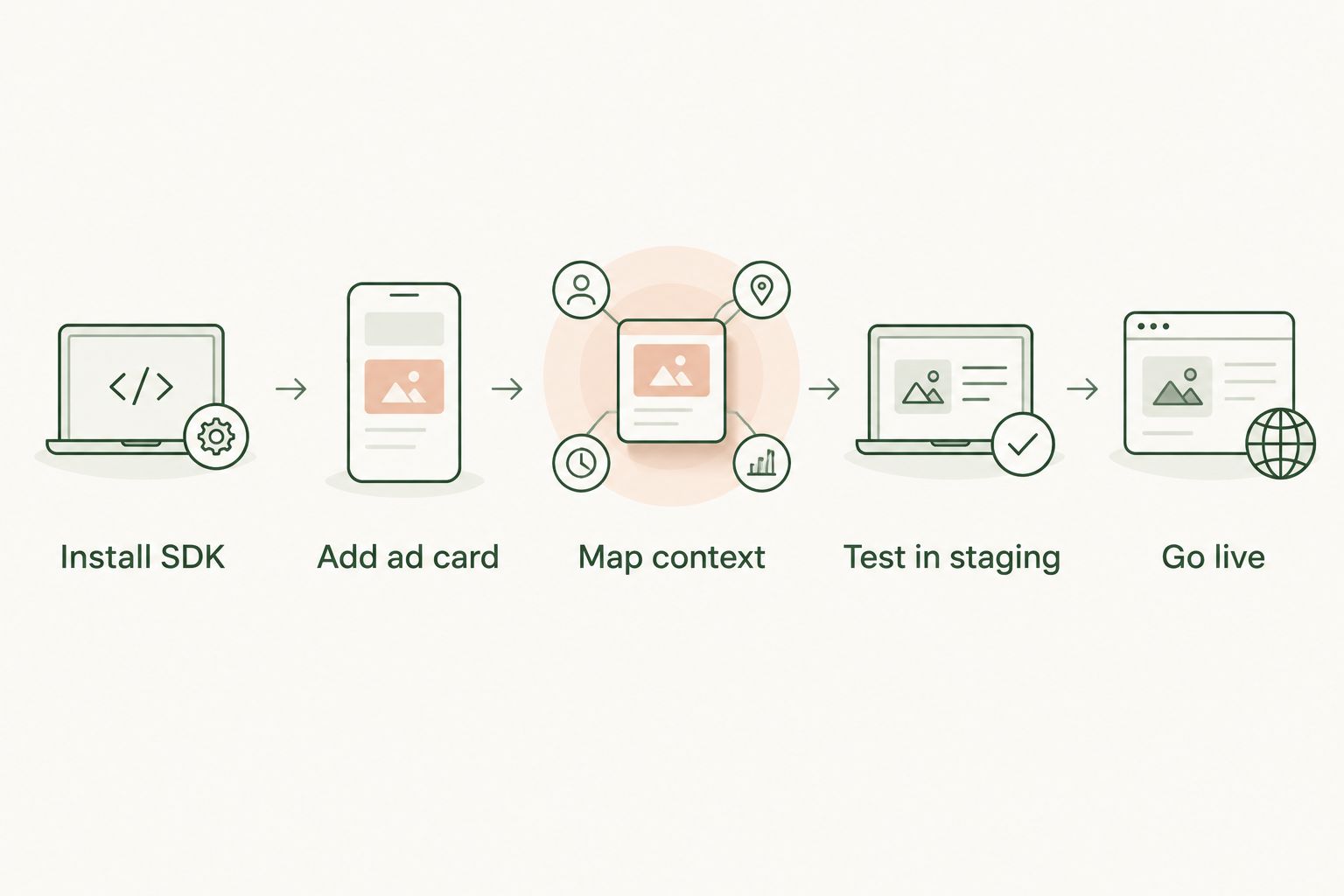
The integration itself breaks into five steps, and only two of them touch code:
- Install and initialize the SDK with an API key — this is the twelve-line change.
- Add the ad card component to the chat UI where an ad should render, as a native card inside the thread rather than a banner.
- Map conversation context so the matcher can trigger ads on relevant turns instead of firing blind.
- Test in staging before any ad serves to a real user.
- Go live and monitor RPM in the dashboard once ads are serving.
Steps 1 and 2 are the fast part, since the core change is Elo's twelve-line integration. Steps 3 and 4 are where teams spend real calendar time, because context mapping and staging validation depend on your own conversation flows, not on Elo's SDK code.
Core SDK integration: twelve lines of code
The part developers actually write is small on purpose. Elo's SDK is built around a twelve-line integration: initialize the client, register a callback, drop the ad card component into the chat thread. There's no separate ad server to stand up and no custom rendering pipeline to build — the card renders inline, styled to match the surrounding conversation.
That twelve-line number is the reason a single developer can complete the core integration without a dedicated project plan. It's also why the time-to-integrate-a-conversational-ad-SDK question has a shorter answer than most teams expect walking in.
Multi-platform rollout: six framework guides, one core SDK
The underlying SDK call doesn't change across platforms, but the surrounding setup does, which is why Elo maintains six framework-specific integration guides: iOS, Android, React Native, Flutter, Next.js, and Vercel AI SDK apps.
A Next.js chat app and a React Native mobile app both call the same core SDK method — the difference is where that call sits in the render lifecycle. Teams running on more than one platform should expect to repeat steps 1 and 2 per platform, not per feature, since the ad card component itself doesn't change.
Testing and ad review: the phase most teams underestimate
This is where the real project time lives. Before ads go live for real users, test the SDK integration before launch in a staging environment: confirm the ad card renders correctly across screen sizes, confirm context mapping triggers on the turns you expect, and confirm frequency caps behave the way your product spec says they should.
Teams that skip staging validation and push straight to production are the ones who report integration "taking weeks" — not because the code took weeks, but because they're debugging context-matching edge cases in front of live users instead of in staging.
Why integration timelines vary
- Framework — Next.js and Vercel AI SDK apps ship the core change fastest; a custom, self-hosted stack needs a bit more wiring around the ad card component.
- LLM backend — OpenAI and Anthropic-based apps use the same context hooks; a custom LLM app needs a few extra lines to pass conversation context into the matcher.
- Ad slot count — one ad card per session tests faster than multiple placements spread across a long multi-turn conversation.
- Revenue split configuration — multi-tenant platforms need a revenue split model set up in the dashboard, which is a configuration task, not a redeploy.
- Disclosure requirements — teams that need explicit sponsored-content labeling add a review cycle with legal or compliance before launch.
- QA depth — teams running full staging validation before flipping ads live spend more calendar time up front than teams shipping an MVP integration and iterating after launch.
Is integrating an ad SDK harder for a custom LLM chatbot?
No — Elo's SDK supports apps built on OpenAI, Anthropic, or a custom LLM through the same core integration path. A custom LLM app just passes conversation context into the matcher directly instead of using a pre-built OpenAI or Anthropic context hook.
Do you need dedicated QA time before launch?
Yes — run the integration in staging before serving a single live ad, following the same validation steps used to test the SDK integration before launch. Skipping this step is the most common reason a launch date slips past its target in 2026.
Does multi-agent or multi-tenant architecture add integration time?
It adds configuration time, not code time. Multi-tenant platforms need a revenue split model set up in the dashboard, and multi-agent systems need conversation context tagged by agent, but the underlying SDK call itself doesn't change between a single-agent app and a multi-agent one.
Start your Elo integration
See the twelve-line SDK setup and connect a Vercel AI SDK app directly.
FAQ
How long does it take to integrate a conversational ad SDK in 2026?
The core code change takes a single developer a short sitting to complete, since Elo's integration is built around a twelve-line SDK call; the surrounding testing and context-mapping work is what extends the calendar timeline.
Does the ad SDK slow down chatbot response time?
Elo's SDK runs the ad matcher call asynchronously so it doesn't block the model's response, meaning the ad card can render without holding up the chat reply.
Can you integrate an ad SDK without redesigning the chat UI?
Yes. Elo's ad card renders as a native card inside the existing chat thread, not a banner, so there's no separate ad UI to design from scratch.
Do you need advertiser relationships before integrating the SDK?
No. The SDK connects to Elo's ad network directly, so you don't need to negotiate direct advertiser deals before your first ad serves.
What frameworks have ready-made integration guides?
Elo publishes integration guides for Next.js, Vercel AI SDK, iOS, Android, React Native, and Flutter apps — six frameworks covered as of 2026.
Is the SDK integration different for OpenAI-based apps versus Anthropic-based apps?
No. Apps built on OpenAI, Anthropic, or a custom LLM all use the same core Elo SDK call; only the context-passing step differs slightly for custom LLM stacks.
How much engineering time should you budget for a first integration?
Budget more calendar time for testing and context mapping than for the SDK call itself, since the core Elo integration is a twelve-line code change.
Does adding ads require a separate mobile release cycle?
If your chat app runs on iOS, Android, or React Native, the ad card ships inside your existing app, so it doesn't need a new SDK-only release outside your regular update cycle.
One last thing
The part of a conversational ad SDK integration that actually eats calendar time in 2026 isn't the twelve lines of code — it's deciding when an ad card should appear at all. Teams that map five or six high-intent moments in their chat flow before writing any code spend less time in the testing phase than teams that try to place ads on every turn and dial it back after launch. Decide the trigger moments first; write the twelve lines second.