
There's no fixed number for how much an AI chatbot earns from ads in 2026 — no credible source publishes one, because chatbot ad revenue is a function of three variables you control: message volume, fill rate, and effective CPM (eCPM). Any site that gives you a flat dollar figure is guessing. The honest starting point is the formula, not a headline number, and the biggest hidden cost is fill rate — advertiser demand doesn't cover every conversation, so a chunk of your eligible messages simply won't monetize no matter how good your traffic is.
- How much an AI chatbot can earn from ads depends on message volume, fill rate, and eCPM — not a fixed monthly number.
- Vertical matters: finance, SaaS, and shopping assistants attract more advertiser demand than general-purpose companion apps.
- Fill rate is the variable most developers ignore — unfilled ad-eligible messages earn nothing.
- Elo's adserver runs contextual, conversational ad units inside the chat itself, not banner overlays.
- The only reliable way to know your number is to instrument your own chat and measure eCPM directly.
Why this matters
Developers building on OpenAI, Anthropic, or a custom LLM stack want a revenue line before they commit engineering time to an ad SDK. That's reasonable. But every public "chatbot ads earn $X/month" claim you'll find online either comes from a single anecdote or an unrelated ad network's blended average across formats that have nothing to do with conversational chat. Contextual, in-chat ad units behave differently from display or video, and the developer audience asking this question in 2026 mostly runs apps with wildly different traffic profiles — from a solo builder's side project to a multi-tenant SaaS copilot serving thousands of daily sessions.
The useful move isn't chasing a number someone else published. It's understanding the formula, then plugging in your own traffic.
How much can an AI chatbot earn from ads?
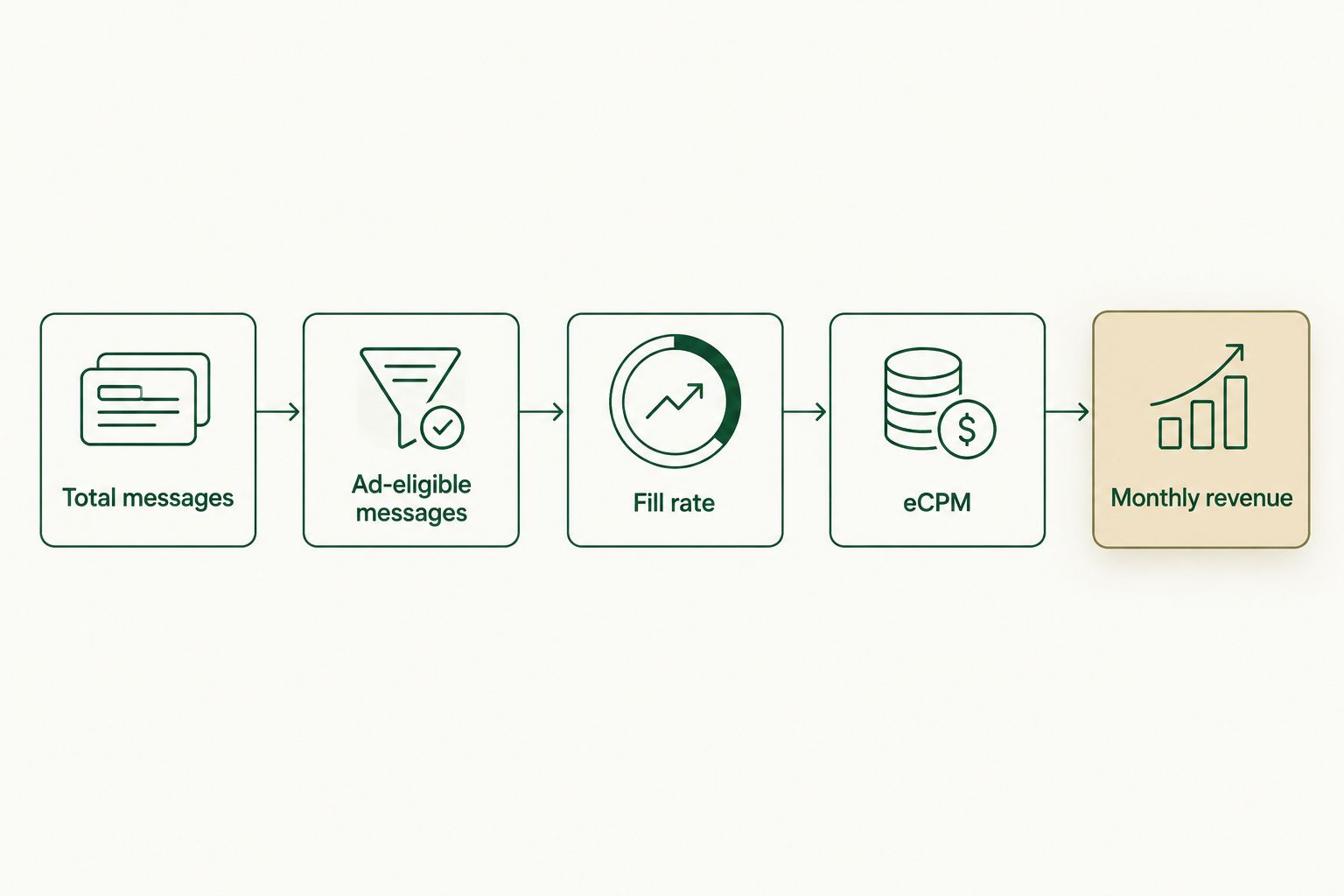
Monthly ad revenue for a chat app breaks down into four inputs multiplied together. Change any one of them and the output moves.
| Input | What it means | Who controls it |
|---|---|---|
| Total messages/month | Every user turn in the chat | You, via retention and growth |
| Ad-eligible messages | Turns where a contextual ad match makes sense | The matcher and your ad placement rules |
| Fill rate | % of eligible messages an advertiser actually bids on | Advertiser demand in your vertical |
| eCPM | Revenue per 1,000 filled ad impressions | Advertiser competition, format, geography |
Revenue = (ad-eligible messages ÷ 1,000) × fill rate × eCPM. Two chatbots with identical traffic can land in very different places on that equation if one serves B2B SaaS buyers and the other serves late-night companion chat with thin advertiser demand.
Indie chatbots and side projects
A solo-built GPT wrapper or custom LLM app with modest, inconsistent traffic sits at the low end of every input in the formula above: fewer ad-eligible messages, and often thinner advertiser interest because volume is too small to attract premium bids. Verdict: worth adding an ad SDK anyway — a chat that earns nothing is guaranteed zero revenue, and chatbot monetization for indie developers doesn't require the traffic a display network would demand.
Mid-size AI apps with a loyal user base
Apps with steady daily active sessions and a defined use case (cooking assistants, career coaching, personal finance) generate more ad-eligible messages per user and typically pull stronger fill rates because the conversation topic maps cleanly to advertiser categories. Verdict: this tier sees the clearest lift from contextual matching — the ad, when it appears, matches what the user was already asking about.
High-traffic AI chat platforms
Multi-tenant platforms and enterprise copilots run enough volume that fill rate and eCPM start to matter more than raw message count — a small eCPM improvement compounds across millions of turns. Verdict: prioritize eCPM optimization over volume growth once you're past the point where advertiser demand, not traffic, is the ceiling. How to increase eCPM in an AI chatbot covers the levers worth pulling first.
Why ad revenue per chatbot varies
- Vertical. Finance, insurance, real estate, and B2B SaaS assistants attract advertisers willing to pay for qualified intent; general-purpose companion or entertainment chat sees thinner demand.
- Message length and depth. Longer, more specific conversations give a contextual matcher more signal to work with than short back-and-forth exchanges.
- Ad format. Native cards inside the conversation read differently to users than banner-style overlays bolted onto a chat UI, and that affects both engagement and advertiser willingness to bid.
- Geography. Advertiser budgets concentrate in specific markets, which shifts eCPM by region even for identical content.
- Frequency capping. Show too many ads per session and users churn, which shrinks the message volume that drives the whole formula in the first place.
- Disclosure and trust. How you disclose sponsored content inside the chat affects whether users tolerate ads long enough to keep the session — and the revenue — going.
“There is no dependable monthly number for chatbot ad revenue until you measure your own eCPM.”
Contextual ads vs. other ad formats: which earns more per chat?
Developers weighing how to monetize a chat app usually compare three approaches. None of them is universally "best" — the right one depends on chat UX and traffic pattern.
| Approach | Best for | Pros | Cons |
|---|---|---|---|
| Contextual in-chat ads (Elo) | Conversational apps built on OpenAI, Anthropic, or custom LLMs | Native cards matched to conversation context, non-intrusive to chat flow | Revenue still depends on advertiser demand in your vertical |
| Traditional display/banner network | Apps with a visible sidebar or web wrapper around the chat | Familiar integration pattern for ad ops teams | Breaks conversational UX, users tend to ignore or block banners in a chat interface |
| Direct advertiser deals | High-traffic apps with a defined, sellable audience | No intermediary revenue split on negotiated deals | Requires sales effort and minimum scale most early-stage apps don't have |
Contextual, conversational ad units are built specifically for the chat surface rather than adapted from web display inventory — that's the core design premise behind an ad SDK for AI chat interfaces. The honest tradeoff: it still depends on the matcher finding a real advertiser fit for the conversation, which is a demand-side variable no SDK can fully control.
See your own chatbot's ad math
Instrument the SDK and measure real eCPM instead of guessing at a monthly figure.
How do I estimate my own chatbot's ad revenue?
Run the formula above with your own numbers instead of borrowing someone else's. Pull your monthly message count, estimate the share that's genuinely ad-eligible (not every turn is — a user asking to summarize a document isn't an ad moment), and instrument the SDK to report fill rate and eCPM back to you directly rather than assuming a blended average. How to forecast ad revenue for an AI chatbot walks through building that estimate before launch, and how to measure ad revenue per user in a chatbot covers tracking it after you're live.
FAQ
How much can an AI chatbot earn from ads?
There is no fixed monthly figure — earnings equal ad-eligible messages divided by 1,000, multiplied by fill rate and eCPM. Two chatbots with the same traffic can land in very different places depending on vertical and advertiser demand in 2026.
Does chat volume matter more than vertical for ad revenue?
Both matter, but vertical often moves the number more than raw volume. A smaller finance or B2B SaaS assistant can out-earn a larger general-purpose companion app because advertiser demand concentrates in specific categories.
What is fill rate and why does it matter for chatbot ads?
Fill rate is the percentage of ad-eligible messages an advertiser actually bids on. An unfilled message earns nothing, so fill rate — not just traffic — sets a hard ceiling on revenue.
Is contextual advertising better than banner ads for AI chat apps?
Contextual, in-chat ad units are built for conversational surfaces and avoid breaking chat UX the way a bolted-on banner does. Whether it earns more depends on advertiser fill for your specific vertical.
Do I need a lot of traffic before adding an ad SDK?
No. A chatbot with low, inconsistent traffic still earns something from an ad SDK, where it earns nothing without one. Scale mainly changes which lever — volume or eCPM — is worth optimizing first.
Can I run ads inside a custom GPT or Claude-based assistant?
Yes, contextual ad SDKs are built to work across OpenAI, Anthropic, and custom LLM stacks. The integration approach differs by platform, so check the setup guide for your specific model provider.
Does frequency capping affect chatbot ad earnings?
Yes. Showing too many ads per session drives users to leave the chat sooner, which shrinks total message volume — the first input in the revenue formula — even if eCPM stays constant.
One last thing
Stop looking for someone else's monthly number and build a two-week test instead: instrument the ad SDK, let real traffic run through the matcher, and read your own fill rate and eCPM before you project anything for 2026. Every chatbot's math is different — the one number worth trusting is the one your own conversation data produces, and Elo's adserver is built to surface that number directly rather than make you estimate it.