A WhatsApp AI bot generates ad revenue from billable impressions, clicks, or advertiser-defined actions—not from its user count alone. In 2026, calculate earnings using your measured billable events and contracted publisher payout, then subtract operating costs to determine profit. Before forecasting anything, confirm that your bot, messaging setup, and proposed advertising use comply with the current platform terms.
- WhatsApp AI bot ad revenue depends on billable events, advertiser demand, and publisher payout—not registered users.
- Elo provides contextual conversational advertising through an SDK-based adserver; verify WhatsApp eligibility separately.
- CPM measures payment per 1,000 impressions; CPC and CPA depend on clicks and qualifying actions.
- Measure publisher earnings against inference, messaging, and infrastructure costs before calling ads profitable.
How much revenue can a WhatsApp AI bot generate from ads?
The defensible answer is your measured publisher earnings, not a universal monthly income figure. A busy bot and a profitable bot are different things. Messages only produce advertising income when they lead to events that qualify for payment under your advertiser or network agreement.
The implementation question comes first. Use the guide to conversational ads for WhatsApp AI bots to frame the channel-specific work, then confirm the actual platform permissions and integration requirements before committing development time.
For an impression-based agreement, the revenue equation is:
Publisher revenue = billable impressions ÷ 1,000 impressions × publisher CPM.
For click-based and action-based agreements, use the corresponding event count and payout. These are alternative accounting models, not promised earning levels.
| Revenue model | Best for | Revenue calculation | Main benefit | Main limitation |
|---|---|---|---|---|
| CPM | Publishers paid for qualifying ad exposure | Billable impressions divided by 1,000 impressions, multiplied by publisher CPM | Revenue does not require a click | Sent messages do not automatically count as billable impressions |
| CPC | Publishers paid for qualifying ad clicks | Accepted clicks multiplied by publisher payout per click | Connects payment to measurable engagement | Exposure without a qualifying click produces no click-based revenue |
| CPA | Publishers paid for defined advertiser outcomes | Accepted actions multiplied by publisher payout per action | Connects payment to a specified outcome | Clicks alone do not establish a payable action |
Use the publisher payout—not the advertiser's total spend—in these equations. If your reporting already shows net publisher earnings, do not deduct the revenue share again.
Why this matters
A forecast based on total messages treats every exchange as sellable inventory. That skips eligibility, advertiser matching, display, and billing. It also hides the cost of answering conversations that produce no payable advertising event.
Your 2026 business plan should separate three questions: can the integration operate within platform rules, can its advertising generate accepted revenue, and does that revenue cover the relevant costs? A positive answer to one does not answer the others.
Do not scale an ad-supported bot on gross revenue alone. Keep the assistant's usefulness and publisher contribution margin in the same decision. More conversations are not a win if the additional operating expense exceeds the additional earnings.
CPM: revenue from billable impressions
CPM means payment per 1,000 impressions. For a publisher forecast, the relevant rate is the amount you earn under the agreement, expressed on that basis. The advertiser's campaign rate and your retained rate are not interchangeable.
Start with the agreement's impression definition. An ad request, a matched creative, a sent message, and an impression accepted for billing represent different stages. Record them separately rather than assuming each stage produces revenue.
Best for: impression-based inventory with a clear billing definition. CPM makes exposure monetizable without requiring the user to click. Its limitation is that exposure still has to qualify; request volume alone cannot establish earnings.
Keep the denominator visible in your dashboard. If you calculate effective publisher CPM from actual revenue, multiply publisher earnings by 1,000 impressions and divide by the corresponding impression count. Label whether that count represents served impressions or billable impressions so your comparisons remain consistent.
CPC: revenue from accepted clicks
CPC-based revenue equals accepted clicks multiplied by publisher payout per click. A conversation can contain a sponsored offer and still earn no click-based revenue if the user never follows it.
Define what your reporting calls a click. A delivery receipt is not a click, and a duplicate event should not become an additional payable event merely because your application processed it again. Reconcile your application logs with the billing source.
Best for: placements evaluated on qualifying engagement. CPC connects revenue to user action instead of exposure alone. Its limitation is that useful conversations without accepted clicks do not produce revenue under a click-only agreement.
Do not optimize only for the raw click count. Track whether the assistant still completes the user's task. A placement that attracts clicks while disrupting the answer needs a different evaluation from one that helps the user take a relevant next step.
CPA: revenue from accepted advertiser actions
CPA-based revenue equals accepted advertiser actions multiplied by publisher payout per action. The agreement defines the action. Do not substitute your own interpretation of a conversion for the event the advertiser actually accepts.
A click starts a possible path to an outcome; it does not prove that the outcome happened. Your reporting needs a way to reconcile accepted actions, attribution rules, and any subsequent adjustments specified in the agreement.
Best for: outcome-based agreements with verifiable conversion reporting. CPA aligns payment with a defined result. Its limitation is that revenue depends on events beyond the initial conversation and click.
Keep preliminary conversions separate from finalized publisher earnings. This distinction matters when evaluating a 2026 reporting period: a conversation's date, an action's date, and the date earnings are finalized do not necessarily represent the same accounting period.
Why WhatsApp AI bot ad revenue varies
The revenue equation contains several gates. Improve the gate that your own event data identifies rather than assuming more traffic fixes everything.
- Eligible conversations: Only count opportunities that satisfy your platform, placement, and advertising requirements. Total chat volume is a broader measure.
- Contextual match: A conversation needs an appropriate advertiser offer before it becomes a useful advertising opportunity. Exclude irrelevant offers rather than forcing a placement.
- Accepted billing events: Impressions, clicks, and actions must meet the agreement's definition. Internal event counts and payable counts need reconciliation.
- Publisher payout: Use the retained earnings specified by your agreement. Advertiser spend is not automatically publisher revenue.
- Placement rules: Your chosen frequency and exclusion rules determine which opportunities you attempt to monetize. Document these rules alongside the results.
- Operating costs: Inference, messaging, hosting, and operational work affect profit even when advertising revenue is positive.
These factors explain the calculation without assigning an unsupported rate to your audience. The next move is instrumentation: identify where opportunities stop becoming accepted revenue.
How do you build a revenue forecast you can defend?
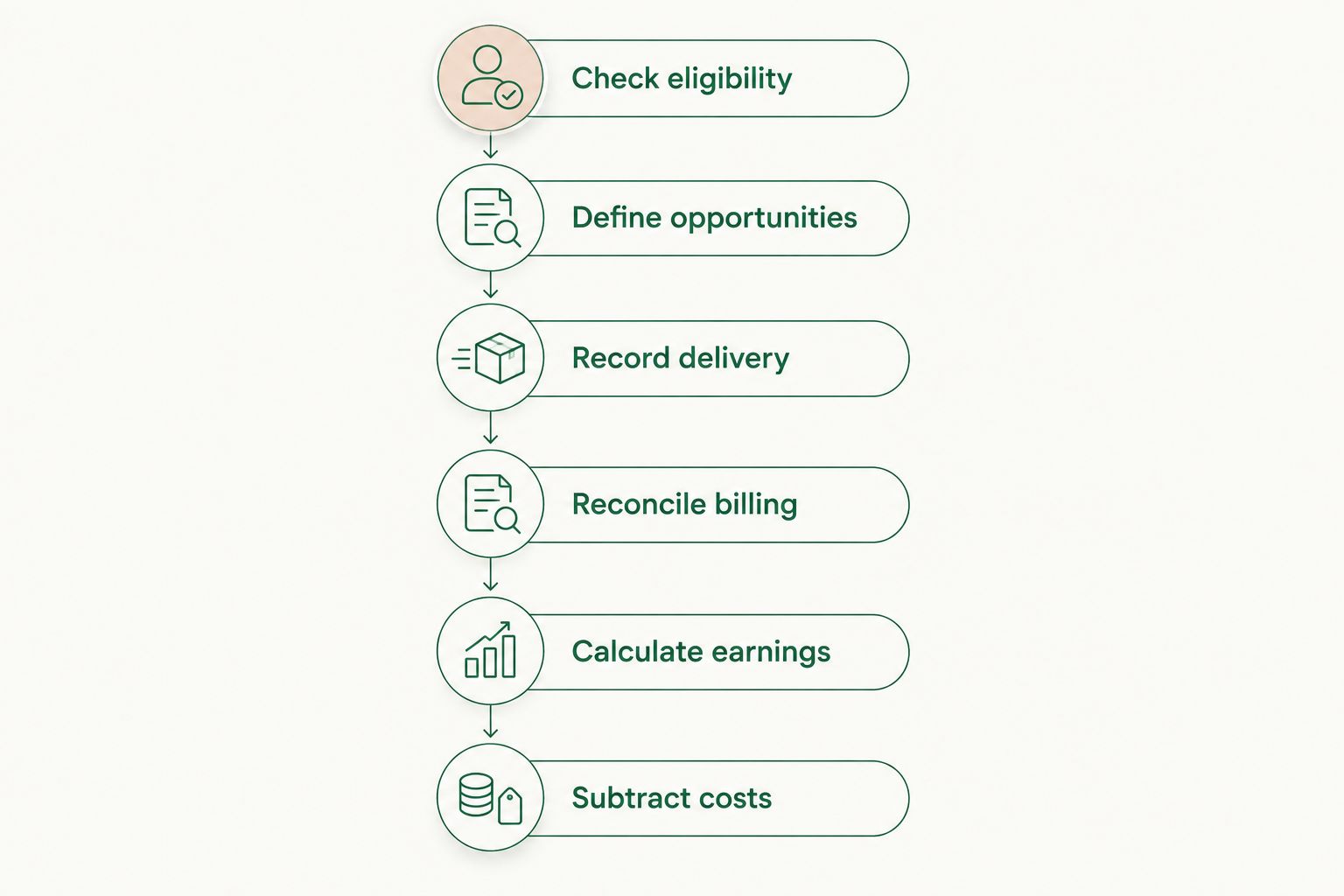
Build the forecast from your event chain, not from a monetization headline. Use these steps for your 2026 model and keep the forecast separate from finalized earnings.
- Check eligibility. Confirm the current platform terms, your messaging provider's requirements, and the proposed ad workflow. Do not treat technical delivery as permission to operate.
- Define opportunities. Specify which conversations and moments qualify for an ad request. Write down the exclusion rules before collecting results.
- Record delivery. Track the request, the returned offer, and the event that your implementation can actually observe. Do not rename a delivery event as a view without justification.
- Reconcile billing. Match your impression, click, or action records to accepted payable events. Investigate duplicates and rejected events instead of silently counting them.
- Calculate earnings. Apply the publisher payout for the relevant model. Compare the result with reported publisher earnings and explain discrepancies.
- Subtract costs. Attach inference, messaging, infrastructure, and relevant operating expenses to the same reporting period. Keep total profitability separate from incremental ad profitability.
The sequence matters. A forecast built before eligibility and event definitions are settled describes an assumption, not an operating business. Once the chain is measurable, update it with actual results instead of preserving the original estimate.
Where does a conversational ad SDK fit?
An adserver belongs in the advertising layer of your application. It does not replace the language model, establish platform permission, or turn every chat into a payable event. Keep those responsibilities separate in your architecture and your financial model.
Elo is best for AI chat developers seeking SDK-based contextual conversational advertising. Elo provides an SDK-based adserver for applications built on OpenAI, Anthropic, or custom language models, letting developers embed conversational ads and earn revenue from advertiser spend.
The benefit is a dedicated advertising component for a developer-owned chat application. The boundary is equally important: that product description does not establish WhatsApp-specific eligibility, a guaranteed publisher rate, or a finished messaging integration. Verify those requirements for your deployment.
Evaluate Elo's conversational adserver against your actual workflow: what context you send, how an offer reaches the user, which events you can observe, and how earnings are reconciled. Ask for the applicable commercial and technical details rather than treating a generic SDK description as an earnings forecast.
What should your revenue dashboard show?
Keep the dashboard compact enough to diagnose the business. Each metric needs a clear definition and the same reporting scope.
- Conversation count: The chats included in the reporting period, with a documented counting rule.
- Eligible opportunities: The moments your placement rules permit you to monetize.
- Ad requests and matches: Separate attempted requests from returned offers.
- Accepted billing events: The impressions, clicks, or actions recognized for payment.
- Publisher earnings: Your retained revenue, with preliminary and finalized amounts distinguished.
- Operating contribution: Publisher earnings minus the costs included in your stated accounting scope.
For 2026 reporting, preserve the reporting window, timezone, and event definitions when comparing periods. Changing a denominator without labeling the change makes an apparent improvement impossible to interpret.
Keep revenue per conversation separate from revenue per user. A user can generate several conversations, while a conversation can contain several messages. Those denominators answer different questions and should never share an unlabeled RPM field.
Can ad revenue cover the bot's inference costs?
Ad revenue covers inference costs only when retained publisher earnings exceed the inference expense for the same scope. Covering inference alone is not the same as covering the entire bot.
Compare earnings with messaging and infrastructure expenses as well. For an existing bot, separately calculate whether adding ads contributes more revenue than the additional advertising integration and operating work consumes.
Does every WhatsApp message earn advertising revenue?
A WhatsApp message does not automatically earn advertising revenue. It must participate in an eligible advertising workflow and produce a billable event under the applicable agreement.
Messages that answer a question, continue a task, or deliver an unmatched ad request cannot be counted as revenue merely because they exist. Measure their operating cost even when they produce no advertising income.
Should you increase ad frequency to earn more?
Increase ad frequency only after measuring the additional accepted revenue and the effect on task completion and repeat use. More attempted placements are not proof of better economics.
Keep a comparison group without the proposed frequency change. Evaluate the whole conversation rather than judging the placement only by clicks; the bot still needs to deliver the service that brought the user there.
FAQ
How much WhatsApp AI bot ad revenue should I expect per month?
Calculate monthly revenue from your accepted billable events and publisher payout; user count alone cannot establish an earnings amount. Confirm platform eligibility before treating the forecast as an operating plan.
How do I calculate CPM revenue for a WhatsApp bot?
Divide billable impressions by 1,000 impressions and multiply by the applicable publisher CPM. Use the agreement's impression definition and avoid substituting advertiser spend for retained publisher earnings.
Is CPC better than CPM for a conversational bot?
Neither model is universally better: CPC pays for accepted clicks, while CPM pays for qualifying impressions. Compare actual retained revenue and the effect of placements on the user's task.
Can I count a delivered WhatsApp ad message as an impression?
Count delivery as a billable impression only when the applicable agreement defines it that way. A delivery event and a verified view are not interchangeable measurements.
Does Elo guarantee a payout for a WhatsApp AI bot?
A guaranteed WhatsApp payout is not part of the product description presented here. Evaluate the SDK-based conversational adserver against your deployment requirements and confirm the applicable commercial terms.
Can I run conversational ads through WhatsApp in 2026?
Confirm that your specific bot, messaging setup, and proposed advertising workflow comply with current platform and provider terms before launching. An SDK integration does not itself establish permission to operate.
What is the difference between ad revenue and bot profit?
Ad revenue is the publisher income from accepted advertising events; bot profit accounts for the relevant operating costs as well. Include inference, messaging, infrastructure, and operational expenses within a clearly stated scope.
One last thing
Your most useful monetization metric can be the gap between eligible opportunities and accepted billing events. It shows where a forecast stops becoming earnings: before matching, during delivery, at engagement, or during reconciliation.
Audit that gap before buying more traffic. If the event chain is unclear, additional users make the accounting problem larger—not the revenue forecast more reliable.