
Direct ad deals are worth replacing programmatic for a chatbot only when committed advertiser demand covers the inventory you intend to sell and the revenue justifies sales and campaign work. Otherwise, keep programmatic as the baseline and evaluate direct deals for specific conversation contexts; a negotiated campaign still requires delivery, reporting, and collection.
- Direct ad deals vs programmatic chatbot decisions depend on advertiser demand, eligible conversations, and operating work—not headline CPM.
- Direct deals fit publishers with committed buyers and clearly defined conversational inventory.
- Programmatic fits publishers seeking automated demand access without negotiating every advertiser relationship.
- Elo offers an SDK-based adserver for developers monetizing AI chat applications with contextual conversational ads.
Is it worth direct ad deals instead of programmatic for a chatbot?
Sell directly when you have a buyer for a defined placement. Do not replace programmatic because a prospect expresses interest. A signed agreement, accepted creative, agreed measurement, and a workable delivery plan are the relevant evidence.
The decision has separate commercial and technical layers. Your advertiser relationship determines how you sell inventory; your adserver determines how you deliver it. Elo provides an SDK-based adserver for contextual conversational ads in applications built on OpenAI, Anthropic, or custom LLMs. That describes delivery infrastructure, not a guarantee that a direct campaign will outperform automated demand.
| Approach | Best for | Main advantage | Main limitation | Decision rule |
|---|---|---|---|---|
| Direct deals | Publishers with committed advertisers and defined conversational inventory | Negotiate placement, creative, reporting, and commercial terms directly | You own sales, campaign coordination, and collection | Use for commitments you can deliver and measure |
| Programmatic | Publishers seeking automated access to advertiser demand | Automated buying reduces the need to negotiate each advertiser relationship | Eligible requests still depend on compatible demand and buying rules | Use as a baseline, not a guaranteed revenue source |
| Hybrid | Publishers with selected direct commitments and other available inventory | Assign different demand sources to different opportunities | Requires explicit priority, exclusions, and fallback behavior | Use only when your serving setup supports the routing |
For a 2026 monetization plan, compare these approaches against the same inventory definition. Total chatbot messages are not automatically ad impressions. A relevant placement must also be permitted, rendered, and measured under the rules you establish.
Why this matters
A direct campaign adds obligations to your chatbot product. You need to know which conversations qualify, what the sponsor receives, and what happens when delivery falls short. Without those boundaries, a sponsorship agreement becomes an open-ended engineering and account-management task.
Programmatic does not eliminate product decisions. You still control where ads belong, which contexts are excluded, and how sponsored content stays separate from the assistant's answer. Automation concerns buying and serving; it does not settle your user-experience policy.
Choose the sales model after defining the placement. In your 2026 plan, a sponsored card following a relevant answer is a different inventory product from a campaign that asks the assistant to promote a brand throughout a conversation. Do not treat them as interchangeable.
Direct deals: best for defined inventory and committed buyers
A direct deal is useful when you can describe an audience and placement in terms an advertiser accepts. Specify the eligible conversation topic, supported geography and language, creative format, reporting events, and campaign boundaries. Avoid selling an undefined promise of access to chatbot users.
The main advantage is negotiated control. You can discuss exclusions, creative approval, delivery expectations, and reporting before launch. Those terms belong in the agreement, not in assumptions made after the advertiser signs.
The main disadvantage is ownership of the commercial workflow. Prospecting, proposals, revisions, approvals, reporting questions, and payment follow-up become your responsibility unless you explicitly assign them elsewhere. Count that work when comparing the campaign with automated demand.
Best for: a publisher with a specific advertiser willing to accept clearly documented inventory. Hold the deal if the buyer needs targeting or measurement you cannot provide. A larger commitment does not make an unsupported campaign deliverable.
Also distinguish a reservation from exclusivity. A sponsor buying eligible placements does not automatically need control of every conversation in the app. Define the scope before you agree to exclude other advertisers.
Programmatic: best for automated demand access
Programmatic buying automates transactions according to the buying system's rules. It does not necessarily mean an open auction: programmatic advertising also includes negotiated arrangements delivered through automated systems. Direct selling and automated delivery are therefore not strict opposites.
The practical advantage is that you do not need a separate sales negotiation for every advertiser served through that demand source. This fits publishers who want to focus on the application rather than operate an advertiser sales pipeline.
The limitation is dependence on suitable demand. An ad request is not a promise of a filled placement, and an available advertiser is not necessarily appropriate for the current conversation. Check the provider's supported formats, eligibility rules, reporting definitions, and controls.
Best for: a publisher seeking automated advertiser access without managing each buyer relationship. Do not assume a general display integration supports conversational placements. Assess the actual interface and event model your application needs.
For your 2026 baseline, record results from the eligible inventory you actually expose. Keep blocked contexts and unrendered responses separate from delivered impressions. Otherwise, the comparison mixes demand performance with application behavior.
Hybrid: best for selected sponsorships plus other demand
A hybrid setup keeps direct commitments for defined inventory and uses another demand source where those commitments do not apply. It is an allocation strategy, not a requirement to show more ads.
The advantage is flexibility. You can test a sponsor relationship without making every eligible conversation dependent on that advertiser. The limitation is routing complexity: a direct campaign, an exclusion, and a fallback request need consistent rules.
Best for: a publisher with a deliverable direct campaign and a serving setup that supports the intended allocation. Confirm those capabilities before promising priority or fallback. This article does not establish that any particular provider supports your proposed routing.
Document the behavior before implementation:
- Which conversation contexts qualify for the direct campaign?
- Does the agreement reserve delivery or only permit it?
- Which advertiser categories are excluded?
- What happens when the direct creative is ineligible?
- When should the application show no ad?
The guide to running direct-sold and programmatic ads together covers the related implementation question. Keep the commercial agreement and the serving rules aligned; neither substitutes for the other.
Why the direct-versus-programmatic decision varies
The deciding factors are the obligations created by each model. Use these factors to evaluate your own chatbot rather than treating publisher traffic alone as the answer.
- Buyer commitment: distinguish an exploratory conversation from an approved campaign with agreed terms.
- Inventory scope: define which contextual conversational placements you can sell and measure.
- Sales ownership: assign prospecting, negotiation, approvals, and collection rather than leaving them with engineering by default.
- Delivery requirements: check whether targeting, exclusions, reservations, and reporting match your serving setup.
- Demand compatibility: assess whether the available advertisers fit your permitted conversation contexts.
- User-experience boundaries: keep sponsor requirements from changing the assistant's independent answer or overriding sensitive-context exclusions.
There is no universal traffic threshold that resolves these questions. A useful decision requires evidence about your inventory, buyers, and workload. An app-wide traffic total cannot tell you whether a particular sponsorship is deliverable.
How do you compare direct deals with programmatic fairly?
Compare retained revenue, operating work, and delivery obligations for equivalent inventory. Do not compare a proposed sponsorship with realized programmatic results as though both are completed revenue.
- Define inventory. Write the eligibility rules before forecasting delivery. Specify placement, conversation context, geography, language, exclusions, and the event that counts as an impression.
- Record the baseline. Measure programmatic requests, rendered impressions, and revenue using consistent definitions. Separate eligible opportunities from all chatbot activity.
- Scope the deal. Record the advertiser's delivery requirements, accepted creative, reporting needs, payment terms, and remedies for missed obligations.
- Count operating work. Track sales, engineering changes, creative review, reporting, and account management. Separate initial setup from recurring campaign work.
- Compare outcomes. Use the same eligible inventory and reporting window. Review retained revenue alongside workload and any observed changes in user behavior.
- Choose allocation. Keep the baseline, assign a limited direct campaign, or use a hybrid arrangement supported by your infrastructure. Expand only after actual delivery validates the plan.
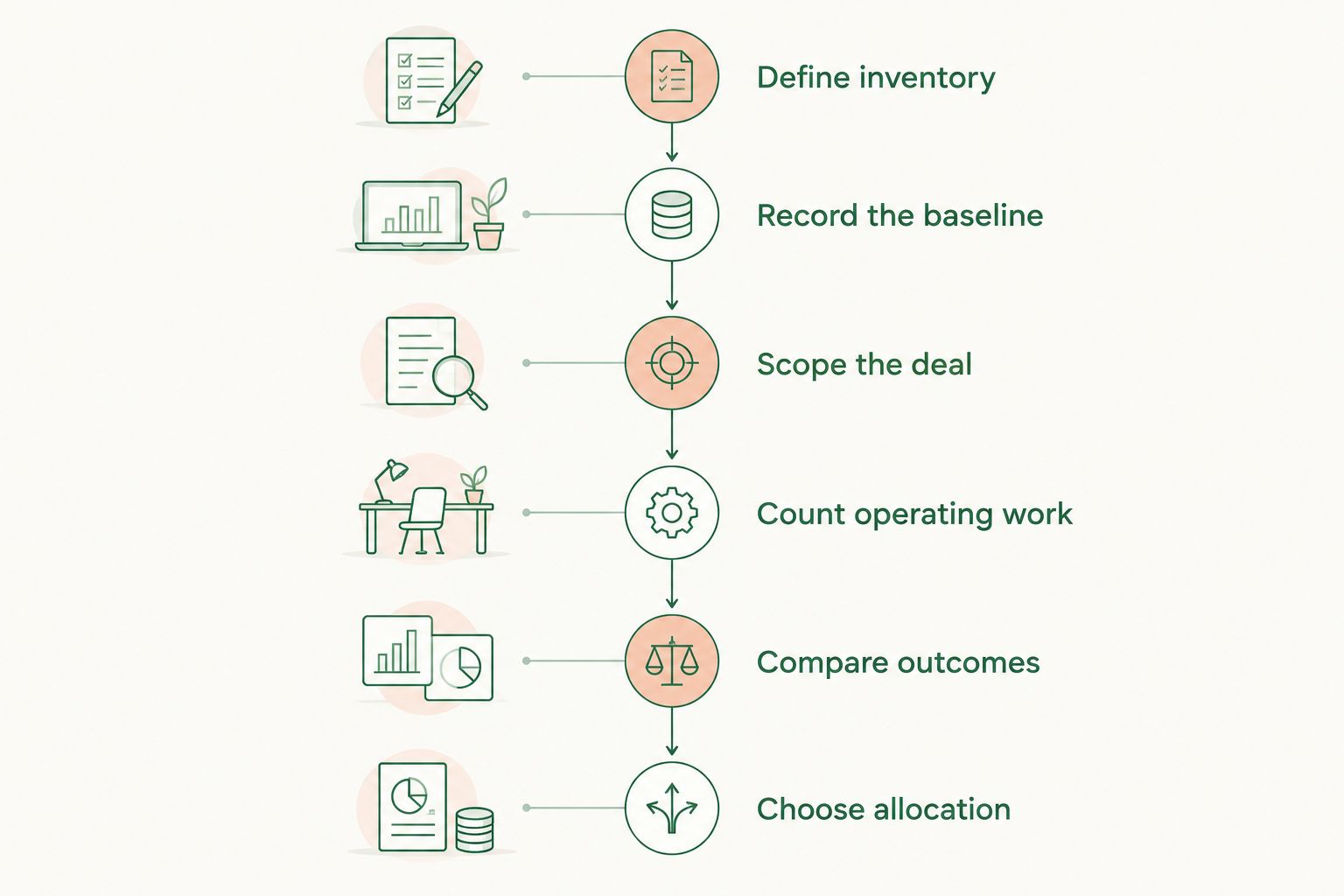
For a 2026 evaluation, decide the reporting window before the campaign begins. Changing the window after seeing results makes the comparison less useful. Record contract changes and inventory changes so you can explain differences without attributing everything to the sales model.
Use consistent denominators
CPM expresses a rate per 1,000 impressions. Effective CPM expresses realized revenue per 1,000 served impressions. Neither captures sales effort or tells you how much revenue the entire chatbot generates.
For product-level analysis, define conversation RPM as revenue per 1,000 conversations. State what counts as a conversation and whether the denominator includes conversations where ads are prohibited. Different definitions produce different results even with identical revenue.
Fill rate is served impressions divided by eligible ad requests, multiplied by 100 percent. Keep that denominator stable across the comparison. A direct campaign that targets a narrow context should not be judged against every request the application generates.
Compare equivalent inventory first; compare operating effort second. A campaign-level rate and an app-level revenue measure answer different questions. Keep both rather than using whichever makes a proposed deal look stronger.
Can direct ad deals and programmatic run together?
Direct deals and programmatic can run together when your serving infrastructure supports the required allocation rules. Define campaign eligibility, reservation behavior, exclusions, and the no-ad outcome before launch.
A hybrid setup does not require a direct sponsor to appear in every session. Sell the placement the advertiser agreed to buy, not unrestricted influence over the assistant.
Does a direct advertiser need access to chatbot transcripts?
A direct advertiser does not inherently need raw transcripts to receive campaign reporting. Start with agreed delivery and engagement events, and disclose only information your policies, permissions, and obligations permit.
Conversation context can contain sensitive information. Treat reporting requirements as a data-design decision, not a routine concession during negotiation.
Should you replace programmatic after signing a sponsor?
Signing a sponsor alone is not a reason to replace programmatic across the app. First establish the campaign's eligible scope, delivery requirements, payment terms, and exclusions.
Keep unrelated inventory outside the commitment unless the agreement explicitly includes it. Your 2026 allocation should reflect the contract you can fulfill, not the size of the sponsorship announcement.
Where an SDK-based adserver fits
Elo is for developers monetizing AI chat applications with contextual conversational ads. Its SDK-based adserver lets developers embed those ads and earn revenue from advertiser spend. That is relevant to the delivery layer of this decision.
The fit is specific: Elo conversational ads belong in the discussion when you need contextual ad delivery inside an AI chat application. The boundary is equally important. An SDK does not replace an advertiser agreement, your sales process, or your inventory forecast; verify the controls required for your proposed campaign before committing.
FAQ
Are direct ad deals better than programmatic for a chatbot?
Direct ad deals are better when committed buyers accept inventory you can deliver and the revenue justifies the operating work. Programmatic is the better baseline when you need automated demand access without negotiating each advertiser relationship.
How much traffic do I need to sell chatbot ads directly?
There is no universal traffic threshold for selling chatbot ads directly. Evaluate the buyer's requirements against your eligible conversational inventory, not total messages alone.
Can I guarantee every chatbot conversation will show a sponsor?
Do not guarantee sponsor delivery in every conversation unless your inventory rules and serving behavior support that commitment. Excluded contexts, creative eligibility, and user-experience boundaries must remain part of the delivery plan.
Does programmatic mean an open auction?
Programmatic does not mean only an open auction. It describes automated buying and selling, which can also include negotiated arrangements.
What should I measure before replacing programmatic?
Measure retained revenue, eligible requests, rendered impressions, operating work, and delivery obligations for equivalent inventory. Keep campaign rates separate from app-level revenue measures.
Can Elo deliver ads inside an AI chatbot?
Elo provides an SDK-based adserver for embedding contextual conversational ads in AI chat applications. Developers of applications built on OpenAI, Anthropic, or custom LLMs can use it to earn revenue from advertiser spend.
Should a sponsor control my chatbot's answers?
Keep sponsored placements separate from the assistant's independent answers. Define the commercial placement explicitly rather than granting a sponsor undefined influence over the conversation.
One last thing
A direct deal can still use automated delivery. The useful distinction is not manual versus automated; it is which obligations you accept and which inventory you commit. Before replacing programmatic, write the no-ad rule alongside the delivery rule. A conversation that should not carry a sponsor must remain outside the sales promise.