
Yes. You can personalize AI chat ads without breaking privacy rules when you use an appropriate legal basis, disclose the advertising data flow, honor applicable user choices, and restrict what reaches advertising partners. Matching an offer to the current conversation reduces the need for persistent profiles, but contextual advertising is not automatically anonymous or exempt from privacy law.
- Personalized ai chat ads privacy starts with limiting advertising inputs, not removing names from transcripts.
- Contextual targeting is the recommended default; persistent behavioral profiles require additional privacy controls.
- Elo provides a conversational advertising SDK for AI chat developers; publishers must assess their own data flows.
- Keep sensitive conversations, private documents, and unnecessary identifiers outside advertising requests.
Can AI chat ads be personalized without breaking privacy rules?
Yes, but personalization needs a defined boundary. Adapt the ad to an allowed topic or an explicitly chosen preference. Do not treat access to the conversation as permission to send the conversation to advertisers.
For a 2026 implementation, separate contextual relevance from identity-based targeting. The guide to contextual advertising for custom LLM chatbots covers the former; the privacy decision depends on the actual information processed and disclosed.
Use this sequence before enabling ad requests:
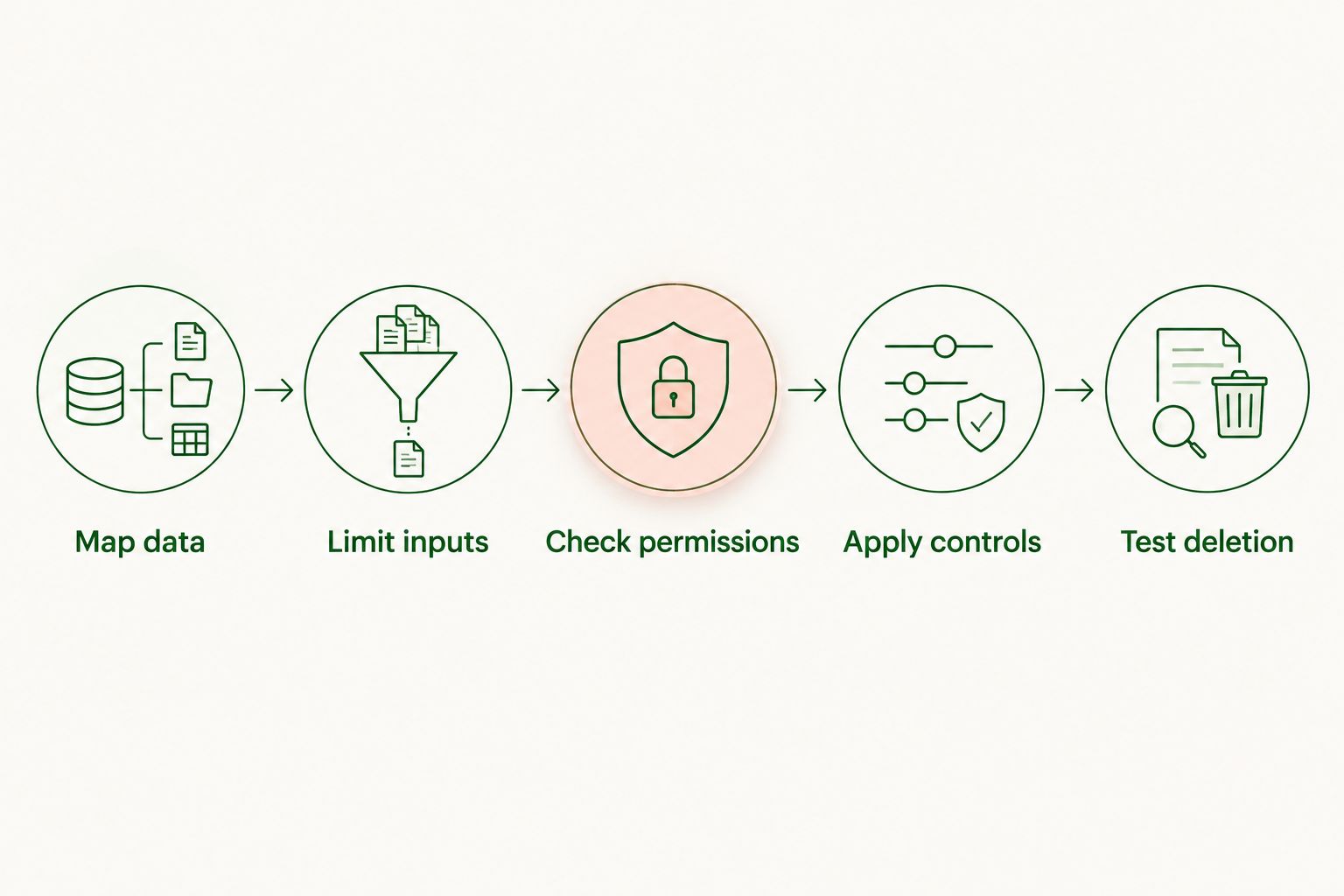
- Map data. Identify everything the advertising integration receives, including request metadata, identifiers, topic labels, and measurement events. Include logging and analytics destinations, not just the matcher.
- Limit inputs. Replace unrestricted transcript access with an allowlisted advertising topic where the integration supports it. Exclude confidential information and sensitive topics rather than relying solely on name removal.
- Check permissions. Determine the applicable legal basis, consent requirements, and opt-out obligations for each audience and processing purpose. A privacy notice does not replace a required permission.
- Apply controls. Enforce choices before a request leaves the application. Prevent restricted signals from entering retry queues, analytics exports, or downstream measurement.
- Test deletion. Confirm that retention limits, withdrawal, and deletion requests affect the relevant systems and partners. Document exceptions rather than silently retaining everything.
These are implementation recommendations, not a certification that a particular SDK or configuration complies with every law.
Why this matters
A chat message can contain information that a page view never exposes. Users paste account details, medical questions, employment documents, and private correspondence because they want help—not because they intend to create an advertising audience.
The application controls the boundary. If your assistant needs a document to answer a question, that does not establish that an advertising partner needs the same document to select an offer.
For your 2026 launch review, inspect the outbound payload rather than the feature label. A system called contextual can still transmit persistent identifiers or revealing text. A system called personalized can operate on a narrow, user-selected preference.
Judge privacy by the data flow, not by the name of the targeting method. That distinction gives engineering, product, and legal teams a shared object to review.
Contextual targeting: best for current-task relevance
Contextual targeting selects an ad from the immediate task or conversation topic. For example, a generic request about organizing project work can support a broad project-management category without exporting the user's message or building a lasting identity profile.
Its advantage is narrower advertising input. Its limitation is that the current context can itself reveal personal information. A health question does not become safe advertising material merely because it arrived in the latest message.
| Approach | Best for | Practical advantage | Privacy limitation |
|---|---|---|---|
| Contextual targeting | Relevant offers tied to an ordinary current task | Does not inherently require a persistent user profile | Topics and request metadata can still reveal personal information |
| Explicit preferences | Users who deliberately select advertising interests | Gives users a direct way to influence relevance | Requires clear purpose explanations and preference controls |
| Behavioral profiling | Use cases with a justified need for cross-session targeting | Uses activity beyond the current conversation | Adds identity linkage, retention, and user-choice obligations |
Start with contextual targeting when the current task supplies enough relevance. Do not add cross-session identifiers simply because the advertising stack accepts them.
Explicit preferences: best for user-directed relevance
Explicit preferences let users choose categories they want to see. A user-selected interest in developer tools is different from silently deriving an interest from private workplace conversations.
The advantage is direct participation. The limitation is purpose ambiguity: a preference supplied to improve assistant answers is not automatically a preference supplied for advertising.
Keep those purposes separate in the interface. Explain whether the setting changes assistant responses, sponsored offers, or both. Let users change an advertising preference without rewriting their account profile or erasing useful assistant settings.
For a 2026 release, test the disabled state as carefully as the enabled state. Removing a preference from the screen is insufficient if the old value remains in advertising requests, cached segments, or measurement events.
Behavioral profiling: best for justified cross-session targeting
Behavioral profiling uses past activity to influence future ad selection. It extends the advertising decision beyond the current request and introduces additional questions about identity, purpose, retention, and disclosure.
Its advantage is access to historical signals. Its limitation is the larger processing footprint. Combining sessions, devices, or partner data creates obligations that a narrow contextual implementation does not necessarily share.
Require a documented reason for every historical signal. Identify where users exercise applicable choices and what happens after they opt out or withdraw consent. Do not describe a profile as anonymous when it remains connected to an account or persistent identifier.
Do not make behavioral profiling the default merely to pursue better monetization. Establish the lawful design first, then assess whether historical targeting adds enough value to justify its additional data handling.
Why privacy requirements vary
Personalized AI chat ads privacy depends on the implementation and audience, not a universal permission switch. These factors determine the review:
- Jurisdiction. EU data protection requirements and US state privacy requirements differ in scope, terminology, and user rights.
- Information sensitivity. Health details, religious beliefs, financial circumstances, and other revealing content demand different treatment from ordinary product categories.
- Targeting purpose. Selecting an offer for a current task differs from building a reusable advertising profile.
- Partner use. A recipient that follows restricted instructions differs from one that combines information for its own advertising purposes.
- Audience age. Child-directed services and services with actual knowledge of child users raise specific requirements.
- Storage and linkage. Retention, account identifiers, event logs, and connections across services change the processing footprint.
Do not infer compliance from server-side processing alone. Moving the request away from the browser changes where processing occurs; it does not eliminate the disclosure or the recipient's obligations.
Which privacy rules should developers check in 2026?
EU users: review the processing purpose and legal basis
For a 2026 EU assessment, the General Data Protection Regulation's Article 5 provides the core principles, including purpose limitation, data minimization, and storage limitation. Article 6 governs lawful bases; Article 9 places additional restrictions on special-category personal data.
Do not assume legitimate interests authorizes every advertising use. Assess the actual purpose, necessity, and effect on users. Separately assess consent requirements under applicable rules implementing the ePrivacy framework for storing or accessing information on a user's device.
GDPR Article 12 generally requires responding to rights requests within 1 month, subject to its extension provisions. Your request-handling process therefore needs to reach the advertising systems that hold relevant personal data, not just the account database.
US users: assess state rights and sensitive-data rules
For a 2026 US assessment, identify which state privacy laws apply to the business and processing. Relevant obligations can include notices, targeted-advertising opt-outs, sale or sharing opt-outs, sensitive-data requirements, and recognition of applicable preference signals.
Under the California Consumer Privacy Act and its implementing rules, covered requests to know, delete, or correct generally have a 45-calendar-day response period, with permitted extensions. Do not reuse that deadline as a universal rule for every request or jurisdiction.
Health-related chat data also needs a separate review. The absence of HIPAA coverage does not establish that collection or advertising disclosure is unrestricted; state consumer-health laws and federal consumer-protection requirements can still matter.
Children: review eligibility before advertising runs
COPPA generally addresses online collection of personal information from children under 13 years by covered operators. Assess whether the service is child-directed or has actual knowledge that it collects personal information from children in that age group.
Do not send a child's conversation to an advertising service while leaving the legal assessment for later. Age-related controls belong before the ad request, alongside any required parental permissions and restrictions.
These are statutory reference points, not a complete jurisdictional checklist. Obtain a legal assessment for the audience, data, and advertising arrangement you actually operate.
How do you keep conversation data out of ad requests?
Create a separate advertising boundary. The assistant can process information needed for its answer while the advertising path receives only approved signals needed for its own purpose.
Use the same implementation sequence across web, mobile, and server integrations: Map data, Limit inputs, Check permissions, Apply controls, and Test deletion. Keep each stage explicit so an engineer can identify where a prohibited request stops.
Start by defining an allowlist for the outbound schema. Possible fields include a broad permitted topic, a placement identifier, and the applicable advertising-choice state. This is a design example, not a claim about any provider's required fields.
Then inspect everything surrounding that schema. URLs, IP addresses, error messages, referrer information, and diagnostic logs can carry information the main payload excludes. A clean topic field does not compensate for an unrestricted transcript in an exception log.
Test refusal paths with synthetic sensitive content. Verify that prohibited topics suppress the request rather than producing a more general label that still reveals the sensitive subject. Use invented test content instead of real user conversations.
Also examine click destinations and measurement. Do not attach raw messages to tracking parameters or send conversation text with conversion events. Review what the advertiser receives after the user selects the offer.
Does removing names make a chat transcript anonymous?
No. Removing names alone does not make a chat transcript anonymous. Employer details, locations, unusual circumstances, account identifiers, and combinations of facts can still identify someone.
Pseudonymization and anonymization are different. Replacing an account name with a persistent token can preserve the connection to the same person, even if the recipient cannot immediately read the person's name.
For advertising, prefer excluding unnecessary transcript content over repeatedly trying to sanitize it. Redaction remains useful, but it should not become permission to export every sentence that survives a filter.
Does user consent make every kind of personalization acceptable?
No. Consent does not remove every other privacy obligation or override applicable prohibitions. Scope, transparency, data minimization, security, retention, and rules for sensitive information still need attention.
A generic acceptance of app terms is not a substitute for specific consent where specific consent is required. Explain the advertising purpose and relevant recipients, then make withdrawal effective in the systems performing that processing.
Keep advertising choices distinct from the assistant's essential operation where the applicable rules require that separation. Document the behavior for both states rather than promising privacy controls that the request path ignores.
Where a conversational ad SDK fits
Elo is for developers who want SDK-based contextual ads in AI chat applications. Its stated offering supports applications built on OpenAI, Anthropic, or custom LLMs and lets publishers earn revenue from advertiser spend.
The integration benefit is an adserver built for conversational advertising. The limitation is that choosing an SDK does not, by itself, establish the lawful basis or privacy controls for your application.
Evaluate Elo against the data boundary you have defined. Request the actual field requirements, partner-processing terms, retention details, and user-choice handling before deciding which signals to send. Treat those as procurement questions, not assumed product capabilities.
FAQ
Can personalized AI chat ads comply with privacy laws?
Yes, personalized AI chat ads can comply when the implementation satisfies applicable legal bases, transparency requirements, user choices, and data restrictions. Compliance depends on the actual processing, not the personalization label.
Is contextual advertising automatically anonymous?
No, contextual advertising is not automatically anonymous. Conversation topics, identifiers, and request metadata can still constitute personal information.
Do I need consent before showing ads in an AI chatbot?
Consent requirements depend on the jurisdiction, data, and processing involved. Showing an ad and collecting information for behavioral targeting are separate activities that need separate assessment.
Can I send a whole chat transcript if I remove the user's name?
Removing the user's name does not establish that sharing a transcript is lawful or anonymous. Limit advertising inputs and assess whether the remaining content can identify or reveal sensitive information about someone.
Can users opt out of personalized ads but still see contextual ads?
A contextual fallback is possible when its own data processing is lawful and respects the applicable choice. Do not reuse prohibited profile signals under a contextual label.
Does an advertising SDK make my chatbot privacy compliant?
No, an advertising SDK does not automatically make a chatbot privacy compliant. Elo provides a conversational advertising SDK; publishers still need to assess data flows, permissions, contracts, and controls.
What should I do with medical or mental-health conversations?
Keep sensitive medical and mental-health content outside advertising targeting by default. Obtain a specific legal assessment before considering any advertising processing involving that content.
One last thing
Your analytics pipeline can undo the privacy boundary your matcher respects. A restricted ad request achieves little if a debugging export sends the same conversation to another recipient.
Before launch, inspect a complete synthetic session from message input through ad selection, click measurement, retries, and error logging. Approve the whole advertising data path—not just the payload you intended to send.