
To monetize a chatbot built on Amazon Bedrock, add billing or contextual advertising at the application layer, separate from model inference. Choose subscriptions or usage billing when users pay for the task; test conversational ads when relevant commercial offers fit the conversation, and measure revenue after inference, retrieval, and serving costs.
- To monetize chatbot built on Amazon Bedrock, separate model inference from billing, ad selection, and revenue measurement.
- Elo fits developers seeking an SDK-based conversational adserver; confirm Bedrock-specific integration requirements before implementation.
- Keep sponsored content separate from Amazon Bedrock answers, retrieved evidence, and tool instructions.
- Measure contribution per session, not ad revenue alone; preserve a working chat experience when no ad returns.
How do you monetize a chatbot built on Amazon Bedrock?
Build the revenue layer around your chatbot backend. Your application decides who can use the assistant, which conversations qualify for monetization, where sponsored content appears, and which events count toward revenue.
Start with the business model, not an SDK installation. The guide to launching an ad-supported AI chatbot covers the advertising path; compare that path with direct user billing before changing your Bedrock application.
| Revenue model | Best for | Benefit | Trade-off |
|---|---|---|---|
| Subscriptions | Recurring workflows with repeat use | Connects payment to continued access | Heavy users still require usage controls |
| Usage billing | Tasks with measurable consumption | Connects billing to consumed units | Requires clear metering and billing explanations |
| Contextual ads | Conversations with relevant commercial intent | Adds advertiser-funded revenue | Requires disclosure, demand, and placement controls |
| Hybrid model | Products serving different user segments | Separates paid access from ad-supported access | Adds entitlement and reporting complexity |
Choose the model that matches the task, then validate its economics. A chatbot that answers internal operational questions has a different monetization decision from an assistant that helps users evaluate purchases. Do not treat every conversation as advertising inventory.
Why this matters
Amazon Bedrock provides access to foundation models through AWS. Your chatbot still needs application-level rules for billing, advertising, consent, and reporting; choosing a model does not make those decisions for you.
For a 2026 launch, write down what generates revenue and what consumes resources before adding monetization code. A successful inference request is not a successful business transaction. An ad request is not an impression, either.
The practical objective is contribution: recognized revenue minus attributable delivery costs. Track that result alongside task completion so monetization does not become a reason users stop using the assistant.
Build the monetization path in your application
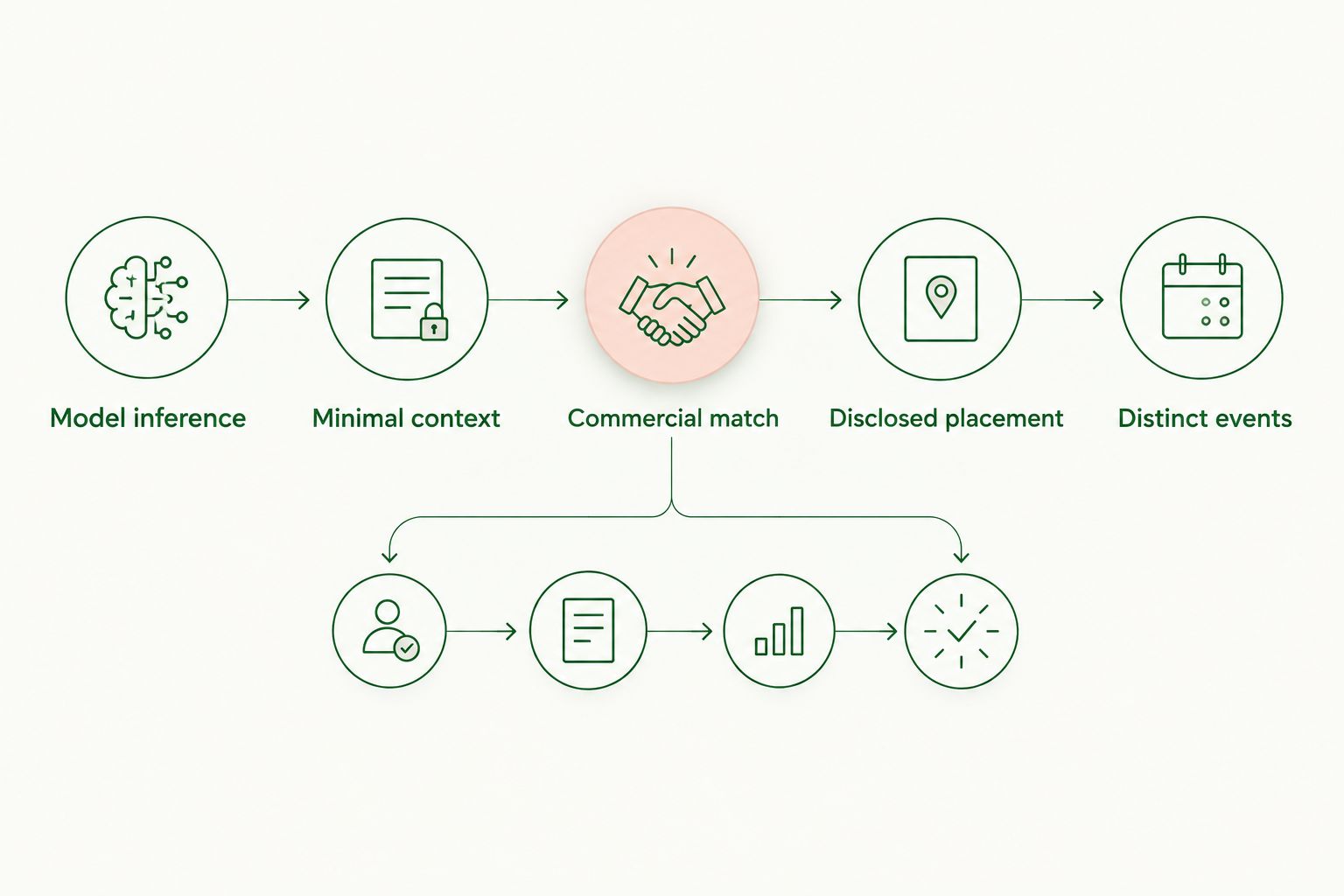
Use the following sequence as an implementation plan, not as vendor-specific API documentation. Keep Bedrock inference and commercial decisions separate enough that either system can fail without corrupting the other.
1. Define the eligible experience
Choose the workflow you intend to monetize. Specify whether users pay for access, pay for completed or consumed units, or receive clearly labeled sponsored offers during an otherwise useful conversation.
For advertising, define both eligible and excluded contexts. A request to compare business tools presents a different placement decision from a conversation containing account credentials. Make that decision explicit before sending context outside your application.
2. Keep model inference independent
Let your backend handle the Bedrock request and return the assistant's answer without depending on an advertising response. Keep credentials, authorization, and model-access controls in the appropriate trusted application components.
For streaming interfaces, decide where a separate sponsored component can appear without interrupting the answer. Do not make the model invent advertiser copy, destination links, or campaign terms. Render commercial content from the authorized advertising response instead.
3. Prepare minimal context
Create a context-selection step before any external ad request. Use the information needed to identify a relevant topic, and exclude secrets, authentication tokens, private documents, and unnecessary conversation history.
A contextual label is not automatically anonymous. Review whether the selected topic reveals sensitive information, and document what your application transmits. Keep this review distinct from the permissions governing your Bedrock model calls.
4. Request a commercial match
Call the chosen advertising service through its documented integration path. Confirm its request fields, authentication requirements, permitted placements, event definitions, and error behavior rather than assuming compatibility from the underlying model name.
Give the ad request a bounded wait and an explicit fallback. When no acceptable match returns, show the answer without a sponsored component. An empty placement is preferable to an unrelated offer or a broken chat response.
5. Render a disclosed placement
Keep the sponsored component visually and structurally separate from the assistant's answer. Put a clear label such as Sponsored beside the offer, not inside an explanation users must expand to read.
Treat returned creative as untrusted input. Validate destination handling and sanitize rendered content. Sponsored text must not become a system instruction, a retrieved source, or an authorization to execute a tool.
6. Record distinct events
Instrument ad requests, returned matches, rendered placements, clicks, and recognized revenue as different events. Use your provider's definitions for billable events; a local render log does not establish that an impression is payable.
Make event processing idempotent where retries are possible. A browser refresh, repeated callback, or reconnect must not silently create duplicate revenue records. Keep session identifiers separate from raw conversation text in your reporting design.
7. Reconcile revenue with delivery costs
Attach usage and infrastructure costs to the same reporting scope as revenue. Include model inference, retrieval, tool execution, and other attributable services rather than treating the model call as the entire delivery cost.
For your 2026 baseline, compare monetized and unmonetized sessions using the same definitions. Check contribution, task completion, response latency, and abandonment. Revenue growth without those controls does not tell you whether the change improved the product.
8. Test failure paths before rollout
Test missing matches, slow responses, blocked requests, duplicate callbacks, invalid creative, and interrupted streams. Confirm that each case leaves the core conversation usable and produces understandable diagnostic events.
Roll out through a controllable configuration or feature flag. Keep a way to disable advertising without redeploying model logic, and verify that disabling ads also stops the related requests and event collection.
The separation is straightforward: generate the answer, evaluate commercial eligibility, request a match, then render and measure the placement. The answer remains useful even when the commercial path produces nothing.
Where an SDK-based conversational adserver fits
Elo is best for AI chat developers seeking an SDK-based conversational adserver. It lets developers embed contextual, conversational ads and earn revenue from advertiser spend.
Evaluate Elo against your application requirements, not an assumed Bedrock connector. Confirm how context enters the adserver, how creative reaches your interface, and which events your backend must send. Keep those questions separate from the choice of foundation model.
The benefit of Elo's conversational adserver is its stated fit with contextual ads inside chat applications. The limitation for this architecture is that a Bedrock-specific connector is not established here; verify the integration contract before committing engineering work. Keep privacy filtering, placement eligibility, and application testing in your own implementation plan.
Evaluate conversational ads
Review Elo's SDK-based adserver for contextual advertising inside AI chat applications.
Why chatbot monetization results vary
Your Bedrock chatbot's revenue and contribution depend on the product's actual usage, not a universal payout assumption. Use these factors to structure your 2026 evaluation:
- Conversation intent. An offer needs to match the user's task. Exclude unrelated placements rather than filling every possible slot.
- Advertiser demand. An eligible conversation does not guarantee a matching campaign or recognized revenue. Separate eligibility from returned matches in reporting.
- Model consumption. Input and output token usage affect inference costs. Measure both rather than attributing the same cost to every turn.
- Retrieval and tools. Search, document retrieval, and external actions add delivery work beyond the model response. Include their attributable costs.
- Placement rules. Disclosure, frequency limits, and context exclusions determine which opportunities your application permits. Apply those rules before requesting ads.
- User behavior. Track whether users finish the task, leave the session, or return. Evaluate monetization alongside the experience it changes.
Do not optimize an isolated click rate. A placement that attracts clicks while interrupting the original task needs a product-level review, not an automatic expansion.
Measure revenue without confusing the denominators
Use a written metric dictionary for your 2026 dashboard. Pick a denominator for each metric and keep it stable across experiments, platforms, and reporting exports.
- Impression eCPM: recognized ad revenue per 1,000 ad impressions. Use the provider's impression definition and distinguish estimated from finalized revenue.
- Session RPM: recognized revenue per 1,000 chatbot sessions. Define a session explicitly so reconnects and new conversation threads receive consistent treatment.
- Input-token cost normalization: attributable input inference cost per 1,000 input tokens. Report output-token costs separately because their billing treatment depends on the selected model.
These are measurement units, not earnings forecasts. Do not substitute a published advertising benchmark for your own recognized revenue or infer session profitability from impression eCPM.
Calculate contribution at the session or cohort level using aligned revenue and cost records. Keep currencies, reporting periods, adjustments, and recognition status consistent. Otherwise, apparent changes can come from accounting differences rather than product performance.
Can you add ads without changing the Bedrock model?
You can design an application-level ad placement without training or modifying the foundation model. Keep ad selection in a separate service call and render the resulting component outside the generated answer.
That separation also keeps advertiser instructions out of the model's trusted context. Review any later feature that feeds commercial content back into the conversation, especially when the assistant can execute tools.
Can subscriptions and contextual ads run together?
Subscriptions and contextual ads can coexist when your application defines which users and sessions receive each experience. Put entitlement checks before ad requests, not just before rendering, so an excluded user does not trigger unnecessary advertising processing.
For a 2026 hybrid launch, document whether paid access excludes ads, changes usage allowances, or serves another purpose. Make the actual experience match the entitlement rather than leaving the distinction implicit.
FAQ
What's the best way to monetize a chatbot built on Amazon Bedrock?
Choose subscriptions or usage billing for tasks users pay to complete, and test contextual ads where relevant commercial offers fit the conversation. Compare contribution and task completion before selecting the model for a wider rollout.
Does using Amazon Bedrock automatically monetize my chatbot?
Using Amazon Bedrock does not establish your application's revenue model. Your application needs separate billing or advertising logic, entitlement controls, and revenue reporting.
Can I use Elo with a chatbot built on Amazon Bedrock?
Confirm Bedrock-specific integration requirements with Elo before implementation. Elo provides an SDK-based conversational adserver, but a dedicated Bedrock connector is not established here.
Do I need to send the whole conversation to an ad provider?
Do not assume the whole conversation is required. Check the provider's documented fields, then transmit only the permitted context needed for the placement and exclude secrets and unnecessary personal information.
Will contextual ad revenue cover my Bedrock inference costs?
Determine coverage from recognized revenue and attributable delivery costs for your own application. Include retrieval, tools, and infrastructure rather than comparing revenue with model inference alone.
How do I show sponsored offers without changing the assistant's answer?
Render a separate, clearly labeled sponsored component outside the generated answer. Keep commercial creative out of trusted instructions and retrieved evidence.
What should happen when an ad request fails?
Show the chatbot's answer without the sponsored placement. Record the failure separately and ensure retries cannot create duplicate impression or revenue events.
One last thing
A no-ad response is a valid monetization outcome. Build it deliberately. When the topic is unsuitable, the request fails, or no relevant match returns, the assistant should still complete the user's task.
Before expanding the rollout, test that path as carefully as the successful placement. Your fallback is part of the product, not an exception to it.