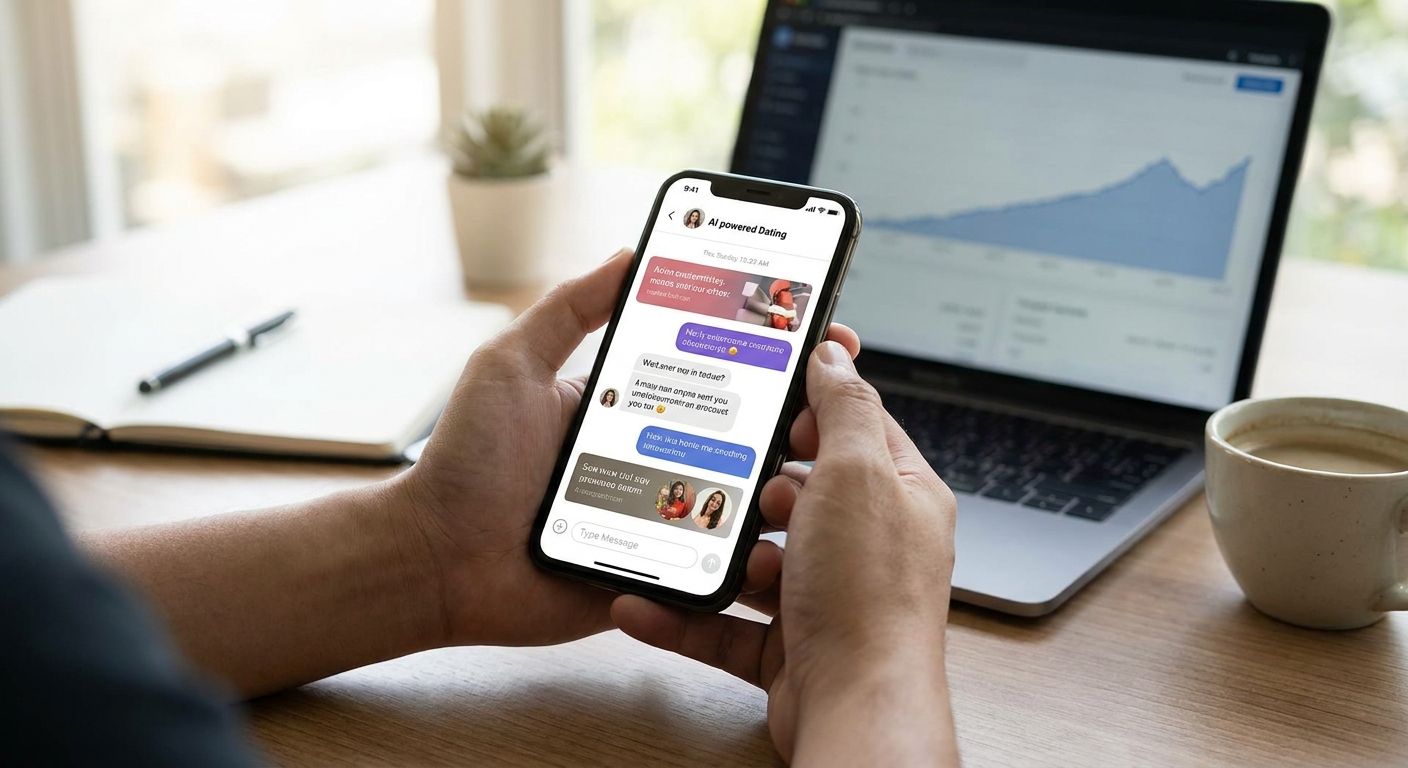
AI dating app assistants sit inside some of the most personal conversations in software — profile coaching, opening-line drafting, breakup venting, date planning. Ad monetization for AI dating app assistants means fitting revenue into that context without the ad feeling like a stranger walked into the room, and in 2026 the SDK you pick decides whether users tolerate the ad or churn on the spot.
- Elo's ad SDK for AI companion apps handles context-sensitive matching for dating chat — buy for launch-ready monetization.
- Generic banner-style mobile ad SDKs break dating chat UX — skip them for this use case.
- Brand safety controls matter more here than in most chat categories — advertisers avoid adjacency to explicit topics.
- GDPR compliance is non-negotiable for a dating app handling sensitive personal data in 2026.
- Roughly a dozen lines of SDK code get a dating assistant monetized without touching the chat UI.
Why this matters
Dating apps monetize two ways today: subscriptions and boosts. Both depend on a user converting, and most never do. An ad layer inside the AI dating app assistant itself monetizes the free-tier users who are chatting every day and never buying a plan.
That's the pitch behind conversational ad monetization: every chat is monetizable, even ones that don't convert. For a dating assistant, that means the profile-review conversation, the pre-date jitters conversation, and the post-ghosting venting conversation can all carry a contextual offer — a florist, a restaurant reservation tool, a therapy app — without a paywall in front of any of them.
The risk is specific to this category. Dating conversations touch intimacy, rejection, and sometimes explicit topics. An ad network that can't read context will drop the wrong ad into the wrong moment, and users notice immediately.
Who this is for
This guide is for developers and product teams building AI dating assistants — matchmaking copilots, profile optimizers, date-planning bots, conversation coaches — on OpenAI, Anthropic, or a custom LLM stack, who want ad revenue as a second monetization layer alongside subscriptions. If you're already running an ad SDK for AI companion apps, the same contextual-matching logic applies to dating assistants, since both categories deal with emotionally loaded, first-person conversation.
What to look for in ad monetization for AI dating app assistants
Context-aware matching, not keyword stuffing
A dating assistant conversation about "what to wear on a first date" needs a fashion or grooming offer, not a generic banner triggered by the word "date." Keyword matching misfires constantly in this category because "date," "match," and "connection" carry multiple meanings. The matcher needs to read intent, not just terms.
Native card format, not interstitials or banners
A banner or full-screen interstitial breaks the intimacy of a dating chat instantly. Native cards that read like a suggestion from the assistant itself — "here's a florist near your date spot" — keep the conversation flowing instead of stopping it cold.
Brand safety and content moderation
Advertisers are risk-averse around anything adjacent to explicit content, and dating conversations drift there more than most chat categories. An ad layer without moderation controls will get flagged by advertisers and pulled from the bidding pool, which shows up as falling fill rate.
Latency that doesn't stall the chat
Dating conversations are fast and emotional. A three-second delay while an ad call resolves reads as the assistant going quiet at the wrong moment. Ad rendering has to happen without the user noticing a pause.
Compliance built for sensitive personal data
Dating apps collect some of the most sensitive personal data that exists — sexual orientation, relationship status, location patterns. Any ad layer touching that data needs to be built for regulatory scrutiny from day one, not retrofitted after a complaint.
See the SDK before you commit
Twelve lines of code, one dashboard, revenue from day one.
Top picks
Elo's ad SDK for AI companion apps — the launch-ready pick. It's built for emotionally loaded, first-person chat, which is exactly the tone of a dating assistant conversation. Native cards, not banners; roughly a dozen lines of integration code; revenue tracked per conversation, not per session. Verdict: Buy.
Brand-safe conversational ads guide — the trust layer. Dating chat drifts into sensitive territory more than any other assistant category, and advertisers pull spend fast from placements that look risky. This is the control set that keeps the ad pool full instead of shrinking. Verdict: Buy.
Ad fatigue controls for AI chat interfaces — the retention guardrail. A dating assistant a user opens daily will burn out on repeated offers faster than a one-off support bot. Frequency capping matters more here than in almost any other category. Verdict: Consider.
GDPR-compliant conversational ads — the compliance floor. Given the sensitivity of dating app data, this isn't optional groundwork, it's the baseline before any ad call goes live in the EU. Verdict: Buy, non-negotiable.
Context matcher for conversation intent — the precision layer underneath everything above. It's what turns "what to wear on a first date" into a grooming offer instead of a random banner. Worth evaluating once the core SDK is live. Verdict: Consider.
What to avoid
- Banner-style mobile ad SDKs built for games. They're tuned for interstitial breaks between levels, not for a continuous chat thread — dropping one into a dating conversation stops the flow dead.
- Keyword-only ad triggers. Matching on the literal word "match" or "date" without reading intent produces embarrassing mismatches in a category built on emotional nuance.
- Ad networks with no explicit content moderation policy. Dating chat drifts into territory that makes advertisers nervous; a network that can't filter for it will see fill rate collapse as advertisers opt out.
“Every chat is monetizable, even ones that don't convert.”
Verdict comparison
| Solution | Context matching | Native format | Brand safety | Compliance | Verdict |
|---|---|---|---|---|---|
| Ad SDK for AI companion apps | Yes | Yes | Built-in | GDPR-ready | Buy |
| Brand-safe ads layer | Partial | Yes | Primary focus | GDPR-ready | Buy |
| Ad fatigue controls | Yes | Yes | Built-in | GDPR-ready | Consider |
| GDPR compliance module | N/A | N/A | N/A | Primary focus | Buy |
| Context matcher | Primary focus | Yes | Built-in | GDPR-ready | Consider |
FAQ
What's the best way to monetize an AI dating app assistant in 2026?
A contextual ad SDK that reads conversation intent and renders native cards beats banner-style networks for dating chat in 2026. It monetizes the free-tier users who chat daily but never buy a subscription.
Is ad monetization better than subscriptions for AI dating apps?
It's additive, not a replacement. Subscriptions convert a fraction of users; an ad layer earns revenue from every conversation, including the ones that never convert.
How much can an AI dating assistant earn from conversational ads?
Revenue depends on conversation volume, advertiser demand, and fill rate, and it's tracked per active conversation rather than per download. Dashboards showing revenue per user are the way to verify it, not projections.
Are conversational ads safe for dating app content?
Only with a brand-safety layer that filters explicit or sensitive content before an ad call fires. Without it, advertisers pull spend and fill rate drops.
Does adding ads slow down an AI dating chatbot?
It shouldn't. Ad rendering needs to resolve without a noticeable pause in the chat, since a three-second delay reads as the assistant going quiet at the wrong moment.
Is GDPR compliance required for AI dating app ads?
Yes, for any EU user data. Dating apps collect sensitive personal data — orientation, relationship status, location — which puts them under stricter scrutiny than most chat categories.
Can I run ads in a dating assistant built on Claude or a custom LLM?
Yes. Ad SDKs built for conversational AI integrate at the SDK layer regardless of which model powers the assistant, whether that's OpenAI, Anthropic, or a custom LLM.
How do I avoid ad fatigue in a dating chat app?
Cap ad frequency per user session and rotate offers so a daily user doesn't see the same florist or restaurant three days in a row. Frequency capping matters more for dating assistants than for one-off support bots.
One last thing
The users who never upgrade to a paid subscription are the ones an ad layer should target first, not last — they're already in the chat every day, they just haven't converted, and a well-matched offer earns from that engagement instead of leaving it on the table in 2026.