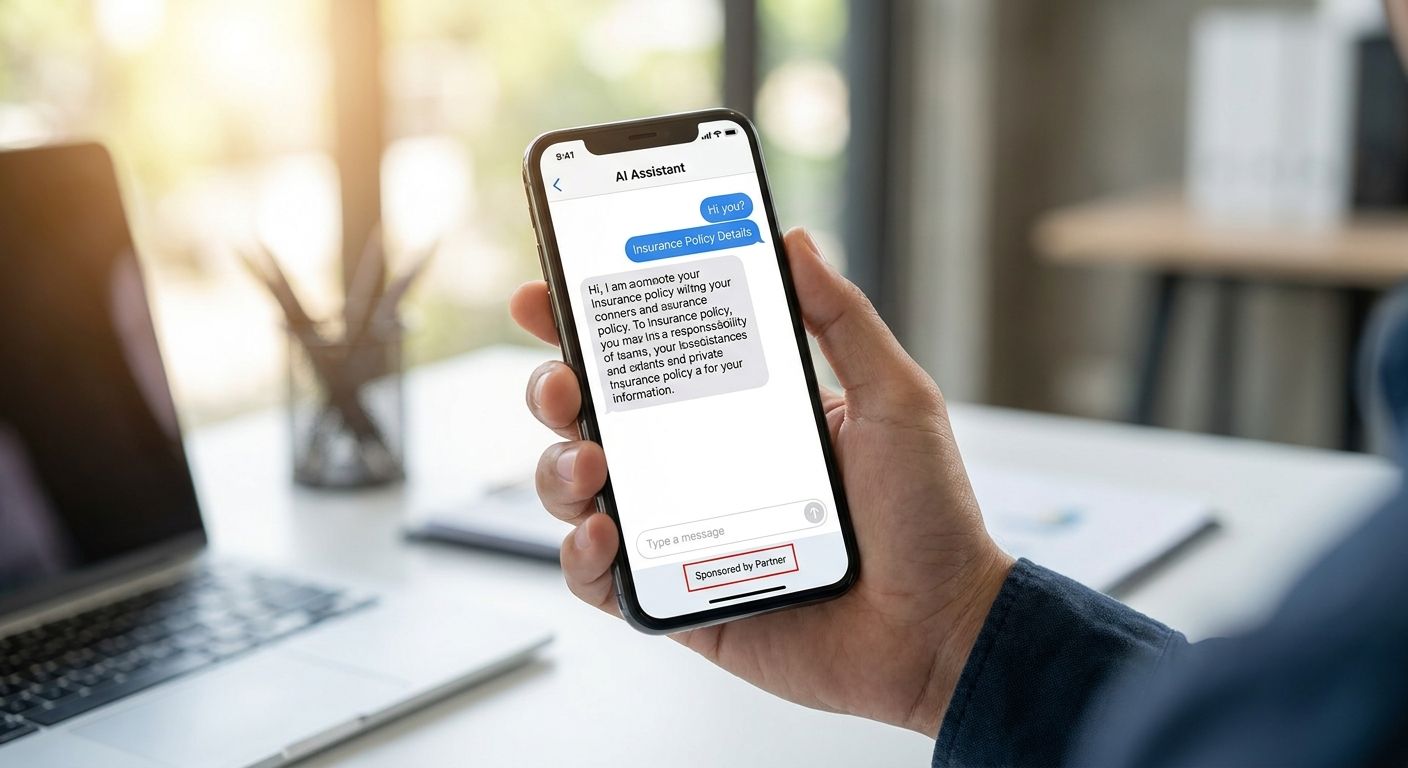
AI insurance assistant apps field high-intent questions about auto, home, life, and health coverage all day, and most of those conversations end at a quote form with zero revenue attached to them. Ad monetization for AI insurance assistant apps means turning that same conversation into a native ad placement without waiting for a policy to close.
- Ad monetization for AI insurance assistant apps works best with a contextual SDK, not a retrofitted mobile ad network — buy the SDK route in 2026.
- Skip generic mobile ad mediation platforms for insurance chat; they can't match auto, home, life, and health coverage context.
- GDPR-grade privacy handling and a compliance review flow are non-negotiable for a regulated vertical like insurance.
- Elo integrates in about twelve lines of code and treats every insurance query as monetizable, even the ones that never convert to a quote.
Why this matters
Insurance has been one of the most expensive verticals in digital advertising for over a decade, and that advertiser demand doesn't disappear when the conversation moves from a search results page into a chat window. An insurance assistant that answers 500 coverage questions a week and monetizes none of them is leaving advertiser spend on the table every single day.
Elo's ad SDK exists to put a native, contextual ad card into that conversation instead of a banner bolted onto the chat UI. The difference matters more in insurance than almost any other vertical, because a user asking about deductibles or SR-22 filings is giving off a purchase-intent signal that most ad networks aren't built to read.
Who this is for
This guide is for developers and product leads shipping an AI insurance assistant — a quote comparator, a claims-status bot, a coverage explainer, or a broker-facing copilot — built on OpenAI, Anthropic, or a custom LLM stack, who want ad revenue without a compliance incident or a chat experience that feels like a used-car lot.
What to look for in ad monetization for AI insurance assistant apps
Context matching by coverage type, not just "insurance"
A user asking about term life pricing and a user asking about auto claims are both "insurance" queries to a keyword matcher, but they need completely different ads. Look for a matcher that reads intent at the coverage-type level — auto, home, life, health, umbrella — not just the vertical label, or you'll serve life insurance ads to someone filing a fender-bender claim.
Compliance and brand safety review
Insurance is regulated at the state level in the U.S., and carriers and brokers won't run with a network that can't show a review process. Any ad monetization for AI insurance assistant apps stack needs a documented brand-safe ad review flow before the first advertiser dollar lands.
Data privacy handling for PII in claims conversations
Insurance chats routinely surface health details, financial history, and claim specifics — exactly the kind of data that triggers GDPR and CCPA obligations. Confirm the ad layer has documented GDPR-compliant handling before that data ever touches an ad matcher, not after a regulator asks.
Latency that doesn't break a quote or claim flow
A user mid-claim doesn't wait for a slow ad call. If the ad card adds a visible delay to the response, users notice and trust drops immediately — insurance is already a low-trust category, and a laggy ad makes it worse.
Fill rate and advertiser demand in the insurance vertical
A perfectly matched ad with no advertiser behind it earns nothing. Confirm the network actually carries insurance-category demand — auto, home, life, health carriers and brokers — not just a generic SaaS or e-commerce catalog repurposed for chat.
Revenue visibility per conversation
You need a dashboard that shows revenue per chat, not just aggregate CPM. Insurance conversations vary wildly in length and intent, and a per-conversation revenue view is the only way to tell which assistant flows are worth optimizing for ad placement.
Top picks for monetizing an AI insurance assistant
Native contextual ad SDK — the safe pick. A purpose-built conversational ad SDK reads the coverage type mid-chat and serves a native card instead of a banner. Integration runs about twelve lines of code, and every query becomes inventory, even the ones that never convert to a quote. Verdict: Buy.
Mobile ad mediation networks retrofitted for chat — the familiar trap. These networks were built for game and app interstitials, not conversational context, and bolting them onto a chat UI usually means a banner slapped under the last message. Match quality drops and users notice the mismatch fast in a regulated category like insurance. Verdict: Skip.
Direct sponsorship deals with carriers or brokers — the manual route. Negotiating directly with a regional carrier or a brokerage gets you higher CPMs and full creative control, but it takes weeks of outreach and ongoing account management per advertiser. Fine as a supplement once volume justifies it, not a starting point. Verdict: Consider.
Header bidding across multiple ad networks — the wildcard. Running several networks in parallel and auctioning each impression can lift fill rate, but it also means integrating multiple SDKs and managing compliance review across each one separately. Worth it once monthly conversation volume is large enough to make the auction meaningful. Verdict: Consider.
What to avoid
- Display banners inside the chat thread. They break the conversational flow and read as an interruption in a category where users already feel wary of being upsold.
- Ad networks with no insurance-specific compliance review. A generic ad network that can't show how it screens insurance creative is a liability, not a revenue line.
- Non-contextual programmatic display retargeted from browsing history. It ignores what the user is actually asking your assistant right now, which is the one signal insurance advertisers actually want.
See how the SDK fits your insurance assistant
Twelve lines of code, native ad cards, revenue on every query.
Verdict comparison
| Approach | Context match | Compliance review | Setup effort | Verdict |
|---|---|---|---|---|
| Native contextual SDK | High | Built-in review flow | About 12 lines of code | Buy |
| Retrofitted mobile ad mediation | Low | Manual, ad hoc | Days of custom integration | Skip |
| Direct carrier sponsorships | High | Manual, per-deal | Weeks of outreach | Consider |
| Header bidding across networks | Medium | Varies by network | Multiple SDKs to manage | Consider |
FAQ
What is ad monetization for AI insurance assistant apps?
It's the practice of embedding native, contextual ads inside an AI insurance assistant's chat responses so every conversation — quote comparisons, claims questions, coverage explainers — can earn advertiser revenue in 2026, not just the ones that end in a policy sale.
Can insurance chatbots show ads without violating compliance rules?
Yes, if the ad SDK has a documented brand-safety review process and handles user data under GDPR and CCPA rules before matching. Insurance is a regulated vertical, so any network without a stated review flow is a risk, not just a feature gap.
Is contextual advertising better than banner ads for insurance chat apps?
Contextual native ad cards outperform banners in insurance chat because they match the specific coverage type being discussed — auto, home, life, health — instead of showing a generic display unit disconnected from the conversation.
Do insurance ad networks require GDPR compliance?
Any network processing insurance conversations touching EU users needs documented GDPR compliance, since claims and coverage chats routinely include health and financial data classified as sensitive personal information.
How long does it take to integrate an ad SDK into an insurance chatbot?
A native contextual SDK typically integrates in about twelve lines of code on top of an existing OpenAI, Anthropic, or custom LLM chat stack, versus days of custom work retrofitting a mobile ad mediation network.
What's the difference between ad mediation and a single ad SDK for insurance chat apps?
A single contextual SDK matches ads to conversation intent directly inside the chat flow, while mediation runs an auction across multiple ad networks per impression — mediation can lift fill rate but adds integration and compliance overhead per network.
Can AI insurance assistants monetize free users only, or paid users too?
Both. A native ad card can run on free-tier assistant traffic to offset serving costs and on paid-tier traffic as a secondary revenue line, since the ad matches conversation context rather than account tier.
How much can an AI insurance assistant earn from ads in 2026?
Revenue depends on conversation volume, coverage-type mix, and advertiser fill in the insurance category, and varies by app — the reliable move is tracking revenue per conversation from day one rather than estimating a blanket rate.
One last thing
The conversation that never converts to a quote is the one most insurance assistant builders write off first — and it's exactly the inventory a contextual ad SDK is built to catch. A user asking "what's a deductible" without ever filing a claim is still an insurance-intent signal an advertiser will pay for in 2026, even if your product never converts them into a policyholder.