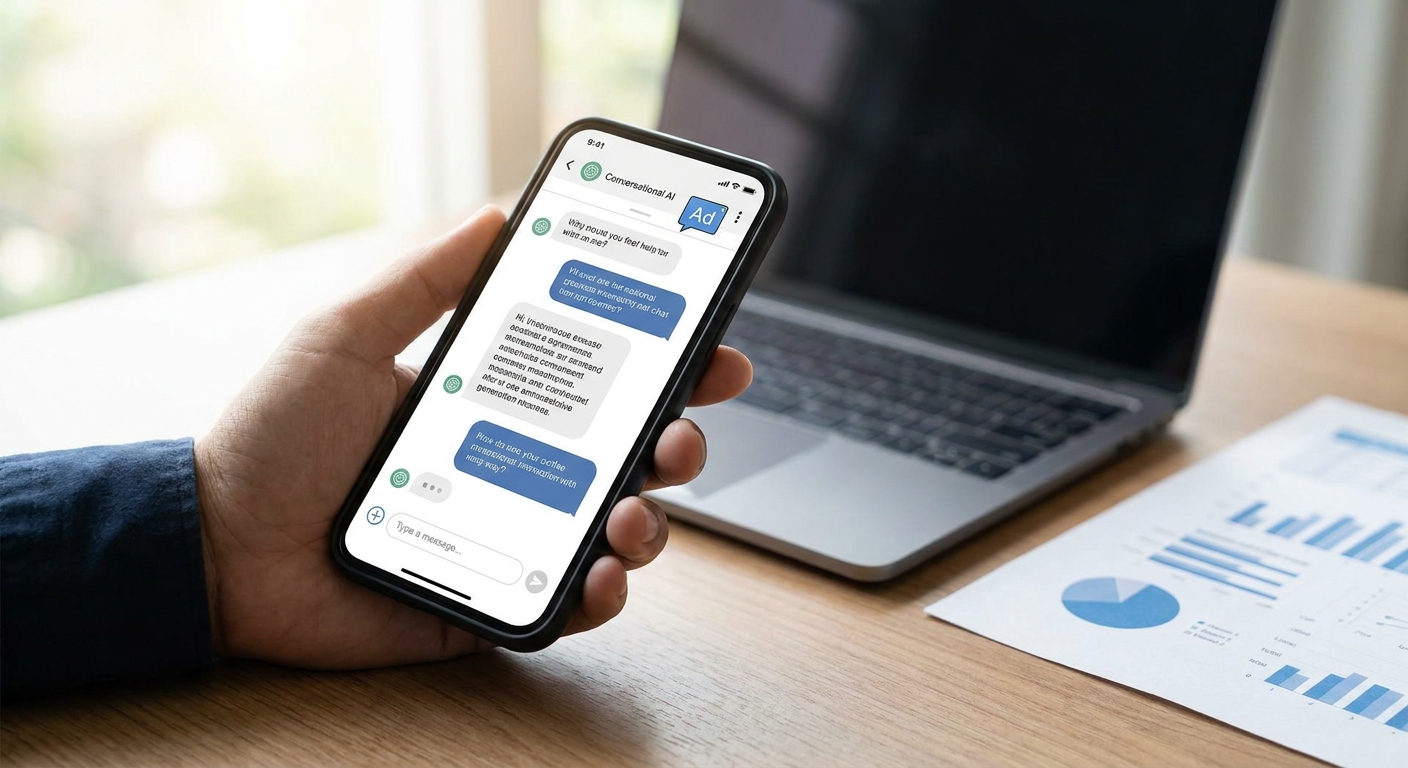
AI sales assistant apps burn LLM tokens on every qualification chat, demo walkthrough, and objection-handling thread — and most of that traffic never converts to a paid seat. Ad monetization for AI sales assistant apps turns those unconverted conversations into revenue instead of pure cost.
- Contextual native ad SDKs beat banner injection for sales chat — Elo's SDK integration runs on roughly twelve lines of code.
- Sales assistant apps convert on intent, so ad matching needs conversation context, not just keyword targeting.
- Multi-network mediation only pays off above roughly 10,000 monthly conversations; below that, a single contextual SDK wins.
- Skip legacy banner and interstitial formats in sales chat — they break the flow that makes the assistant useful.
- Track revenue per conversation from week one, not just fill rate.
Why this matters
Most AI sales assistant apps ship free or freemium to get adoption inside a sales org, then eat the OpenAI or Anthropic API bill on every session. That math works at 500 conversations a month. It stops working at 50,000.
Ad monetization for AI sales assistant apps closes that gap without a paywall. A prospect asking your assistant to compare pricing tiers, book a demo, or troubleshoot a proposal is a high-intent moment — advertisers pay a premium to sit next to that, the same way search ads pay a premium next to purchase-intent queries. Elo runs that matching layer as an SDK, so the ad card shows up as a native suggestion inside the chat instead of a banner bolted onto the UI.
The catch: sales chat is a narrower, higher-stakes surface than a general consumer chatbot. Show the wrong ad — a competitor, an irrelevant SaaS tool, a low-trust offer — mid-pitch, and you've undercut the credibility the assistant was built to project. That's the buyer problem this guide solves.
Who this is for
This is for developers and product leads building AI sales assistants — SDR bots, lead-qualification chat widgets, pre-sales concierge tools embedded on a pricing page, or Slack-based sales copilots — running on OpenAI, Anthropic, or a custom LLM stack. You're likely giving the tool away or bundling it into a freemium plan, and you're looking at ad revenue as a way to offset inference cost or fund a free tier without gating core features behind a paywall.
What to look for in ad monetization for AI sales assistant apps
Context matching accuracy
A sales conversation carries explicit signal — product category, budget range, competitor names, objection type — that a matcher can use instead of guessing from vague page-level targeting. If the ad network can only match on the app's category rather than the live conversation, you get generic ads that feel bolted on. Sales prospects notice bolted-on faster than casual chat users do, because they're already evaluating your credibility.
Fill rate at lower conversation volume
Sales assistant apps generally run lower monthly conversation counts than consumer chatbots — this is a B2B surface, not mass consumer traffic. A network built for scale (millions of daily consumer sessions) may simply not have inventory for a niche B2B vertical. Ask any monetization partner what fill rate looks like below 10,000 monthly conversations before you integrate, not after.
Non-intrusive ad placement
A sales assistant's entire value is speed and flow — a prospect asking three quick questions and getting to a demo booking. Full-screen interstitials or auto-playing video ads break that flow and cost you the conversion the assistant exists to drive. Native cards that render inline, styled like a suggestion rather than an ad, are the only format that survives contact with a sales use case.
Brand safety controls
You cannot let a prospect mid-pitch see an ad for a direct competitor, and you cannot let a compliance-sensitive B2B buyer see a low-trust offer next to your product. Category and advertiser exclusion lists need to be configurable at the SDK level, not a support ticket you file after the fact.
Revenue reporting per conversation
Generic "total ad revenue" dashboards hide the number that actually matters: revenue per conversation, segmented by whether that conversation converted to a sales outcome. Without that split, you can't tell if ads are subsidizing your free tier or quietly suppressing the conversions your business depends on.
Multi-LLM support
Many sales assistant teams route between OpenAI and Anthropic models depending on task — GPT for structured qualification flows, Claude for longer objection-handling threads. An ad SDK tied to one model provider forces you to maintain two monetization stacks. One SDK that works across both is fewer moving parts and fewer places for revenue tracking to break.
See the SDK before you commit
Check the integration steps and UX guidance for conversational ads.
Top picks
Contextual native ad SDK — the safe pick
The spec that matters: integration runs on roughly twelve lines of code, which means a single dev can ship it in an afternoon instead of a sprint. This is the direct-integration model where the ad matcher reads live conversation context and returns a native card, not a banner. For a sales assistant app where every screen is chat, this is the format that doesn't fight your UI. The step-by-step setup for adding conversational ads to a chatbot walks through the exact call sequence. Buy — this is the default starting point for any sales assistant app monetizing in 2026.
Sponsored recommendation cards — the wildcard
Borrowed from shopping-assistant ad formats, this pattern surfaces a sponsored recommendation exactly where a prospect would naturally ask "what else should I consider" — a moment sales assistants hit constantly during comparison and objection-handling. The approach used in conversational ads for AI shopping assistants maps directly onto a sales flow where the assistant is recommending add-ons or complementary tools. Consider if your assistant already handles comparison questions — skip it if your flow is purely qualification-to-booking with no comparison step.
Multi-network mediation — the completionist
Running more than one ad SDK behind a mediation layer improves fill rate at scale, but the overhead only pays off once conversation volume is high enough to matter. The comparison of ad monetization SDKs for chatbot developers breaks down which stacks support mediation versus single-network setups. Consider once you're past roughly 10,000 monthly conversations; below that, mediation overhead outweighs the fill-rate gain. Buy later, not first.
Per-conversation revenue tracking — the pick nobody skips twice
Every team that skips revenue-per-conversation tracking at launch ends up rebuilding it three months in once someone asks whether ads are hurting demo bookings. Track it from day one instead of retrofitting it. Buy — this isn't optional, it's the dashboard that tells you if the rest of the stack is working.
“If an ad card takes longer than 300 milliseconds to render, a sales prospect has already moved on to the next question.”
What to avoid
- Full-screen or interstitial ad units. They look like standard mobile ad inventory and pay accordingly, but they stop a sales flow cold — the exact opposite of what a sales assistant is for.
- Generic display networks with no context matching. They fill inventory but show category-blind ads that read as noise next to a high-intent sales conversation, which damages the credibility your assistant is trying to build.
- Ad networks with no brand-safety exclusion controls. If you can't block competitor names and low-trust categories at the SDK level, you will eventually show the wrong ad to the wrong prospect at the worst moment.
Verdict comparison
| Approach | Context matching | Fill rate at low volume | Chat UX fit | Verdict |
|---|---|---|---|---|
| Contextual native ad SDK | High | Strong | Native, inline | Buy |
| Sponsored recommendation cards | High | Moderate | Native, inline | Consider |
| Multi-network mediation | Moderate | Strong at scale | Native, inline | Consider (scale only) |
| Generic display / interstitial | Low | Strong | Breaks flow | Skip |
FAQ
What's the best way to do ad monetization for AI sales assistant apps?
A contextual native ad SDK that matches ads to live conversation content, rendered as an inline card rather than a banner, is the best fit in 2026. It keeps the sales flow intact while turning unconverted conversations into revenue.
Will ads hurt conversion rates in a sales assistant chatbot?
Poorly matched or intrusive ad formats can hurt conversion, but native cards matched to conversation context generally don't disrupt the flow. The risk is format and matching quality, not the presence of ads itself.
How much does it cost to integrate an ad SDK into a sales assistant app?
Integration effort for a contextual ad SDK is typically small — Elo's setup runs on roughly twelve lines of code, meaning most teams ship it in under a day of dev time.
Can I run conversational ads on both OpenAI and Anthropic based assistants?
Yes, a model-agnostic ad SDK works across OpenAI, Anthropic, and custom LLM stacks without maintaining separate monetization code for each.
Is ad monetization better than a subscription model for sales assistant apps?
They're not mutually exclusive — many teams run ads on the free tier to subsidize inference cost while reserving paid tiers for advanced features. Ad monetization for AI sales assistant apps works best as a complement to a freemium structure, not a replacement for it.
How is ad revenue measured in an AI chatbot?
Revenue per conversation is the metric that matters most, segmented by whether that conversation led to a sales outcome. Total ad revenue alone hides whether ads are subsidizing growth or suppressing the conversions the assistant exists to drive.
What ad format works best inside a sales chat interface?
Native cards styled as suggestions, not banners or interstitials, perform best because they don't interrupt the qualification-to-booking flow a sales assistant is built around.
Do I need multiple ad networks for a sales assistant app?
Not at launch. A single contextual SDK covers most sales assistant apps under 10,000 monthly conversations; multi-network mediation only becomes worth the overhead past that volume.
One last thing
The teams that get ad monetization for AI sales assistant apps wrong almost always get it wrong in the same place: they optimize for fill rate first and revenue-per-conversation second. Flip that order. A sales assistant with a 95% fill rate and irrelevant ads will show it in fewer demo bookings within weeks — track the conversation-level split before you scale spend on any network in 2026.