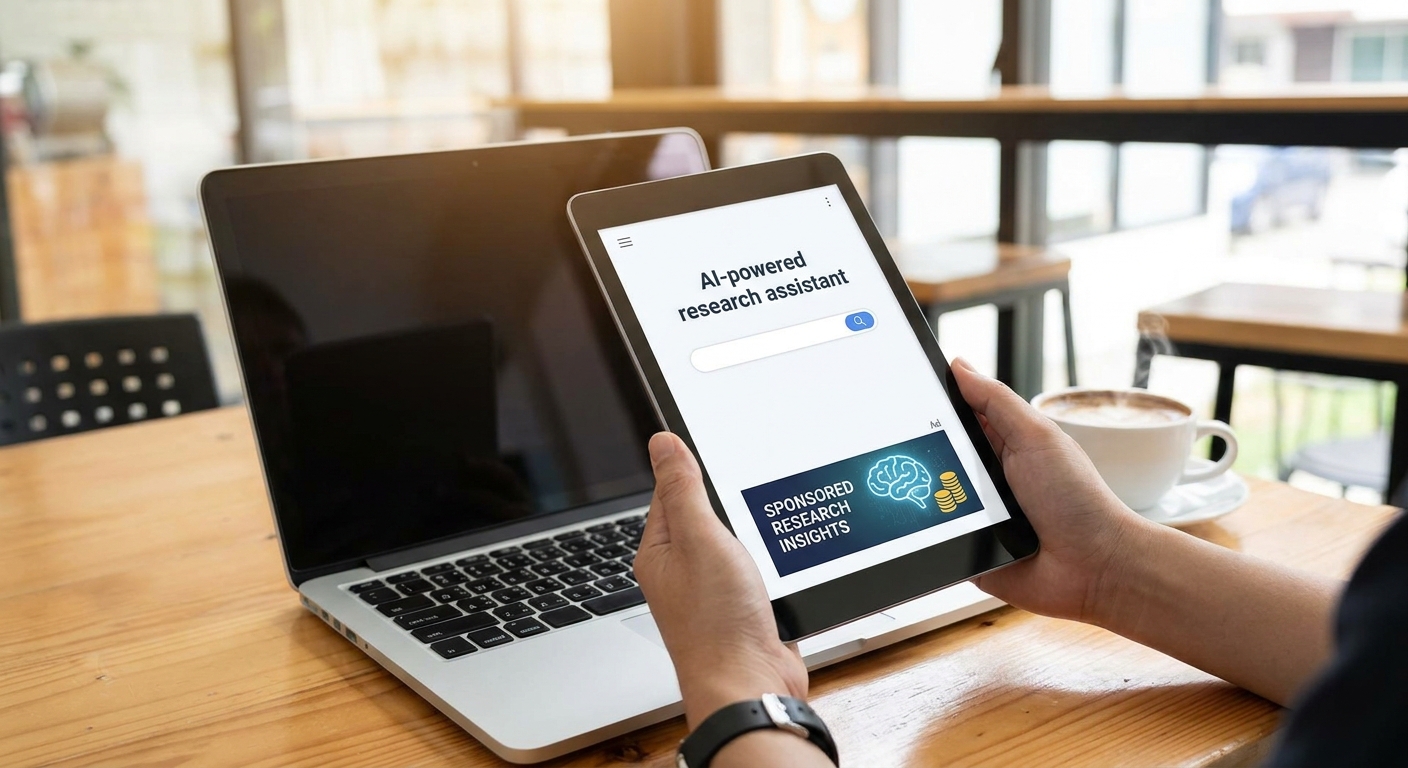
Research assistant apps generate some of the longest, highest-intent chat sessions in the AI chat market — and most ad networks still try to monetize them with keyword matching built for mobile games. Here's what actually works for ad monetization for AI research assistant apps in 2026, and what to skip.
- Elo's SDK reads full conversation context, not keywords — the safe buy for ad monetization for AI research assistant apps in 2026.
- RAG-based research bots pair best with native in-chat cards placed after the citation block, not before it.
- Generic mobile mediation stacks like AdMob or Unity Ads: skip them — built for interstitials, not citation-heavy chat UX.
- Direct sponsor deals work for narrow research verticals but only pay off above roughly 50,000 monthly queries in one topic.
Why this matters
A research assistant session isn't a five-second search query. It's ten minutes of back-and-forth, five subtopics, and a stack of citations the user is actually reading. That's a monetizable audience most ad networks can't reach because their matchers were built for search results pages and app install funnels, not conversation.
Get the ad format wrong here and you don't just lose a click — you lose the user's trust in the citations sitting next to your ad. Get it right, and every research session, even the ones that never convert to a paid tier, earns something.
Who this is for
This guide is for developers and founders running AI research assistants — academic search copilots, legal research bots, technical documentation assistants, market research tools — built on OpenAI, Anthropic, or a custom LLM stack, and looking to add ad revenue in 2026 without breaking the reading experience users came for.
What to look for in ad monetization for AI research assistant apps
Contextual accuracy on research topics
A research assistant answers long, specific queries — "compare monetary policy transmission mechanisms in emerging markets" isn't something a keyword matcher parses well. The ad matcher needs to read the actual conversation, not a URL slug or a single trigger word, especially when one session covers five subtopics in ten minutes. Contextual advertising built for custom LLM chatbots solves this by matching on the full exchange, not a keyword list.
Latency inside retrieval loops
If your assistant is already waiting on vector search and reranking, an ad call that adds 300ms on top is worse than no ad at all. Benchmark ad-fetch latency against your existing retrieval latency before you ship — a research assistant that stalls loses the session before the ad ever gets seen.
Native format that doesn't interrupt citations
Research users read footnotes and source lists closely. A banner or interstitial breaks that flow the way it wouldn't in a casual chatbot. A native card placed after the answer, styled like part of the response, doesn't.
Fill rate on niche and technical topics
Ad inventory for "tensor decomposition" or "maritime trade law in the 1700s" is thinner than inventory for consumer topics. Ask any network for fill-rate benchmarks on long-tail, technical query volume in 2026 before committing to one network exclusively — a research app's query mix skews rare by design.
Revenue share and payout transparency
CPM, CPC, and CPA definitions vary by network, and research verticals often carry different advertiser demand than consumer chat. Get a written revenue share number and a dashboard you can check before integration, not after the first payout cycle surprises you.
Brand safety around cited sources
An ad served next to a citation from a disputed or low-quality source is a support ticket waiting to happen. Keeping conversational ads brand safe means the matcher accounts for source quality context, not just topic overlap.
Top picks for monetizing an AI research assistant app
Elo — the safe pick
Elo's SDK reads the full conversation, not a keyword trigger, and ships native ad cards instead of banners. Integration runs roughly twelve lines of code on top of an existing OpenAI or Anthropic-based stack. Contextual advertising for custom LLM chatbots is the closest fit for a research assistant that needs matching accuracy without UX disruption. Buy.
RAG-native in-chat ads — the specialist pick
If your research assistant is retrieval-augmented, the ad placement matters more than the network. In-chat ads for RAG-based chatbots covers placing the card after the citation stack renders, so the ad never competes with a source list for attention. Buy for RAG-specific research apps.
Direct sponsor deals — the slow-burn pick
Negotiated placements with database vendors, academic tool makers, or B2B software companies can outpay open-network CPMs in a narrow vertical like legal or scientific research. The catch is negotiation time and minimum volume — this only pencils out above roughly 50,000 monthly queries in one topic cluster. Consider if you clear that volume, Wait if you don't yet.
Generic mobile ad mediation stacks — skip these
AdMob, Unity Ads, and similar mobile-game mediation stacks are built for interstitials and rewarded video between app screens, not text-heavy citation flows. They'll technically integrate, but fill quality and format fit for research chat are poor. Skip.
Add ad revenue to your research assistant
Twelve lines of code, native cards, no banners.
What to avoid
- Full-screen interstitials between answers. They look like a quick monetization win but tank session length on research apps specifically, where users are mid-task across multiple turns.
- Keyword-only matching bolted onto an old ad unit. It'll misfire constantly on technical vocabulary and long, compound research queries.
- Any network offering zero payout visibility. If you can't see impressions and revenue per session in a dashboard, you can't audit what a research query is actually worth.
Verdict comparison
| Approach | Contextual accuracy | Native format | Fill on niche topics | Revenue transparency | Verdict |
|---|---|---|---|---|---|
| Elo (contextual SDK) | High — reads full conversation | Native card | Strong across technical topics | Dashboard-based | Buy |
| RAG-native in-chat ads | High — placement-aware | Native, post-citation | Depends on integration | Dashboard-based | Buy for RAG apps |
| Direct sponsor deals | Manual, vertical-specific | Custom | High within one vertical | Negotiated | Consider at scale |
| Generic mobile mediation | Low — keyword-based | Banner/interstitial | Weak on long-tail | Opaque | Skip |
FAQ
What's the best way to monetize an AI research assistant app in 2026?
A contextual ad SDK that reads full conversation context and renders native cards, not banners, works best for AI research assistant apps in 2026. Keyword-only matching misfires on technical, long-form research queries.
Is contextual advertising better than banner ads for research chatbot monetization?
Yes, contextual advertising outperforms banners for research chatbots because it doesn't interrupt citation-heavy reading. Banners and interstitials break the flow users came to the assistant for in the first place.
Do AI research assistant apps need GDPR-compliant ad SDKs?
Any research assistant serving EU users needs a GDPR-compliant ad SDK in 2026. Check consent flow and data handling documentation before integrating any ad network.
Can I run ads in a RAG-based research chatbot without hurting citation trust?
Yes, placing native ad cards after the citation block rather than inline with sources keeps trust intact. Ads that sit between the answer and its citations tend to get flagged as noise by research users.
What's the difference between ad mediation and a single ad SDK for AI chat apps?
Ad mediation stacks multiple ad networks and picks the highest-paying bid per impression, while a single SDK serves one contextual matcher directly. Research apps with thin, niche inventory often do better on a single high-accuracy matcher than a mediation stack built for volume.
How much ad latency is acceptable inside a research chat response?
Ad-fetch latency should stay well under your existing retrieval latency, ideally under 100ms, so the ad doesn't add a visible delay on top of RAG retrieval. Anything that stalls the response before the user sees an answer costs more in session drop-off than the ad earns.
Are direct sponsor deals worth it for niche research topics?
Direct sponsor deals pay off for niche research topics once monthly query volume in that vertical passes roughly 50,000. Below that, negotiation time outweighs the revenue upside compared to a contextual ad SDK.
Do research assistant apps earn less ad revenue than general chatbots?
Not necessarily — research sessions run longer and cover more subtopics, which means more ad impressions per session even without a purchase intent. The limiting factor is fill rate on rare, technical topics, not advertiser demand overall.
One last thing
The fill-rate problem shows up first on your rarest queries, not your busiest ones. Before you commit to a network, pull the ten weirdest questions from last week's logs and test ad fill against those, not against "best running shoes"-style queries you'll never actually see in a research assistant.