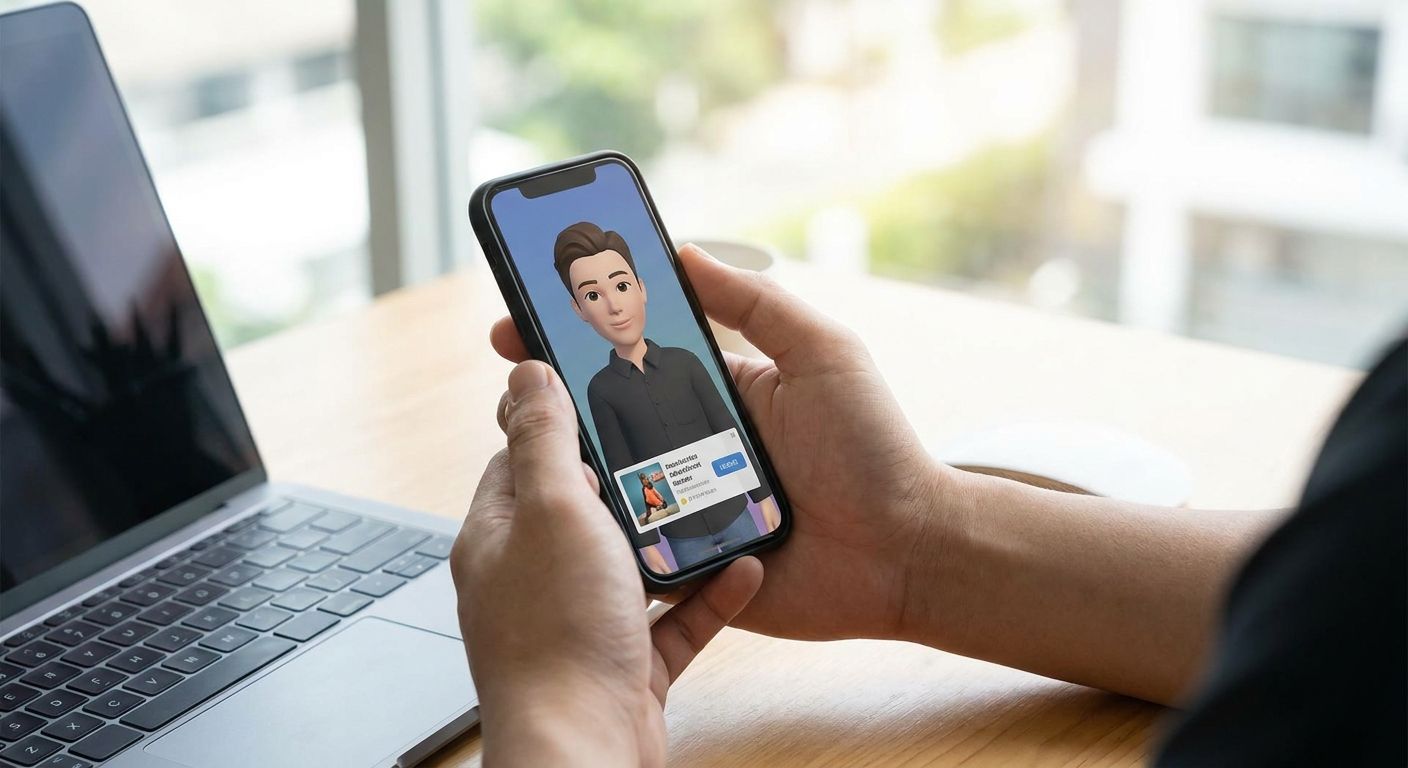
Avatar apps live or die on immersion, and ad monetization for AI virtual avatar apps only works if the ad never breaks the illusion the user is paying attention to. Get the format wrong and users churn inside a single session. Get it right and every conversation — even the ones that never convert to a subscription — becomes a line item on your revenue graph.
- Ad monetization for AI virtual avatar apps works best with native contextual cards rendered inline with the persona, not banners bolted on top.
- Companion and avatar apps run longer sessions than most AI chat categories in 2026, which raises the ceiling on ad inventory per user.
- Elo's ad SDK for AI companion apps integrates in twelve lines of code across OpenAI, Anthropic, and custom LLM stacks. Buy.
- Skip full-screen interstitials between avatar turns — they break the persona and spike session drop-off.
- Mobile ad networks like Liftoff weren't built for turn-based chat; check the alternatives comparison before committing budget.
Why this matters
Avatar apps monetize differently than utility chatbots. A coding assistant gets a question and an answer. An avatar app gets a relationship — sessions run longer, users return daily, and the emotional stakes of interrupting that flow are higher.
That's exactly why banner ads and interstitials fail here. They're built for apps where users tolerate friction because they're passing through. Avatar users aren't passing through — they're staying, which means the ad has to look like it belongs in the conversation, not on top of it.
Most avatar app developers in 2026 are running subscription or freemium models that cap out fast. Ad monetization for AI virtual avatar apps adds a second revenue line that doesn't require the user to pull out a credit card — it just requires the conversation to keep going.
Who this is for
This is for developers and founders running character-based, companion, coaching, or entertainment avatar apps built on OpenAI, Anthropic, or a custom LLM stack, who want ad revenue from free-tier users without turning the persona into a billboard. If your avatar app already has daily active users and a free tier that isn't converting to paid, this is the gap you're closing.
What to look for in ad monetization for AI virtual avatar apps
Native rendering, not banner injection
The ad has to render as a card inside the conversation thread, styled like the rest of the chat UI, not stacked above or below it. A banner breaks the fourth wall of an avatar persona instantly — the user was just talking to a character, and now there's a rectangle from an ad network in the middle of the screen.
Contextual matching tied to persona and topic
A fitness-coach avatar recommending a running shoe brand mid-conversation reads as a natural suggestion. The same ad shown to a user mid-breakup-support conversation reads as tone-deaf. Matching logic needs to understand what the persona is discussing, not just keyword-match the last message.
Turn-taking preservation and latency
If the ad call adds noticeable lag before the avatar's next line, the user notices the pause and the illusion cracks. Ad selection and rendering need to happen inside the same response cycle as the model's reply, not as a separate round-trip that stalls the conversation.
Model-agnostic integration
Avatar apps get built on OpenAI, on Anthropic's Claude, or on a custom LLM — sometimes all three across different product lines. An ad SDK tied to one model provider forces a rebuild the moment you switch or add a stack. Elo's ad SDK for AI companion apps is built to sit across all three without separate integrations per model.
Revenue and event-level reporting
You need to see impressions, clicks, and revenue per user and per persona, not just a monthly total. Without event-level data you can't tell which characters or topics drive the highest RPM, and you're optimizing blind.
Brand safety controls for companion content
Companion and avatar apps sit closer to sensitive territory than a productivity bot — mental health topics, relationship talk, late-night sessions. Advertiser categories need filtering rules specific to that content, not the generic brand-safety list built for news apps.
Top picks for ad monetization for AI virtual avatar apps
The default pick — Elo's ad SDK for AI companion apps. Native card rendering, contextual matching, and model-agnostic integration across OpenAI, Anthropic, and custom LLM builds. Twelve lines of code to get a first ad rendering in a companion app. Buy if your avatar app already has active daily users and you want revenue live this quarter.
The fastest path to revenue — the companion app launch playbook. How to launch a monetized AI companion app walks through sequencing the ad SDK against your onboarding flow so new users see zero ads in session one and contextual cards by session three. Buy if you're pre-launch or re-launching a free tier.
The migration play — moving off mobile ad networks. If your avatar app started as a mobile game and inherited a mobile SDK, the Liftoff alternatives for AI companion apps comparison covers why mobile-first networks underperform on turn-based chat fill rates. Consider if you're already running a mobile ad SDK and seeing weak RPM on chat screens specifically.
The scale play — mediation across networks. Running more than one ad source behind a single request adds fill rate at the cost of integration complexity. Worth evaluating once a single-source SDK is live and you're chasing incremental RPM rather than getting started. Hold until your primary SDK has at least one full month of event data to benchmark against.
Add ads to your avatar app
See the Elo SDK render its first contextual card in an avatar conversation.
What to avoid
- Full-screen interstitials between avatar turns. They stop the conversation cold and read as a system interruption, not a character choice — the exact opposite of what an avatar app is selling.
- Generic banner networks repurposed from mobile games. Built for tap-through, not for a conversational thread; they render outside the chat UI and remind the user they're inside an app, not a relationship.
- Ad networks with no persona-level targeting. If the matcher only reads the last user message and ignores which character or topic is active, expect mismatched ads that undercut trust in the persona itself.
Verdict comparison
| Approach | Native rendering | Model-agnostic | Latency-safe | Verdict |
|---|---|---|---|---|
| Elo ad SDK for companion apps | Yes | OpenAI, Anthropic, custom LLM | Yes | Buy |
| Companion app launch playbook | Yes (by design) | Follows SDK | Yes | Buy |
| Liftoff-style mobile ad network | No | Mobile SDK only | No | Skip for chat surfaces |
| Multi-network mediation | Depends on setup | Depends on setup | Depends on setup | Hold until single-source data exists |
FAQ
What is ad monetization for AI virtual avatar apps?
It's the practice of embedding contextual ads inside an avatar or companion app's conversation flow so free-tier users generate advertiser revenue instead of a subscription fee. In 2026 this usually means native ad cards matched to the persona and topic, rendered inline with the chat.
Is native advertising better than banner ads for avatar apps?
Yes, native cards outperform banners in avatar apps because they render inside the conversation thread instead of on top of it. Banners break the persona's immersion, which is the core value proposition of a companion or avatar app.
Does ad monetization hurt avatar app engagement?
Poorly placed ads do — interstitials and mismatched banners cause session drop-off. Contextual cards matched to the persona and paced correctly typically don't, because users read them as part of the conversation rather than an interruption.
Can I run ads inside a companion app built on Claude or a custom LLM?
Yes, an ad SDK built to be model-agnostic works across OpenAI, Anthropic's Claude, and custom LLM stacks without separate integrations. Check the SDK's provider support before building, since some ad networks are OpenAI-only.
How fast can I integrate an ad SDK into an avatar app?
A well-scoped ad SDK for chat apps can render its first ad in as little as twelve lines of code, though full contextual matching setup takes longer. Plan for a short pilot period to tune matching before opening it to all free-tier users.
What's the difference between ad mediation and a single ad SDK?
A single ad SDK connects your app to one ad source; mediation runs multiple sources behind one request to lift fill rate. Start with a single SDK, add mediation once you have a month of event data to know where fill is actually falling short.
Are conversational ads GDPR compliant?
Compliance depends on how the SDK handles consent and data processing, not on the ad format itself. Confirm the SDK's consent flow and data handling before launch, especially for EU-facing avatar apps.
How much can an avatar app earn per user with contextual ads?
Revenue per user depends on session length, advertiser demand in your app's category, and fill rate, so there's no single number that applies across all avatar apps. Track RPM at the persona level once live to see which characters and topics actually drive revenue.
One last thing
“Every chat is monetizable, even ones that don't convert.”
The free-tier user who never subscribes to your avatar app isn't dead revenue — they're an ad impression you haven't priced yet. The developers getting the most out of ad monetization for AI virtual avatar apps in 2026 aren't the ones with the biggest user base; they're the ones matching ads at the persona level instead of running one generic ad rule across every character in the app.