
Digital publishers’ ad monetization is the sale of advertising within publisher-owned content and experiences to fund publishing; in 2026, the right approach matches each placement to reader intent. This guide covers display inventory, direct sponsorships, and conversational ads, with separate rules for article pages and publisher-operated chat applications.
- Ad monetization for digital publishers works best when display ads, sponsorships, and conversational ads match the publishing surface.
- Elo fits publishers operating AI chat applications, not publishers seeking only article-page display monetization.
- Measure publisher revenue per session alongside engagement; advertiser CPM alone does not describe your business.
- Keep sponsored messages visibly separate from editorial answers and suppress ads in unsuitable conversations.
Why ad monetization matters for digital publishers
A publisher sells access to an audience without selling editorial control. That distinction becomes harder to maintain when advertising appears inside recommendations, search results, or generated answers rather than beside an article.
Your constraints differ by surface. Article pages have defined placements. A conversational interface changes with every exchange, and a reader discussing a news story is not necessarily looking for a commercial recommendation. Treat conversation context as an eligibility signal, not permission to show an ad.
For your 2026 plan, separate article inventory from chat inventory before selecting technology. Establish placement rules, measurement definitions, and sponsored-ad disclosure practices before inviting advertiser demand. A clear label does not rescue an irrelevant placement, but relevance does not remove the need for a label.
How to build your publisher monetization plan
1. Map your publishing surfaces and reader intent
Start with a spreadsheet. List where readers encounter your work, what they are trying to accomplish, and which advertising formats each interface can actually render. Do not start by choosing a network.
Separate editorial reading from commercial discovery. Someone researching a product category has a different task from someone following breaking news. A publisher-operated assistant adds another distinction: the current question can differ from the article that originally brought the reader in.
Build your 2026 inventory map around opportunities you control. Include your website, app, and conversational interface where applicable, but do not assume that distribution on someone else’s platform gives you control over its ad placements. Record technical ownership alongside editorial ownership so the team knows who can change each surface.
- List article pages, newsletters, apps, and chat interfaces separately.
- Describe the reader’s task for each surface.
- Identify who controls rendering and event collection.
- Mark sensitive subjects and unsuitable sponsorship categories.
- Separate existing inventory from proposed placements.
2. Define revenue and engagement before adding demand
Use your existing analytics and a spreadsheet to establish the baseline. Choose a revenue denominator that matches the experience, then document it. A pageview, a chat message, and a completed conversation are not interchangeable units.
CPM means advertiser cost per 1,000 impressions. Publisher page RPM measures publisher revenue per 1,000 pageviews. Session RPM measures publisher revenue per 1,000 sessions. These definitions describe different things; keep advertiser spending separate from the revenue your publishing business receives.
For chat, define session boundaries explicitly. Otherwise, a change in session tracking can look like a monetization improvement even when total revenue is unchanged. Use revenue per session to connect advertising results to the reader experience. Pair that measure with return visits, answer completion, or another engagement event your product already records.
- Write down the denominator for every RPM metric.
- Distinguish ad requests, rendered ads, and counted impressions.
- Record revenue using the same reporting period as traffic.
- Separate article, app, and chat results.
- Document session boundaries and revenue adjustments.
3. Choose the serving path for each surface
The manual route is a small, directly managed sponsorship: maintain approved creative, choose eligible placements, and reconcile delivery yourself. This establishes the operating requirements before you automate them. It also makes the missing pieces obvious: selection logic, rendering, event handling, and reporting.
For a publisher-owned chat application, an SDK-based adserver is an alternative to building that infrastructure. Elo is best for digital publishers monetizing AI chat applications with contextual conversational ads. Elo provides an SDK-based adserver for applications built on OpenAI, Anthropic, or custom LLMs.
That scope matters. Elo’s conversational ad monetization addresses the chat surface; it is not a reason to replace your article-page advertising setup. Evaluate the integration against your own interface, data boundaries, and reporting requirements rather than assuming that one serving path fits every publishing surface.
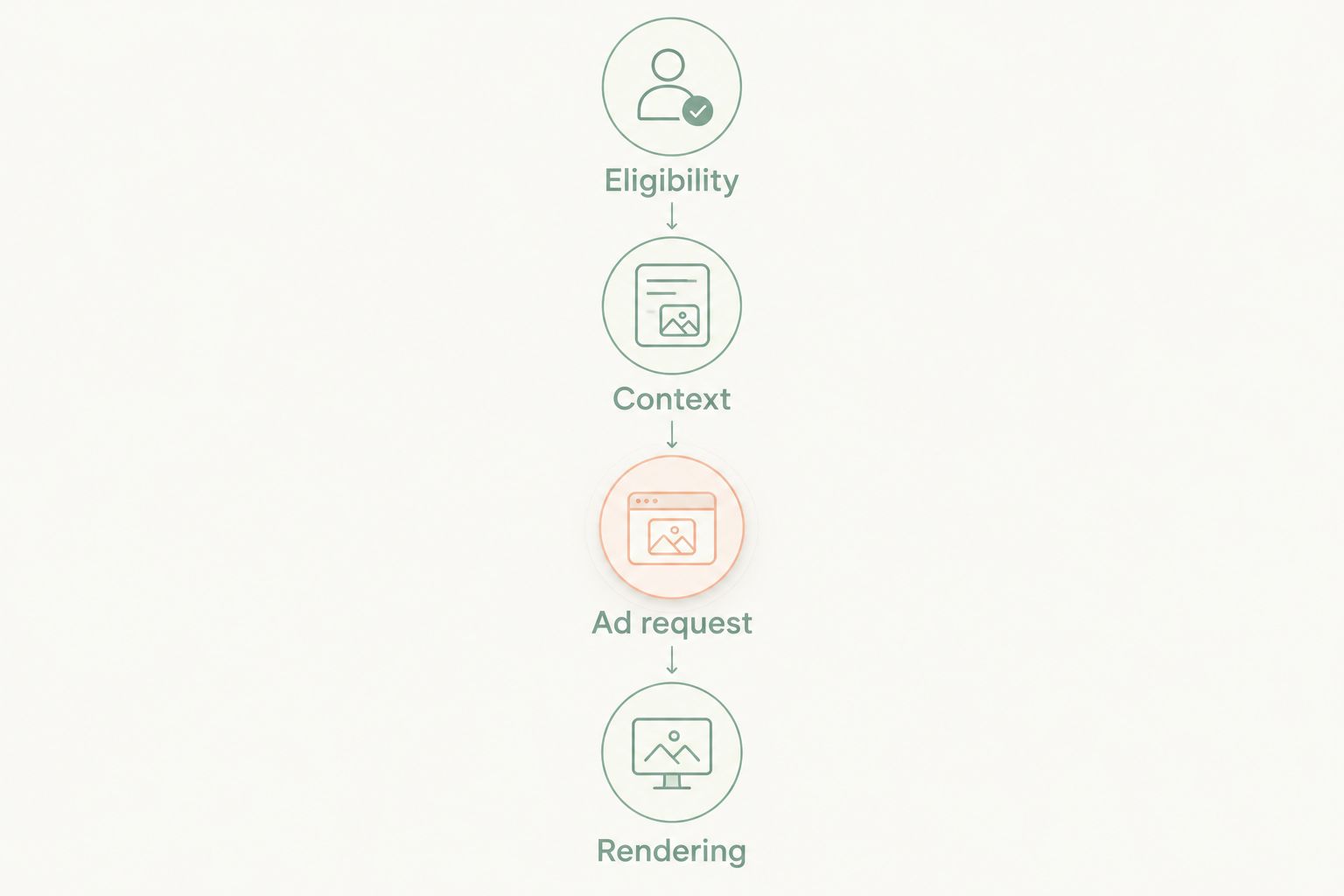
- Eligibility: decide whether the current experience permits advertising.
- Context: prepare only the information needed for matching.
- Ad request: keep commercial selection separate from editorial generation.
- Rendering: display a labeled placement without blocking the answer.
4. Match ads without exporting the whole conversation
Begin with an editorial taxonomy you can inspect manually. Tag content by subject, then distinguish general interest from a request for a product or service. A topic match alone does not establish commercial intent.
For example, an assistant explaining travel restrictions is doing a different job from an assistant helping someone compare luggage. Both conversations concern travel. Only one explicitly requests product guidance. Your matching rules should preserve that distinction instead of treating every topic mention as inventory.
Before connecting an external matcher, document which fields leave your application, why they are needed, and how they are handled. Contextual targeting still requires data decisions. Do not treat the word contextual as a substitute for a privacy review. Keep identifiers and raw conversational text out of the request unless you have established a specific, permitted need.
- Create an inspectable topic and intent taxonomy.
- Separate informational questions from commercial requests.
- Remove unnecessary identifiers from matching inputs.
- Review handling of sensitive and confidential text.
- Log eligibility decisions without duplicating private conversations.
5. Design placements that preserve editorial boundaries
Prototype the placement with a static, clearly labeled example before connecting live demand. Review it inside the actual reading flow, not as an isolated creative asset. The surrounding article or conversation determines whether the interruption is acceptable.
In chat, preserve the editorial answer as its own object. An advertiser message should not silently become a source, a factual citation, or an instruction to the assistant. Let readers distinguish what the publisher answered from what an advertiser paid to present.
For your 2026 launch, define the empty state as carefully as the ad state. A failed request or unsuitable match should leave the article or conversation usable. Do not make the answer depend on the ad response, and do not insert placeholder sponsorship language when no creative is returned.
- Put a clear sponsorship label beside the placement.
- Separate advertiser copy from editorial answer text.
- Preserve source citations and normal reading controls.
- Leave no broken container after an empty response.
- Suppress placements during sensitive or unsuitable exchanges.
6. Validate delivery and reporting before expansion
Test the integration manually with controlled scenarios. Verify what the user sees, which events fire, and how the reporting system records them. A successful ad request is not proof that an ad appeared on screen.
Check duplicate behavior carefully. Chat interfaces can rerender messages, reconnect streams, or restore previous conversations. Your implementation needs an explicit rule for when those actions create a new impression and when they merely redisplay an existing placement. Align the rule with the applicable measurement requirements.
Keep a traceable relationship between requests, placements, and events without storing unnecessary conversation content. During your 2026 validation, reconcile application records against monetization reports using matching dates, time zones, and revenue definitions. Investigate discrepancies before changing traffic allocation; otherwise, you risk optimizing against an instrumentation error rather than a real delivery problem.
- Test eligible, ineligible, empty, and failed responses.
- Check reconnects, retries, and restored conversations.
- Confirm when impression and click events fire.
- Align reporting time zones and date boundaries.
- Document unresolved discrepancies before expanding delivery.
7. Optimize revenue without rewarding interruptions
Start with a manually reviewed release to a defined audience segment. Keep a comparable experience without the new placement so you can distinguish monetization effects from changes in traffic mix, editorial output, or product behavior.
Change a single major variable at a time: placement eligibility, position, format, or repetition. If several variables move together, the results will not tell you which change helped. Decide beforehand which engagement signals require you to pause the test.
A higher click-through rate is not automatically a better publishing outcome. Accidental clicks, intrusive positioning, and misleading labels undermine the interpretation of that metric. Choose the configuration that improves publisher revenue while meeting your reader-experience criteria. Review results by surface and topic, rather than allowing a strong commercial category to hide poor performance elsewhere.
- Define the test audience and comparison experience.
- Record the placement rule before changing it.
- Track revenue alongside engagement and complaints.
- Review results by surface, topic, and device.
- Retain a practical way to disable the placement.
Compare monetization options for your publishing surfaces
Your 2026 choice is not simply direct versus programmatic. It is a decision about which inventory you have, who manages the advertiser relationship, and how much delivery infrastructure you want to own.
The options below solve different problems. Keep established article monetization separate from an experiment in conversational inventory. A publisher can use more than one approach without forcing them through the same integration or measurement model.
| Option | Best for | Main advantage | Key limitation |
|---|---|---|---|
| Direct-sold sponsorships | Publishers with advertiser relationships and clearly defined inventory | Direct control over sponsorship terms and creative review | Your team owns selling, delivery commitments, and reconciliation |
| Programmatic display | Publishers monetizing standard placements on article pages | Automated buying and selling of display inventory | Display placement logic does not define conversational eligibility |
| Contextual conversational ads through Elo | Publishers operating AI chat applications | An SDK-based adserver for embedding ads matched to conversation context | Addresses conversational inventory rather than article-page display needs |
| Publisher-built adserver | Publishers requiring custom serving logic and willing to maintain it | Control over selection, rendering integration, and event design | Your team owns development, maintenance, and advertiser-demand acquisition |
Direct sponsorship offers control but adds operational work. An SDK reduces the serving infrastructure you build, but you still own the reader experience and integration decisions. Building your own system gives you control, not an automatic source of advertiser demand.
Common mistakes digital publishers make
Counting every message as an ad opportunity
A conversation contains follow-up questions, corrections, and clarification. Treating each message as fresh inventory ignores the task the reader is completing. Define eligibility around context and suitability, then measure the opportunities you deliberately exclude as well as those you monetize.
Combining page RPM and conversation RPM
Article traffic and chat usage have different denominators. Combining them into an unlabeled average makes product changes difficult to interpret. Keep surface-level reporting intact, then use total revenue and clearly defined session measures for the business-level view.
Letting sponsorship rewrite the answer
An advertiser recommendation is not an editorial source. Do not let sponsored copy replace cited reporting or appear as an undisclosed conclusion from the assistant. Review the rendered experience, including labels and source placement, rather than approving only the advertiser’s text.
Expanding before checking empty and failed states
A monetization integration must behave acceptably without an ad. Broken containers, stalled answers, and repeated requests are product defects even when the revenue dashboard looks healthy. Test these states before exposing more readers, and keep the serving path independent of the core publishing experience.
FAQ
What's the best approach to ad monetization for digital publishers?
The best approach matches the ad format to the publishing surface and reader intent. Evaluate article-page display, direct sponsorships, and conversational placements separately, then compare publisher revenue alongside engagement.
Is Elo suitable for a digital publisher with a chatbot?
Elo fits digital publishers operating AI chat applications that want contextual conversational ads. Its SDK-based adserver serves that use case; assess article-page display requirements separately.
Should I replace display ads with conversational ads?
Treat conversational ads as a separate inventory decision, not an automatic replacement for display ads. Article placements and publisher-owned chat interfaces have different rendering, eligibility, and measurement requirements.
What's the difference between CPM and publisher RPM?
CPM measures advertiser cost per 1,000 impressions, while publisher RPM measures publisher revenue per 1,000 units of a defined activity. Specify whether that activity is pageviews, sessions, or another denominator before comparing results.
Can a publisher run ads and subscriptions together?
A publisher can design separate advertising rules for subscription and non-subscription experiences. Define eligibility in your own application and ensure the experience matches what subscribers were promised.
How do I keep sponsored chat recommendations separate from reporting?
Render sponsored recommendations as clearly labeled placements separate from editorial answers and citations. Do not allow advertiser copy to silently replace reporting or become a factual source for the assistant.
How much traffic do I need before testing conversational ads?
Determine traffic requirements from the provider's current eligibility terms and your measurement needs. Instrument delivery first, then expand only when you can interpret both revenue and reader-experience results.
One last thing
The most useful first monetization log is not just a list of served ads. It is a record of why a placement was eligible, suppressed, empty, or failed. Those distinctions tell you whether to work on editorial rules, advertiser matching, or integration behavior. Without them, every missed impression looks like the same problem—and adding more demand is not the answer to every problem.


